It’s Follow-Up Friday: Here We Go Again edition!

Welcome to Follow-Up Friday!

Follow-Up Friday is an opportunity to look back on past posts and puzzly topics. Whether we’re updating you with new developments, providing answers to a previously-posted brain teaser or puzzle, or simply revisiting a subject with a fresh perspective, Follow-Up Friday lets us look back and look forward.

In today’s edition, I’d like to revisit optical illusions. One illusion in particular, in fact.

It’s hard to believe that almost exactly a year ago, I dedicated an entire post to explaining the viral Internet phenomenon known as The Dress.

For those who have forgotten (oh, how I envy you), the above picture of a dress was uploaded to Tumblr, and the Internet collectively lost its mind debating whether the dress was white and gold or black and blue.

But why are we revisiting this topic? Because there’s another oversaturated photo of an item of clothing sweeping the Internet these days.

I give you… The Jacket.

And this time around, there are FOUR possible color combinations that people are debating: blue and white, black and brown, green and gold, and green and brown.

So, take a look at that picture, and tell me what you see.

Made your choice? Okay.

According to this article on ABC News, the jacket is blue and white:

High school sophomore and Santa Clarita, California, resident Mariam Kabba said she began a group chat Thursday about the dress after one of her friends was adamant that her blue-and-white jacket was brown and black.

To be fair, I did a quick search of men’s and women’s jackets on the Adidas website, and the only color combinations I saw that fit the style and striping of The Jacket were…you guessed it, blue and white.

But I suspect that won’t dissuade doubters. I can still remember the ardent arguments of the white and gold faction during the heady days of The Dress.

I also wonder if Adidas might capitalize by releasing a four-set of The Jacket jackets, so you can truly have whichever one you see in the picture. That’s what I’d do.


Thanks for visiting PuzzleNation Blog today! Be sure to sign up for our newsletter to stay up-to-date on everything PuzzleNation!

You can also share your pictures with us on Instagram, friend us on Facebook, check us out on TwitterPinterest, and Tumblr, and explore the always-expanding library of PuzzleNation apps and games on our website!

5 Questions with LEGO Artist Mike Doyle!

Welcome to 5 Questions, our recurring interview series where we reach out to puzzle constructors, game designers, writers, filmmakers, musicians, artists, and puzzle enthusiasts from all walks of life!

It’s all about exploring the vast and intriguing puzzle community by talking to those who make puzzles and those who enjoy them! (Click here to check out previous editions of 5 Questions!)

And I’m excited to welcome Mike Doyle as our latest 5 Questions interviewee!

Mike Doyle is a fantastic representative of the constantly expanding independent LEGO builder community on the Internet. Pushing the limits of what people can create with LEGO bricks, Mike has created some iconic pieces, and exhibitions of his work have even appeared at the Columbus Museum of Art!

He’s also one of the driving forces behind the Beautiful LEGO series of photography books, chronicling the amazing non-official designs — I hesitate to call them “amateur” when you see the level of style, dedication, and sophistication involved — being brought to life by LEGO enthusiasts around the world.

Here’s a little lingo for you. These works are often marked MOC — My Own Creation — and creators like Mike are often called an ALE (Adult LEGO Enthusiast), AFOL (Adult Fan of LEGO), or ALH (Adult LEGO Hobbyist).

Mike was gracious enough to take some time out to talk to us, so without further ado, let’s get to the interview!


5 Questions for Mike Doyle

1. What is your process when creating one of these ambitious sculptures? How much planning goes into them before the first brick is laid? How do you know if you’re heading in the right direction or if you need to stop, reassess, and try something else?

I always have an idea before I begin. For the Abandoned Houses series, it was to emphasize the textural aspect of houses falling apart. Also I wanted to comment on the mortgage crisis at the time. The burning newspaper building was a comment on the sensationalist, fearful reporting of the media. All the pieces have a social/political or spiritual aspect to them.

[This stunning piece is “Sign of the Times: Failure of the Fourth Estate.”
Click here for a larger image and a closer look at the rich detail.]

Next, I research for interesting, inspirational images. I begin to assemble a basic idea of what I’m looking for in my head and start building from there. In this way, it is an organic process where I go with the flow until a strong look begins to emerge.

The wonderful thing about working with LEGO, is it is a one-step process in terms of visualization. No cutting, sanding, gluing or painting needed. After a small section of the model is looking good, I can stand back and take a look at that section of the finished product. From there, I can assess if the textures are working hard enough or conveying the message I want.

2. What are some of your favorite Mike Doyle originals? And what creations of others have most impressed or inspired you? Did putting together the Beautiful LEGO books introduce you to new builders and designers, or was it more of a chance to highlight the work of others you admired?

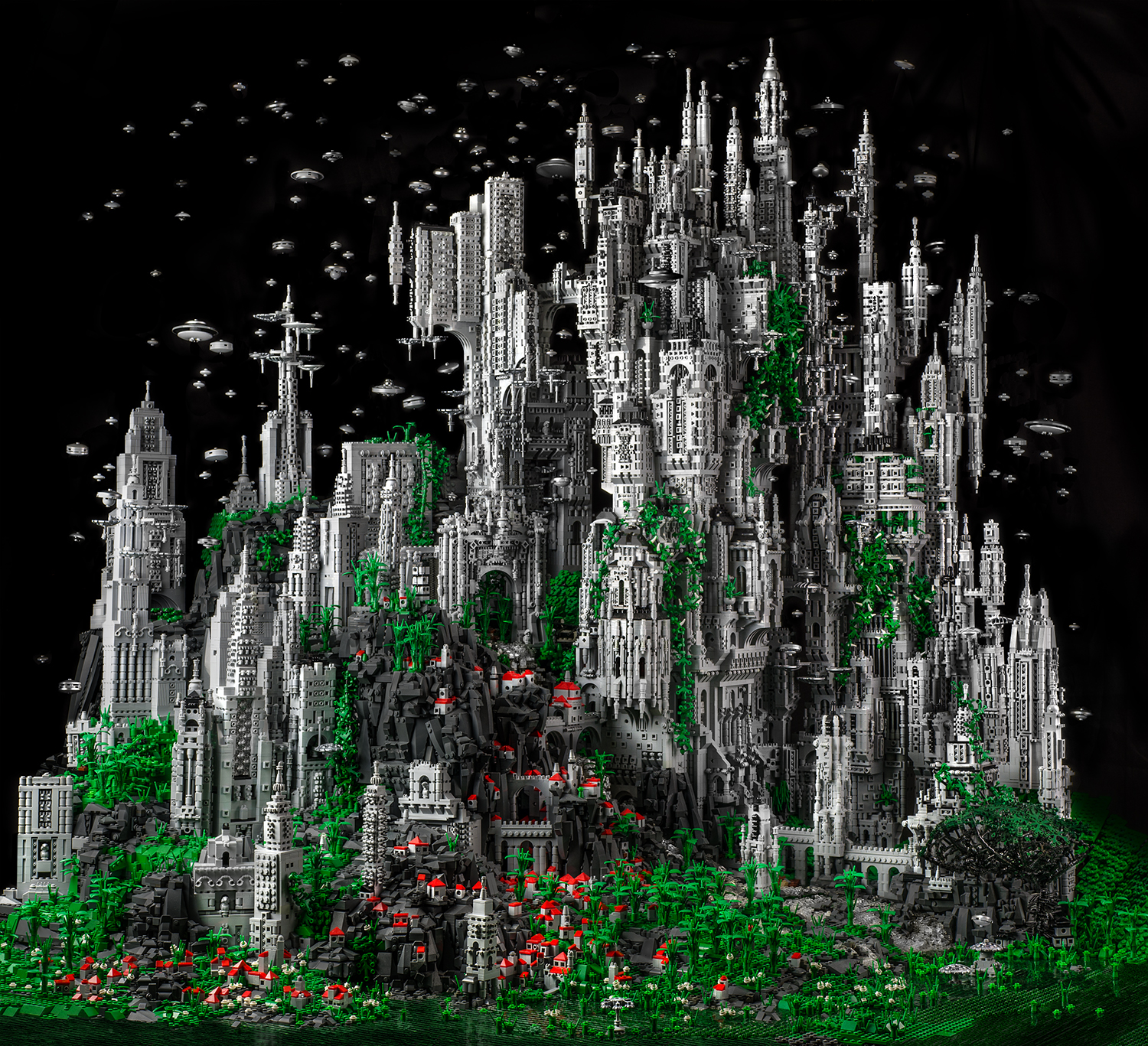
I love all of my pieces like children, so it is hard to pick a favorite. But the ones I find that have drawn my eye the most over time are “Sign of the Times: Failure of the Fourth Estate” and the large sci-fi cityscape called “Odan.”

The power of the smoke and explosion rising over the building is arresting and is not what one would expect for a LEGO model. For Odan, the sheer scale of it all and detailing is still mesmerizing for me. Also, the story behind it is filled with metaphysical principles that are of interest to me.

[Odan, in all its glory. Click here for a bigger picture to get a true sense of scale.]

When I began taking up LEGO, I looked online to see if there were others working creatively in this medium. A quick search uncovered a large group of individuals passionate about their unique LEGO creations.

As I began putting together the Beautiful LEGO books, I found more and more works and designers that were of interest to me. An example of a few of them are Moko’s shiny, sparkling “Fenix”, all of MisaQa’s little 15-30 piece micro works, Mike Nieves‘ organic sculptural representations of animals and the bizarre world of Mihai Marius Mihu.

3. Was it always LEGO for you, or did other puzzles and games play a role in forging the creator you are today?

LEGO is a relatively new interest for me. I picked it up 5 1/2 years ago after visiting Legoland, CA. While there, it suddenly hit me that this little plastic ‘toy’ could be used to create serious art. I have to say though that board games have been my lifelong passion. Every month I look forward to my game group meetings where we play the latest hot Euro games.

[One of Mike’s Abandoned Houses designs.]

4. What’s next for Mike Doyle?

I continue to work with LEGO — though at a slower pace than previous years. Right now I’m exploring a series of abstract works based on metaphysical/spiritual principles. I also look forward to building some more epic cityscapes in the Odan theme.

5. If you could give the readers, puzzle fans, and LEGO building enthusiasts in the audience one piece of advice, what would it be?

The only advice I ever give is to go with the heart. An abundance of creative energy can always be found within one’s passion. Whether it be artistic, work, play, or societal, we all have potential to thrive in our own ways.


A huge thank you to Mike for his time. You can follow his work on his blogspot page, and be sure to check out Beautiful LEGO, Beautiful LEGO: Dark, and Beautiful LEGO: Wild! for some absolutely stunning creations. I can’t wait to see what he has in store for us next.

Thanks for visiting PuzzleNation Blog today! Be sure to sign up for our newsletter to stay up-to-date on everything PuzzleNation!

You can also share your pictures with us on Instagram, friend us on Facebook, check us out on TwitterPinterest, and Tumblr, and explore the always-expanding library of PuzzleNation apps and games on our website!

Playing with your words!

One of the unexpected perks of writing this blog is being contacted by fellow puzzlers. Some send me links and “Have you seen this?” messages, while others ask questions about puzzles and games that make for terrific blog post ideas.

In the last year or so, there has been an increase in actual puzzles. Whether a puzzle goes viral and gets shared around Facebook or they encounter it somewhere and ask for help solving it, it’s fun and a little humbling to represent the puzzle community as a (fairly minor) authority on puzzles.

Of course, I suspect some of those people are trying to stump me. And that’s okay too.

Recently, I received a message with the following brain teaser:

What’s common between the following set of words (Tiny, Noun, English, Polysyllabic, Sesquipedalian)?
Also, what’s common between these words (Verb, German, Misspelled, Hyphenated, and Monosyllabic)?

As a puzzle fan and a word nerd, I quickly realized that wordplay was afoot!

The first set of words are all autonyms (also known as autological words or homological words). They describe themselves. Tiny is a small word, Noun is a noun, etc.

It can be fun to go hunting for autonyms. How about real, pentasyllabic, mellifluous, self-explanatory, or grandiloquent?

There are lots of wordplay possibilities here. The fear of long words is called hippopotomonstrosesquipedaliophobia, which seems a bit cruel. Also, lethologica is the inability to remember the correct word for a given concept or item. But that’s a hard word to remember, so it’s quite possible to have lethologica lethologica.

It’s rare to see wordplay like this in crosswords, but you do see it on occasion. For instance, if you see the clue “Civic center?,” it might take you a second to come up with the answer VEE.

As for the second set of words, they’re the opposite of autonyms, since they don’t describe themselves. Verb isn’t a verb, Misspelled isn’t misspelled, Monosyllabic isn’t single-syllabled, etc. These words are called heterological words.

And these words work their way into common wordplay with ease. Who hasn’t received a forward or seen a Facebook post asking, “Why is ‘abbreviated’ so long?” Because it’s heterological.

You could ask “Why isn’t ‘alphabetical’ alphabetical?” Well, it would be if we spelled it “aaabcehillpt.” Similarly, “backwards” would be backwards if we spelled it “sdrawkcab” and “vowelless” would be vowelless if we spelled it “vwllss.” That makes heterological words autological.

There’s even a paradox that applies to this specific word: the Grelling-Nelson paradox.

It’s both simple and brain-melting all at once. If “heterological” is heterological, then it describes itself, which makes it autological, which is a contradiction. But if “heterological” is not heterological, then by default, it is autological, which it can’t be since it doesn’t describe itself, so again, contradiction.

That makes your head hurt. It’s like a wordy version of the Barber paradox.

In a small town, the barber shaves all those, and only those, who do not shave themselves.” So if he shaves himself, he doesn’t. And if he doesn’t, he does.

Thanks, paradoxes, but I think I’ll stick with autonyms for now. They make life easier.


Thanks for visiting PuzzleNation Blog today! Be sure to sign up for our newsletter to stay up-to-date on everything PuzzleNation!

You can also share your pictures with us on Instagram, friend us on Facebook, check us out on TwitterPinterest, and Tumblr, and explore the always-expanding library of PuzzleNation apps and games on our website!

It’s Follow-Up Friday: Crossword Contest Conclusion edition!

Welcome to Follow-Up Friday!

Follow-Up Friday is a chance for us to revisit the subjects of previous posts and bring the PuzzleNation audience up to speed on all things puzzly.

And today, I’m returning to the subject of crossword contests!

Last month, I announced the latest crossword contest from the topnotch puzzlers at Barany and Friends. The contest, titled Eliminating the Competition, wrapped up on February 8, but the answer to the meta puzzle concealed within each grid was only revealed this week!

As it turns out, the crafty cruciverbalists paid tribute to the American Crossword Puzzle Tournament by dropping the letters A, C, P, and T from the theme entries in the grid! Not only that, but there were no As, Cs, Ps, or Ts to be found anywhere else in the puzzle grid! Diabolical!

Open division puzzle theme answers:

  • They are left over after division: REMINDERS (“Remainders” with the A eliminated)
  • Lack of affection, say: HILLINESS (“Chilliness” with the C eliminated)
  • A cylindrical utensil used to flatten dough: ROLLING IN (“Rolling pin” with the P eliminated)
  • They’re often found in churches or on campuses: BELL OWERS (“Bell towers” with the T eliminated)

They also hid the reveal, MHU, in the lower right corner. (Fiendishly, MHU is MATCHUP with A, C, P, and T eliminated!)

You can check out the full details of the meta puzzle here, including the theme answers for both the Open Division puzzle and the Master Division puzzle, which was a doozy!

But there’s more! They’ve also announced the prizes for the winners, which include paid registrations to the ACPT, puzzle e-books, crossword subscriptions, autographed puzzle books, and specialized crossword puzzles with the winner’s name built into the grid!

They’ve truly gone all out this year to make the Eliminating the Competition contest something special. Kudos to George Barany, Ralph Bunker, John Child, Michael Hanko, and Roy Leban for creating a terrific challenge and a puzzly feast for solvers.

Did you accept the Barany and Friends challenge this year, fellow puzzlers and PuzzleNationers? Let us know if you did! We’d love to hear from you!


Thanks for visiting PuzzleNation Blog today! Be sure to sign up for our newsletter to stay up-to-date on everything PuzzleNation!

You can also share your pictures with us on Instagram, friend us on Facebook, check us out on TwitterPinterest, and Tumblr, and explore the always-expanding library of PuzzleNation apps and games on our website!

PuzzleNation Product Review: Quarto

Tic-Tac-Toe is probably the first strategy game a child encounters, and it’s a simple concept: get three in a row. Other games expand on this idea, like Connect Four, which increases the pattern to four in a row and adds the vertical play aspect to the game. ThinkFun put their own spin on the idea with All Queens Chess, adding the rules of chess to that Connect Four aesthetic.

And Quarto ups the ante significantly, adding elegance and variety to this particular corner of the puzzle-game genre.

You have a board with sixteen spaces laid out in a 4×4 grid, and your goal is to place four pieces in a row. Sounds simple, right? Sure. But when you look at the playing pieces, it gets a little more involved.

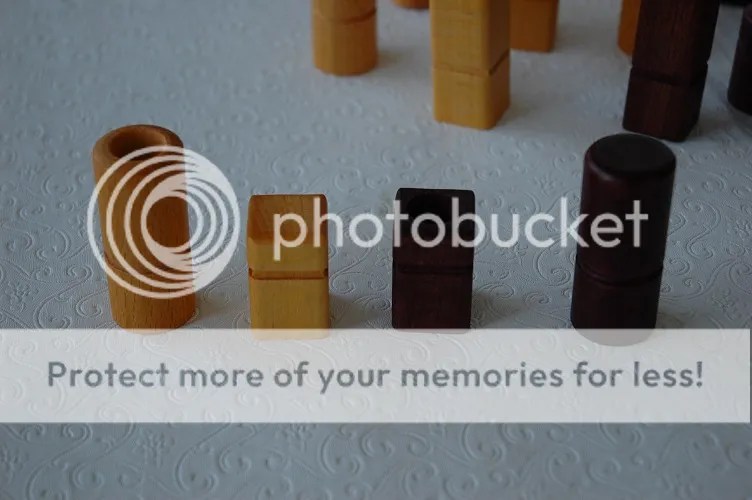
As you can see, across these sixteen differently-shaped pieces, eight different characteristics are possible: light, dark, round, square, solid, hollow, tall, and short. Each piece represents four of these characteristics.

So you have to make a row of four pieces with at least one characteristic in common. It could be four hollow pieces (meaning shape, color, and size don’t matter), four dark pieces (meaning shape, size, and solid/hollow don’t matter), or any of six other possible common factors.

And to add a little more challenge to the gameplay, your opponent chooses which piece you play each round. You have to strategize on the fly, because you never know which piece you’ll be placing next!

For example, here’s a game in progress. There are three dark pegs in a line, so naturally, your opponent picks a light-colored piece, preventing you from taking advantage.

But wait! They accidentally chose a hollow piece, allowing you to complete a line of four hollow pieces in a row! But remember to yell “Quarto!” when you do, or it doesn’t count!

There’s so much strategy wrapped up in such a simple mechanic. Quarto can be explained in a few seconds, but it offers a massive amount of replayability. Especially when you consider how much of the gameplay is happening in your mind as you try to figure out not only what piece to choose for your opponent, but what you might do with whatever piece you’re handed next.

Quarto is a wonderful variation on a classic style of puzzly gameplay. The beautiful playing pieces are well-made and offer plenty of possibilities, and it’s quickly become a favorite in my house as a palate cleanser between longer game sessions.

Quarto was created by Blaise Muller, is published by Gigamic Games, and is available from Marbles: The Brain Store and Amazon.


Thanks for visiting PuzzleNation Blog today! Be sure to sign up for our newsletter to stay up-to-date on everything PuzzleNation!

You can also share your pictures with us on Instagram, friend us on Facebook, check us out on TwitterPinterest, and Tumblr, and explore the always-expanding library of PuzzleNation apps and games on our website!
The Puzzly Art of Anamorphosis

Anamorphic illusions are all about perspective. Making the illusion work requires you to either be in a specific place (positioned a certain distance away and facing a certain direction) or the use of a mirrored cylinder or cone.

Using mirrored objects is called catoptric anamorphosis and using specific perspectives is known as oblique anamorphosis. It’s oblique anamorphosis we’ll be focusing on today.

Most of us have probably seen an example of anamorphosis recently, as it’s become a popular form of urban outdoor art. The ground is painted or colored to provide a fake perspective, and by standing in the proper spot, the illusion is formed.

This creates ample opportunity for some terrific photographs:

[Did you know we’ve got an entire Pinterest page dedicated to this?]

Having a hard time visualizing anamorphosis? Well, the folks at Brasspup have a fantastic YouTube page devoted to science and illusions, and they have several videos featuring some mind-blowing anamorphic illusions.

You can even use light to assist your illusion, as they do here:

What’s even more amazing is that these perspective tricks can move beyond two-dimensional works like paintings and photographs. If you know how to manipulate the viewer, three-dimensional illusions are within your grasp.

Check out this Escher-inspiring creation, built from pens and Jenga blocks! It looks positively impossible!

It really is baffling when you consider how many ways there are to trick the eye. From Necker cubes and shape illusions to forced perspective and anamorphosis, optical illusions are alive and well as a puzzly art form worth exploring.

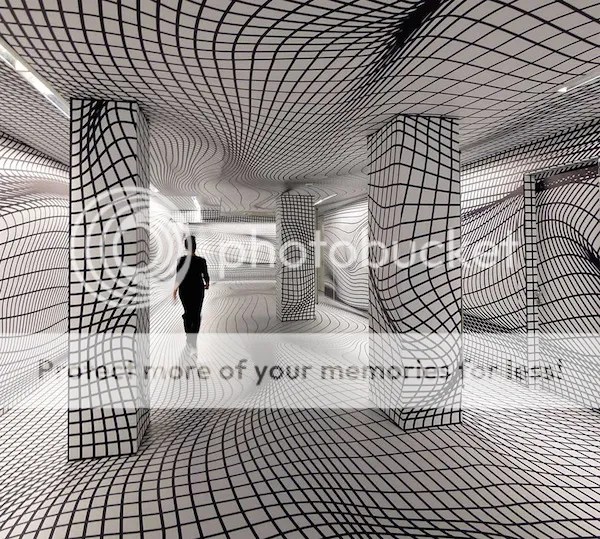
Heck, look at what we can do with nothing more than black lines!

Imagine trying to walk a straight line in that room. Wow.


Thanks for visiting PuzzleNation Blog today! Be sure to sign up for our newsletter to stay up-to-date on everything PuzzleNation!

You can also share your pictures with us on Instagram, friend us on Facebook, check us out on TwitterPinterest, and Tumblr, and explore the always-expanding library of PuzzleNation apps and games on our website!