PuzzleNation Looks Back at 2015!

The year is quickly coming to a close, and as I look back on an eventful year in the world of puzzles and games, I’m immensely proud of the contributions both PuzzleNation Blog and PuzzleNation made to the puzzle community as a whole.

Over the last year, we explored dice games and tile games, apps and pen-and-paper puzzles. We met designers, constructors, and creative types of all kinds. We cracked brain teasers and tackled mind-bending riddles.

We explored the history of puzzles, broadened our understanding of how puzzles and games contribute to brain health, and celebrated the lives of puzzle greats Bernice Gordon, Henry Hook, Merl Reagle, and Leslie Billig, who were taken from us too soon.

We spread the word about numerous worthwhile Kickstarters and Indiegogo campaigns, watching with glee as a puzzle/game renaissance continued to amaze and surprise us with innovative new ways to play and puzzle.

We celebrated International TableTop Day, the debut of The Indie 500 crossword tournament, a new Star Wars movie, the 80th anniversary of Monopoly, new world records set by Rubik’s Cube solvers, and a puzzly wedding proposal, and we were happy to share so many remarkable puzzly landmark moments with you. Heck, we even solved the mystery of The Dress!

It’s been both a pleasure and a privilege to explore the world of puzzles and games with you, my fellow puzzle lovers and PuzzleNationers. I recently posted my 450th blog post, and I’m even more excited to write for you now than I was when I started.

And that’s just the blog. PuzzleNation’s good fortune and accomplishments in 2015 went well beyond that.

In January, we launched the Penny Dell Bible Word Search for iPad, and in March we started our monthly hashtag games. In May, we added Penny Dell Jumbo Crosswords 2 for iOS devices, and July saw the debut of our Crossword Clue Challenge every weekday on Twitter and Facebook.

But the standout showpiece of our puzzle app library has been the Penny Dell Crossword App. With our Dell Collection puzzle sets, our monthly Deluxe puzzle sets, and the 2015 Deluxe Combo (not to mention our various value packs and supreme bundles), we maintained a steady stream of quality puzzle content for solvers and PuzzleNationers.

We added a free daily puzzle feature for all users, and just before Christmas, we launched the Penny Dell Crossword App for Android devices, ensuring that more puzzle lovers than ever have access to the best mobile crossword app on the market today.

[Fred, our Director of Digital Games, shows off the Penny Dell Crossword App
at the American Crossword Puzzle Tournament in March.]

And your response has been terrific! We amassed over 1500 followers for the blog and we’re closing in on 1700 followers of the PuzzleNation Facebook page, numbers that are both humbling and very encouraging.

2015 was our most productive, most exciting, and most creatively fulfilling year to date, and 2016 promises to be even brighter.

Thank you for your enthusiasm, your support, and your feedback, PuzzleNationers. Have a fantastic New Year. We’ll see you in 2016!


Thanks for visiting PuzzleNation Blog today! Be sure to sign up for our newsletter to stay up-to-date on everything PuzzleNation!

You can also share your pictures with us on Instagram, friend us on Facebook, check us out on TwitterPinterest, and Tumblr, and explore the always-expanding library of PuzzleNation apps and games on our website!

Keep your Get Out of Jail Free card handy.

Recently, friend of the blog Chris Begley sent me an article about some interesting math facts. Most of them were about probability and how many people misinterpret the likelihood of various events happening based on bad assumptions about probability.

For instance, since you have a 50/50 chance of heads or tails when you flip a coin, it seems logical that if you flipped a coin ten times, you’d get heads five times and tails five times, whereas in reality, it’s common to have runs of one result or the other that fly in the face of that simple 50/50 assumption.

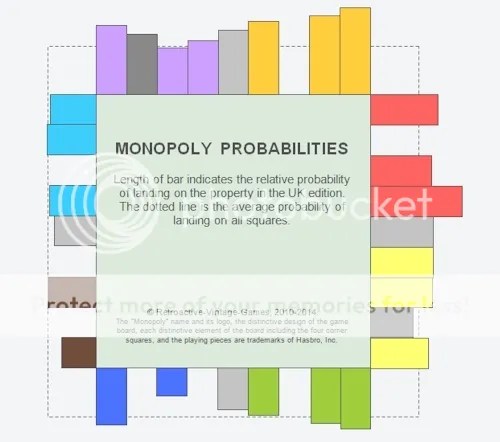
But that wasn’t the fact that caught my eye. I thought it was much more intriguing that not all spaces on a Monopoly board have an equal likelihood of being landed on.

And that can affect how you play. For instance, if you believe each spot has an equal chance of being landed on — 1 in 40, given the 40 squares on the board — you might opt to buy all three colors in a given area to give yourself a 3/40 chance (7.5%), or you might go for all 4 railroads to give yourself a 4/40 chance (10%).

[A breakdown of spaces and likelihood of landing, based on the UK version.
(Chance and Community Chest cards differ between UK and US versions,
though probabilities for spaces in the US version are quite similar.)]

But that’s not how Monopoly actually works. Some spaces are far more likely than others. This is partly due to rolling two dice every time you move (which makes 6, 7, or 8 spaces the most likely results). There are also rule cards that make some squares more likely than others.

The most common space to land on is Jail (due in no small part to the Go to Jail square and where Chance and Community Chest cards send you). The most common PROPERTY to land on is Illinois Avenue, followed by B&O Railroad, Tennessee Avenue, New York Avenue, and Reading Railroad.

[A breakdown of space probabilities for the US version of the game.]

On the flip side, Mediterranean Avenue is the least likely to be landed on, followed by Baltic Avenue, Luxury Tax, Park Place, and Oriental Avenue. (Again, the Go to Jail square comes into play, as Park Place is seven squares away and the most common dice roll is 7.)

I like that a little properly applied math might make you a better Monopoly player. (Though if I’m going to walk the Boardwalk, I’d rather be playing The Doom That Came to Atlantic City.)


Thanks for visiting PuzzleNation Blog today! Be sure to sign up for our newsletter to stay up-to-date on everything PuzzleNation!

You can also share your pictures with us on Instagram, friend us on Facebook, check us out on TwitterPinterest, and Tumblr, and explore the always-expanding library of PuzzleNation apps and games on our website!
It’s Follow-Up Friday: Monopoly’s Birthday edition!

Welcome to Follow-Up Friday!

By this time, you know the drill. Follow-Up Friday is a chance for us to revisit the subjects of previous posts and bring the PuzzleNation audience up to speed on all things puzzly.

And today, I’d like to revisit the subject of Monopoly.

I recently posted about the 80th anniversary of the game and their real-money promotion in France.

And whether you’re a fan of the game or not, you can’t deny its staggering success or the genuine historical impact it has made.

Yesterday was the official 80th anniversary of the game. March 19, 1935 was the day Parker Brothers acquired the rights from the game from Charles Darrow, who claimed to have invented Monopoly, although the game was actually invented by a woman named Elizabeth J. Magie. (Parker Brothers now owns the rights from both parties.)

And over the course of 80 years, a lot of trivia has accumulated regarding the game. Here are a few of my favorite little nuggets:

  • The character locked behind the bars is called Jake the Jailbird. Officer Edgar Mallory sent him to jail.
  • Escape maps, compasses, and documents were inserted into Monopoly game boards smuggled into POW camps inside Germany during World War II. Real money for escapees was slipped into the packs of Monopoly money.
  • Tokens from the United States Monopoly: Here & Now Edition were flown into space aboard Space Shuttle Atlantis in 2007.

You can check out Hasbro’s full listing of Monopoly history and trivia here!

And now, a few questions: when you play Monopoly, what token do you use? And what’s your favorite variation of the game? Let me know! I’d love to hear from you!

Thanks for visiting PuzzleNation Blog today! You can share your pictures with us on Instagram, friend us on Facebook, check us out on TwitterPinterest, and Tumblr, and be sure to check out the growing library of PuzzleNation apps and games!

Do Not Pass Go, Do Not Collect Cash Money

Monopoly is celebrating its 80th anniversary this year, no small accomplishment in the world of board games. Available in 43 languages and sold in 111 countries worldwide, the most ubiquitous board game in history is launching a few special promotions to commemorate their eight-decade anniversary.

In the US, they’ve released a special anniversary edition of the game, featuring game tokens representing different decades.

In France, however, the prize is a little bit sweeter.

You see, 80 special sets of the game will be distributed to stores, each with a special bonus: real money mixed in with the Monopoly money.

From an article in The Guardian:

Only one set will land the major jackpot, in which every game note is replaced by real money — for a total windfall of 20,580 euros ($23,268).

In addition, 10 sets will contain five real 20-euro notes, two 50-euro notes and one 100-euro note.

A lesser prize can be scooped in 69 sets, which will have five 10-euro notes and five 20-euro notes.

Evenly distributed among the many variations of the game currently available — junior and electronic editions included — the anniversary sets are out there right now, waiting to be claimed.

This follows in the fine tradition of other specialty Monopoly sets over the years, like the all-chocolate entirely edible version of Monopoly Neiman Marcus sold in the ’70s, or the $100,000 version produced for FAO Schwarz that included emeralds and sapphires embedded into the game board and real U.S. currency.

[Check out this solid gold edition of Monopoly!]

And you can’t help but wonder if other board games will follow suit for their big anniversaries. Imagine Mouse Trap with a real mouse, or Fireball Island with a real gemstone in the center. Heck, an anniversary edition of Hungry Hungry Hippos that includes a real hippo would certainly make for some great press!

As long as nobody tries to release copies of Pandemic with an actual virus, we should be good.

Thanks for visiting PuzzleNation Blog today! You can share your pictures with us on Instagram, friend us on Facebook, check us out on TwitterPinterest, and Tumblr, and be sure to check out the growing library of PuzzleNation apps and games!

It’s Follow-Up Friday: Bad Board Games edition!

Welcome to Follow-Up Friday!

By this time, you know the drill. Follow-Up Friday is a chance for us to revisit the subjects of previous posts and bring the PuzzleNation audience up to speed on all things puzzly.

And today, I’d like to return to the subject of board games.

Now, for the most part, I try to keep the spirit of blog posts here positive. We share puzzle news, explore history, and talk about puzzles and games we enjoy. It’s more fun to write about things that excite me and that I enjoy about puzzles and games than to wallow or sling mud.

That being said, sometimes you can’t help but poke a little fun at some of the misfires in the board game industry. Jimmy Fallon, host of The Tonight Show, is apparently a big board game aficionado — though, according to the games he lists, he hasn’t checked out a new game from the last 25 years or so — and he’s seen his share of stinkers.

Recently, he featured four games on The Tonight Show that he thinks deserve a thumbs-down. Check it out, courtesy of a link provided to me by friend of the blog and Penny/Dell Puzzles social media guru Darcy Bearman:

Honestly, considering some of the games and stunts he plays with celebrities, I wouldn’t have been surprised to see Jimmy play a round of Ring Around the Nosey with a Victoria’s Secret model or the latest winner of Dancing with the Stars.

What board games do you think deserve to be featured in a future edition of this segment, fellow puzzlers? I know Monopoly takes its fair share of abuse from board game fans these days, but there must be more worthy contenders out there. I’d love to hear from you!

Thanks for visiting PuzzleNation Blog today! You can share your pictures with us on Instagram, friend us on Facebook, check us out on TwitterPinterest, and Tumblr, and be sure to check out the growing library of PuzzleNation apps and games!

5 Questions with Board Game Designer Jim Deacove

Welcome to another edition of PuzzleNation Blog’s interview feature, 5 Questions!

We’re reaching out to puzzle constructors, video game writers and designers, board game creators, writers, filmmakers, musicians, and puzzle enthusiasts from all walks of life, talking to people who make puzzles and people who enjoy them in the hopes of exploring the puzzle community as a whole.

And I’m excited to have Jim Deacove as our latest 5 Questions interviewee!

[Jim, left, alongside his wife, Ruth.]

For more than 4 decades, Jim Deacove has been designing games for Family Pastimes, a Canadian board game company (and family business) dedicated to cooperative gaming. With over one hundred games to his credit, Jim is one of the most prolific and passionate game designers at work today.

Whether he has players teaming up to serve hungry customers (Bus Depot Diner), keep the livestock happy while predators lurk nearby (Coyote!), or pull off a flawless magic show while avoiding being trapped in their own tricks (Amazing Illusions), Jim’s games are bright, colorful, creative, and many are appropriate for all ages. And that’s not getting into his puzzlier efforts, like AARI (an acronym/abbreviation-themed scrabble variant) or Gridlock (a sliding-tile puzzle game about a monster traffic jam).

Jim was gracious enough to take some time out to talk to us, so without further ado, let’s get to the interview!

5 Questions for Jim Deacove

1.) How did you first get into board games?

When I was about 5 years old, my mother says I began making up board games with paper, crayons and various items from my dad’s woodshop. My inspiration came from looking at pictures of games such as Sorry and Monopoly in what was a popular Christmas catalogue, Eaton’s. We were too poor to buy them, so I made imitations of what I thought the games were about. As they say, the rest is history.

2.) Family Pastimes is rare, in that the company focuses completely on cooperative games, whereas most board games are built around competing with other players, not working with them. How is designing cooperative games different from designing more traditional board games?

I used to design competitive games in high school, mostly strategy games, because I played Chess a lot until in university, I lost the taste for blood. I also designed competitive games on sport themes, largely for my and my friends’ enjoyment. I once designed a world political game that took three days to play and I agreed with a player who said that life was too short to spend so much time on a game, designing or playing one.

I have always found designing games to be easy, once I get in the mental space that lets the ideas flow, this is usually assisted by a warm bath or by keeping a notebook by my bedside, because some of my best ideas have come while I am asleep. I record them upon awakening.

3.) What, in your estimation, separates a great game from a run-of-the-mill game?

Probably time. Some games hold up, others don’t and it is difficult to judge even then, because what is one person’s run-of-the-mill is another person’s great game. But even time is suspect. I know this will enrage some folks, but Chess has held the interest of humans for a long time and could be described as a great game, while Checkers has also held up, but personally I think Checkers is a run-of-the-mill game.

4.) What’s next for Jim Deacove and Family Pastimes?

I thought of retiring and taking up other pursuits that have been just a hobby up to now — cartooning, jazz drumming, oil painting, running a live theatre, finishing a variety of writing projects, etc. — but the game ideas keep on coming. The real world is so full of inspiring themes. For example, one of my new designs, Moon Mission, was inspired by the landing of the Curiosity Rover on Mars and witnessing the expressions of joy in the NASA Control Room when it happened. Who says a collaborative effort can’t be exciting?

My plan is to keep on going with new designs. I can’t help it. It’s my work. As I say to folks who chide me saying, “You have to start getting out more. You are 75 years old and your expiry date is nearing.” Hey, I reply, never mind the expiry date, I still have room on my “Best Before” date.

5.) If you could give the readers, writers, aspiring game designers, and puzzle fans in the audience one piece of advice, what would it be?

Make cooperative games. Please. We have enough of the other game experience. And, it’s selfish, I know, but I always enjoy playing someone else’s cooperative game for a change.

Oh, and keep your day job, and avoid having a garage, because that is where you will end up storing unsold cartons of your game.


Many thanks to Jim for his time. Check out Jim’s library of cooperative board games at Family Pastimes. I can’t wait to see what he cooks up next.

Thanks for visiting PuzzleNation Blog today! You can share your pictures with us on Instagram, friend us on Facebook, check us out on TwitterPinterest, and Tumblr, and be sure to check out the growing library of PuzzleNation apps and games!