It’s Follow-Up Friday: Crosswordnado edition!

Welcome to Follow-Up Friday!

By this time, you know the drill. Follow-Up Friday is a chance for us to revisit the subjects of previous posts and bring the PuzzleNation audience up to speed on all things puzzly.

And today, I’m posting solutions to our Sharknado and Crosswordese puzzles from the last two weeks!

Two Follow-Up Fridays ago, I posted a deduction puzzle in honor of Sharknado 3 rampaging its way across TV screens all over the world, and I challenged you to complete the schedule of mayhem wrought by our five heroes with five different weapons across five different cities on five different days! (Whew!)

How did you do?

And that brings us to our second solution. Last week, we discussed crosswordese — those words that only seem to appear in crosswords, to the dismay and bafflement of casual solvers — and I created a 9×9 grid loaded with crosswordese.

Did you conquer the challenge?

ACROSS

1. Toward shelter, to salty types — ALEE
3. Arrow poison OR how a child might describe their belly button in writing — INEE
5. Flightless bird OR Zeus’s mother — RHEA
6. Hireling or slave — ESNE
8. “Kentucky Jones” actor OR response akin to “Duh” — DER
9. Compass dir. OR inhabitant’s suffix — ESE
12. Wide-shoe width OR sound of an excited squeal — EEE
15. No longer working, for short OR soak flax or hemp — RET
16. Like a feeble old woman OR anagram of a UFO pilot — ANILE
17. Actress Balin OR Pig ____ poke — INA

DOWN

1. Mean alternate spelling for an eagle’s nest — AYRIE
2. Old-timey exclamation — EGAD
3. Unnecessarily obscure French river or part of the Rhone-Alpes region — ISERE
4. Supplement OR misspelling of a popular cat from a FOX Saturday morning cartoon — EKE
7. Maui goose — NENE
10. An abbreviated adjective covering school K through 12 OR how you might greet a Chicago railway — ELHI
11. My least favorite example of crosswordese OR good and mad — IRED
12. Ornamental needlecase — ETUI
13. Movie feline OR “Frozen” character — ELSA
14. Shooting marble OR abbreviation for this missing phrase: “truth, justice, and ____” — TAW

I hope you enjoyed both of these challenging puzzles! If you haven’t had your fill of crafty puzzlers, worry not! We’ll be tackling another tough brain teaser in two weeks!

Thanks for visiting PuzzleNation Blog today! You can share your pictures with us on Instagram, friend us on Facebook, check us out on TwitterPinterest, and Tumblr, and be sure to check out the growing library of PuzzleNation apps and games!

It’s Follow-Up Friday: Broadway Puzzles edition!

Welcome to Follow-Up Friday!

By this time, you know the drill. Follow-Up Friday is a chance for us to revisit the subjects of previous posts and bring the PuzzleNation audience up to speed on all things puzzly.

And today, I’m posting the results of our #PennyDellBroadwayPuzzles hashtag game!

[Sir Ian McKellen, exhausted from coming up with puns all night.]

You may be familiar with the board game Schmovie, hashtag games on Twitter, or @midnight’s Hashtag Wars segment on Comedy Central.

For the last few months, we’re been collaborating on puzzle-themed hashtag games with our pals at Penny/Dell Puzzles, and this month’s hook was Penny/Dell Broadway Puzzles!

Examples of shows might be “Oooooooooooooklahoma Runs!” and examples of songs might be “(I Am) Sixteen Going on Seven-Ups” or “Give and Take My Regards to Broadway.”

So, without further ado, check out what the puzzlers at PuzzleNation and Penny/Dell Puzzles came up with!


Shows!

Figgerits on the Roof / Fiddler’s Frame on the Roof (featuring the smash song Matchmaker)

Keep On Movin’ Out

Les MiséraBubbles

The Bookworms of Mormon / The Book of Bricks and Mortar

La Cage aux Fill-Ins

Lucky Starlight Express

Jesus Christ Superstarspell / Jesus Christ Superscore

The Mystery Word of Edwin Drood / The Mystery Person of Edwin Drood

A Chorus Line ‘em Up / Draw the Chorus Line / End of the Chorus Line / A Crostic Line

A Funny Thing Happened on the Way to the Foursomes / Four(-um) Corners / Four Square

How to Succeed in Boxes Without Really Trying

A Little Puzzler Night Music

The Fan Words of the Opera / The Shadow of the Opera

Sunrays Boulevard

Oh! (Quote) Cal-cu(la)ta!

Hair-A-Letter

The Best Little Scoreboard in Texas / The Best Little “Score”house in T(ripl)ex-as

Annie-gram

Annie-gram Get Your Gun

Fill-Into the Woods / Drop-In to the Woods

Avenue (Q)uotagrams

Kiss Me, Kate-gories

The Curious Incident of the Dog in the Timed Framework

Godspell(down) / Godspellbound / God Spell it out

Can-Can Cancellations

Les Miz(sing Vowels)

The WIZard Words

Wizard Words of Oz, featuring the song “Follow the Yellow Brick By Brick Road”

Bowl Mame

The Pajama Bowl Game

Cactus Flower Power

The 25th Annual Putnam County Starspelling Bee

Odds and Evens Couple by Neil Simon Says

The Merry Window Boxes

A Balancing Act of God

Kiss of the Spider’s Web

Drummerman of La Mancha


Songs!

“Ya Got Double Trouble” (The Music Man)

“Sit Down, You’re Rockin’ the Quick Quote” (Guys and Dolls)

“There’s a Places, Please for Us” (West Side Story)

“The Circle Sums of Life” (The Lion King)

“Dance: Ten, Looks: Three from Nine” / “Dance a Perfect Ten, Looks Three of a Kind” (A Chorus Line)

“I Don’t Need Anything But You Know the Odds” (Annie)

“Scoremaster of the House” (Les Miserables)

“Getting to Know You Know the Odds” (The King & I)

Mamma Mia needs some Alphabet Soup!!” (Mamma Mia)

“Surrey with the Fringe On Top to Bottom” (Oklahoma!)

“Ease on Down the Crossroads” (The Wiz)

“Cell Blockbuilders Tango” (Chicago)

“I Don’t Know How To Solve This” (and I’ve solved so many puzzles before…) (Jesus Christ Superstar)

“No Places, Please Like London” (Sweeney Todd)

“No Good Deal” (Wicked)

“Grease Is the Codeword” (Grease)

“A Whole New Word Trails” (Aladdin)

“I’m Still Here & There” (Follies)


Some of our Twitter followers also got in on the fun, with @MicMcCracken tweeting “Les Misery Loves Company!”

And, naturally, it wouldn’t be a PuzzleNation game unless someone went above and beyond the call of duty. This time around, fellow PuzzleNationer Debra created a puzzly version of the opening stanza of “My Favorite Things”!

Crosswords and Word Seeks and Sudoku
Fill-Ins and Ken-Kens and Logic Problems too
Codewords and Crostics and Diamond Rings
These are a few of my favorite things!


All in all, the game was great fun!

Have you come up with any Penny/Dell Broadway Puzzles of your own? Let us know! We’d love to see them!

Thanks for visiting PuzzleNation Blog today! You can share your pictures with us on Instagram, friend us on Facebook, check us out on TwitterPinterest, and Tumblr, and be sure to check out the growing library of PuzzleNation apps and games!

Puzzles in Pop Culture: Brooklyn Nine-Nine

brooklyn-nine-nine-season-2-episode-16-captain-holt-jake-peralta-terry-jeffords

In previous editions of Puzzles in Pop Culture, we’ve explored opinions about crosswords, embarked on scavenger hunts with sitcom characters, and even saved New York with brain teasers alongside John McClane in Die Hard with a Vengeance. But it’s rare when a movie or TV show poses a puzzler and leaves it to the audience to solve it.

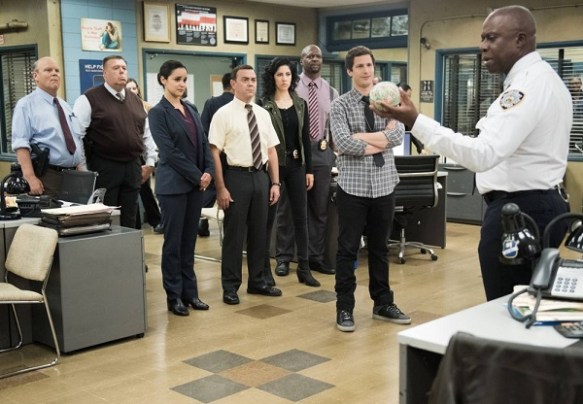
In “Captain Peralta,” a recent episode of the Fox police sitcom Brooklyn Nine-Nine, a subplot featured Captain Holt posing a brain teaser to his fellow officers.

There are 12 men on an island. 11 weigh exactly the same amount, but one of them is slightly lighter or heavier. You must figure out which.

The island has no scales, but there is a seesaw. You can only use it three times.
maxresdefault4

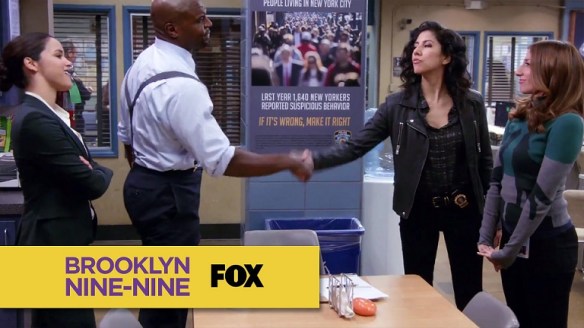
With Beyonce tickets going to the person who solved the puzzle, the competition was fierce. Rosa suggested using the seesaw to threaten the men into confessing. Amy and Terry suggested that the first seesaw ride involve putting six men on one side and six on the other, which Captain Holt quickly said wouldn’t work.

As it turns out, Holt was hoping one of his officers would solve the puzzle for him, since he’s been unable to crack it for years. The episode ended without providing the audience with a solution.

Thankfully, your friends here at PuzzleNation Blog would never leave you high and dry like that. Let’s get puzzling!

bizarroshipwrecked07-02-95

Now, this WOULD be a simple logic problem if you knew you were looking for someone lighter or you knew you were looking for someone heavier. In that case, a 3×3 ride, 4×4 ride, or even the 6×6 ride Amy and Terry suggested, would eliminate part of the field immediately, and the remaining two uses could determine the heavy person or the light person.

Unfortunately, in Captain Holt’s puzzle, you don’t know if the person is heavier or lighter, which makes this more difficult. For instance, if you knew you were looking for someone heavier, you could immediately eliminate anyone on the side of the seesaw higher in the air. But if you don’t know if the subject in question is lighter or heavier, then you could have a heavier person on one side or a lighter person on the other.

Diabolical.

But, with some careful deduction, you CAN solve this puzzle.

First, let’s identify our 12 castaways with the letters A through L. Now let’s divide them into three groups of four: ABCD, EFGH, and IJKL.
seesaw

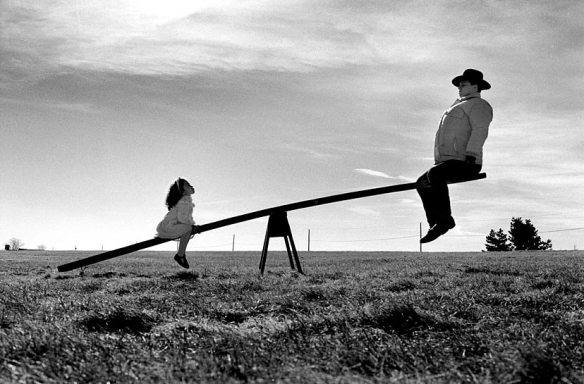
For the first seesaw ride, let’s weigh ABCD vs. EFGH.

There are three possible outcomes:

  • They balance, meaning we can eliminate all eight of them and our mystery person is in IJKL.
  • ABCD sinks while EFGH rises, meaning there’s a heavier person in ABCD or a lighter person in EFGH, so we can eliminate IJKL.
  • EFGH sinks while ABCD rises, meaning there’s a heavier person in EFGH or a lighter person in ABCD, so we can eliminate IJKL.

OUTCOME 1: They balance

For the second seesaw ride, we’ll take IJK and weigh them against any three of the eliminated people — let’s say ABC — because we know they weigh the same.

OUTCOME 1-1: if IJK balances against ABC, we know that L is our guy. For the third seesaw ride, weigh L against A to determine if L is lighter or heavier.

OUTCOME 1-2: if IJK sinks, one of them is heavier than ABC. For the third seesaw ride, weigh I against J. If they balance, K is the heavy one. If I or J sinks, he’s the heavy one.

OUTCOME 1-3: if IJK rises, one of them is lighter than ABC. For the third seesaw ride, weigh I against J. If they balance, K is the light one. If I or J rises, he’s the light one.


article-2401231-1b6471bd000005dc-74_634x452

OUTCOME 2: ABCD sinks while EFGH rises

For the second seesaw ride, we have eight possible suspects — four heavy, four light — so we mix up the two previous groupings in order to eliminate some suspects. We’ll take E, F, and A and weigh them against G, B, and L. That’s two from the lighter side and one from the heavier vs. one from the lighter, one from the heavier, and one we know is standard.

Again, there will be three possible outcomes:

OUTCOME 2-1: If EFA balances with GBL, they’re all eliminated, leaving either H as a lighter person or either C or D as a heavier person. For the third seesaw ride, weigh C against D. If they balance, H is lighter. If they don’t, whichever is heavier is our guy.

OUTCOME 2-2: If EFA sinks, either A is heavy (because E and F were on the lighter side before) or G is light (because B was on the heavier side and L has already been eliminated), and we can eliminate C, D, and H. For the third seesaw ride, weigh G against L. If they balance, A is heavy. If they don’t, then G is light.

OUTCOME 2-3: If EFA rises, either B is heavy (because G was on the lighter side and L has already been eliminated) or either E or F is light (because A was on the heavier side), and we can eliminate C, D, and H. For the third seesaw ride, weigh E against F. If they balance, then B is heavy. If they don’t, whichever is lighter is our guy.

giant-see-saw

OUTCOME 3: EFGH sinks while ABCD rises

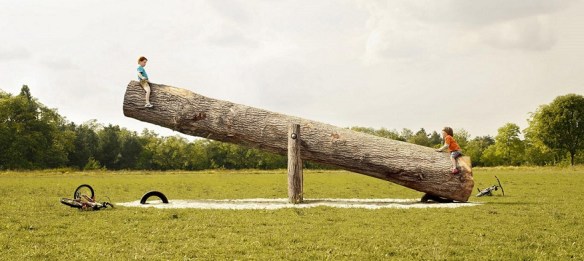
For the second seesaw ride, we have eight possible suspects — four heavy, four light — so we mix up the two previous groupings in order to eliminate some suspects. We’ll take A, B, and E and weigh them against C, F, and L. That’s two from the lighter side and one from the heavier vs. one from the lighter, one from the heavier, and one we know is standard.

Again, there will be three possible outcomes:

OUTCOME 3-1: If ABE balances with CFL, they’re all eliminated, leaving either D as a lighter person or either G or H as a heavier person. For the third seesaw ride, weigh G against H. If they balance, D is lighter. If they don’t, whichever is heavier is our guy.

OUTCOME 3-2: If ABE sinks, either E is heavy (because A and B were on the lighter side) or C is light (because F was on the heavier side and L has already been eliminated), and we can eliminate D, G, and H. For the third seesaw ride, weigh C against L. If they balance, E is heavy. If they don’t, then C is light.

OUTCOME 3-3: If ABE rises, either F is heavy (because B was on the lighter side and L has already been eliminated) or either A or B is light (because E was on the heavier side), and we can eliminate D, G, and H. For the third seesaw ride, weigh A against B. If they balance, then F is heavy. If they don’t, whichever is lighter is our guy.


This was one whopper of a brain teaser, to be sure, and I’m not surprised it stumped even the likes of the impressive Captain Holt. But, as a special treat, if you’d like to see the Captain himself explain the solution, go here and check out the embedded video. Enjoy.

Of course, it doesn’t answer the real question: who cares about weight? Why aren’t they building a boat to escape the island?

Thanks for visiting PuzzleNation Blog today! You can share your pictures with us on Instagram, friend us on Facebook, check us out on TwitterPinterest, and Tumblr, and be sure to check out the growing library of PuzzleNation apps and games!

Happy Thanksgiving, puzzlers and PuzzleNationers!

To celebrate this most festive and familial of days, we couldn’t help but cook up a little puzzle for you and yours today. Please enjoy this Thanksgiving puzzle, and have a safe and happy holiday!

Five Houses, One Big Meal

This Thanksgiving, five families (the Corbins, the Johnsons, the McDashes, the Whittons, and the Edgertons) agreed to each bring one part of Thanksgiving dinner to five other households in the neighborhood. The options were Turkey, Stuffing, Sweet potato, Turnip, and Rolls.

Each family dropped off a different food at each house at a different time (9 AM, 10 AM, 11 AM, Noon, and 1 PM). No two families gave the same food to the same house, or showed up to the same house at the same time.

The table below displays each family’s name, each household they visited, what food they dropped off, and what time they dropped off the food. Some of the boxes have been filled in already. Can you complete the chart and figure out what time each family dropped off each food?

Thanks for visiting the PuzzleNation blog today! And say, why not save yourself the hassle of Black Friday madness by checking out our Holiday Puzzly Gift Guide?

Hold on, let’s be logical about this…

A few weeks ago, I did a blog post exploring the history of paper puzzles, comparing relatively new puzzle innovations like crosswords and Sudoku — crosswords are nearing their 100th anniversary, and Sudoku has only been around a few decades in its current form — to a much older style of puzzling, the riddle.

But it occurs to me that another branch of puzzles, logic puzzles, can trace their formative roots nearly as far back.

Logic puzzles are a curious breed of puzzles, since they rely less on grids and trivia and more on deductive reasoning. (Yes, many solving styles utilize grids, like this one from our friends at Penny/Dell Puzzles, but they’re not strictly necessary.)

If I was to chart the evolution of puzzles like that of animals or plants, riddles and logic puzzles would be offshoots of the same ancestor. Riddles are actually very simplistic logic puzzles, since they often rely on a single twist or turn of phrase.

For example, there’s the riddle “what gets wetter as it dries?”

The answer is “a towel.” The riddle relies on logical misdirection. The structure implies a passive voice (something becoming dry) but its actual structure is active voice (something actually drying another object).

This is known as a garden path sentence, and a terrific example is this quotation often attributed to Groucho Marx: “Time flies like an arrow, fruit flies like a banana.”

The main difference between the two is the complexity of logic puzzles as they’ve developed. Riddles are a one-and-done trick of wordplay, while logic puzzles are multilayered exercises in deduction.

So, from riddles, it’s easy to imagine mystery stories and whodunits as the next precursor in the development of logic puzzles. From the early days of the genre’s creation at the hands of Edgar Allan Poe to its explosion in popularity under the quick and clever pens of Agatha Christie and her fellow authors, the plot of virtually every mystery story is a logic puzzle in itself.

The arrangement is similar. You’re given your setting and the circumstances that gathered the players together. Then you’re given the pertinent information on who was where at a given time, and it’s left to you (and the ubiquitous detective) to unravel the truth from a convoluted mishmash of information.

Except for the detective, that’s the modern day logic puzzle exactly.

(I snagged this helpful image from www.logic-puzzles.org.)

Heck, there are even some mystery stories that are considered unsolved, practically waiting for an enterprising logic puzzle fan to find the key piece of evidence that will unlock the entire story.

Frank Stockton’s story “The Lady, or the Tiger?” comes to mind, as does Stanley Ellin’s “Unreasonable Doubt”. (I encountered these stories in Otto Penzler’s collection Uncertain Endings: The World’s Greatest Unsolved Mystery Stories.)

And in case you’re curious as to why I’m rambling about riddles and Poe and how they directly or indirectly influenced the evolution of logic puzzles as we know them… the answer is simple.

With the hundredth anniversary of the crossword fast approaching, it’s made me wonder just how long the spirit of puzzle-solving has been with us as a civilization.

And when you can trace logic puzzles back hundreds of years and riddles back thousands of years, it’s hard not to smile and imagine that we’re enjoying the same mental and puzzly challenges generations and generations of others have tackled in the past.

It’s a humbling and heartening thought.

Thanks for visiting the PuzzleNation blog today! You can like us on Facebook, follow us on Twitter, check out our Classic Word Search iBook (recently featured by Apple in the Made for iBooks category!), play our games at PuzzleNation.com, or contact us here at the blog!