The Connecticut Festival of Indie Games, Part 2!

And we’re back!

Yup, I attended the CT FIG event last Saturday, and there were so many great games to talk about that I simply couldn’t get the job done on Tuesday. So we’re back with the second half of my event recap.

Last time, I focused on games that are available now or will be soon; this time around, it’s all about games in development!
ctfig29

I’d say that more than half the games at the event were in development or not yet published. Some were clearly in beta testing or working with a prototype, hoping to gauge the interest level of puzzle and game fans. Others were gearing up for Kickstarter campaigns, or in the middle of one, or had even tried Kickstarter previously, only to go back to the drawing board. Still others were hoping to impress game publishers or make contacts to help take their games to the next level.

It was interesting and insightful to see the creative process at work here, not only to observe how crowdfunding has revitalized the puzzle-game and board-game markets, but simply to watch firsthand as designers interact with players and learn from each and every playthrough.
ctfig7047

And, to be honest, it’s fun and invigorating to be around enthusiastic people. Virtually everyone I met at the CT FIG was genuinely excited to talk about their games, and they clearly loved what they do. For many of them, these prototype and unreleased games are their babies, their pride and joy, and they were absolutely stoked to show them off.

That’s the kind of infectious energy I can definitely get behind.

One of the first people I talked to at CT FIG was Darrin Horbal of DPH Studioz. He had three games to show off, all in varying stages of development.
ctfig1

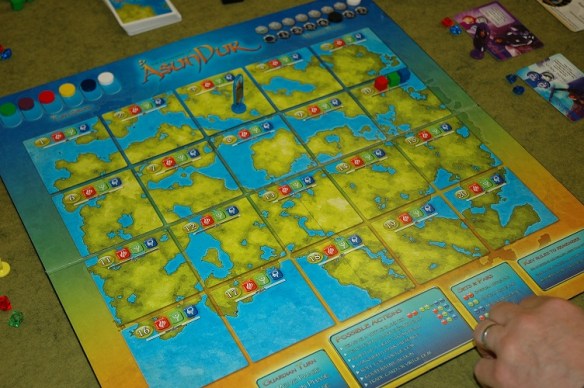
His flagship game is The Guardians of AsunDur, a collaborative game where players work together as guardian angels to defend AsunDur from dark forces.
ctfig2

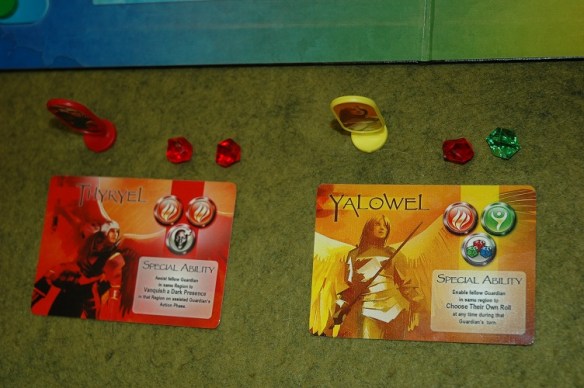
By rolling dice and utilizing colored gems, they battle back the forces of darkness in co-op game play that encourages teamwork and strong strategic planning.
ctfig5

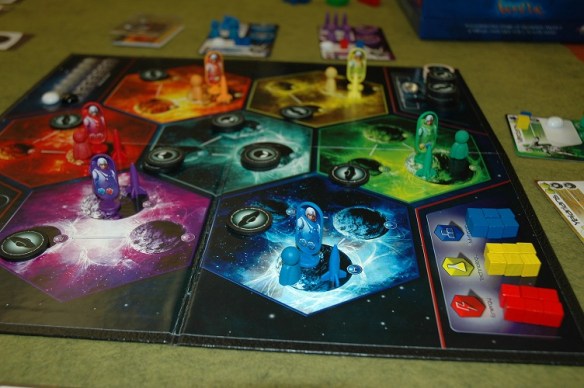
That same style of game play factors into another of Darrin’s board-game projects, Starguard: The Grey Wars, a space-combat game where alien conquerers threaten six different star systems, and only a concerted team effort will prevent the invading alien forces from running roughshod across the galaxy.

I’m a big fan of co-op games, and both of these games had in-depth, elegant systems of play that offered plenty to keep experienced players busy without losing younger players in the shuffle.
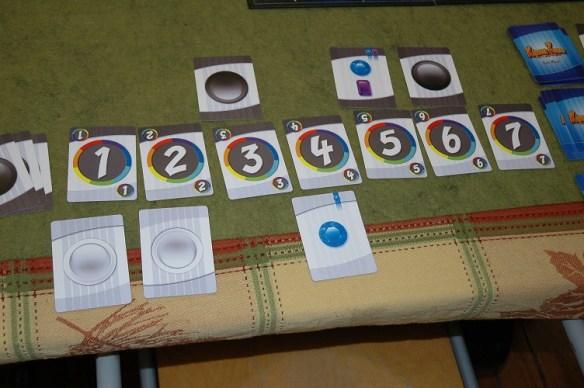
ctfig3

The last game he brought for display was Khroma Zones, a more traditional player-versus-player card game that was easily the puzzliest of the three games. Utilizing the same color-matching game mechanic as Guardians of AsunDur in a simpler format, it’s a great game for families and younger players that might not be ready for more involved game play.

But Darrin was far from the only game designer to have multiple projects in the works.

ctfig32

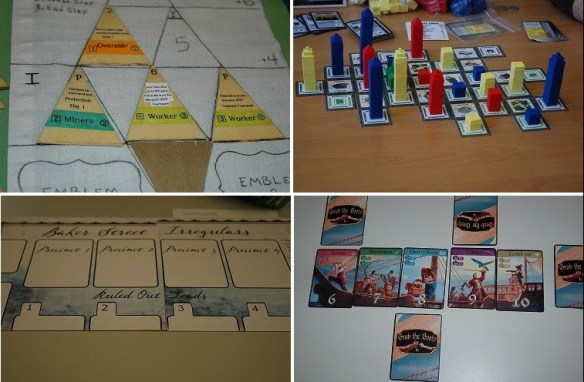
[Ravenous River, a card game inspired by the classic cabbage-goat-wolf river-crossing brain teaser, shares space at a table with ChronoSphere, a Timeline-style card game with bluffing (recently funded on Kickstarter), and Baker Street Irregulars, a crime-solving puzzle game set in the world of Sherlock Holmes.]

I’m pretty sure Isaac Shalev of Kind Fortress set the high-water mark for the event. He had six games at his table, each with their own unique flavor. (Only one, the abovementioned Ravenous River, was available for purchase there, but I sincerely hope some of his other games follow suit soon.)
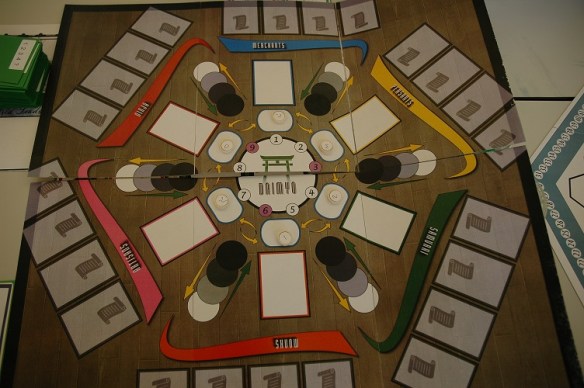
ctfig36

There was something for seemingly every style of card game or board game fan here, from the card-flipping game Flip the Table to the resource-management strategy game set in feudal Japan, Daimyo.

But the one that most appealed to my puzzly sensibilities was Seikatsu, a three-directional tile-placement game that mixes and matches elements from a half-dozen classic games to provide a wonderfully balanced game-play experience.
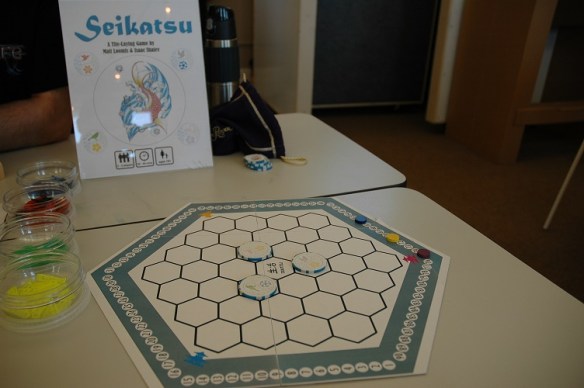
ctfig35

Unlike many scoring games where tile placement can easily disqualify you from gaining points, Seikatsu assigns one of three directions to each player, meaning virtually every tile on the board could score points for every player. This simple tweak adds massive game-play opportunities, making for a wonderful puzzly session that encourages, rather than discourages, new players.

Kickstarter was a recurring theme in many of the conversations I had with game designers that day. Several of the games I covered in Tuesday’s post were funded and brought to market thanks to crowdfunding, and many others would soon be following suit.
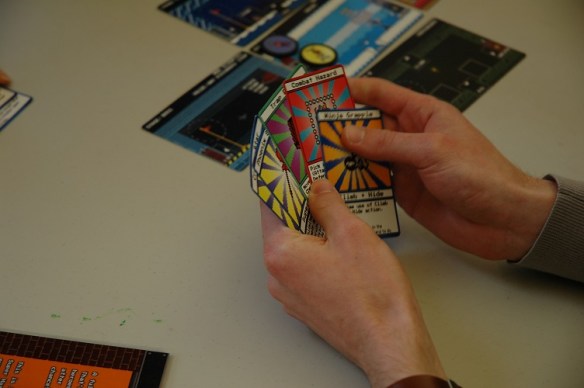
ctfig66

Super Hazard Quest, a card game inspired by 8-bit side-scrolling video games, is on Kickstarter right now (and recently passed its funding goal, thanks in part to the team’s impressive hustling during CT FIG, no doubt).

In the game, you take on the role of a classic video game archetypal hero — the floating princess, the spy, the alien hunter, etc. — and you build and explore a unique video game world while racing to be the first to reach the final boss.
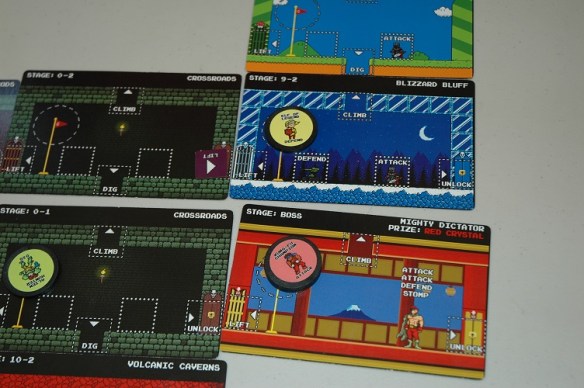
ctfig68

As several event goers and I played through a spirited round of the game, co-creator Mike Mendizabal told me that the game was actually intended as a cooperative game (like Guardians of AsunDur or Forbidden Island), but the players in play testing refused to work together! So they ended up retooling the game for individual achievement.

I love learning little in-development details like that.
ctfig41

Christopher Bowden of Winter Moon Games shared his own story of development tribulations and lessons learned as I observed a playthrough of his company’s flagship game, Pandemonium Estate.
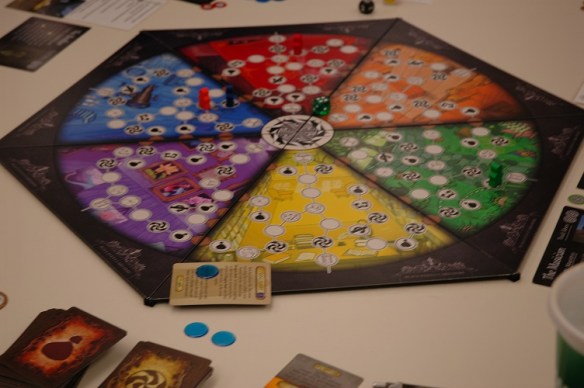
ctfig40

A board game with shifting board pieces and game play that encourages players to betray each other, Pandemonium Estate is a colorful, dark, and very fun game that indulges the more playfully mean-spirited side of board games. (You know that shamefully satisfying feeling when you play Sorry and bump another player’s game piece back to the start? Multiply that by about 50 and you get something approximating the sinister glee of Pandemonium Estate.)

Christopher told me that he and his team had already taken the game to Kickstarter, but they quickly realized they’d done so before either they or the game was ready. They took some much-needed time to retool, refocus, and get their ducks in a row, and it proved to be a valuable learning experience.

They’re looking forward to bringing their new and improved version of the game to Kickstarter sometime in the future, and I suspect they’ll have great success when they do.

One game that I expect will do quite well is This Is Only a Test, Carl Van Ostrand’s game featured at The Board Room’s table. (I also referenced The Board Room in my previous post when I covered the DNA dice game GATUCA.)
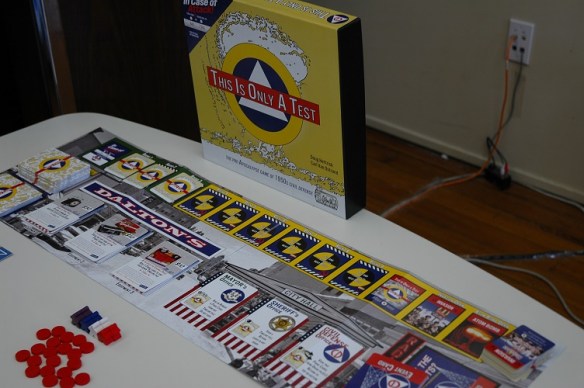
ctfig48

This Is Only a Test is a resource-management game fueled by ’50s nostalgia and doomsday prepping, as you and your fellow players try to gather the necessary materials to survive the end of the world. But be warned…this might be a real nuclear threat, or it might simply be a test. Neither you nor any of the other players will know which is the case until the very end of the game.
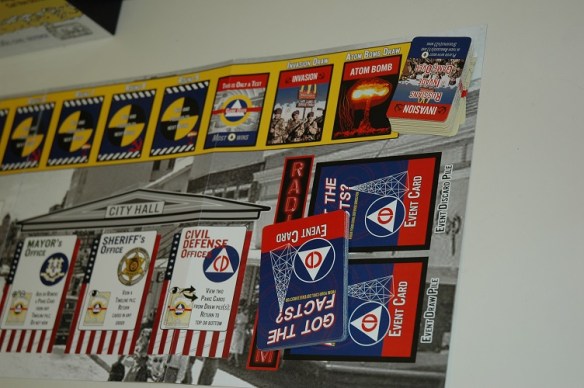
ctfig49

It’s an intriguing game mechanic, one I haven’t really encountered before. In most games, you might not know who will win, or how they’ll do it, or what obstacles they’ll face, but I can’t recall another game where the actual endgame is unknown until the last card is played.

Oh, and speaking of the end of days, that brings me to our next game, Pyramidia.
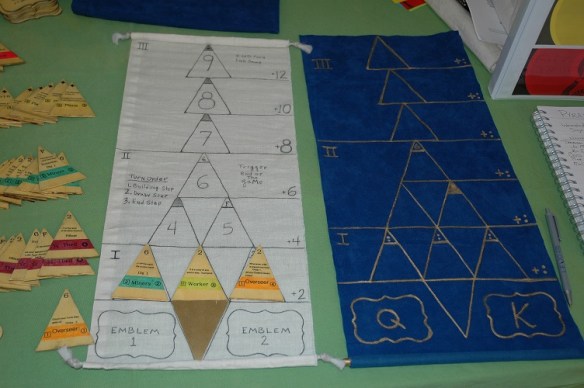
ctfig45

In this puzzly game of curses and construction, you and your fellow players are racing to build the finest Egyptian tomb possible. You gain points for your management of labor, for how much gold you save, and for how magnificent your structure is.

I think the physical building aspect, as well as the numerous ways to win the game, will appeal to puzzle solvers and board game fans both. The triangular game pieces not only added a nice touch stylistically to the game, but they created game play openings for players to either curse each other or themselves for a tactical advantage.

ctfig46

As the game was explained to me, it immediately became clear how much effort had gone into balancing the various styles of play, and I could easily imagine how many hours and hours of brainstorming and playtesting go into each and every one of these games.

And hey, if you’ve got a board-game idea and you’d like to meet up with fellow aspiring designers and players, look no further than CT FIG attendee Alex Wilkinson. He’s part of a group called Let’s Make Games CT based out of New Haven, and they’re always happy to participate in game testing, brainstorming, and all things game development.
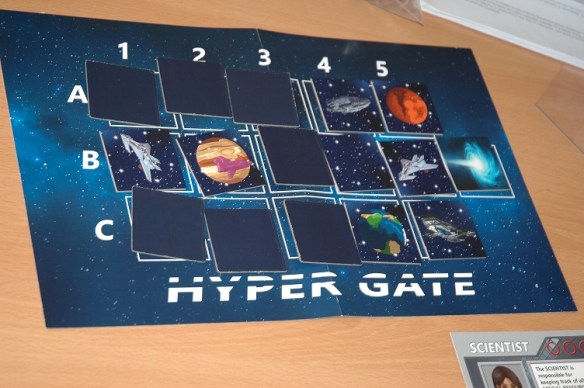
ctfig26

He had two games to show off — a space exploration game called Hypergate that allowed for some engaging role-playing scenarios, and a hilarious card game called Misfit Monsters, where lesser-known creatures like the YOLO Phoenix and the Half-Centaur could do battle.
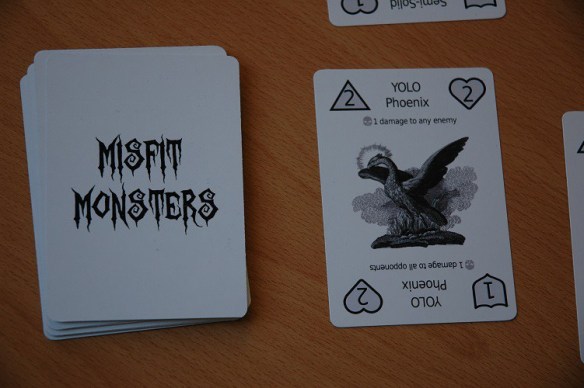
ctfig27.jpg

It’s genuinely exciting to be around people who love what they’re doing, and that positive energy was all over the Connecticut Festival of Indie Games.

I want to send a big thank you out to all of the amazing developers, designers, and game fans I talked to. I wish them all great success, and I hope to see many of these games on the shelves of game shops and retailers in the near future!


Thanks for visiting PuzzleNation Blog today! Be sure to sign up for our newsletter to stay up-to-date on everything PuzzleNation!

You can also share your pictures with us on Instagram, friend us on Facebook, check us out on TwitterPinterest, and Tumblr, and explore the always-expanding library of PuzzleNation apps and games on our website!
The Connecticut Festival of Indie Games!

Last year, one of our most popular posts was Max’s review of the Boston Festival of Indie Games. And when I heard that Connecticut was hosting its first Festival of Indie Games this year on International TableTop Day, I definitely wanted to check it out.

Now, I have neither Max’s charm nor his good looks, but I hope you’ll indulge me in my own rundown of the CT FIG this weekend.

ctfig12

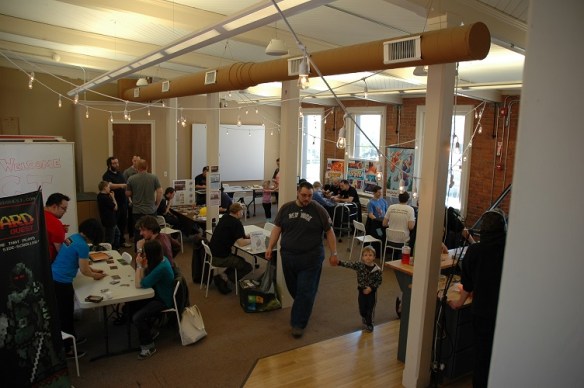
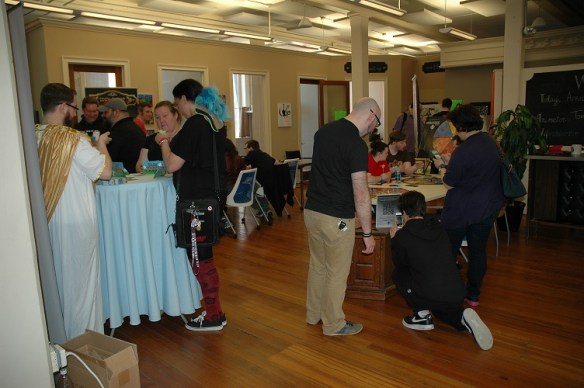
Elm City Games and The Grove combined forces to host the inaugural event in New Haven, and it made for a fun, intriguing, and intimate event.

The designers were spread out all over the building, wherever there was space, so you’d go down a hall and find a half-dozen tables, then head upstairs for a dozen more, and then down around random corners for a few more exhibitors. It was like a game-filled scavenger hunt with surprises around every turn.

ctfig1

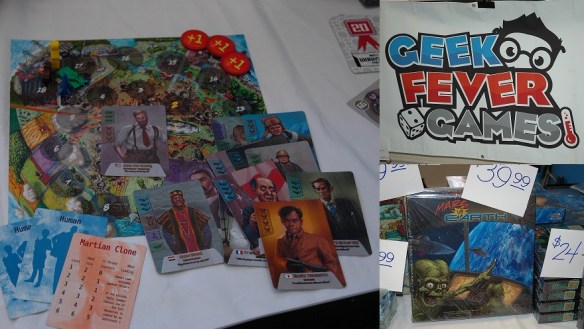
One of the first booths I visited belonged to the folks at Geek Fever Games, because only last week, I touted their Kickstarter for Avoid the Void right here on PuzzleNation Blog!

They had a playtesting area set up where guests could try out the game, as well as several games available for sale, including an alien invasion game called Mars vs. Earth, a robot-building card game called Awesome Bots, and Young Wizards, a card game that brings magic and RPGs to life in a simple, easy-to-learn format.

ctfig8910

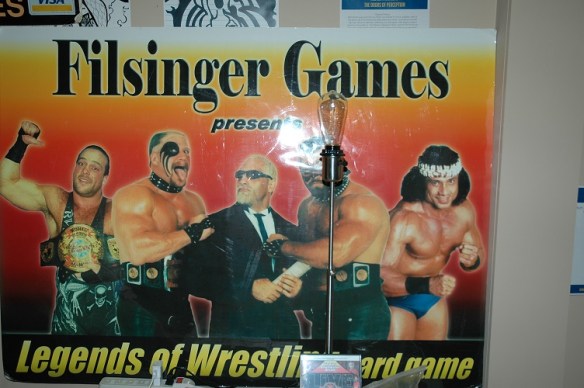
I also had a chance to sit down with Todd from Filsinger Games — one of the nicest guys on the planet — who was offering an intriguing take on role-playing games: a pro-wrestling edition.

ctfig14

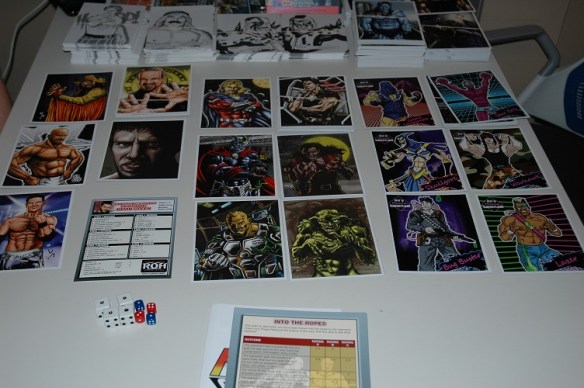
Yup, Filsinger Games figured out how to boil down all the mechanics and style of professional wrestling into a game you can play with any old six-sided die, and it’s great fun. The company has licensed with classic wrestlers and new indie stars to use their likenesses and move-sets for the game, and you can learn how to play in minutes flat.

I realize that RPGs and wrestling may not be everyone’s cup of tea, but I was thoroughly impressed by the simple, elegant design of the game, as well as the outside-the-box variations, like ’80s-style video game wrestlers, monsters, and more.

ctfig13

It’s worth noting at this point that my goal was to make it to noon before spending any money on games. I arrived at the event at 10:30.

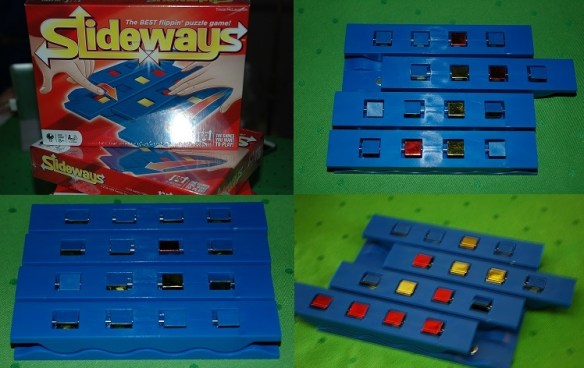
Slideways was the puzzle game to first crack my resolve, then my wallet.

ctfig1516

[A progression of my first time playing Slideways. The creator was red and I was gold. As you can see, I lost. Also, the last photo looks different because I photographed it in nighttime mode in order to better show off the metallic colors of the flippable tiles.]

Proudly displayed alongside an award earned at the Boston FIG, Slideways is the brainchild of Tricia McLaughlin and distributed by R&R Games.

Combining the classic four-in-a-row playing style of Connect Four or Quarto with the board-manipulating game play of Rush Hour Shift, Slideways offers a lot of choice in a little package.

Plus you can change moves your opponent has made, allowing even more flexibility of play! (And if you order through the R&R Games website, use the promotion code SLIDEWAYS to get 25% off!)

ctfig23

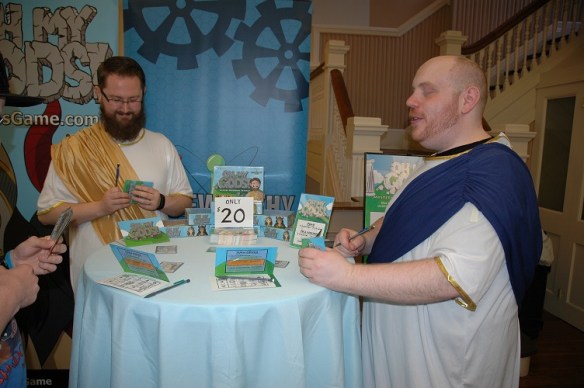
[Designer Tim Blank closes his eyes dramatically before bestowing judgment upon an unsuspecting player.]

After visiting the well-dressed fellows at Gameworthy Labs (and winning a copy of Oh My Gods! in a raffle; review coming soon!), I continued exploring the plethora of possible booths to check out.

(It’s worth noting that unlike Boston FIG, CT FIG was almost exclusively board games and card games, with very few digital games to be seen. I suspect more digital games will be involved with every passing year.)

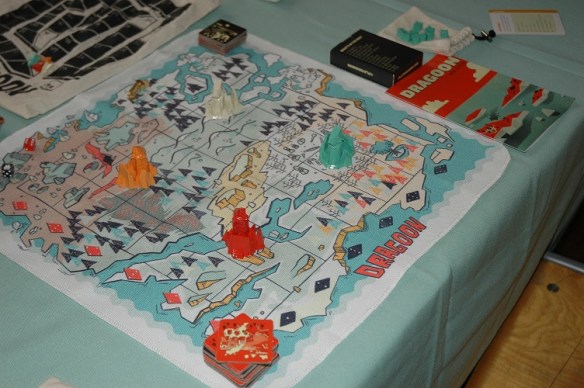
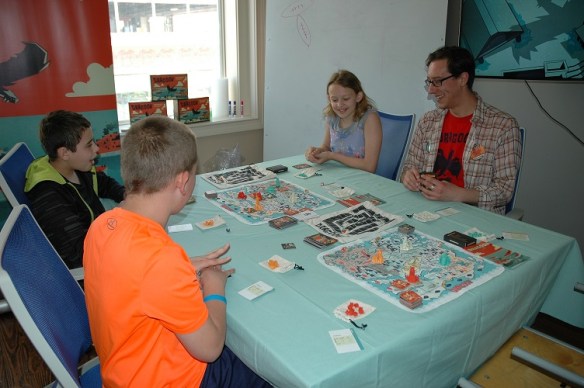
One board game that caught my eye was Dragoon, a clever reversal of classic fantasy storytelling tropes by the team at Lay Waste Games.

ctfig21

Usually, it’s humans fighting off dragons, but in Dragoon, you play a dragon whose lands are being invaded by humans! How rude! So it’s up to you to roar and be generally dragon-y and keep them away, all while stealing their gold, because as we all know, dragons love gold.

It’s a funny concept executed beautifully. With a cloth map as your game board, well-crafted metal pieces for the dragon and its cave, and some sharp game play mechanics, it’s terrific stuff.

ctfig22

I spoke to Jon Ritter-Roderick of Lay Waste Games, and he shared that this was another Kickstarter success story, and that they were taking pre-orders for the game because they’d already sold out of their original print run! (Good news for my wallet, since I would definitely have bought a copy right then and there.)

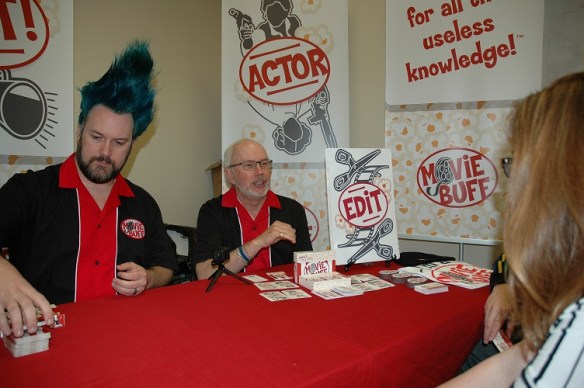
I had a similar experience when I sat down with the dapper crew behind Movie Buff, a card game that pits your movie knowledge against that of your fellow players. If someone names a movie, how fast can you name an actor in it or quote that movie?

ctfig44

[And the Oscar for Best Hair goes to…]

Combining your own knowledge of the movies with the order-shifting rules of Uno, Movie Buff is a fun and frenetic way to establish your cinematic dominance over friends and loved ones alike.

Oh, and spoiler alert: When we played a round to show off the game, I won. (They’re also taking pre-orders now.)

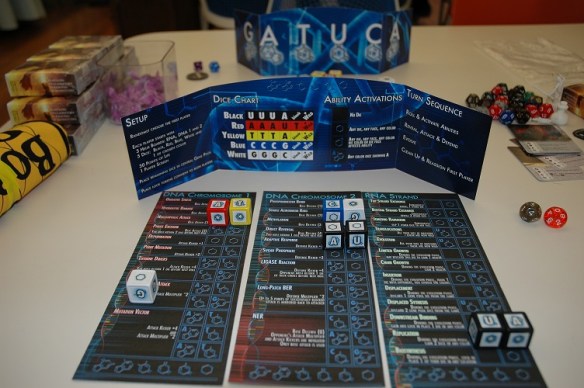
I next tested my puzzle-game skills in a round of GATUCA, a dice-rolling combat game based on DNA, of all things. (And riffing on the sci-fi film Gattaca.)

ctfig43

Oh, and my opponent? The nephew of the friend of the guy who designed the game.

Allow me to explain: The designer and his pals from The Board Room needed a fourth person to demo their game-in-development This Is Only a Test, so this amiable fellow (nephew of the friend of the designer) stepped up. And when the designer and his team went off to do a livestream demonstration of one of their games, said nephew-friend was left to man the table.

But he stepped up and made for an impressive opponent in my first round of the game. You roll dice to determine what components you have available, and then you apply them to the game sheets in front of you in order to attack, defend, or evolve. It’s a little overwhelming at first, but new players will catch on quickly, and it’s a fun variation on simpler dice-rolling combat games.

ctfig52

I went from learning about DNA (and how to make it work to my advantage in combat) to learning about language and color theory with the team at TPG.

They’re teachers who also play and design games, and their mission is simple: combine those two worlds to create games that help students learn.

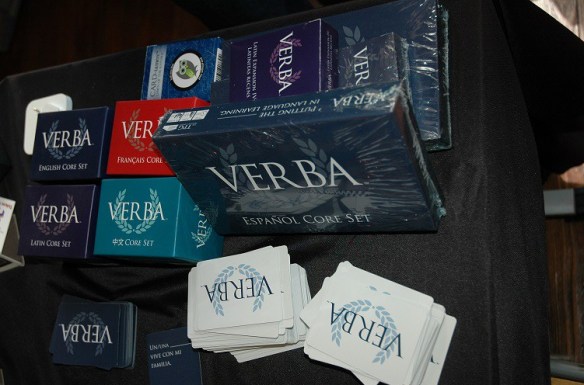
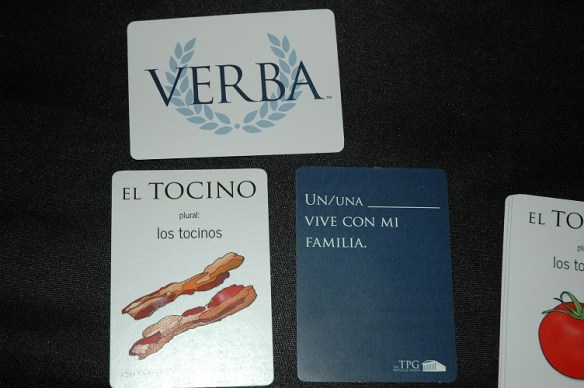
Their flagship product is Verba, a language game that uses the card-combining game play of Cards Against Humanity or Apples to Apples in order to reinforce and engage foreign-language learning. Students are given sentences (the blue cards) and must complete them with one of the white cards.

ctfig54

With editions in Latin, Spanish, French, and English (for English language learners), it’s a terrific immersive way to explore an unfamiliar language with practice and fun, one that appealed greatly to the word nerd and language lover in me.

(They also had a game where you hatched dragon eggs with color theory, which looked fascinating, but that I didn’t get to try out. Hopefully I’ll get a second chance to give that game a shot.)

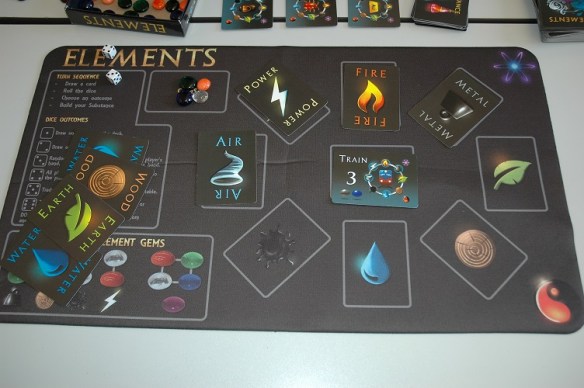
I did, however, get to try my hand at wielding the elements and bringing items to life, thanks to the crew at Rampage Games and their game Elements.

ctfig55

Elements is all about combining the elements fire, air, earth, and water to bring different substances into existence. You have to manage your limited resources, use your cards wisely, and outwit your opponents in order to complete your substances before they complete theirs. I can easily see this game appealing to all sorts of puzzle fans. (And it must have, since its Kickstarter campaign closed out successfully that very day!)

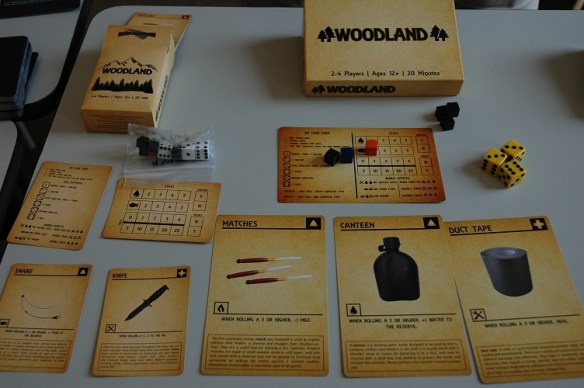
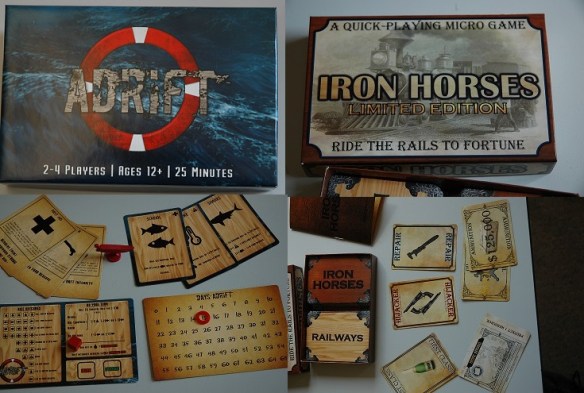
Nick Rossetti of Rampage Games was kind enough to walk me through some of the other games they also have available, including quick-play survival games like Woodland and Adrift, as well as Iron Horses, a card game where competing train companies battle to be the biggest and best in the land.

ctfig61

ctfig6263

But it was their soon-to-be-available card game Aurora that piqued my puzzly interest. While Elements is all about building single items or substances, Aurora is about building entire solar systems and tending to them so that intelligent life may emerge. Talk about ambitious!

ctfig57

[Aurora and Elements were both added to the increasingly long list of games I would’ve bought on the spot, had they been available.

I did end up returning to the Geek Fever Games table and buying Awesome Bots, as well as a card game called Plus Word Plus that’s all about finding common ground between words.

And several other games from other booths.]

As you can see, there were so many noteworthy and interesting games that I can barely describe them all. Heck, this is a pretty long post. And guess what? We’re only halfway done. There were so many great games to cover that I’m splitting my CT FIG recap into two posts.

I devoted this post to games that are available right now (or will be soon). Thursday’s post will be all about games in development or not yet available for sale!


Thanks for visiting PuzzleNation Blog today! Be sure to sign up for our newsletter to stay up-to-date on everything PuzzleNation!

You can also share your pictures with us on Instagram, friend us on Facebook, check us out on TwitterPinterest, and Tumblr, and explore the always-expanding library of PuzzleNation apps and games on our website!

Kickstarter Round-up!

International TableTop Day is this Saturday, a day where we celebrate getting together with family and friends to play games! Board games, card games, role-playing games, puzzles…anything that involves gathering in person and having fun around a table fits the bill!

But we simply can’t wait until Saturday — plus the office is closed that day — so we’re hosting our PuzzleNation’s TableTop Day event in-house TODAY! And I figured what better day could there be for a round-up of puzzly crowdfunding campaigns marking some of the newest and most intriguing projects in the puzzle-game industry today!

I’ve covered various campaigns for board games, card games, and puzzle projects across the Kickstarter and Indiegogo crowdfunding platforms over the years, and today I’d like to share three more that could use your attention.

The first is the strategy game Tak.

Tak is a collaboration between game designer James Ernest, head honcho of Cheapass Games and Hip Pocket Games, and author Patrick Rothfuss, creator of the Kingkiller Chronicle series, to bring to life a game featured in Rothfuss’s novel The Wise Man’s Fear.

The premise sounds simple: build a road of pieces connecting opposite sides of the board. By using some pieces as parts of your road and others as walls to block your opponent, this mix of chess, Stratego, and Go is all about strategy. Plus, the game is adaptable, playable on square boards as small as 3×3 and as large as 8×8.

This is a new pub game that feels like a timeless classic, and it looks perfect for puzzlers of all ages.

Now let’s move from the pub to outer space with another Kickstarter campaign, Avoid the Void.

This is a different sort of strategy game, since it’s all about outlasting your opponents, not completing a task first. In Avoid the Void, whole sectors of space are being replaced with black holes, and everyone is scrambling to gather resources and elude these hungry death traps.

You’ve got an ever-changing gameboard, intriguing alien races (including one resembling a piece of cake), and all the reason in the world to deceive, outmaneuver, and betray your fellow players, just so you can stay in the universe a little while longer.

This is a game designed for replayability, allowing you to indulge in all of the diabolical selfishness of games like Monopoly, but without the huge time commitment. After all, the universe is collapsing and there’s no time to waste!

And speaking of replayability, the makers of this last Kickstarter campaign are known for puzzle games with high replay factor. Let’s talk about Pyramid Arcade from Looney Labs.

We normally talk about Looney Labs card games like Fluxx or Loonacy, but their original product line revolved around the Looney Pyramids system: various games you can play with their signature colored pyramids.

Now, they’re launching Pyramid Arcade, covering TWENTY-TWO different games and encompassing 90 pyramids of various colors. It’s their largest release ever, and with all the variants and mini-games they’ve created for these game pieces over the years, this promises to be a game set with endless possibilities.

Pattern-matching games, chess- and Tic-Tac-Toe-inspired games, bluffing games, strategy games, and even a tower-building game…Pyramid Arcade literally has something for everyone.


These are three intriguing and very worthy projects, and I hope you contribute to one or more of them. As someone who has become a regular donor to various Kickstarter and Indiegogo campaigns, I am proud to have funded some marvelous new ideas and watched them take shape over the months that followed.

Thanks for visiting PuzzleNation Blog today! Be sure to sign up for our newsletter to stay up-to-date on everything PuzzleNation!

You can also share your pictures with us on Instagram, friend us on Facebook, check us out on TwitterPinterest, and Tumblr, and explore the always-expanding library of PuzzleNation apps and games on our website!
PuzzleNation Product Review: Schrodinger’s Cats

Even if you don’t know the science behind it, you’ve probably heard of Schrodinger’s cat at some point in your life. If you haven’t, let me give you the short short version: there’s a box with a cat in it, and a substance that may or may not release inside the box and kill the cat.

So until you open the box, there’s no way of knowing whether the cat is alive or not. Schrodinger posited that, since we can’t know which is the case, both are true until the box is opened. It’s essentially a thought experiment which delves far deeper into quantum mechanics and particle physics than I’m going to in this review.

But the idea that someone created a card game based on the concept of Schrodinger’s cat is not only audacious, but pretty impressive. (And the puns are just the icing on the cake.)

[Some of the cat physicists in the game: Sir Isaac Mewton,
Sally Prride, Madame Purrie, and Neil deGrasse Tabby.]

Schrodinger’s Cats was funded through a Kickstarter campaign last year, and it’s the brainchild of Heather Wilson, Heather O’Neill, and Chris O’Neill. A mix of bluffing, deduction, and wagering, this game combines Name That Tune-style bravado and strategy with Poker-style game play.

Each player is a cat scientist forming hypotheses on how many boxes contain live cats, dead cats, or nothing at all. (While Schrodinger is away, of course. As the old saying goes, when the scientist’s away, the cats will play. Or something like that.)

Every player receives one box card for each player in the game (so if there are three players in the game, each player receives three box cards), as well as one cat scientist card.

Once the cards are dealt, players look at their box cards and see what each box contains, hiding this info from the other players. Then the players begin hypothesizing. They wager on how many of each result are in ALL of the boxes on the board. So, in the game layout above, there are nine boxes, and each scientist has to wager what’s in all the boxes.

But instead of starting with a high guess and then wagering lower totals (as you would in Name That Tune), you start low in Schrodinger’s Cats and wager upward. Scientists can also affect the wagering by “showing findings” — revealing one or all of their own boxes to either prove their hypothesis or make the other players doubt their own — or by swapping out some boxes. (Each cat scientist card also allows for a one-time-use special action for a player, which can also prove useful.)

When a player either refuses to wager higher or challenges another player’s hypothesis by yelling “Prove it!”, all of the boxes are revealed and the hypothesis is proven or debunked (meaning the player stays in the game or leaves). After multiple experiments (rounds of play), one character remains and wins the game (and an honorary doctorate from Cat Tech University).

What I enjoyed most about this game (other than all the pseudo-scientific jargon involved in playing the game) was the wagering, bluffing, and reading of opponents that is integral to the game play. With so few possible cards to reveal (only four, in varying quantities, as opposed to 13 different cards across four suits in poker), it’s not nearly as challenging as the classic card game, but offers a lot of similar game mechanics.

It’s great fun to try to outwit or read your fellow players in order to make the best hypothesis, and that’s a sort of puzzling that is often left behind in puzzle games. Often, you’re so busy trying to achieve a certain goal or acquire points that you stop actively interacting with the other players; but in Schrodinger’s Cats, a lot of puzzling and game play takes place in the actions and reactions of the other players. It’s a delightfully social game.

Although you can play with as few players as two or as many as six, I recommend playing with at least four characters to keep the game moving and interesting. Between raising hypotheses, showing findings, and trying to puzzle out what your fellow players are hiding, the more uncertainty you can introduce to the game, the better.

Schrodinger’s Cats is available from 9th Level Games and can be found here.


Thanks for visiting PuzzleNation Blog today! Be sure to sign up for our newsletter to stay up-to-date on everything PuzzleNation!

You can also share your pictures with us on Instagram, friend us on Facebook, check us out on TwitterPinterest, and Tumblr, and explore the always-expanding library of PuzzleNation apps and games on our website!
It’s Follow-Up Friday: Schools and Spheres edition!

Welcome to Follow-Up Friday!

By this time, you know the drill. Follow-Up Friday is a chance for us to revisit the subjects of previous posts and bring the PuzzleNation audience up to speed on all things puzzly.

And today, I’d like to return to the subject of Kickstarter philanthropy!

[Image credit: for-preneur]

I’ve written about crowdfunding a lot in this blog, because over the last few years, platforms like Kickstarter and Indiegogo have changed how many puzzles and games are created, funded, and brought to market.

There’s a virtual board game and card game renaissance stemming from these websites, and many puzzle constructors are bypassing traditional publishing formats and taking their puzzle suites and projects straight to the audience this way.

But there’s also the opportunity to give back to your community in meaningful ways.

I recently stumbled across the Kickstarter campaign for StrataSphere, a strategy puzzle game from Family Games America that really caught my eye.

Like a next-level version of Connect Four and KerPlunk, StrataSphere challenges you to place your sliding tabs in various slots around the cube, then use them to drop your spheres to the bottom layer first.

But what most intrigued me about the project wasn’t the puzzle itself, but one of the crowdfunding options being offered. Instead of just pledging for a copy of the game for yourself, you could pledge a little more money and donate a copy of the game in your name to a school of your choosing. Puzzle philanthropy.

I reached out to the team at FGA to find out more about the project, and had the opportunity to chat with Paulette Hall, communications director for FGA.

Where did the idea for StrataSphere come from?

The game was originally envisioned and developed by German designer Claudia Herz, who originally named it BallCube. Claudia remembers that after spending time sketching and offering the idea to other game publishers she finally made a handmade sample of acrylic glass and presented it at a trade-show not too far from her home.

The reaction and feedback was overwhelming. People wanted to know everything about the game and know where it can be purchased. This is what encouraged her to pursue the project. With a combination of inspiration from Claudia and outer-space, we renamed the game StrataSphere 2.0.

For people unfamiliar with FGA, what sort of puzzles and puzzle-games are your bread and butter? Is StrataSphere a traditional FGA-style puzzle, or is it a new direction for you?

FGA’s tag-line, Learning Through Laughter, has been been incorporated into all of our gift, game, and puzzle products since being established in 1987. StrataSphere 2.0 is not so much a puzzle but a strategy tabletop game that is a more contemporary modern addition to our line of products.

Our more popular items include eco-friendly wooden games and puzzles like Cathedral, Don’t Break The Bottle, and our wood and wire puzzles. While this strategy game is new to FGA, FGA is not new to strategy games.

The option for supporters to donate an additional copy to a school of their choosing is one I’ve never seen before, and I’m surprised more Kickstarter campaigns haven’t utilized it. Is this the first product that has incorporated this sort of program? Is this a long-term goal for FGA going forward?

FGA helped raise funds for actor Ted Danson’s American Oceans Campaign in the late ’80s and early ’90s with their environmental games and puzzles such as Endangered and Colorful Kingdom. A percentage of sales was also given to the ASPCA.

Donations of FGA products go out yearly to schools and organizations. A big part of FGA is our ability to give back, and we wanted to start 2016 with a campaign that will help us continue to do that. Our students are our future, and the state of our school systems has geared our focus of this campaign to get valuable learning material back into our schools and into their hands.

I think this is not only a really exciting puzzle game, but a worthwhile cause as well. You can check out all the details on the StrataSphere Kickstarter page. They’re more than halfway to their funding goal, and I sincerely hope they make it there and beyond.


Thanks for visiting PuzzleNation Blog today! Be sure to sign up for our newsletter to stay up-to-date on everything PuzzleNation!

You can also share your pictures with us on Instagram, friend us on Facebook, check us out on TwitterPinterest, and Tumblr, and explore the always-expanding library of PuzzleNation apps and games on our website!
PuzzleNation Product Review: Scrimish

The best card games are simple. People love War and Poker and Hearts and Go Fish because, at their core, they’re games you can learn quickly and play endlessly. There are no long tutorials or play-throughs, so you can learn all the complexities and rules with ease.

It’s difficult to find puzzly card games that are as accessible and replayable. Scrimish, a card game created by Danny Zondervan and recently funded through Kickstarter, fits the bill nicely. The rules are simple, but the strategy in the actual game is what gives Scrimish major replay value.

[On a very festive battlefield, I’ve finished setting up my cards
(bottom of the frame), while my opponent is still working on hers.]

Scrimish is an elegant mix of War, Chess, and Memory.

Each player gets a set of 25 cards, arranging them into five piles of five cards each, face down. The goal? Find your opponent’s crown card before they find yours.

Then you take turns drawing a card from the top of one of your piles and attacking the top card of one of your opponent’s piles in a one-on-one battle. Here’s where the War aspects begin. You see, each card has a number value, and the higher number wins. The losing card is discarded, and the winning card goes back to whatever pile it came from.

So in every encounter, both players learn something, because even if you lost that attack, you’ve learned the value of one of the cards on top of one of your opponent’s piles.

That’s where the Memory aspect comes in, because you have to remember what cards of your opponent’s you’ve seen. (You can check your top cards or your piles as often as you and your opponent see fit.) Then you can plan other moves and try to uncover their crown card.

You’ve got shield cards to defend with, archer cards to attack with, numbered weapon cards to battle with, and one crown card to defend. So, essentially, you’re playing a miniature game of chess with your opponent, except your pieces are hidden from them.

And that’s what makes for such a satisfying playing experience. You’ve got all sorts of strategy going on, plus chances for misdirection in both your attacks and your placement of cards at the beginning of the game. Do you go out heavy with high numbered cards early, or do you test their defenses with low cards? Do you arrange attack stacks and defensive stacks, or do your spread your resources out across all five stacks?

Plus, every card you attack with is one less you have in your stacks. So you’ve got a resource management aspect as well. All of this gameplay and puzzly potential, with fewer cards than your standard poker deck.

It takes only a few minutes to learn, but all the thought that goes into it makes every game of Scrimish feel fresh and new.


Thanks for visiting PuzzleNation Blog today! Be sure to sign up for our newsletter to stay up-to-date on everything PuzzleNation!

You can also share your pictures with us on Instagram, friend us on Facebook, check us out on TwitterPinterest, and Tumblr, and explore the always-expanding library of PuzzleNation apps and games on our website!