5 Questions with Laser and Aubrey, The Doubleclicks

Welcome to a marvelously musical edition of PuzzleNation Blog’s interview feature, 5 Questions!

We’re reaching out to puzzle constructors, video game writers and designers, writers, filmmakers, and puzzle enthusiasts from all walks of life, talking to people who make puzzles and people who enjoy them in the hopes of exploring the puzzle community as a whole.

And I’m overjoyed to have The Doubleclicks as our latest 5 Questions interviewees!
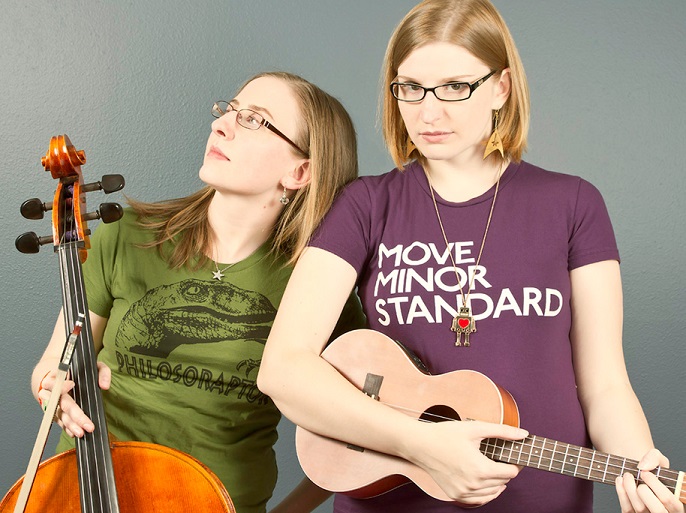
The Doubleclicks are Laser and Aubrey Webber, two Portland-based siblings who spin musical magic with cellos, guitars, and catboards (keyboards that meow). Advocates for science education, geeky self-esteem (especially for girl geeks), and the joyful fusion of cats and Netflix, their relentless charm has made them a favorite at conventions and game stores alike.

On the heels of their phenomenally successful Kickstarter campaign, they’re preparing for a flurry of upcoming tour dates, and that’s just the beginning of all the Doubleclicks goodness you can expect in 2014.

Laser and Aubrey were gracious enough to take some time out to talk to us, so without further ado, let’s get to the interview!

5 Questions for The Doubleclicks

1.) You’ve created marvelous and charming songs about Agent Coulson of S.H.I.E.L.D., dinosaurs, teddy bears, and the guy who yells “Freebird” at concerts. Can you tell us a little bit about how you choose what instruments and arrangements you’ll use for a given song? That seems like a puzzly endeavor in itself.

Great question! Some choices are obvious when it comes to arrangement: if we write a Christmas song, for example, it’s likely there will be some jingle bells. We try to mix up our style, and fortunately with a cello there are a lot of options: from a Tango to a rock song, depending on whether we are trying to go for a parody of style (like the Freebird song) or a genuine take (like our lullaby).

2.) You have a strong connection to the board game community, with your signature dice, your collaborations with creators like James Ernest, and your recent appearance on Wil Wheaton’s internet board game show TableTop. Since music and board games are both very cooperative endeavors, are they worlds that mesh well together, or is there something in particular about the Doubleclicks that invites such synergy?

Shortly after starting our band, we released a music video for our song about Dungeons & Dragons, and after that we started being invited to play at conventions. We’ve always been game fans, but going to these cons as performers afforded us a new opportunity: to actually meet the people who make these games, which is really, really, super, awesome. I think the subject matter of the songs and the content of our hearts makes us want to hang with game designers. And we are super serious about making a Doubleclicks card or board game sometime soon.

(Check out this fun Doubleclicks song about playing board games
to prepare for their appearance on Tabletop!)

3.) During your recent Google Hangout when you discussed your Kickstarter campaign, you mentioned you don’t have a lot of time for puzzles, but you enjoy them. On the rare occasion you do get to indulge in some puzzle fun, what are your favorites?

We were introduced to the puzzling word properly thanks to Team Snout, puzzle creators of amazing quality here in Portland. They’re involved in an event called Puzzled Pint which is like EXTREME pub trivia (except puzzles), and that is just a huge awesome fun time. They also involved us in a big event called WarTron a couple years ago in which they actually embedded a puzzle in our setlist, which was awesome.

4.) What’s next for the Doubleclicks?

We just wrapped up a Kickstarter that will keep us busy for at least a year. We’ll be releasing an album this spring as well as new songs and videos every month all year, and we’ll have a season of weekly songs during the summer. It’s going to be a really busy year and we are excited.

5.) If you could give the readers, writers, aspiring musicians, and puzzle fans in the audience one piece of advice, what would it be?

Make great friends and be involved in interesting things: if you’re a musician, play games. If you’re a game designer, get super into cooking.

Also, the LEGO movie is really good.
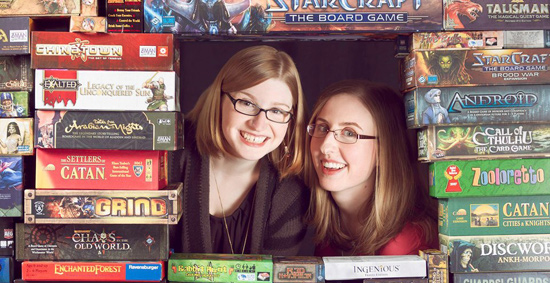
Many thanks to Laser and Aubrey for their time. Check out their website for all things Doubleclicks, and be sure to follow them on Twitter (@thedoubleclicks) and Facebook, sample their music on Bandcamp, and subscribe to their YouTube channel for videos and other treats! I cannot wait to see what they create over the coming year.

Thanks for visiting the PuzzleNation blog today! You can like us on Facebookfollow us on Twitter, cruise our boards on Pinterest, check out our Tumblr, download our puzzle apps and iBooks, play our games at PuzzleNation.com, or contact us here at the blog!

Let’s get this party (kick)started!

The newest tool in the arsenal of big thinkers and big dreamers is crowdfunding, wherein creators take their ideas directly to the people in the hopes that a lot of small donations will add up into capital to make their ideas reality.

Websites like Kickstarter and Indiegogo have literally made dreams come true, and that’s as true for puzzle entrepreneurs as anyone else. Many top-tier constructors are going straight to the fanbase with their puzzles, and with marvelous results. Constructors like Trip Payne, Eric Berlin, and Matt Gaffney have all had success on Kickstarter and Indiegogo with previous campaigns.

And I wanted to spread the world about some other puzzly endeavors that might interest the PuzzleNation readership.

There’s only a few hours left in the kickstarter campaign for musical duo the Doubleclicks.

This marvelous musical duo has not only written songs about numerous nerdy subjects — board games, Dungeons & Dragons, and dinosaurs among them — but they’re also champions of self-expression and self-confidence, especially among the geek girl community. (Their song “Nothing to Prove” served as the buoyant soundtrack of a video decrying “fake geek girl” nonsense.)

Pairs, a card game for two to eight players, was just launched yesterday by the folks at Cheapass Games. A 5-minute card game where the goal is to NOT gain points, Pairs is designed to be easy to learn and easy to play.

[Click here to check out our session of 5 Questions with Cheapass Games president and game designer James Ernest.]

Apps and online games have also gotten into crowdfunding. There’s Colorino, a color-matching strategy app that would appeal to the Candy Crush crowd, as well as Puzzle Nuts 2. A sequel to the physics-based puzzle game Puzzle Nuts, Puzzle Nuts 2 challenges players to negotiate different contraptions and figure out how to transport all of their acorns from one end of the screen to the other. Fans of Angry Birds, Cut the Rope, and other mechanical-style puzzles could find plenty to enjoy here.

A master maze designer with several successful Kickstarter campaigns under his belt has already reached his primary goal, and is now striving to reach a major stretch goal. (Stretch goals are additional finish lines that creators can make available if their initial goal is met. Stretch goals often include more puzzles, finer artwork, additional game pieces, and other details that allow for a richer play experience.)

And then there’s Steam-Donkey, a card game where you try to attract visitors to your steampunk beachside resort. With ne’er-do-wells all around, it’s a game with emphasis on art and characters with a curiously distinct flair all its own.

High Heavens is a combination board game/card game/miniatures game that places the player in a battle between the gods. Right now, creator Ryan Lesser is on his second Kickstarter campaign, an expansion that will offer new gameplay options, miniatures, and characters to the original High Heavens set. (The original High Heavens was also funded through Kickstarter contributions.)

Sweet Escape is a platformer strategy app where you try to lead walking bits of candy to safety while dealing with all sorts of obstacles and threats inside a bizarre factory.

Finally, over on indiegogo, we have PuzzleFix, a photo jigsaw puzzle game actually encourages people to submit their own photographs to become new puzzles.

The amazing thing about all of these projects is that the audience, the potential fans, have an enormous role to play in not only sharing their thoughts with game and puzzle creators, but they can show their support for designers and projects they believe in, and do so in a meaningful way.

I’ve contributed to several of these campaigns with high hopes, and I can’t wait to see how they turn out.

Thanks for visiting the PuzzleNation blog today! You can like us on Facebookfollow us on Twitter, cruise our boards on Pinterest, check out our Tumblr, download our puzzle iBooks and apps, play our games at PuzzleNation.com, or contact us here at the blog!

5 Questions with James Ernest of Cheapass Games

Welcome to another edition of PuzzleNation Blog’s interview feature, 5 Questions!

We’re reaching out to puzzle constructors, video game writers and designers, writers, filmmakers, and puzzle enthusiasts from all walks of life, talking to people who make puzzles and people who enjoy them in the hopes of exploring the puzzle community as a whole.

And I’m overjoyed to have James Ernest as our latest 5 Questions interviewee!

James Ernest represents Cheapass Games, a company with a brilliantly simple rationale: they know you have board games at home, so why jack up the price of their games by making you buy more dice, chips, or tokens? Their games contain exactly what you need to play the game, and describe precisely what you’ll need to scrounge up from other games in order to play.

As president and game designer, James is instrumental not only in maintaining the Cheapass Games legacy of great games for a fair price, but he’s also adept at utilizing Kickstarter campaigns and social media to communicate directly with the devoted board game and card game audience. In doing so, he’s helped introduce numerous hilarious and innovative games to the market, including:

  • Unexploded Cow: a card game where you try to rid the world of mad cows and unexploded ordnance.
  • U.S. Patent Number One: a game where you and your opponents build time machines and race back in time to register for the very first patent. [Glenn’s note: Currently out of print, but one of my all-time favorite board games.]
  • Veritas: a Risk-like strategy game where you try to become the predominant Truth in Dark Ages France while monasteries burn down around you. (Check out our full product review here!)

James was gracious enough to take some time out to talk to us, so without further ado, let’s get to the interview!

5 Questions for James Ernest

1.) For nearly two decades now, the Cheapass Games brand has been synonymous with affordable games with tongue-in-cheek humor and high replay value. How do you know when a game is right for your brand? What role do you play in bringing these games to market?

I’m the designer as well as the publisher for Cheapass Games, so I play nearly all the roles. I try to create products that fit into that format. When I make something that doesn’t fit the format, I often look for other ways to bring it to market, such as finding another publisher, or using a separate imprint under Cheapass Games.

For a while I used “James Ernest Games” as an imprint for my higher-priced games, though I currently release everything as Cheapass. I also used the “Hip Pocket” brand for smaller, more abstract games, and that one will be coming back next year.

2.) Many of the games in your library rely on a combination of strategy and step-by-step chain thinking, both skills most puzzle enthusiasts have in spades. Are you a puzzle fan? And what about that style of gameplay appeals to you?

The challenge in creating a strategy game is to make a puzzle with variety, so it can be replayed without getting dull. Part of that variety comes from rules that can give rise to meaningfully different game paths, and part of it comes from the interaction of players with different strategies.

As you’ve mentioned, I also like games to have stories, and that works in a similar way: the story has to be open-ended enough that it can proceed differently each time. The game is more like an environment where the players tell their own stories, rather than a way to tell a linear story. This is obvious for RPGs [roleplaying games] but I think it’s true for other games as well.

3.) You’ve created games of your own as well as helping others bring their games to life. What puzzles and board games, either in gameplay or in the experience of producing them for sale, have most influenced you?

I learned a lot about game construction from playing and working on Magic: the Gathering. A lot of my games have decks of different card types, balanced to produce the right mix of hands, based on my experience doing deck construction in Magic.

I also draw a lot of my approach to games from Pitch, which is a cutthroat trick-taking game. In a nutshell, you can choose different strategies in that game, either to play conservatively and win slowly, or to take risks and have the potential to win quickly or move backwards. Neither of those strategies is dominant and that makes the game good. Of course I also play a lot of poker, which contains similar choices.

4.) What’s next for James Ernest?

My next project is Pairs, a “New Classic Pub Game,” which I will be Kickstarting in February. After that, I have a couple of older Cheapass Games that I want to bring back into print. And I’m working on a new tabletop miniatures game called Cagway Bay, which is pirate-themed and diceless. I have a number of new game projects as well, but right now I’m not announcing any of them because I can’t be sure when they will be ready.

5.) If you could give the readers, writers, aspiring game designers, and puzzle fans in the audience one piece of advice, what would it be?

If you want to create things, there is no substitute for practice. Don’t just read about games; don’t just play them. You have to make a lot of games.

Many thanks to James for his time. You can check out the latest news from Cheapass Games on their website — including their upcoming Kickstarter campaign for the game Pairs! — or follow James on Twitter (@cheapassjames). I cannot wait to see what he and the great folks at Cheapass Games come up with next.

Thanks for visiting the PuzzleNation blog today! You can like us on Facebookfollow us on Twitter, cruise our boards on Pinterest, check out our Tumblr, download our puzzle iBooks and apps, play our games at PuzzleNation.com, or contact us here at the blog!

Going Digital

Ever since the first crossword puzzle was published on December 21st, 1913, paper and puzzles have been inextricably linked.

Or, at least, they were. But with the advent of the Internet and the evolution of electronic publishing, that link is more tenuous than ever.

“Technology and the opportunities for puzzle creators and solvers to interact with one another will change the ways crosswords are created.” — crossword constructor Robin Stears

Digital puzzle distribution is gaining momentum, and it’s a fascinating time to be part of the puzzle community as individual puzzle constructors and major publishers begin the transition into the electronic market.

Here at PuzzleNation Blog, we’re smack dab in the middle of the revolution. We’re online-only content, representing an online puzzle-game website, and we’ve made recent forays into the mobile market with our Classic Word Search iBook. Digital distribution is literally what PuzzleNation‘s about.

During our 5 Questions interview, Robin Stears had quite a bit to say about the push for downloadable content and digital distribution, and I thought the subject merited its own separate blog post.

Here, Robin champions the move to digital content:

I’m on a mission to change the way crossword puzzles are distributed. Digital collections are easier to share, more affordable for solvers, and most important, they create no physical waste.

While I agree that sometimes there’s nothing more satisfying than finishing the New York Times crossword in ink, and I’ve made a decent living selling puzzles to crossword puzzle books, thanks to Eileen Saunders at Penny Press, I do believe that digital, interactive crosswords are the future.

And she’s hardly alone in that assessment.

Many top-tier constructors are going straight to the fanbase with their puzzles, not only in distributing them, but in crowdfunding their newest puzzle projects through Kickstarter and Indiegogo. (We’ve written several posts about endeavors like these.)

Here, Robin explains the benefits of digital puzzle distribution:

Fans should be able to buy crosswords directly from their favorite constructors at a reasonable price, and be able to share them with their friends even after they’ve solved them — that’s impossible to do with crossword puzzle books, but not with digital puzzles.

From now on, every collection I self-publish will be in digital format, .puz and .pdf files that puzzle fans can solve, share or print as much as they want. Not having them printed and mailed saves me both time and money, so I can publish more puzzles more often for a lower price.

More opportunities to share puzzles will create more crossword puzzle fans, and more puzzle constructors, and that’s good for everyone.

The next few years will no doubt prove critical for the growing digital puzzle market as a whole. It’ll be interesting not only to see how the big print companies adapt, but to watch how individual constructors like Robin Stears lead the charge.

Thanks for visiting the PuzzleNation blog today! You can like us on Facebook, follow us on Twitter, check out our Classic Word Search iBook (recently featured by Apple in the Made for iBooks category!), play our games at PuzzleNation.com, or contact us here at the blog!

Let’s get this puzzle (kick)started!

The Internet has become the new frontier for innovation. The global marketplace is more open than ever, and with blogs, websites, and social media, virtually anyone with an idea can get the word out. From artists to inventors, entrepreneurs to aspiring businessmen, the Internet is as close to a level playing field as you’re ever likely to find.

The newest tool in the arsenal of big thinkers and big dreamers is crowdfunding, wherein creators take their ideas directly to the people in the hopes that a lot of small donations will add up into capital to make their ideas reality.

Websites like Kickstarter and Indiegogo have literally made dreams come true, and that’s as true for puzzle entrepreneurs as anyone else.

From a tangram game for your iPhone to the world’s biggest word search, from a X-shaped Rubik’s Cube variant to puzzly video games and short films, it seems like the puzzle community is as vocal in its support as it is generous.

And as I was browsing Kickstarter, I came across a few as-yet-unfunded projects that seemed interesting.

The first is a puzzle-based platformer game with a darkly artistic motif.

It’s called Monochroma, and it involves a pair of brothers solving numerous puzzles and overcoming obstacles as they explore a curious black-and-white cityscape. It’s heavy on atmosphere and suspense, and looks like great fun.

The second is an attempt to crowdfund a collection of cryptic crosswords made by some popular cryptic puzzlers (similar to successful efforts by Roy Leban, Trip Payne, and other puzzlers to fund their own puzzly endeavors). Cryptic crossword fans are a crafty and devoted fanbase, so I suspect this kickstarter will do well.

The third is an intriguing hybrid of books and board games, inspired by the legend of King Minos’s labyrinth from Greek mythology. Essentially, one player (or multiple players) tries to gain points and escape the maze that traverses every page of the book. Its one-and-done gameplay experience (there are no do-overs, apparently) might dissuade some donors, but the challenge could definitely entice some hardcore maze enthusiasts.

The last one is arguably the most ambitious, featuring a light-up life-size puzzle for attendees of the annual Burning Man festival.

Playuzzle is a grid of color-shifting polygons, and the challenge for players is to use strategically placed buttons and their own movements through the grid to make every polygon the same color. It’s like a life-size Q-Bert game!

With ideas as varied and interesting as these, the puzzle community can rest assured that we won’t run out of engaging puzzly challenges anytime soon.

Thanks for visiting the PuzzleNation blog today! You can like us on Facebook, follow us on Twitter, check out our Classic Word Search iBook, play our games at PuzzleNation.com, or contact us here at the blog!