
I’m a sucker for statistical analysis, especially when it comes to puzzles and games. In previous posts, I’ve looked at improved strategies for playing Guess Who, Hangman, and Monopoly.
And now, we’ve got solid data that might indicate the best method for tackling your daily Wordle solve.
Last week, as the world celebrated five years of Wordle solving, the New York Times posted an article analyzing 730 MILLION games of Wordle from the past year, and they came to an interesting conclusion:
Players in Hard Mode solve in fewer turns on average.
That seems like an contradiction in terms. Hard Mode limits letter choices and flexibility based on which letters are locked in (green), whereas Standard Mode allows you to play any letter at any time, which should offer a solving advantage.
But it doesn’t seem to, as Hard Mode solvers average more efficient solves than Standard Mode solvers.
While it’s possible this could be attributed to the pool of solvers — Hard Mode likely attracts better or more efficient solvers in general — the article theorizes that Hard Mode’s constraints push players to guess less wastefully.
This, combined with better starting-word selection — apparently vowel-heavy words like ADIEU and AUDIO are statistically less efficient! — leads to better results overall.
These are certainly helpful guidelines, but I do think an overall change in tactics can also help solvers in both Standard and Hard Mode.
The article mentions one of the dangers of Hard Mode solving, “the rhyming trap,” where you end up with most of a word in green, like _ATCH, but you’re left with all the rhyming possibilities, which could result in a worse score or even a failure to complete the day’s solve at all.
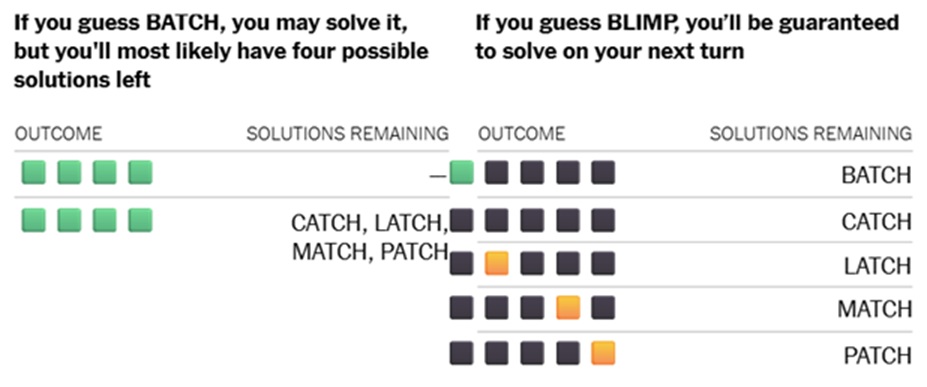
Standard Mode solvers can play a word like BLIMP, which would confirm or eliminate BATCH, LATCH, MATCH, and PATCH, covering most of the possible answers in one fell swoop.
This isn’t an option in Hard Mode, but it has led to players attacking the puzzle in reverse, trying to eliminate letters early, rather than trying to confirm letters early.
After all, if you go vowel-heavy and confirm, say, two letters, that’s two spots taken up in every single guess. But if you go one vowel at a time and burn through consonants with words like CHILD or MONTH, you whittle down the alphabet quicker. (I remember David Kwong writing about this technique in his email newsletter a while back.)
It’s interesting to have actual data to examine, even if the data seems counterintuitive at the start.
Of course, if you want the answers the fastest way possible, you could just do what I did last week and get the next day’s Wordle spoiled for you by Google AI.
Yeah.
You see, my mother solves Wordle every day and keeps track of her results on her calendar. Every word, every number of guesses. It’s her ritual and I respect that.
But on Thursday of last week, she realized she hadn’t written down the previous few days’ words and results. And we are completionists, both of us, so around 8 PM that night, I did a quick Google search of the week’s answer words to help her out.
And lo and behold, the stupid Google AI told me Friday’s word ahead of time.
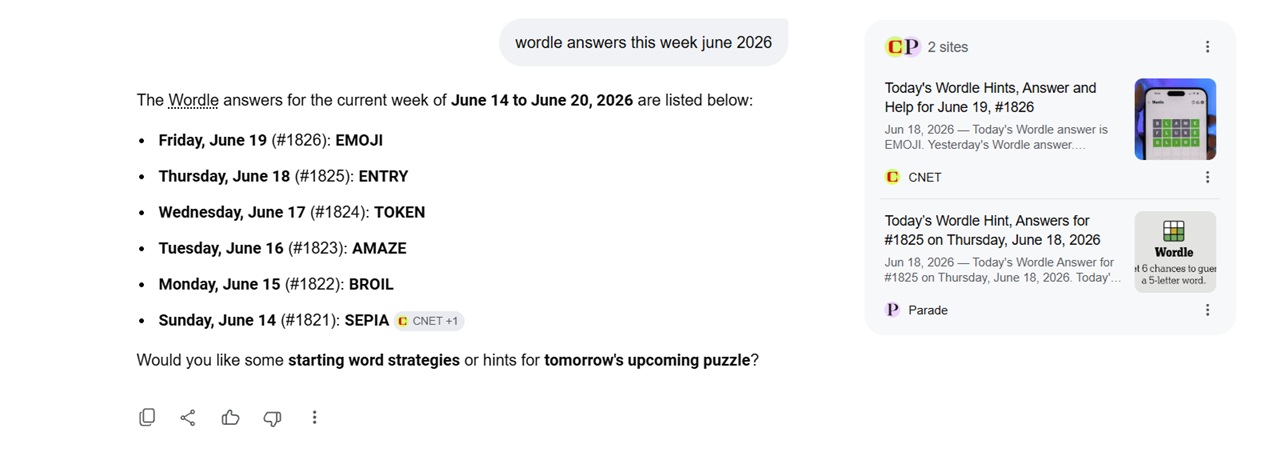
Yes, I suppose it is my fault for not typing “-AI” into the search bar. (And unfortunately, as entertaining as it is to type “shut the f*ck up bot” into the search bar and see the AI’s momentary contrition, that only lasts a few searches at most before it returns.)
But it also sucks that this was a possibility at all. I genuinely didn’t think I’d be spoiling the next day’s solve for myself with a casual search of the week’s words.
Hopefully WordleBot doesn’t figure out this trick. It’s smug enough already.
Did you learn anything from the NYT’s deep-dive into Wordle solving statistics, fellow solver, or do you already have your starting word of choice that you’ll be sticking with? Let me know in the comments section below! I’d love to hear from you.

