I prefer ink to pencil.

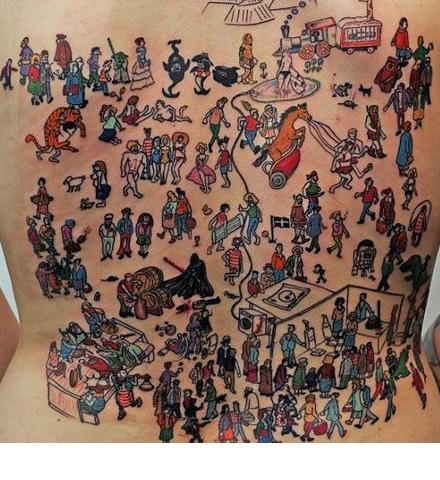
(Yes, that’s a tattoo of a Where’s Waldo? scene.)

A buddy of mine was showing off his latest tattoo the other day.

Naturally, this led to everyone in the group showing off their choicest pieces of body art.

And then other people at the coffeeshop joined in. Total strangers lifted sleeves and doffed shirts to show off their tattoos.

At one point, I was pretty sure every inked person in a 3-mile radius was there, and I was awash in butterflies and tribal patterns, cursive script and symbolic tributes to loved ones.

I was the odd man out, seeing as I have no tattoos to compare and/or flaunt, as the case may be.

I’ve got nothing against tattoos. I think they’re cool, actually, and they can be creative and artistic (and just plain badass). Obviously, many of my friends are tatted up. I just haven’t taken the plunge yet, and I don’t know that I ever will.

But I do have plenty of ideas for tattoos.

They range from the nerdy to the esoteric:

–Luke Skywalker’s severed hand, still clutching Anakin’s old lightsaber, with the words “Never Forget” underneath.

–A teddy bear with a hatch open in its belly, revealing a little green man as a pilot

–A chainsaw with the word Groovy along the chainbar

–A globe made of LEGO bricks

–Zombie Lincoln, surrounded by campaign signs

–Silhouettes of a man and woman tangoing across a crossword grid floor

And that last one got me thinking. I’ve seen plenty of tattoos honoring fandom and hobbies. From movies and TV shows to literature and music, but I don’t think I’ve ever encountered a puzzle-centric tattoo in the wild that wasn’t a jigsaw puzzle piece. (Surprisingly common, as it turns out.)

So, I did a small incantation, tossed a little salt around, and summoned a helpful imp to search the Internet for me. That imp is better known as “Google Image Search”.

And I turned up quite a few puzzle-themed tattoos! Check it out!
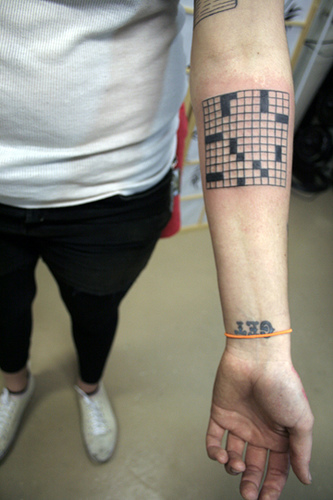
Here’s a fresh shot of an asymmetrical puzzle grid. (And it’s 12 x 12 boxes too. Definitely a personalized grid.)
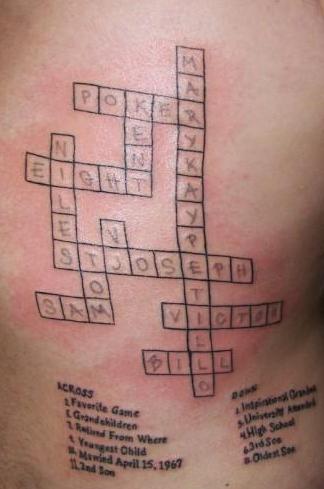
A lot of crossword-style tattoos I discovered involve answers with a personal connection: the names of children, family members, hobbies, accomplishments, etc.
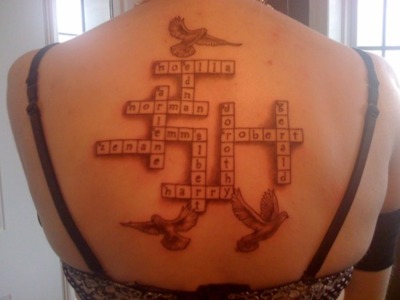
This one is a particularly lovely example of the above style.
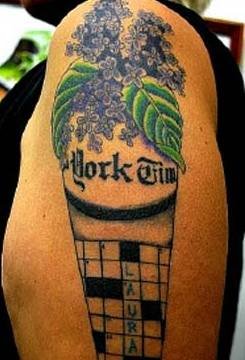
And, of course, here’s a nod to the most legendary and infamous crossword of all, The New York Times Crossword.
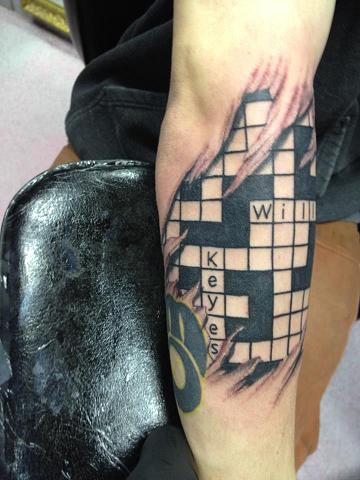
This one is probably my favorite. (Except for the Connect-the-Dots giraffe tattoo I found while searching.) I love the idea that lurking just beneath the surface is a puzzle fiend, easily recognized by all and sundry. =)
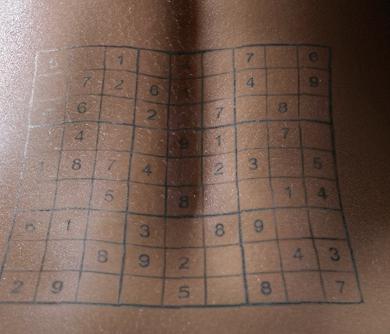
And here’s a Sudoku! Perfect for lazy days at the beach.

Why, the possibilities are endless! Maybe I could get the Diggin’ Words dogs along the inside of my forearm, or a cryptogram of a favorite Mark Twain quote along my calf! Or the PuzzleNation logo on my forehead! It’s free advertising!

…

Yeah, it’s probably best that I remain tattooless for now. But in the meantime, I can keep calm and puzzle on, and I suggest you do the same. Until next time…
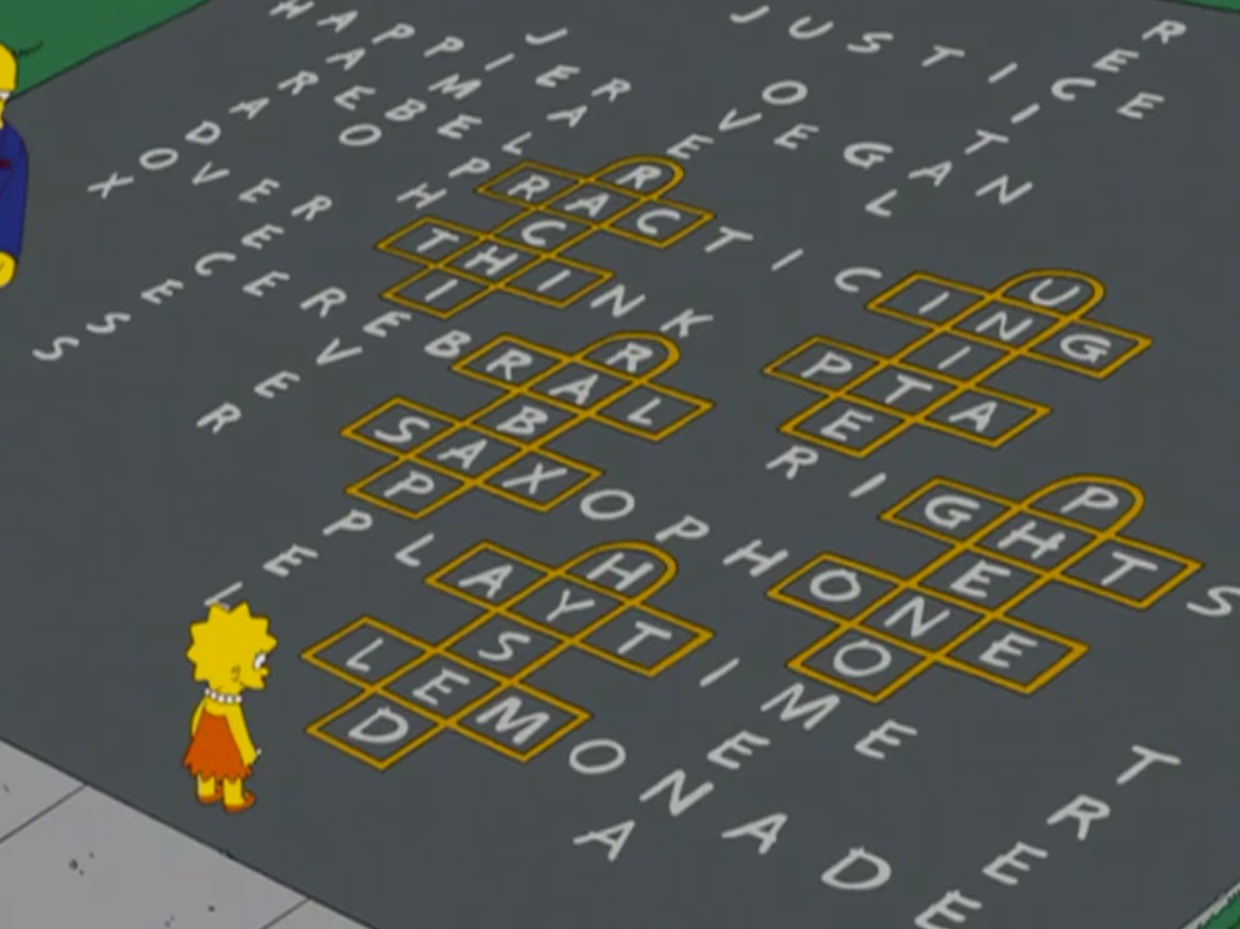
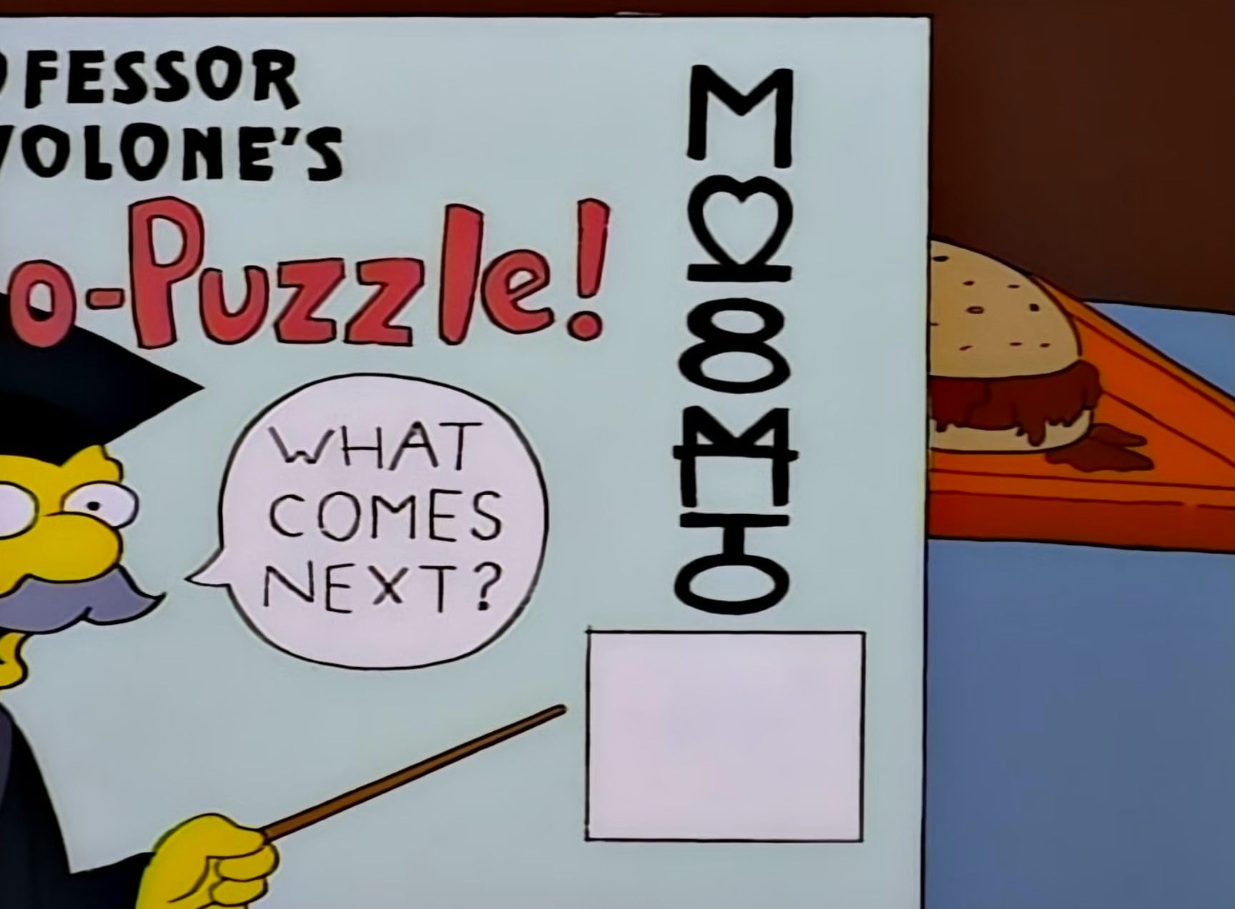
Puzzles in Pop Culture: The Simpsons

From Stanley’s love of crosswords on The Office to the clever conundrums constantly conjured by the Riddler in various iterations of Batman, puzzles have played roles both big and small in numerous TV shows and films.

But for my money, few shows have made puzzles the centerpiece of storyline development and family interaction quite like The Simpsons.

The first episode that comes to mind — and my personal favorite — is season 9’s Lisa the Simpson.

In the episode, Lisa is stumped by a brain teaser and begins to worry about her intelligence, a concern that is only exacerbated by Grandpa’s revelation of the Simpson Gene, a genetic quirk that caused Homer and Bart’s descent from academic achievement to hilarious idiocy.

In the end, of course, Lisa discovers she’ll be just fine — the defective gene is on the Y chromosome, so only male Simpsons are afflicted — and she conquers the brain teaser.

Puzzly themes would continue to crop up in the show from time to time.

For instance, Homer discovers a secret acrostic message from his mother in the newspaper in season 15’s My Mother the Carjacker. But most of the puzzle-centric goodness centered around Lisa.

She indulged in palindromic fun with fellow Mensa members in season 10’s They Saved Lisa’s Brain, as well as an anagramming game in the season 6 classic Lisa’s Rival.

(That’s when I first learned that Alec Guinness anagrams into Genuine Class.)

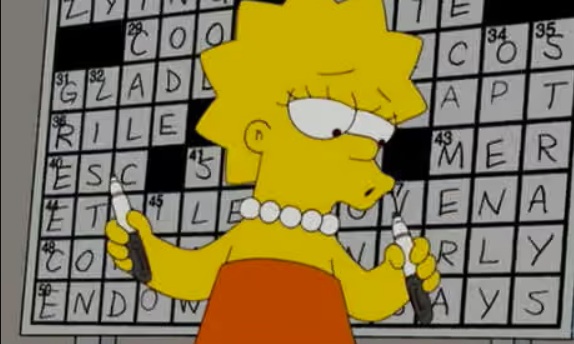
But puzzles wouldn’t again take center stage until season 20’s episode Homer and Lisa Exchange Cross Words.

In the episode, Lisa quickly becomes a crossword fiend, solving all the puzzles she can and eventually entering the Crossword City Tournament.

Trouble brews when Homer bets against her in the championship round, and their relationship fractures.

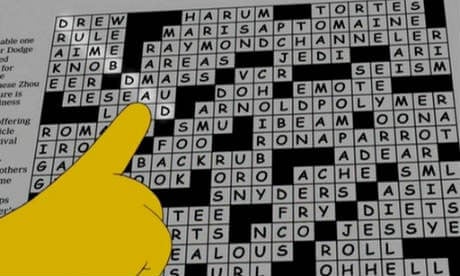
This was a real watershed moment in synergy for the show, since they somehow managed to convince The New York Times to publish the same puzzle in the paper that Homer uses to apologize to Lisa.

(You can click here to see the full puzzle.)

Homer’s hidden message runs along the diagonal, and it’s a brilliantly unobtrusive trick. I’m sure some solvers never even noticed the tie-in. (The puzzle didn’t reference The Simpsons or the episode in any other way.)

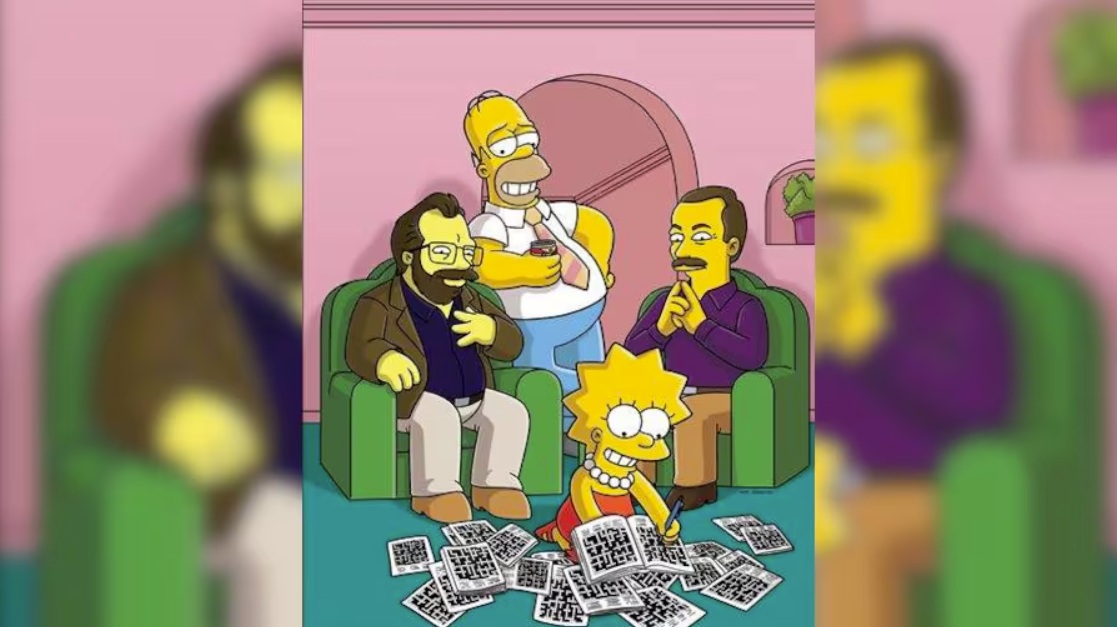
Puzzlemaster Merl Reagle created the puzzle, and Will Shortz oversaw the project. Both also appeared in the episode. (Reagle also created the word crossings for the hopscotch puzzle pictured above.)

It’s a real treat to see puzzles incorporated into a narrative like this. Instead of a time-killer or a mere passing interest, they become linchpins of each story. The puzzles create conflict, drive epiphanies, and bring people together.

It’s a testament to the power of puzzles in pop culture. Plus, they’re just a buttload of fun.

Hope you enjoyed this little (animated) trip down memory lane. Until next time, keep calm, puzzle on, and I’ll catch you again soon.

The Nerd Potluck Looms Large!

Aloha, fellow puzzlers and solvers galore!

Last week, I mentioned that I’d be attending a Nerd Potluck this coming weekend. It’s a celebration of all things puzzle, game, and nerd-centric, and I’ve been working on a new word puzzle to challenge my fellow attendees.

And as promised, you’re getting the first peek at it. I call the puzzle “Word Personals.”

Word Personals is based on the singular parlance of personal ads and dating slang.

Your standard personal ad looks something like this:

SWM, 31, brown hair, brown eyes, calf muscles of a Roman gladiator, enjoys full contact rock-paper-scissors and the films of Ben Stiller…

The breakdown is pretty simple.

–SWM is short for single white male in standard personal ad jargon. SWF would be single white female. (SBF would be single black female, MWM would be married white male, etc.)
–That’s followed by the person’s age and a brief description.

So my idea was to employ this format, but make the ads themselves word puzzles to be decoded by a solver.

Here’s an example:

SWF, 6, one letter once, one letter twice, and one letter three times, enjoys hanging out and giving people the slip.

Again, the breakdown is pretty simple.

–SW stands for “single word.” (If it was “MW,” it would be “multiple words,” indicating a phrase.)
–The next letter, F, stands for “features,” indicating that characteristics of the word will follow. (If it was “M,” it would be “means,” indicating a definition, synonym, or hint toward the definition would follow.)
–The number that follows is the number of letters in the word or phrase.
–Finally, there’s the description, which is in two parts. The first part, as indicated by “F,” gives some characteristics of the word. The second part is a jokey clue to provide further information.

And there you have it, Word Personals. I’m sure you’ve solved the example one already, so how about we check out a few more?

1) SWM, 8, power or vigor, enjoys vowel conservation and Herculean qualities.

2) MWF, 11, can read backwards and forwards, enjoys formal greetings and the days before holidays.

3) SWF, 4, goes from one syllable to three by adding a letter, enjoys taking car trips in the past tense.

4) MWM, 9, stutter-stop way of talking, enjoys frequent breaks and a certain British inspector.

I admit, It’s a bit esoteric, but I like the concept quite a bit, and I think it’ll be a hit.

Naturally, your thoughts are welcome. What’s confusing? What works? Is it too prone to alternates? Too easy? Too difficult? Your input would be very much appreciated.

In the meantime, I hope Word Personals provided you with a bit of brain-teasing today. So keep calm, puzzle on, and I’ll catch you next time. Wish me luck!

Warming up for a Nerd Potluck

Greetings, fellow puzzlers and enigma enthusiasts!

I’m attending a Nerd Potluck next weekend, and I could use your input.

Now, for the uninitiated, a Nerd Potluck is a party where everyone brings something suitably nerdy. It could be a game, a puzzle, a brain teaser, or something else that fits the nerd party aesthetic.

This is a natural extension of other parties my friends and I used to throw. We’re all gamers, RPG fans, and puzzle nerds.

No matter what the occasion — birthday, homecoming, reunion, Thursday — I can’t remember a party that didn’t include a few rounds of Mafia or a spirited game of the trivia/Truth-or-Dare hybrid my friend Dan invented, Who Wants to Eat a Millionnaire?

Last time we threw a Nerd Potluck, my contribution was a handful of Politos, jokey off-kilter summaries of movie plots.

(I based the idea on the writings of Rick Polito, a writer for the Marin Independent Journal in California, who is known for his sharp single-sentence summaries of films.)

Example: Transported to a surreal landscape, a young girl kills the first person she meets and then teams up with three strangers to kill again.

Answer: The Wizard of Oz

How great is that?! The answer is very. Very great.

So, I opted to come up with some of my own to challenge my fellow puzzle-loving movie buff pals. Here’s a sampling of them:

–A suicidal man has an intense hallucinatory psychotic episode, then is saved by a timely family-organized intervention.

–The minds and opinions of a group of prisoners are gradually changed by a charismatic knife-wielding stranger.

–An improperly supervised gang of miscreants, when left to their own devices, commit acts of trespassing, property damage, assault, consort with known criminals and pillage historical artifacts for their own gain.

–A group of friends scatters and licks their wounds after bullies wreck their secret snow fort.

(Feel free to leave guesses in the comments section. I’ll follow Eric’s example, and ask you for one answer per person. I’ll post the answers in the comment section later!)

It was a fairly popular exercise in outside-the-box thinking, but it feels a bit “been-there, done-that.”

This time around, I’m working on something new, more brain teaserish than anything else.

It’s not quite ready; I’m still ironing out a few kinks stylewise. (If I have the chance, I’ll post it here next week, a few days before the Nerd Potluck. I’m sure your input would be helpful.)

But a ladyfriend of mine will be attending, and she has a different challenge in mind.

She wants to make a puzzle-themed dessert.

Naturally, I suggested strawberry shortzcake, but she was considering tiramisudoku. (I know, a puzzle fan with a sweet tooth. She’s awesome.)

So, any suggestions for puzzly dishes? Cryptograham crackers could be fun, but who wants to do all that writing in icing?

Oh well, if not, no worries. I’m sure she’ll come up with something. (Hopefully I will too!)

But in the meantime, thanks for reading. Keep calm and puzzle on, gentle readers!

For when you get bored playing the expert level of Sudoku.

Do you find your average Super-Challenging God-Level Expert Platinum Blond mode of Sudoku too easy?  Now you can prove it!

A pair of computer scientists from the  Babes-Bolyai University (Romania) and the University of Notre Dame (USA) have made some remarkable connections between Sudoku, the classic k-SAT problem, and the even more classic non-linear continuous dynamics.

Using these connections they’ve been able to come up with a “Richter Scale” to objectively determine the difficulty of a Sudoku puzzle.

So when you encounter a puzzle labelled hard and you find it easy all you need to do is to compute its η, a co-efficient that measures the hardness of the problem.

Simple as that! Now you can have both the challenge (or lack-thereof) of the Sudoku game plus figuring out just how badly the editors mischaracterized its difficulty level!

I’m off to try and figure out how well our Classic Sudoku difficulty ratings stack up….

Source: The Chaos Within Sudoku – A Richter Scale