Puzzles in Pop Culture: The Simpsons (revisited!)

In previous editions of Puzzles in Pop Culture, I’ve recapped a classic episode of M*A*S*H and delved into the rich puzzling history of MacGyver.

Today, however, I’m returning to the ever-giving well of puzzly goodness provided by that unstoppable animated juggernaut, The Simpsons.

In an earlier blog post, I discussed the show’s hilarious ventures in the worlds of brain-teasers and crosswords, but I neglected one shining example of puzzleriffic fun in Season 20 episode “Gone Maggie Gone.” (Oddly enough, the same season that featured “Homer and Lisa Exchange Cross Words.”)

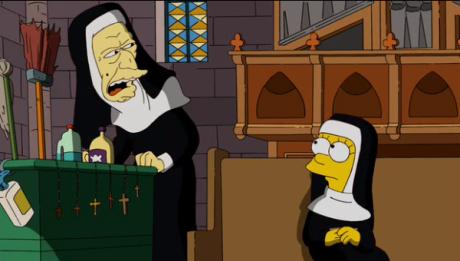
In an episode that playfully melds elements of Gone Baby Gone, Ratatouille, and The Goonies, while delightfully skewering National Treasure and The Da Vinci Code, Homer accidentally leaves Maggie on the doorstep of a convent. When the nuns take her in and Homer can’t retrieve her, Lisa infiltrates the convent, discovering a series of elaborate puzzles that may lead to both Maggie and a jewel hidden in Springfield.

The puzzles take center stage early in this episode, as Homer encounters his own version of the cabbage, wolf, and goat river-crossing puzzle — in this case, featuring Maggie, Santa’s Little Helper, and a colorful bottle of rat poison. (His attempt to solve this puzzle is how Maggie ends up in the convent in the first place.)

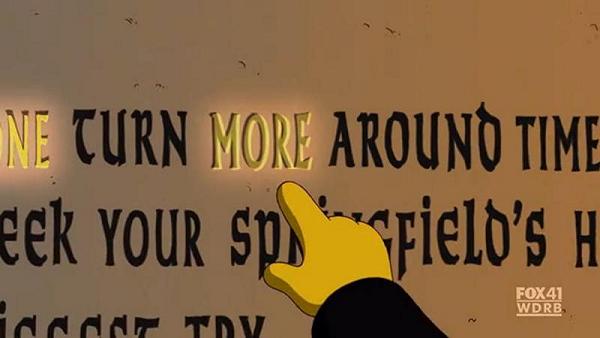
Lisa’s first clue is to “seek God with heart and soul,” which leads her to play “Heart and Soul” on the church organ. After a ridiculously overelaborate Rube Goldberg device opens up, the next clue tells her to seek the biggest man-made ring in Springfield.
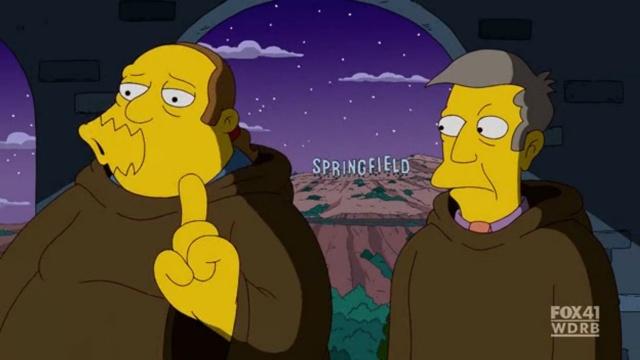
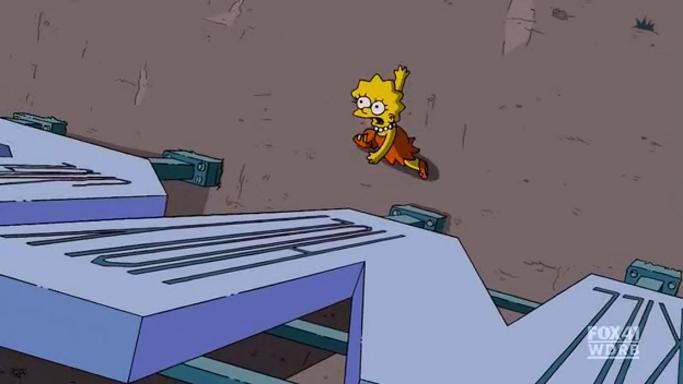
After a red herring and a stop for some goofy exposition from amateur puzzle-solvers Comic Book Guy and Principal Skinner, Lisa deduces that the biggest ring in Springfield is, in fact, the word RING in the Hollywood-esque Springfield Sign in the hills, and the adventurous trio sets off.
Hidden on the giant letters of the Springfield Sign is the message “Great crimes kill holy sage,” which Lisa dutifully anagrams into the message “Regally, the rock gem is Lisa.” Naturally, she does so just in time for Mr. Burns (the requisite shadowy Freemason figure) to emerge and take everyone back to the convent.
When she arrives, the nuns tell her Maggie is in fact the gem they’ve been seeking, and they re-anagram the message to read, “It’s really Maggie, Sherlock.” A pretty impressive feat of wordplay, I’d say.

(Naturally, Marge enters the scene here and sets everyone to rights by taking Maggie home. Bart sits on the throne of the gem child just vacated by Maggie, and ends up transforming the world into a nightmarish hellscape, as you’d expect.)

With elements of logic puzzles, brain-teasers, and anagram goodness, this episode is a treat for puzzlers of all ages, plus it’s hysterical to boot. The Simpsons excels at not simply including puzzles in their stories, but making the puzzles the linchpin of the story, something to drive the characters to learn and grow and challenge themselves.

While this episode was a little goofier and a little less heartfelt than “Homer and Lisa Exchange Cross Words,” it remains a worthwhile entry in the Puzzles in Pop Culture library.

How about some efficient German puzzles?

A friend of mine passed me a copy of a German puzzle book, and I thought it would neat to share some overseas puzzle fun with my fellow puzzle fiends.

Now, I have to admit that I’m slightly biased here. German is my favorite language that I don’t speak — how could it not be with words like “backpfeifengesicht,” meaning “a face deserving of a good hard smack.” — and I simply love that you can jam together words in order to form new words for any and all occasions. It’s a marvelously adaptable language.

You might be familiar with the word “weltschmerz,” which means a sort of sentimental pessimism or melancholy over the state of the world. It translates from the German for “world pain.”

But when you add the prefix paleo- to the word, you get paleoweltschmerz, the theory that the dinosaurs became extinct through sheer boredom with the world.

Yup, it wasn’t a meteor, it was ennui. How great is that?

Anyway, let’s get to the puzzles! [Click each puzzle pic for a larger version!]

Here we have German versions of a Codeword puzzle and a Framework. It’s a little jarring to see recognizable words like MAXIMUM and MOHAIR amidst so many unfamiliar ones.

Here’s another Codeword and a logic puzzle. (As a side note, I would totally watch a movie entitled Das Logical.)

This German word seek is awesome, if only for the incredibly long words being accommodated. I don’t think I’ll ever manage to get “Ypsilonwachtel” into a word seek grid.

We’ve got an interesting symbolic math puzzle, and another Framework, plus what appears to be a deduction puzzle with repeated letters. (A deduction puzzle with EXTRA SCHWER, by the way. Which is terrific, as there’s been a shortage of SCHWER around here for a few weeks now.)

If I can obtain more international puzzles, maybe this could be a running series of posts, making PuzzleNation a little more PuzzleInternational. =)

Da Vinci’s got nothing on these codes.

Cryptograms and similar coded puzzles have been a mainstay of newspapers and puzzle books for decades now, and it’s not hard to see why. Codebreaking has been a puzzler’s playground for centuries.

Back in November, the skeleton of a carrier pigeon from World War II was found, along with a coded message the dearly departed bird had been ferrying somewhere.

One of Britain’s national intelligence agencies declared that the message couldn’t be decoded without access to the original material responsible for the code.

What puzzler could resist a challenge like that?

A Canadian puzzle fiend, Gordon Young, with the help of his great-uncle’s World War I codebook, cracked the code in 17 minutes.

Now, of course, wartime codecracking stories are common, given the importance of reliable communication and strategy during combat and operations. Most people are familiar with terms like the ENIGMA machine or one-time pads.

(Codebreaking and cryptography were considered so crucial to the war effort that Agatha Christie was investigated for her novel N or M?, which featured a character named Major Bletchley, a name that made the government nervous, considering that their major codebreaking center was Bletchley Park.)

But wartime was hardly the only opportunity for codecracking to yield great results.

Among the many storied cases of San Francisco detective Isaiah Lees — a man considered one of the real-life rivals to Sherlock Holmes in terms of detection — there’s another curious case of codebreaking.

A bank robber had been arrested, and his coded journal came into Lees’ possession. When Lees cracked the code, he got much more than he bargained for.

The bank robber was no mere thief. He was William Fredericks, a man who’d killed a Nevada sheriff and provided the weapons for a Folsom prison jailbreak. It’s only due to Lees’ diligence that the murderer was duly punished for his crimes.

But the highlights of codebreaking history are hardly relegated to the past. Plenty of young puzzlers have been given the chance to flex their mental mettle in Britain, thanks to the National Cipher Challenge.

Tasked with decrypting a series of cryptic codes, thousands of students had two months to best everything from simple letter-shifting codes (known as Caesar cyphers) to much more complicated codes involving anagramming, letter-shifting, and other obfuscation techniques.

Aimed at attracting young people to math and computer science, the National Cipher Challenge is just one more example of how puzzle skills are helping pave the way to the future.

Notes:

For more info on the National Cipher Challenge, check out their website.

For more on the curious crossing of Bletchley Park and Agatha Christie, check out this terrific article on the Daily Mail.

For more on codes and codebreaking in general, I highly recommend Secret Language: Codes, Tricks, Spies, Thieves, and Symbols by Barry J. Blake.

There’s a method to my puzzly madness.

Pattern-finding is not merely a staple of one’s puzzle-solving repertoire, it’s a fundamental part of innumerable scientific, mathematical, and sociological discoveries.

From the Golden Mean and the Pythagorean Theorem to the Platonic solids and instances of symmetry throughout nature, our ability to discern patterns from the chaos all around us has helped to define the rules governing our universe.

Those a-ha! moments come in all shapes and sizes, from discovering previously unknown planets (by observing inconsistencies in established patterns) to the simple joy of puzzling out whether the five-letter word meaning “kingly” that starts with R and ends with L is “REGAL” or “ROYAL”.

This combination of keen observation and associative thinking is key to solving a lot of puzzles and brain-teasers.

For instance, consider the following numerical progression:

49 50 53 54 ___ 58 61 62 65

Pretty simple, right? Just add 1, then add 3, and repeat, making 57 the missing entry in the chain.

How about this one?

J F M A M J J…

What comes next?

While this one isn’t as straightforward as the numerical one above, the same parts of the brain are lighting up as you assess the possibilities, toss aside those that don’t fit, and conclude that these can only be the months of the year, and A, for August, would come next.

And here’s one that combines aspects of our previous examples, which I mentioned in a blog post last year:

In this zero-to-ten puzzle, place the missing numbers.

8 5 4 _ _ 7 _ 10 3 2 0

Now, if you started with mathematical patterns, you’d be stymied pretty quickly. -3, -1, blanks, -7, -1, -2. Nothing jumps out at you.

Then the associative brain kicks in, and you look beyond the numbers. What could they represent? Letters? Syllables?

And then the sheer simplicity of alphabetical order hits you like a freight train full of Scrabble tiles, and you instantly know where to place nine, one, and six.

Of course, there’s a flipside to such intuitive leaps. It’s called apophenia.

Apophenia is the spontaneous perception of connections and meaningfulness of unrelated phenomena.

This is the sort of thinking that fuels conspiracy theories and false positives in scientific data, assigning causality to coincidence.

One step beyond apophenia, you have pareidolia, a psychological term for the mind’s obsession with finding patterns in essentially random objects. When people see a face on the surface of Mars due to shadow and geography, or they see the Virgin Mary in the burn marks on a grilled cheese sandwich, that’s pareidolia at work.

It’s all part and parcel of being a pattern-finder. Some patterns reveal the underpinnings of the universe, others just reveal you’ve been staring at a tile floor a little too long. =)

Oh, and before I go, here’s one more numerical progression for the road. Enjoy!

242 121 123 41 ___ 11 15 3 8

A day for puzzles and games galore!

Aloha, friends and fellow puzzle fiends! Just a quick reminder that tomorrow (March 30th) is International TableTop Day!

For the uninitiated, International TableTop Day is the brainchild of Internet superstars and gaming devotees Wil Wheaton and Felicia Day, a day devoted to board games, card games, dice games, roleplaying games (RPGs), and any other communal game-playing activity played on a table or any convenient flat surface.

(And with so many puzzle-based games out there, from Boggle and Scrabble to Jenga and Hex, I think it definitely merits mention here on the PuzzleNation blog.)

While the term “TableTop” was originally coined to differentiate one style of gaming or roleplaying from another. TableToppers were your Magic card-carrying, dice-rolling, character sheet-wielding gamers, as opposed to those who played video games or engaged in Live-Acting Roleplaying (LARPing).

Obviously, the definition has since expanded to include many other types of games, so long as you play with others around a table.

As not only a self-confessed puzzlin’ fool, but a devoted player of Dungeons & Dragons and other RPGs, I’m happy to tell you that some of my all-time favorite puzzles have come from my experiences as a roleplayer.

I remember being trapped in a dungeon in my friend’s game, and there was this elaborate machine that would open the door with flowing water if you could direct the water properly. You did so by way of numerous levers located in various rooms around the dungeon. And as a bare-bones adventuring party, we didn’t have anything with which to draw a map of the labyrinthine corridors, so I basically had to memorize the route in my head, figure out what each of the levers did, then run around the dungeon pulling them in the precise order necessary to unlock the door.

It was mindbending and frustrating and a terrific time. That’s the kind of puzzle-gaming experience I’d love to share with others.

Since Easter is this Sunday and I’ll already be spending time with my nephews this weekend, I’m hoping to introduce them to some of my favorite board games and puzzle games. I’ll definitely be bringing my two-player version of Brick by Brick with me.

A variation on the classic Tangram-style of piece-moving puzzle solving, Brick By Brick puzzles offer a shadowed shape you need to form with irregularly shaped bricks. You can play by yourself or go head-to-head with an opponent, or even team up and use both sets of bricks to solve even tougher shadow puzzles. It’s great fun and a terrific brain-teaser.

I’m hoping it’ll be the gateway drug to other puzzle games as they get older, since they’re a little too young for some of my favorites. (Like U.S. Patent Number 1, the game where you’ve built a time machine, and so have your opponents, and you race to soup them up and travel back in time to register for the very first patent. It’s a blast.)

Oh, and Older Sister? Beware, I’m also bringing Upwords, a marvelous variation on Scrabble where you can place letters on top of other letters in order to form new words. You’re going down, sis!

Of course, in the midst of all this TableToppy goodness, I’ll be bending the rules a bit, since I also plan on sharing the spirit of International TableTop Day by playing some two-player PuzzleNation games with friends abroad. Hey, it’s much harder to gather around the table with an ocean between you.

In any case, I hope you indulge your puzzle fancy tomorrow with some communal puzzle-game goodness. Have a fantastic holiday!

I’m gonna need a stepladder.

Plenty of places claim they offer large crosswords for the truly devoted solver, but nobody holds a candle to the Ukraine, whose citizens crafted this 100-foot-tall monument to puzzling.

Located in the city of Lviv (Lvov, to Russian speakers), the puzzle is an art installation perfectly designed to keep visitors thoroughly challenged. The clues are scattered on landmarks throughout the city, further encouraging both tourism and brain-boosting.

The puzzle appears incomplete during the day, but at night, special lighting reveals the answers in fluorescent paint.

I can only hope this will inspire other communities to raise the stakes even higher. Crop crosswords that can only be solved with Google Maps! Landscaping sudoku hedges complete with topiary set numbers! Cowboy-style word searches where you actually lasso words on cattle!

Okay, maybe not that last one. But hey! At least I’m trying! The artists of Lviv have set the bar — not to mention the grid — pretty darn high.