PuzzleNation Book Review: Tic Tac Tome

Welcome to the tenth installment of PuzzleNation Book Reviews!

All of the books discussed and/or reviewed in PNBR articles are either directly or indirectly related to the world of puzzling, and hopefully you’ll find something to tickle your literary fancy in this entry or the entries to come.

Let’s get started!

Our book review this time around features an interactive challenge, as we match wits with Willy Yonkers’ Tic Tac Tome: The Book That Will Beat You at Tic Tac Toe.

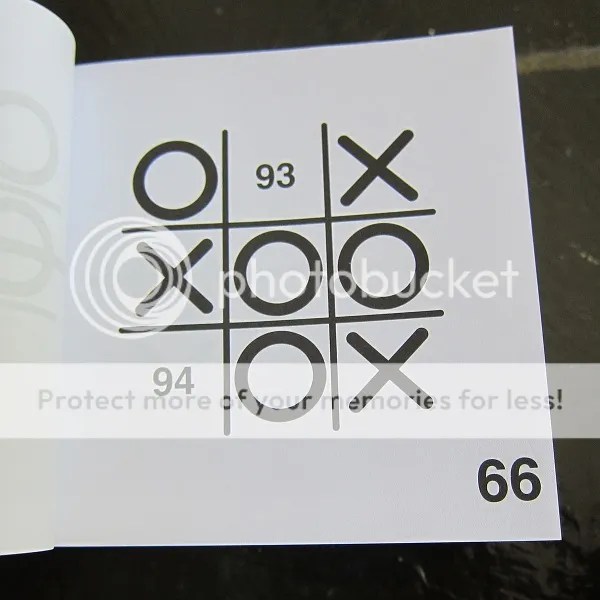
Plenty of books can make you feel stupid, but it’s far more rare for a book to actually defeat the reader in one-on-one combat. Tic Tac Tome pits the player against the endless permutations of Tic-Tac-Toe, challenging you to avoid losses and draws and seek out the lone path that means victory against the diabolical book.

Playing is pretty simple. You choose where to place your X and turn to the page number indicated. On that page you’ll see your mark, as well as the book’s countering move. You then select your next move, and turn to that page number. And repeat until you’ve won, lost, or reached a draw.

[Both pictures courtesy of Winkbooks.net.]

This is an immensely clever idea, especially since the book offers you the chance to either go first or take the much more challenging route of letting the book make the crucial first move. (The richly smug and snarky introductory section, ostensibly written by the book itself as it taunts the reader, only adds to the charm.)

Unfortunately, I did encounter at least one error in the book (two pages had been misassigned or swapped), so be aware: there could be more errors lurking within the fourteen-hundred-plus pages of the book.

That being said, I enjoyed sparring with Tic Tac Tome, and I suspect most puzzle fans and Tic-Tac-Toe enthusiasts would also enjoy. This is prime coffee table book material.

[To check out all of our PuzzleNation Book Review posts, click here!]

Thanks for visiting PuzzleNation Blog today! You can share your pictures with us on Instagram, friend us on Facebook, check us out on TwitterPinterest, and Tumblr, and be sure to check out the growing library of PuzzleNation apps and games!

Puzzles in Pop Culture: Die Hard With a Vengeance

die-hard-with-a-vengeance-original

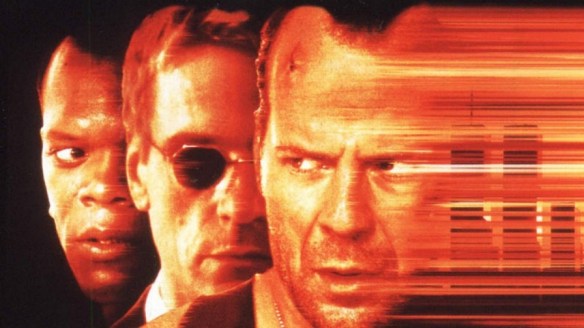
It’s summer, and when it comes to Hollywood, summer means big blockbuster action movies. One of my favorites is the Bruce Willis / Samuel L. Jackson modern classic Die Hard With a Vengeance.

For those who are unfamiliar with the film — shame on you! — it’s the third installment of the Die Hard franchise, featuring catchphrase-spouting New York City cop John McClane battling terrorists, criminals, and all sorts of unsavory characters.

In Die Hard With a Vengeance, a bomber named Simon is terrorizing the city and McClane is one of his playthings, forced to play Simon Says and accomplish increasingly difficult tasks that Simon sets before him. As McClane (and electrician Zeus Carver, who saves McClane from the first of Simon’s games) race around the city trying to prevent other bombs from going off, Simon enacts an elaborate scheme to rob the city.

Thankfully, McClane and Zeus have a knack for brain teasers and riddles, because several of Simon’s devious tasks require quick thinking and sharp puzzle skills.

diehardwithavengeance1

[One of the last movies to feature payphones as a key plot point…]

First, Simon hits them with a math problem:

As I was going to St. Ives, I met a man with seven wives. Each wife had seven sacks, every sack had seven cats, every cat had seven kittens. Kittens, cats, sacks, wives. How many were going to St. Ives?

As McClane fervently tries to do multiplication in his head, Zeus realizes this isn’t a word problem, it’s a riddle. The man was going to St. Ives when he met this man, meaning the man was coming from St. Ives. So the wives, sacks, cats, and kittens are irrelevant. Only the narrator is going to St. Ives, so the answer to the riddle is 1.

stives-1886892

[Seems like a nice place to take your many wives…]

In their second puzzly task, Simon offers the following question:

“What has four legs and always ready to travel?”

McClane doesn’t get it, but Zeus immediately identifies it as an elephant joke for kids (although he doesn’t actually deliver the punchline: an elephant, because it has four legs and a trunk).

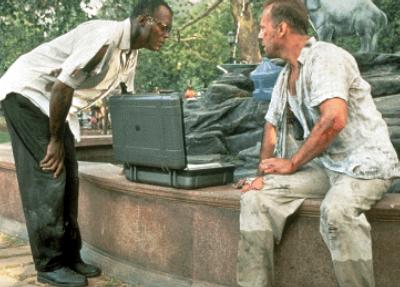
They quickly spot a nearby fountain with an elephant statue. Awaiting them is a suitcase bomb and two empty jugs. When McClane opens the suitcase, he accidentally arms the bomb, and Simon calls to inform them that the only way to disarm the bomb is to fill one of the jugs with exactly four gallons of water and place it on the scale in the suitcase.

die-hard-vengeance-laptop

[And they say what we learn in school has no practical, real-world applications…]

The problem is the two jugs hold 3 gallons and 5 gallons, respectively. Simon has set them up with another brain teaser, but one with a dire time limit to solve.

Thankfully, there are two ways to solve this brain teaser.

Method #1

  • Fill the 3-gallon jug and pour the water into the 5-gallon jug.
  • Refill the 3-gallon jug and pour the water into the 5-gallon jug until the 5-gallon jug is full, leaving 1 gallon in the 3-gallon jug.
  • Empty the 5-gallon jug and pour the 1 gallon of water from the 3-gallon jug into the 5-gallon jug.
  • Fill the 3-gallon jug again and empty it into the 5-gallon jug, leaving exactly 4 gallons in the 5-gallon jug.

Method #2

  • Fill the 5-gallon jug and pour that water into the 3-gallon jug until the 3-gallon jug is full, leaving 2 gallons in the 5-gallon jug.
  • Empty the 3-gallon jug and pour the 2 gallons of water from 5-gallon jug into the 3-gallon jug.
  • Refill the 5-gallon jug and pour that water into the 3-gallon jug until the 3-gallon jug is full, leaving 4 gallons in the 5-gallon jug.

Either way, you’ve disarmed the bomb. Good job!

140-billion-die-hard

[While Simon has McClane and Zeus run
all over the city, he has one specific goal…]

The final riddle Simon gives Zeus and McClane is another brain teaser masquerading as a math problem:

“What is 21 out of 42?”

At the time of the film’s release, there had been 42 presidents, so 21 out of 42 was President Chester A. Arthur, and Chester A. Arthur Elementary School was where Simon had hidden one of his bombs (a fake one, as it turns out) as a distraction.

In the end, McClane and Zeus outwit the cunning Simon, and once again, puzzle-solving skills save the day! Hooray!

Thanks for visiting PuzzleNation Blog today! You can share your pictures with us on Instagram, friend us on Facebook, check us out on TwitterPinterest, and Tumblr, and be sure to check out our library of PuzzleNation apps and games!

It’s Follow-Up Friday: Treasure Room edition!

Welcome to Follow-Up Friday!

For those new to PuzzleNation Blog, Follow-Up Friday is a chance for us to revisit the subjects of previous posts and update the PuzzleNation audience on how these projects are doing and what these people have been up to in the meantime.

And today, I’d like to return to the subject of treasure hunts.

A treasure hunt (and its sibling, the scavenger hunt) are terrific puzzle events, because they can combine crafty trivia, questions, and deduction with some good old-fashioned physical activity as you chase down the next clue. (Sometimes, they even involve some digging, if your huntmaster is crafty enough.)

And the parents of one very lucky four-year-old are topnotch huntmasters.

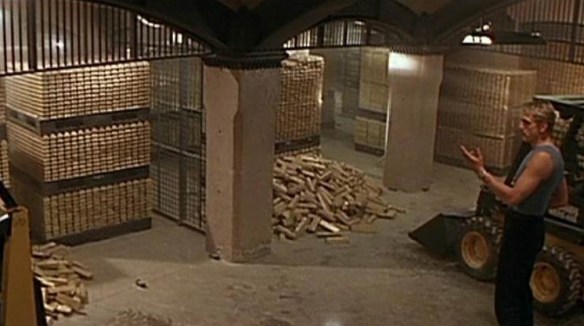
Not only did they organize a treasure hunt for their son, complete with clues to unravel, but the final clue led to his bedroom, instructing him to push aside his dresser.

Behind the dresser, he discovered his birthday gift: a hidden treasure room, all for him!

As it turns out, when the birthday boy was almost two years old, he and his parents moved into a new house. The room intended for him had a small storage room attached, and in a fit of brilliance, his parents not only had the room refurbished, but they kept the room a secret for TWO YEARS before revealing it as his birthday gift for turning four.

Now that is some world-class puzzly skill being put to a wonderful use.

[This story originally appeared on Sarah Goer’s blog Things I Make, and I discovered a repost of the story on IO9.com. All pictures of the treasure room courtesy of Things I Make.]

Thanks for visiting PuzzleNation Blog today! You can share your pictures with us on Instagram, friend us on Facebook, check us out on TwitterPinterest, and Tumblr, and be sure to check out our library of PuzzleNation apps and games!

(More Than) 5 Questions: Lollapuzzoola edition!

Welcome to a very special edition of 5 Questions!

Usually, 5 Questions is simply that: five individual questions answered by our guest. But this time around, we’ve ditched the 5 Q format in lieu of a more relaxed, conversational interview. I hope you enjoy!


Last weekend marked the seventh edition of Lollapuzzoola, a crossword puzzle tournament held in New York City and hosted by people who love puzzles for people who love puzzles.

The brainchild of Ryan Hecht and Brian Cimmet, Lollapuzzoola has quickly become a beloved yearly tradition for top constructors and solvers, and I’m pleased to announce that friend of the blog and Crossword Goddess Patti Varol won the Locals division this year!

Patti is Puzzle Editor for The Uptown Puzzle Club and Acquisitions Editor for both Uptown and The Crosswords Club, as well as Assistant Editor for the Los Angeles Times Crossword.

Patti was gracious enough to take some time out to talk about her experience at Lollapuzzoola, so without further ado, let’s get to it in a very special edition of 5 Questions!


Tell us a little about Lollapuzzoola.

My favorite description of LPZ is from the organizers: it’s the best tournament held in New York on a Saturday in August.

How does it differ from the American Crossword Puzzle Tournament?

It’s much more casual and laid-back, smaller, 150ish competitors versus 600ish.

All crosswords?

All crosswords. There’s usually a theme to the day — last year was birds (… I think) and this year it was baseball. There’s a meta puzzle that everyone solves to pass the time between the last puzzle and the Finals.

How many times have you participated?

This is my second year.

What do you look forward to most when heading into the tournament?

Now? Winning!

I’m kidding. I talk to crossword people all day long, but it’s always over IM or email. It’s great to see them in person.

[Tournament directors and pro puzzlers
Patrick Blindauer and Brian Cimmet]

And the crosswords at LPZ are fantastic — the clues are clever and current, the themes are fun and tricky. There is usually one puzzle with an off-the-page gimmick.

Last year there was a very fun puzzle with picture clues. This year there was one with audio clues (for the theme entries, not the whole puzzle).

How do they determine which three solvers in each division go into the final solve?

Ugh, math.

There are two divisions. Express and Local. If you’re in Express, you’re one of the solving gods – you’re in the top 20% at ACPT. Local is everyone else, the mere mortals who happen to be pretty good at crosswords.

[Glenn’s note: There is also a Rookie division, a Pairs division (where you solve with a partner) and an At-Home division, where anyone can purchase the puzzles for a very reasonable $10 and compete from the comfort of home.]

Scoring is a reflection of speed and accuracy. The scoring is way simpler at LPZ than it is at ACPT, but it’s still math, so…

The way they [Brian Cimmet and Patrick Blindauer] write it all up, you really get a sense of how playful the whole event is. They are there to have fun, and so the day is lots of fun for everyone. They are relaxed and we are relaxed… unless we have to stand on tiptoe in front of 200 people.

Oh, and you’re allowed to cheat.

You’re allowed to cheat?

They have a system with Google tickets. Once the allowed puzzle time reaches the halfway point, you can write a clue number on the back of a Google ticket, and signal to a judge. The judge comes over and writes the correct answer on your ticket. 25 points are deducted from your score, and you forfeit the 100-point perfect puzzle bonus.

But the penalty for multiple wrong letters can be worse than -25 for the ticket. I used 2 of them on puzzle 4, and I still had 6 letters wrong! That puzzle was a beast.

[Some of the trophies awarded at Lollapuzzoola 6 last year.]

So, can you take us through what it’s like to solve the final puzzle?

After everyone has solved the first five puzzles, the standings are announced and the top three in each division go into the final puzzle, which is solved on whiteboards in front of all the solvers.

When Brian Cimmet called my name for second place of the Local division, I was stunned. And then it turned out that the first place person really belonged in the Express division, so I was bumped up to first place.

They took us into this room in the back so they could set up the grids and distribute the puzzles to the crowd. Sara [Nies, ranked 47th overall, but a finalist in the Local division], Simon [McAndrews, 48th overall], and I were a blur of nervous, giggly energy, but Francis [Heaney], Jon [Delfin], and Scott [Weiss], the Express gods, were all chill.

They bring us out, and there were two immediate problems: I couldn’t get the noise-canceling headphones to stay on my head – they were too big and I was shaking so hard from nerves. And then I couldn’t really reach the top line of the dry-erase board. I was a nervous, shaking, flustered mess. We were all joking about finding me a phone book or a dictionary for me to stand on, but they couldn’t find one, and they had me test it out – I could reach, barely, on my tiptoes.

[Several solvers tackling the final puzzle
at a previous Lollapuzzoola event.]

I was on the far right of the stage. I could see Simon, but not Sara. I was shaking so hard at first that I couldn’t read the clues on the paper. And the board seemed so big and the puzzle seemed to be in German… I closed my eyes, took a deep breath, and didn’t throw up on my shoes. I started solving in the lower right corner, because it was right in front of my face. Ultimately, I solved from the bottom up.

Simon finished solving first, and once he stepped away from the stage, I calmed down – I knew I couldn’t win, so I just wanted a clean grid. I slowed down, I read more carefully, I started to enjoy the puzzle. I was sure Sara had finished already, too. I finished the puzzle and started checking the grid, line by line, very carefully, and then I took a step back … and saw Sara was still solving! I turned around and took off my headset as quickly as I could, and there was this huge collective sigh of relief – Sara had only two letters left when I turned around.

My friends were on the edges of their seats, telling me to stop checking the grid and turn around. I finished a good 20 seconds ahead of her, but officially, it’s only 3 seconds because I took so damn long to check the grid. Doug [Peterson, crossword gentleman] told me later that he had been trying to get Brian and Patrick’s attention because they hadn’t noticed I was done – they were busy reviewing Simon’s grid.

Heartbreak for Simon, who finished more than a minute before me: he left a square blank and placed 3rd. But as soon as I finished, Simon thumbsed-up to me and whispered, “It’s you!” because of his wrong letter. Big smile, really gracious.

And, it turns out – had Erin [Milligan-Milburn, who has a cheating trophy named for her after winning Rookie of the Year when she wasn’t a rookie] and Angela [Halsted, Locals finalist last year] remained in the Local division, it would have been an all-girls Local final! And I still would have been in first place going into the finals. How cool is that?

And I got the greatest trophy.

And a gift card to Barnes and Noble, and a puzzle book. A bunch of us agreed it would have been funnier if a dude got the bikini-clad musclewoman trophy… but I’m not giving it back.

(It didn’t sink in that I’d actually won until Oscar, Brian’s two-year-old son, handed me the musclewoman.)

After everything was over, I asked Doug, “How did this happen?” And Doug, laconic as ever, shrugged and said, “You’re good at crosswords?”

So you’ll be back next year to defend your title?

If I understand correctly, I will be in the Express division next year. But I will be there. And they just announced the date — Lollapuzzoola 8 will be on 8/8.

What advice would you give a first-time Lollapuzzoola-er?

Solve puzzles. Have fun. Stay for pizza.


Many thanks to Patti for her time and insight into the Lollapuzzoola experience. You can check out her work at The Uptown Puzzle Club, The Crosswords Club, and the Los Angeles Times Crossword. Can’t wait to see what she cooks up next.

Thanks for visiting PuzzleNation Blog today! You can share your pictures with us on Instagram, friend us on Facebook, check us out on TwitterPinterest, and Tumblr, and be sure to check out the growing library of PuzzleNation apps and games!

George Washington: Commander in Chief (and Codes)

George Washington was the first American president, the Father of Our Country, a general, a farmer, and an inventor. He invigorated and empowered the role of the president far beyond what the Framers of the Constitution originally envisioned, and is widely regarded as the standard against which all presidents are measured.

But did you know he also created America’s first spy ring?

The story is fascinating, and you get the full scoop in Brian Kilmeade and Don Yeager’s book George Washington’s Secret Six: The Spy Ring That Saved the American Revolution.

As the Revolutionary War raged on and America struggled to rout the British forces, Washington realized that British spycraft was heavily responsible for American losses. Determined to even the playing field, Washington marshalled trusted associates to form America’s first spy ring, known as the Culper Ring.

Originally, Washington and his agents employed code names and a few numerical substitutions for words in their messages. The two key agents, Benjamin Tallmadge and Abraham Woodhull, were designated Culper Junior and Culper Senior, respectively, while a still-unidentified female agent is known only as Agent 355. (355 was Tallmadge’s code for “lady.”)

10 stood for New York and 20 for Setauket, so that the recipient would know the source of the information contained in the reports. Two additional numbers, 30 and 40, were used to designate Jonas Hawkins and Austin Roe as post riders delivering the messages to their next destination.

But after two close calls with key agents and information endangered by the British, they followed the French model and developed a more elaborate code system.

Making a list from 1 to 763, he [Benjamin Tallmadge] … assigned each pertinent word, location, or name a numerical code. He became 721, Woodhull as Culper Senior 722, Townsend as Culper Junior 723, Roe 724, and Brewster 725. General Washington was 711 and his British counterpart, General Clinton, was 712. Numbers were often represented by letters, so that the year “1779,” for example, might read as “ennq.”

Could you decipher this message, a rudimentary version of the code eventually used by the Culper Ring?

[In this example of Tallmadge’s ever-evolving code,
“Setauket” went from “20” in the earlier code to “729.”]

They delivered their coded messages through some tried-and-true spying methods, including employing invisible ink and disguising vital communiques as bland family letters. And the Culper Ring had some stunning victories to its credit, including rooting out Benedict Arnold’s traitorous plot to hand over West Point to the British.

[An example of the more elaborate, French-inspired code system
employed later in the war by Washington and the Culper Ring.]

The Culper Ring even saved American aspiring cryptographers one heck of a headache. There was a standing order for agents to “learn as many of the British navy’s code signals as possible, so that the French fleet could decipher what the enemy ships were communicating to one another during naval engagements.”

As you might imagine, even skilled codebreakers would’ve had a nearly impossible time memorizing the codes AND deciphering them in the midst of battle. Thankfully, the Culper Ring obtained a copy of the entire British Naval Codebook, not only saving the eyes and sanity of numerous Americans, but delivering Yorktown to American Revolutionary forces.

In fact, British intelligence agent Major George Beckwith commented, “Washington did not really outfight the British, he simply outspied us!”

And he used some puzzly cryptography skills to do it.

Thanks for visiting PuzzleNation Blog today! You can share your pictures with us on Instagram, friend us on Facebook, check us out on TwitterPinterest, and Tumblr, and be sure to check out the growing library of PuzzleNation apps and games!

It’s Follow-Up Friday: Parking Lot edition!

Welcome to Follow-Up Friday!

For those new to PuzzleNation Blog, Follow-Up Friday is a chance for us to revisit the subjects of previous posts and update the PuzzleNation audience on how these projects are doing and what these people have been up to in the meantime.

And today, in the spirit of yesterday’s post about The Riddler, I’d like to post a brain teaser for you to solve!

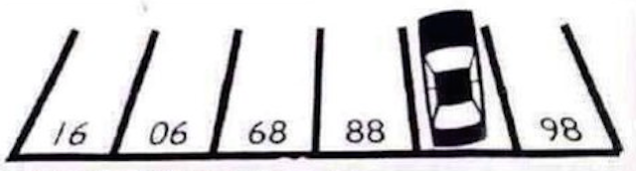
Can you explain the numbering system in this parking lot?

Also, do you have any favorite riddles or brain teasers? Let us know and we might feature them in a future post!

Thanks for visiting PuzzleNation Blog today! You can share your pictures with us on Instagram, friend us on Facebook, check us out on TwitterPinterest, and Tumblr, and be sure to check out the growing library of PuzzleNation apps and games!