Hidden in a crossword!

[A grid from BeekeeperLabs.com.]

Everyone loves a little something extra, and that goes double for puzzle fans.

Whether it’s a hidden quote or a secret theme lurking in plain sight, a bonus answer revealed after a tough solve or a final twist that wows you with a constructor’s cleverness and skill, these little surprises are gifts every solver can appreciate.

In Sunday’s New York Times Crossword, what appears at first blush to be a simple themed puzzle — with poet WILLIAM CARLOS WILLIAMS paired with his poem THE LOCUST TREE IN FLOWER — turns out to be much more, as the entire poem is concealed within the grid!

[Image sourced from Amy Reynaldo’s Diary of a Crossword Fiend.]

While this is a particularly ambitious example, this is not an uncommon challenge for a constructor to tackle.

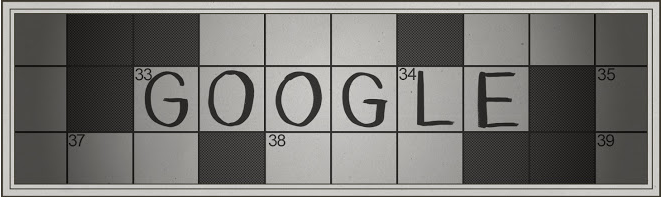
Sometimes, the bonus is announced upfront, as it was in Merl Reagle’s puzzle for the 100th anniversary of the crossword a few years ago. His puzzle was converted into a solvable Google Doodle, and Merl added a crafty word search element by hiding the word FUN multiple times in the grid.

Why “fun,” you ask? Because that was the set word in Arthur Wynne’s original “word-cross” puzzle over one hundred years ago!

[Click here if you haven’t tackled Merl’s marvelous puzzle.]

Our friends at Penny/Dell Puzzles have a recurring crossword variant, Revelation, which conceals a quotation in a standard crossword grid, using the same letters-in-circles technique as Jacob Stulberg did in his poem puzzle.

And, of course, I would be remiss in my duties if I didn’t mention the secret message reading out in both a New York Times crossword and a puzzle featured on The Simpsons, wherein Homer conceals an apology to Lisa inside a crossword with the help of Will Shortz.

[Check out the full puzzle by clicking here.]

So, crossword fans, be vigilant! You never know what hidden treats are lurking inside seemingly innocuous puzzles.

Thanks for visiting PuzzleNation Blog today! You can share your pictures with us on Instagram, friend us on Facebook, check us out on TwitterPinterest, and Tumblr, and be sure to check out the growing library of PuzzleNation apps and games!

Happy Mother’s Day!

Today is Mother’s Day, and as always, I’d like to celebrate with a puzzle! So, in honor of the day and mother’s everywhere, I’ve conjured up a Penny/Dell Puzzles-style Unscramblers puzzle for you!

Rearrange the pairs of letters in the left-hand column to form the names of 12 TV sitcom moms. Then match them with their TV shows in the right-hand column!

Enjoy! And Happy Mother’s Day to all the marvelous, wonderful, inspiring, hard-working moms out there!

Thanks for visiting PuzzleNation Blog today! You can share your pictures with us on Instagram, friend us on Facebook, check us out on TwitterPinterest, and Tumblr, and be sure to check out the growing library of PuzzleNation apps and games!

It’s Follow-Up Friday: More Apps edition!

Welcome to Follow-Up Friday!

By this time, you know the drill. Follow-Up Friday is a chance for us to revisit the subjects of previous posts and bring the PuzzleNation audience up to speed on all things puzzly.

And I’d like to return to the subject of puzzle apps!

On Tuesday, I announced the release of two new puzzle sets for the Penny Dell Crosswords app.

What I didn’t tell you is that today, we’ve got even more new puzzle content for you, as we launch Penny Dell Crosswords Jumbo 2!

Available for iPad, iPhone, and iPod Touch, Penny Dell Crosswords Jumbo 2 offers all the quality crossword solving you’ve come to expect from PuzzleNation.

You’ve got 150 puzzles (ranging from Easy to Medium to Hard), all with our alternate clue feature, Smart Step navigation, and more!

You can check out all the details by clicking here!

But wait, there’s more! On Sunday, in honor of Mother’s Day, PuzzleNation Blog will be offering a free puzzle for everyone to enjoy! Be sure to check your PuzzleNation feeds this weekend to partake in some Mom-celebratory puzzling!

Thanks for visiting PuzzleNation Blog today! You can share your pictures with us on Instagram, friend us on Facebook, check us out on TwitterPinterest, and Tumblr, and be sure to check out the growing library of PuzzleNation apps and games!

“Outside the Box” Brain Teaser Solving!

Over the past few months, we’ve focused on logic puzzles quite a bit. Whether we’re figuring out Cheryl’s birthday, determining the weights of island castaways with a seesaw, or puzzling out which members of the starship Enterprise crew are fierce Fizzbin players, we’ve been fixating on deduction as a key puzzle-solving skill.

But outside-the-box thinking can be just as valuable when it comes to puzzling, especially when brain teasers are involved.

If there are ten birds on a telephone wire and you shoot one, how many are left?

At first glance, the answer is nine. But if you think beyond the mechanics of the question and into the real world consequences, you’ll realize the real answer is zero, because the other nine birds would take off when they heard the gunshot.
Let’s apply this kind of thinking to a mathematical brain teaser that reportedly baffled 96% of America’s top math students.

I can already sense eyes glazing over at the prospect of applying formulas and delving into high-end mathematics, but trust me: a little outside-the-box thinking will simplify this puzzle immensely.
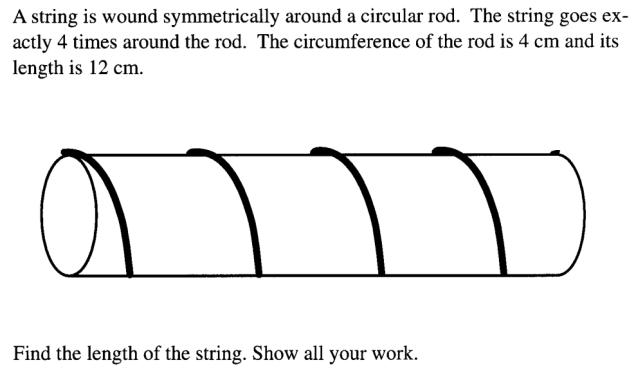
Now, remember that the string is wound symmetrically around the rod. That’s key to this. When you look at the rod, the distance from the string to the next loop of the string is the same. So each loop is 3 centimeters.

How does this help us? Well, we know the circumference of the rod is 4 centimeters. Between these two pieces of information, we can ignore the rod entirely and mentally flatten it out into a rectangle.

Now we’re not dealing with a rod and a string, we’re dealing with four diagonal lines. And with one of the best known mathematical principles — the Pythagorean theorem — we can determine the length of one of those lines.

We’ll treat the diagonal as the longest side of a right triangle. The rod has a circumference of 4 centimeters, which means the triangle has a length of 4 centimeters. Each loop has a width of 3 centimeters, which means the triangle has a width of 3 centimeters. And the Pythagorean theorem — A squared + B squared = C squared, meaning 4 squared + 3 squared = our diagonal squared — gives us 16 + 9 = our diagonal squared. So 25 = our diagonal squared, which means 5 = our diagonal.

And since that diagonal appears four times, since our string wraps around the rod four times, our total length of string is 20 centimeters.

Okay, yes, that was a lot of math, but it would have been much MORE math had we not thought outside-the-box and tackled it from a different angle.

Now, I realize that I tend to pass myself off as a topnotch puzzler and brain-teaser specialist, but there have been plenty of times in the past when a brain teaser has bested me because I wasn’t thinking outside the box.

Here’s one that stumped me recently.

You have a set of 3 light switches. One of them controls a light in a room upstairs. You can turn the light switches on or off as many times as you like.

You can go upstairs — one time only — to see the light. You cannot see the whether the light is on or off from downstairs, nor can you change the light switches while upstairs.

No one else is in the room to help you.

Based on the information above, how would you determine which of the three light switches controls the light inside the room?

Let me give you a minute to think about this one.

Okay, did you get it?

Now, the key here is maximizing the amount of information you can get from that single trip upstairs to observe the light. And it takes thinking outside-the-box to do that.

Here’s what you do:

Flip the first switch, and leave it on for a few minutes. Then shut it off, and flip the second switch. Leaving the second switch flipped, head upstairs.

Now, visually, there are two possible outcomes: either the light is on or it’s off. If the light is on, you know the second switch controls the light.

If the light is off, however, there are still two possibilities. In this problem, it’s easy to fixate on information from your eyes, but the solve depends on another sense.

Remember how we flipped the first switch and left it on for a while? Well, if the first switch controls the light, we’ll be able to feel residual warmth from the light being on if we touch the light. If the third switch controls the light, the light will still be cool.

And there you go: one trip upstairs, one answer.


So, now that we’ve handed deduction puzzles and outside-the-box stumpers, you should be ready to tackle any riddles and brain teasers you encounter!

Thanks for visiting PuzzleNation Blog today! You can share your pictures with us on Instagram, friend us on Facebook, check us out on TwitterPinterest, and Tumblr, and be sure to check out the growing library of PuzzleNation apps and games!

Penny Dell Crosswords App updates for you and yours!

It’s always exciting to announce an addition to our ever-expanding library of puzzle apps, so you can imagine how stoked I am to present two new puzzle sets for the Penny Dell Crosswords App!

Available for in-app purchase right now, Collection 6 offers 150 puzzles to challenge you! And just in time to honor Mom, our Mother’s Day Deluxe Set offers 35 puzzles sure to test your puzzly mettle!

Not only that, but we’re debuting a new feature for the app itself, as requested by many of our users.

With the Hide Completed Puzzles feature, any magazines you’ve conquered will no longer display in your puzzle library, making it easier to sort and organize your app purchases! (Don’t worry, a single click will unhide them if you wish!)

We’re constantly striving to make our apps better, more engaging, and easier to use, and our latest edition of the Penny Dell Crosswords App is our best yet! Click here to explore our entire library of Crossword content, and as always, details on ALL of our app content can be found on the PuzzleNation homepage!

Thanks for visiting PuzzleNation Blog today! You can share your pictures with us on Instagram, friend us on Facebook, and check us out on TwitterPinterest, and Tumblr!

It’s Follow-Up Friday: Rapid Rubik edition!

Welcome to Follow-Up Friday!

By this time, you know the drill. Follow-Up Friday is a chance for us to revisit the subjects of previous posts and bring the PuzzleNation audience up to speed on all things puzzly.

And I’d like to return to the subject of twisty puzzles.

Obviously the most famous twisty puzzle of all time is the Rubik’s Cube. It’s one of the most recognizable puzzles in the world, and there are entire tournaments dedicated to speed-solving those signature cubes.

As you may recall, I’ve written about Rubik’s Cube world records before, but you’ve never seen a solve like this. Collin Burns set a new world record for speed-solving a 3×3 Rubik’s Cube.

His solve was so fast that he could’ve solved a dozen Rubik’s Cubes or more in the time it’s taken you to read this far. Check it out!

[youtube https://www.youtube.com/watch?v=huh4GEPKYt4]

Collin’s solve took 5.253 seconds, shattering the previous record of 5.55 seconds. Absolutely mind-blowing.

I wonder if Erno Rubik had any idea his eponymous cubes would’ve inspired something like this.

Thanks for visiting PuzzleNation Blog today! You can share your pictures with us on Instagram, friend us on Facebook, check us out on TwitterPinterest, and Tumblr, and be sure to check out the growing library of PuzzleNation apps and games!