Cracking the GCHQ Christmas Card!

As you may recall, my fellow puzzlers and PuzzleNationers, a few months ago, a government organization in England called the GCHQ — Government Communications Headquarters — released a puzzly Christmas card designed to tax even the savviest puzzle solvers.

They’ve finally released the answers to this mind-blowing series of puzzles, and I’d like to go over some of them with you. Partly to marvel at the puzzle wizardry necessary to solve this challenging holiday gift, and partly to gloat about the parts I managed to solve.

So let’s get to it!


Part 1 was a logic art puzzle where you have to deduce where to place black squares on an open grid in order to form a picture.

Each column and row has a series of numbers in it. These numbers represent runs of black squares in a row, so a 1 means there’s one black square followed by a blank square on either side and a 7 means 7 black squares together with a blank square on either side.

This is mostly a deduction puzzle — figuring out how to place all the strings of black squares with white spaces between them within the space allotted — but no image immediately emerged, which was frustrating. Once the three corner squares started to form though, I realized the answer was a QR code, and the puzzle started to come together nicely.


Part 2 was a series of six multiple-choice brain teasers. I’ll give you the first three questions, along with answers.

Q1. Which of these is not the odd one out?

A. STARLET
B. SONNET
C. SAFFRON
D. SHALLOT
E. TORRENT
F. SUGGEST

Now, if you stare at a list of words long enough, you can form your own patterns easily. Here’s the rationale the GCHQ used to eliminate the odd ones out:

STARLET is an odd one out because it does not contain a double letter.
SONNET is an odd one out because it has 6 letters rather than 7.
SAFFRON is an odd one out because it ends in N rather than T.
TORRENT is an odd one out because it starts with T rather than S.
SUGGEST is an odd one out because it is a verb rather than a noun.

SHALLOT is our answer.

Q2. What comes after GREEN, RED, BROWN, RED, BLUE, -, YELLOW, PINK?
A. RED
B. YELLOW
C. GREEN
D. BROWN
E. BLUE
F. PINK

After playing around with some associative patterns for a while, I realized that somehow these colors must equate to numbers. First I tried word lengths, but 5-3-5-3-4-___-6-4 didn’t make any sense to me. But then, it hit me: another time where colors and numbers mix.

Pool balls. Of course, the colors and numbers didn’t match, because this is a British puzzle, and they don’t play pool, they play snooker.

So the colored balls in snooker become the numbers 3, 1, 4, 1, 5, -, 2, 6. The numbers of Pi. And now the blank makes sense, because Pi reads 3.1415926, and there’s no 9 ball in snooker.

So the next number in the chain is 5, and 5 is the color BLUE.

Q3. Which is the odd one out?
A. MATURE
B. LOVE
C. WILDE
D. BUCKET
E. BECKHAM
F. SHAKA

This one came pretty quickly to me, as the names Oscar Wilde and Charlie Bucket leapt out. And if you follow the phonetic alphabet, you also get Victor Mature, Romeo Beckham, and Shaka Zulu. (I didn’t get Mike Love, however.)

Since Shaka Zulu was the only one where the phonetic alphabet word was the surname, not the first name, SHAKA is the odd one out.

(The other three questions included an encryption puzzle, a number pattern (or progressions puzzle), and a single-letter puzzle.)

Granted, since you could retake this part as many times as you wanted, you could luck your way through or brute force the game by trying every permutation. But managing to solve most of them made this part go much faster.


Part 3 consisted of word puzzles, and was easily my favorite section, because it played to some strengths of mine.

A. Complete the sequence:

Buck, Cod, Dahlia, Rook, Cuckoo, Rail, Haddock, ?

This sequence is a palindrome, so the missing word is CUB.

B. Sum:

pest + √(unfixed – riots) = ?

This one is a little more involved. To complete the formula, you need to figure out what numbers the words represent. And each word is an anagram of a French number. Which gives you:

sept + √(dix-neuf – trois) = ?

Dix-neuf is nineteen and trois is three, so that’s sixteen beneath a square root sign, which equals four. And sept (seven) plus four is eleven.

The French word for eleven is onze, and ZONE is the only anagram word that fits.

C. Samuel says: if agony is the opposite of denial, and witty is the opposite of tepid, then what is the opposite of smart?

This is a terrific brain teaser, because at first blush, it reads like nonsense, until suddenly it clicks. Samuel is Samuel Morse, so you need to use Morse Code to solve this one. I translated “agony” and tried reversing the pattern of dots and dashes, but that didn’t work.

As it turns out, you need to swap the dots and dashes, and that’s what makes “denial” read out. This also worked with “witty” and “tepid,” so when I tried it with “smart,” the opposite was OFTEN.

D. The answers to the following cryptic crossword clues are all words of the same length. We have provided the first four clues only. What is the seventh and last answer?

1. Withdraw as sailors hold festive sing-song
2. It receives a worker and returns a queen
3. Try and sing medley of violin parts
4. Fit for capture
5.
6.
7. ?

Now, I’m not a strong cryptic crossword solver, so this part took FOREVER. Let’s work through it one clue at a time.

1. Withdraw as sailors hold festive sing-song

The word WASSAIL both reads out in “withdraw as sailors hold” and means “festive sing-song.”

2. It receives a worker and returns a queen

The word ANTENNA both “receives” and is formed by “a worker” (ANT) and “returns a queen” (ANNE, reading backward).

3. Try and sing medley of violin parts

The word STRINGY is both an anagram of “try” and “sing” and a violin part (STRING).

4. Fit for capture

The word SEIZURE means both “fit” and “capture.”

Those four answers read out like this:

WASSAIL
ANTENNA
STRINGY
SEIZURE

And with three more answers to go, it seemed only natural that three more seven-letter answers were forthcoming. Plus, when you read the words spelling out downward, you notice that the first four letters of WASSAIL, ANTENNA, STRINGY, and SEIZURE were spelling out.

If you follow that thought, you end up with the start of a 7×7 word square:

 WASSAIL
ANTENNA
STRINGY
SEIZURE
ANNU___
INGR___
LAYE___

And the only seven-letter word starting with INGR that I could think of was INGRATE.

WASSAIL
ANTENNA
STRINGY
SEIZURE
ANNU_A_
INGRATE
LAYE_E_

And if the last word is LAYERED…

WASSAIL
ANTENNA
STRINGY
SEIZURE
ANNU_AR
INGRATE
LAYERED

Then the missing word must be ANNULAR. The original question asked for the last word though, so our answer is LAYERED.


This brings us to Part 4, Number Puzzles, where I must confess that I finally tapped out, because I could only figure out the first of the three progressions involved.

Fill in the missing numbers.

A. 2, 4, 8, 1, 3, 6, 18, 26, ?, 12, 24, 49, 89, 134, 378, 656, 117, 224, 548, 1456, 2912, 4934, 8868, 1771, 3543, …

B. -101250000, -1728000, -4900, 360, 675, 200, ?, …

C. 321, 444, 675, 680, 370, 268, 949, 206, 851, ?, …

In the first one, you’re simply multiplying by 2 as you go.

2, 4, 8, 16, 32, 64, 128, 256, 512, 1024, 2048, 4096, 8192, 16384, 32768, 65536, 131072, 262144, and so on.

But you begin to exclude every other number as you move into double-digits, triple-digits, quadruple-digits, and beyond.

2, 4, 8, 16, 32, 64, 128, 256, 512, 1024, 2048, 4096, 8192, 16384, 32768, 65536, 131072, 262144, and so on.

So the answer, 512, becomes the real answer, 52.

But, as I said, I couldn’t crack the other two, and I’m already exhausted just running through these four sections!

And, based on the answers they released recently, Part 5 only got more mindbending from there.

As a matter of fact, not a single entrant managed to get every answer in Part 5 correct. Prizes were awarded to the three people who came closest however, and it turns out a staggering 30,000+ people made it to Part 5. Color me impressed!

This was, without a doubt, the most challenging puzzle suite I have ever seen, and I offer heartfelt kudos to anyone in the PuzzleNation Blog readership who even attempted it!

You’re welcome to try it out for yourself, though. I highly recommend using this link from The Telegraph, which allows you to skip to the next part if you get stumped.


Thanks for visiting PuzzleNation Blog today! Be sure to sign up for our newsletter to stay up-to-date on everything PuzzleNation!

You can also share your pictures with us on Instagram, friend us on Facebook, check us out on Twitter, Pinterest, and Tumblr, and explore the always-expanding library of PuzzleNation apps and games on our website!

It’s Follow-Up Friday: Rubik’s Explosion edition!

Welcome to Follow-Up Friday!

By this time, you know the drill. Follow-Up Friday is a chance for us to revisit the subjects of previous posts and bring the PuzzleNation audience up to speed on all things puzzly.

And I’d like to return to the subject of twisty puzzles.

I’ve written before about the 3-D printing revolution and its effect on puzzling; now creators can customize puzzles like never before, designing mind-blowing puzzles and games unlike anything you’ve seen before.

And twisty puzzles like the Rubik’s Cube are a favorite of many 3-D puzzle designers.

You may remember last year when I wrote about the world’s largest Rubik’s-style puzzle, a 17x17x17 twisty puzzle known as the “Over the Top” Rubik’s Cube, created by Oskar van Deventer.

Well, Oskar’s masterpiece has been one-upped by the folks at Coren Puzzle, who have created a 22x22x22 Rubik’s-style cube!

Composed of 2,691 individual 3-D printed pieces, they’ve had some difficulty bringing their new puzzle to fruition, as you’ll see in the video below, posted a few months ago:

Yes, the first attempt to assemble this monstrous puzzle literally exploded in their hands. (Twice!) But they persevered, and now, please feast your eyes on the new record holder:

And here I sit, having never solved an actual Rubik’s Cube. This one might be a bit too much for me.


Thanks for visiting PuzzleNation Blog today! Be sure to sign up for our newsletter to stay up-to-date on everything PuzzleNation!

You can also share your pictures with us on Instagram, friend us on Facebook, check us out on Twitter, Pinterest, and Tumblr, and explore the always-expanding library of PuzzleNation apps and games on our website!
Puzzle Romance!

download

Valentine’s Day is only a few days away, and a friend who knows I write a weekly puzzle blog asked if I’d be penning anything in particular for the blog regarding the holiday.

I replied that I was working on a post about puzzly ideas for Valentine’s Day gifts and experiences, similar to the post I did last year. And he laughed at the very idea of puzzle romance, the poor fool.

“Sir, how dare you doubt the power of puzzles to sway the heart of someone special!” I bellowed back, caught up in the moment.

I mean, seriously. Does this guy not realize that we’ve featured several wonderful stories of puzzle romance in this blog alone?

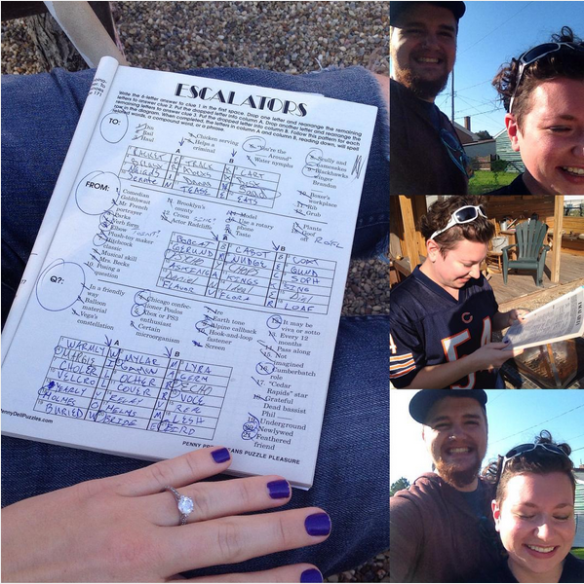
Heck, one of my favorite posts last year was about a puzzly proposal that our friends at Penny Dell Puzzles helped orchestrate.

escalators1

You can get the full story here, but in short, a puzzler in love reached out to PDP for their assistance in hiding his proposal within one of his girlfriend’s favorite puzzles, Escalators. They even did a small print run just for him to camouflage the proposal in a puzzle book!

It was a marvelous team effort, brilliantly executed…oh, and she said yes.

puzzlelove

Plus there’s this terrific story about a friend of mine who composed some cryptic-crossword-style clues as part of a gift for his longtime girlfriend. When she solved all of the clues, they spelled out the message “Truly happy being yours.”

There are all sorts of thoughtful and romantic puzzle ideas out there, from a relationship scavenger hunt like the one from Parks and Recreation to this video of a Rubik’s Cube-themed proposal at a speed-solving event:

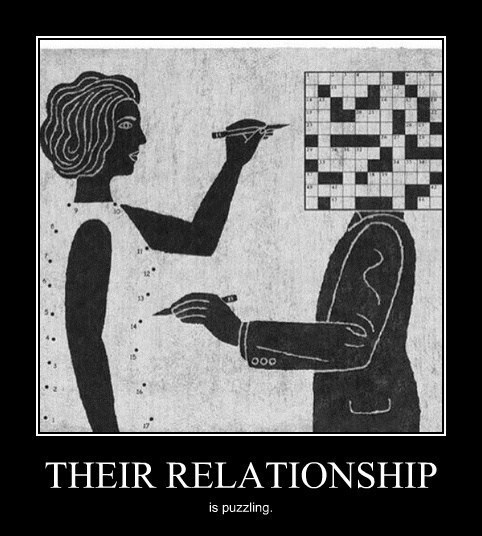
With a little ingenuity — and maybe some puzzly friends — you can create a unique and wonderful experience for someone you love. Puzzle romance is real, my friends. Just look at this happy couple, united by their mutual love of puzzles:

daily-morning-awesomeness-35-photos-2342


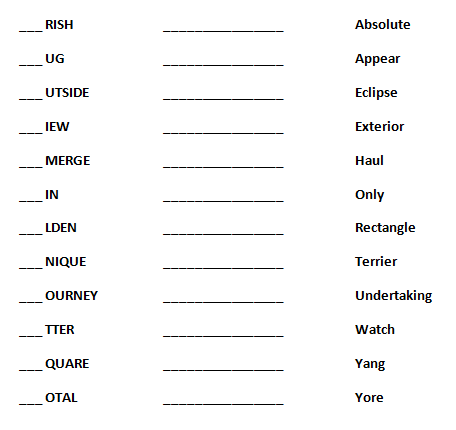
I wanted to close this post out with a little something for all the puzzlers and PuzzleNationers out there. And with Valentine’s Day coming up, it seemed appropriate to whip up a Matchmaker puzzle for you to solve. Enjoy!

Fill in the missing first letter of each word in the column on the left. Next, look for a related word in the group at the right and put it in the blank in the second column. When the puzzle is completed, read the first letters of both columns in order, from top to bottom, to reveal a romantic song lyric.

matchmaker


Thanks for visiting PuzzleNation Blog today! Be sure to sign up for our newsletter to stay up-to-date on everything PuzzleNation!

You can also share your pictures with us on Instagram, friend us on Facebook, check us out on Twitter, Pinterest, and Tumblr, and explore the always-expanding library of PuzzleNation apps and games on our website, like our Valentine’s Day-themed puzzle set!

2016_february_anim

Puzzles for Kids?

Puzzling is a terrific activity for people of all ages. But most puzzles are designed with adults in mind, crafted with challenging vocabulary, misleading or tricky cluing, and devious designs meant to test your puzzly mettle.

Kids are often left behind. Why? Because, quite honestly, it’s hard to make quality puzzles with appropriate vocabulary and difficulty levels. Most kids’ puzzles are mind-numbingly easy, almost to the point of being patronizing. Where can you find quality puzzles designed with kids in mind?

Wonder no more! Puzzle constructor, author, and friend of the blog Eric Berlin has recently launched Puzzle Your Kids, a subscription puzzle series featuring topnotch puzzles for ages 9 and up!

Available in three-month, six-month, and one-year increments, each subscription guarantees two puzzles a week emailed right to you and designed with younger solvers in mind. And we’re not talking just crosswords! Based on the sample puzzles on the website, kids can expect some terrific puzzly variations on familiar shapes and styles to keep them on their toes.

[Check out this spiral grid design from one of the sample
puzzles on the website. Click here to see the full puzzle.]

As the author of the thoroughly enjoyable Winston Breen series of YA puzzle novels, Eric has a terrific sense of how to build puzzles that will challenge young minds without frustrating them.

I suspect Puzzle Your Kids will be the perfect gateway for new solvers, and just the fix young, established solvers need to foster a lifelong love of puzzles.

For more details on Puzzle Your Kids, click here to check out the full website.


Thanks for visiting PuzzleNation Blog today! Be sure to sign up for our newsletter to stay up-to-date on everything PuzzleNation!

You can also share your pictures with us on Instagram, friend us on Facebook, check us out on Twitter, Pinterest, and Tumblr, and explore the always-expanding library of PuzzleNation apps and games on our website!
It’s Follow-Up Friday: View a Clue Animals edition!

Welcome to Follow-Up Friday!

By this time, you know the drill. Follow-Up Friday is a chance for us to revisit the subjects of previous posts and bring the PuzzleNation audience up to speed on all things puzzly.

And today, we’ve got answers to last week’s View a Clue game!


If you recall, we selected ten animals that commonly show up in crossword grids — some have become crosswordese at this point — to see if the PuzzleNation audience could identify them from pictures.

Without further ado, let’s get to the answers!

#1 (5 letters)

Answer: ELAND, an African antelope

#2 (3 letters)

Answer: KEA, a New Zealand parrot

#3 (3 letters)

Answer: EMU, a flightless Australian bird

#4 (5 letters)

Answer: COATI, a tropical raccoon-like animal

#5 (4 letters)

Answer: NENE, a Hawaiian goose

#6 (3 or 4 letters)

Answer: ERN or ERNE, a sea eagle

#7 (4 letters)

Answer: IBEX, a horned mountain goat

#8 (3 letters)

Answer: SEI, a large whale

#9 (5 letters)

Answer: OKAPI, an African animal and kin to the giraffe

#10 (4 letters)

Answer: ANOA, an Indonesian buffalo


How many did you get? Let me know in the comments below! And if you have ideas for another View a Clue game, tell us below!

Thanks for visiting PuzzleNation Blog today! Be sure to sign up for our newsletter to stay up-to-date on everything PuzzleNation!

You can also share your pictures with us on Instagram, friend us on Facebook, check us out on Twitter, Pinterest, and Tumblr, and explore the always-expanding library of PuzzleNation apps and games on our website!
PuzzleNation Product Reviews: Takat and Noueni

In today’s product review, we look at two card games that are all about matching colors, identifying patterns, and scoring points, but in very different ways. Today, we put Takat and Noueni under the PuzzleNation Blog microscope!


Let’s start with Takat.

A card game for 2 to 4 players designed by Tyler Kilgore, Takat is different from most pattern-matching tile games or card games because it’s not about maximizing points…it’s about scoring as few points as possible as you place cards and create different colored shapes on the board.

The game starts with each player secretly drawing a card that reveals that player’s color for this game. Not only are you trying to conceal your color from your opponents, but you’re trying to guess what color they have, based on how they place cards and build shapes on the board.

[Some of the multicolored tiles. There are only two legal plays represented here: the second and third tiles in the top row, and the third tile in both the top and bottom rows.]

The multicolored patterns on the cards allow for all sorts of placement options. When you place a card, you can either neighbor a card on the board or partially overlap it, but you always have to make sure the colors match. If the edge of a card is red and blue, the card you place beside it must also be red and blue.

Since the goal of the game is to score as few points as possible, the strategy quickly becomes a mix of bluffing and deduction. You have to complete shapes in your opponents’ colors without revealing your own. (For instance, if you keep building red, blue, and yellow shapes but not green ones, you’ve told your opponents you’re purposely avoiding green, which will only encourage them to build green shapes and give you more points.)

In this game in progress, the players have mostly avoided completing any shapes; there’s the mostly-round yellow shape on the top right as well as the pointy red shape below it (which is partially formed by two overlapping tiles, unintentionally obscuring the black line at the bottom right of the yellow shape.) Those two are the only shapes completed, which means those shapes are worth more points than shapes that aren’t enclosed by black lines.

But since you can score points on neighboring tiles as well as completed shapes, you have to pay as much attention to who placed a tile as you do to what tile they placed.

For instance, on the bottom left, there’s 2 points for the neighboring red tiles, 3 points for the blue shape above it, and 2 points for the yellow rectangle beside the blue shape, despite none of those shapes being closed by black lines.

The game ends when all cards have been played. Then the players reveal their colors, and the points on the board are tallied up, based on how many shapes were made (and how many were completed), as well as how many cards were used in making each shape. The lowest score wins.

The game play of Takat is pretty easy to pick up, but the scoring is a bit more esoteric and takes some getting used to. It does, however, make for a fun variation on the usual tile-placement scoring game, and as a fan of games like Mafia and other bluffing/concealment games, it does make for a more tense playing experience than your average round of Qwirkle.


Now let’s take a look at Noueni.

Designed by 263 Games, Noueni is also a card game for 2 to 4 players that involves pattern-matching, color-based scoring, and cards that can either overlap or sit next to other cards. But there are some important distinctions between Noueni and Takat.

For example, each player chooses their color at the start of the game, and there’s no attempt to conceal it from your opponents. Also, like many pattern-matching games, highest score wins. In this game, your score is determined by how many of your scoring orbs are on the board by the end of the game.

Each card has two colored scoring orbs and a pattern of black lines emerging from them. Those lines are the connectors, and they determine how the cards placed on the board line up. Any card played must link up with the other cards on the board, whether there’s zero, one, two, or three connectors along that neighboring edge.

As you can see, the green scoring orb on the upper left connects to the red orb by three connections, but the other red orb connects to a yellow orb with only two. So far, there have been no overlapping cards played, so all four players are tied with two scoring orbs showing apiece. (The connections aren’t part of the scoring; they’re just the mechanism for lining up cards.)

A few moves later into the game, the yellow (upper right), red (upper left), and blue (middle) players have all added to the board using those matching connections, but the green player has overlapped half of a blue card, using those connections and obscuring the blue scoring orb.

Overlaps allow you to cover your opponents’ scoring orbs and claim those spots for yourself, but you have to exactly match the connections they left behind. (You can only overlap half of a card already on the board, so even if the green player had a card exactly matching BOTH of the blue card’s connections, that’s an illegal play. The green player could, however, overlap half of one card and half of another, if the connections lined up.)

And that’s where the strategy aspect of Noueni comes into play. It’s a mix of expanding the board and placing as many scoring orbs as possible, but also seizing the opportunity to hide your opponents’ orbs and match those same connection patterns.

The game ends when all cards have been placed, and the player with the most visible scoring orbs wins.

Noueni is more straightforward than Takat, which will make it more accessible to new players, but it also lacks the tension of hiding your color and ferreting out your opponents’ colors. On the flip side, Noueni does maintain that ever-present paranoia that at any point, someone might drop a card on top of yours and steal a key scoring orb at a crucial moment in the game.

Both are terrific games that build on the pattern-matching color tile game format in interesting ways, requiring more from a player than simply outscoring their opponents. You need to outthink them too.

Takat and Noueni are both available from The Game Crafter.


Thanks for visiting PuzzleNation Blog today! Be sure to sign up for our newsletter to stay up-to-date on everything PuzzleNation!

You can also share your pictures with us on Instagram, friend us on Facebook, check us out on Twitter, Pinterest, and Tumblr, and explore everything PuzzleNation on our website!