Puzzle History: Codebreaking and the NSA

ohr577n

[Image courtesy of NSA.gov.]

The National Security Agency has been in the news a lot over the last few years.

It arguably all started with Edward Snowden and the revelations about government surveillance, both domestic and foreign, that emerged in his wake. Between President Trump’s intimations of Obama-era wiretapping (which also supposedly involved England’s GCHQ) and recent news stories about NSA contractor Reality Winner leaking information, the NSA continues to draw mainstream attention in the 24-hour news cycle.

When you factor in the declassification of codebreaking intel during and after World War II, we know more about the NSA’s inner workings than ever before.

You might be asking what the NSA has to do with puzzles. Well, everything. Because the NSA was born as a codecracking organization.

enigma

The NSA was founded in November of 1952, but its formative stages began during World War II, as codebreakers were recruited in the U.S. starting in 1943. Not only were they tasked with tackling the German ENIGMA code, but their secondary mission was to solve “the Russian problem.” This group was known as Signals Intelligence, or SIGINT.

William Friedman, one of the early figures in American codebreaking, described cryptanalysis as “a unique profession, demanding a peculiar kind of puzzle-solving mentality combined with patience. So staffing this new organization was a curious endeavor.”

Those who were recruited came from all walks of life:

Career officers and new draftees, young women math majors just out of Smith or Vassar, partners of white-shoe New York law firms, electrical engineers from MIT, the entire ship’s band from the battleship California after it was torpedoed by the Japanese in the attack on Pearl Harbor, winners of puzzle competitions, radio hobbyists, farm boys from Wisconsin, world-traveling ex-missionaries, and one of the World’s foremost experts on the cuneiform tablets of ancient Assyria.
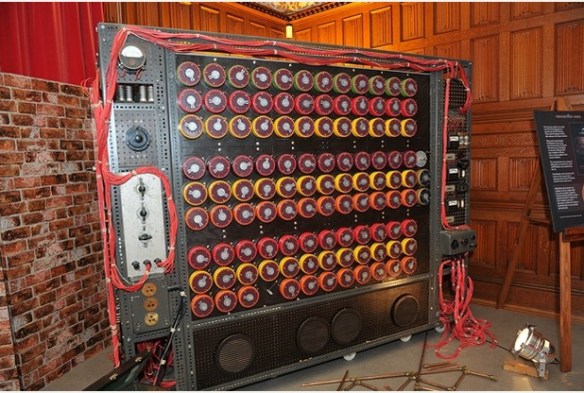
04/11/14 imitation game - bletchley park, milton keynes

A large campus was built that echoed the style and efforts of Britain’s Bletchley Park, including Alan Turing’s calculating machines, the bombes. Efforts on both sides of the Atlantic centered on cracking ENIGMA, the German codes used in all sorts of high-level communications. The teams worked alongside the bombes to try to determine which of the 456, 976 possible codes was being used in a given piece of communication.

It was a truly Herculean effort.

But while nearly half the staff focused on the Germans, others focused on cracking Russian codebooks, where words were translated into four-digit codes. Often, decrypting these codes involved “brute force” efforts, poring through numerous messages to pair up messages that used similar numerical groups, meaning they used the same cipher.

This would only work if the Soviets were lazy in their production of so-called “one-time pads,” encryption devices that had a particular code, which would be used once and then thrown away. Brute force codebreaking revealed that some of the one-time pads had been used more than once, a lapse in Soviet security that could work to the advantage of U.S. intelligence.

That deduction led to another stunning discovery: cracking the system used in encrypted messages to tell agents which encryption was used in a given missive. You see, each encoded message contained within it a code that dictated the cipher necessary to decrypt the message.

The Russians would later complicate this work by employing multiplexers: devices that would transmit numerous messages at once, making it harder to separate one message from another in the same dispatch.
hqdefault6

[Image courtesy of Virtantiq.com.]

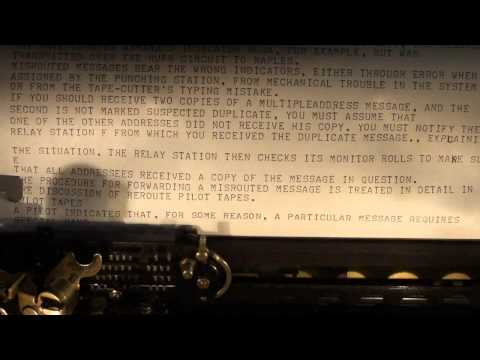
The Germans would unwittingly aid the US in their Russian codebreaking efforts when a POW camp in Bad Aibling, Germany, was captured by the US army, and they uncovered a German device designed to “de-multiplex” Russian messages. The device was called the HMFS, because Hartmehrfachfernschreiber, while a great deal of fun to type, is hard to say quickly.

After World War II ended, U.S. intelligence consolidated their efforts on “the Russian problem,” continuing their work unraveling the Russian codebooks. Slowly, the codemasters began determining which organizations in the Soviet government used which codes. Even if the codes weren’t broken yet, it helped the intelligence community organize and prioritize their efforts.

The problem? They had a very tight timeframe to work in. Those duplicated codebooks were produced during a very small window of time in 1942, and only issued to Soviet agents in the three years that followed. By 1947, SIGINT analysts knew the Soviets would soon run out of the duplicated pads. Once they did, those recurring patterns of encrypted numbers would stop, and the best chance for cracking the Soviet codes would be lost.

Still, there was reason to be encouraged. Some important code words had been identified. TYRE was New York City, SIDON was London, and CARTHAGE was Washington; ENORMOZ appeared often enough that they determined it referred to atomic bomb research in Los Alamos.

It would also be revealed, through careful analysis of decrypted intel, that Soviet agents were embedded in both the U.S. Justice Department and in England’s Bletchley Park campus. The Justice Department agent was identified and tried, but released after the court found insufficient evidence to place her under surveillance in the first place.

This was one consequence of the secrecy surrounding codebreaking: an unwillingness to reveal their codebreaking success by turning over evidence of it. (As for the Bletchley Park spies, one was identified in 1951 and confessed in 1964. The other was never identified.)

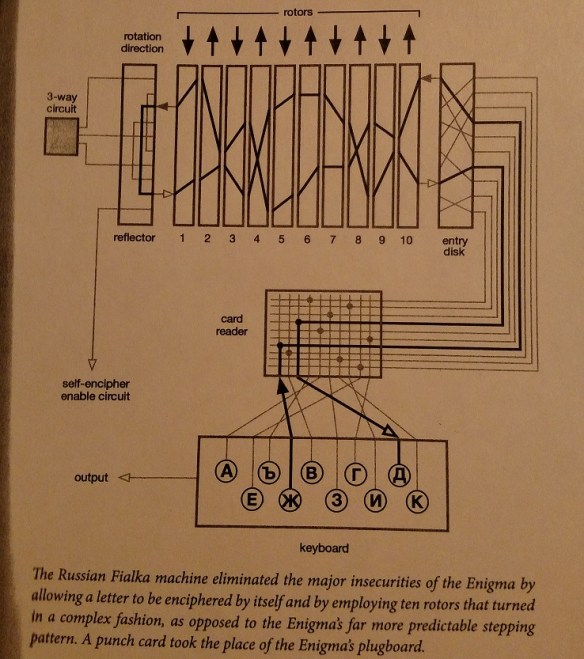
By this time, the Russians had gone over ENIGMA machines captured during the German retreat, and had unraveled not only how the devices worked, but how to improve upon them. This would lead to the next-generation Russian Fialka machine.
fialka

With ever-increasing complexity when it came to encryption, thanks to increased automation, codebreaking evolved into not just intelligence work, but intelligence analysis. After all, if you don’t know something is important, you don’t necessarily give it the attention it deserves. As researcher Stephen Budiansky put it, “The top translators at Bletchley were intelligence officers first, who sifted myriad pieces to assemble an insightful whole.”

It also led to bigger, faster machines, like Goldberg and Demon, two computation machines designed to more efficiently pore over the vast amount of encrypted information being intercepted by the various U.S. intelligence services.

In 1948, though, the game changed. It changed so dramatically that November 1, 1948, is still remembered in NSA circles as Black Friday.


I hope you’re enjoying this look at the early days of America’s codebreaking efforts. Part 2 will continue next week, with a look at the rise of the NSA, Cold War cryptography, and more!

[Quotes and certain photos were sourced from Code Warriors: NSA’s Codebreakers and the Secret Intelligence War Against the Soviet Union by Stephen Budiansky.]


Thanks for visiting PuzzleNation Blog today! Be sure to sign up for our newsletter to stay up-to-date on everything PuzzleNation!

You can also share your pictures with us on Instagram, friend us on Facebook, check us out on TwitterPinterest, and Tumblr, and explore the always-expanding library of PuzzleNation apps and games on our website!
Codecrafting with Crosswords!

We’ve discussed ciphers and codecracking numerous times in the past, and rightly so. It’s a style of puzzling that has literally affected the outcomes of battles, helped shape key historical moments, and changed the face of spycraft.

And it’s a puzzle form that continues to evolve to this day. We’ve moved far beyond the simple one-to-one replacement encryptions of your standard newspaper cryptogram, and intrepid solvers are always looking for newer and more devious ways to conceal their messages.

Tumblr user Cipherface has cooked up a pretty ingenious system that actually uses another style of puzzling in its execution: crosswords.

tumblr_nfh6mgvdtf1t4n39mo1_540

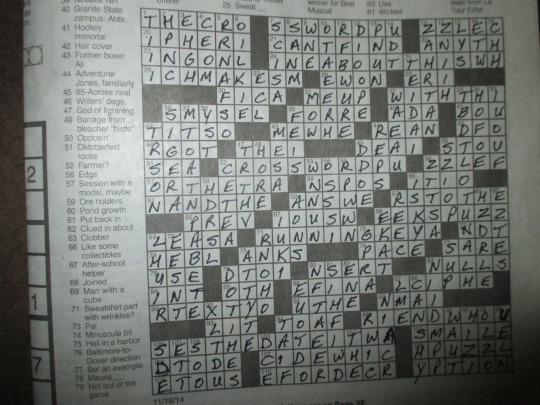
Here’s how it works. You write your message out in the open spaces of the crossword, ignoring the black squares.

tumblr_nfh6mgvdtf1t4n39mo2_r1_1280

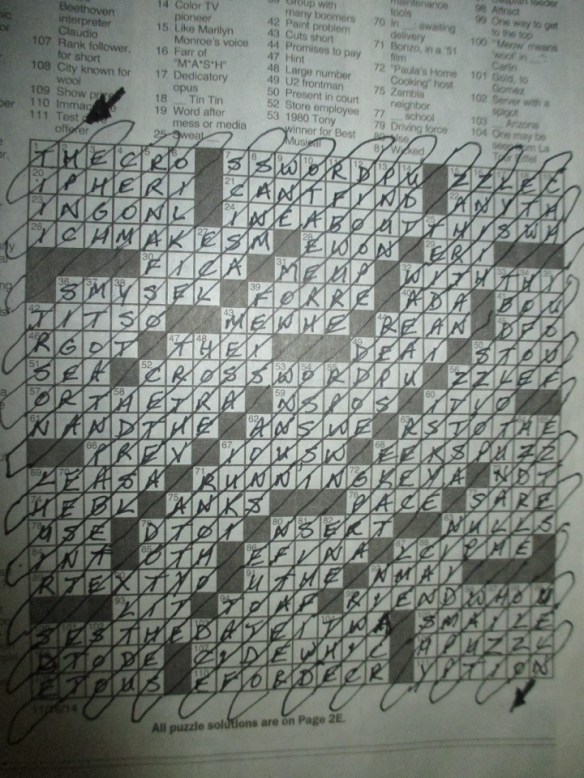
Then, map out this diagonal path as the first step to encrypting your message.

tumblr_nfh6mgvdtf1t4n39mo4_r1_1280

Do the same with the puzzle’s answer key, and you’ve got your running key, the text used to substitute letters for the letters in your actual message.

table2

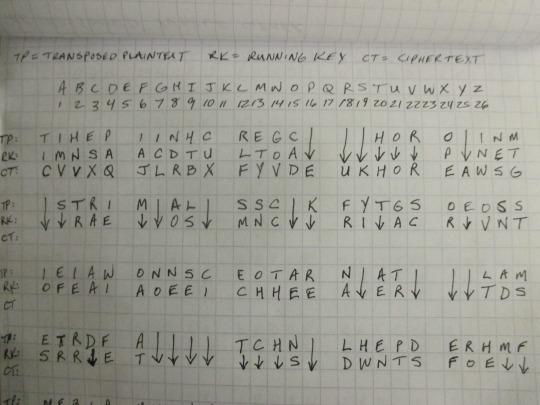
Then you run your message through the tabula recta, a table where you use the letter you want revealed and the letter in your running key to pick the letter in your encryption.

tumblr_nfh6mgvdtf1t4n39mo5_r1_540

Here, we can see Cipherface mapping out the encrypted message using this method.

From the Tumblr writeup:

The idea is to use a crossword puzzle for the transposition and the answers to the previous weeks puzzle as a running key. And the blank spaces are used to insert nulls into the final ciphertext. You then mail it to a friend who uses the date it was mailed to decide which puzzle to use for decryption.

It’s a pretty clever way to leave your encryption key in plain sight, and yet keep your messages secret. The running key keeps changing, so it’s more effective than traditional running keys, which stayed the same for longer periods of time.

Not to mention, using the puzzle’s publishing date? What a quick and easy way to keep your friend informed in an innocuous way. You’d just need to decide ahead of time which newspaper to use.

And it figures. The best way to make a puzzle better? Add another puzzle.


Thanks for visiting PuzzleNation Blog today! Be sure to sign up for our newsletter to stay up-to-date on everything PuzzleNation!

You can also share your pictures with us on Instagram, friend us on Facebook, check us out on TwitterPinterest, and Tumblr, and explore the always-expanding library of PuzzleNation apps and games on our website!
The Diabolical Long Division Brain Teaser!

From time to time, I’ll receive an email with a brain teaser I’ve never seen before. Sometimes they come from friends, or fellow puzzlers. Other times, PuzzleNationers will ask for my assistance in solving a puzzle that has flummoxed them.

That was the case with today’s puzzle, and I’ll admit, this one was a bit of a doozy to unravel.

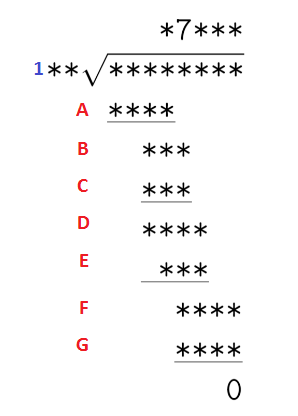
longdiv1

Yup, an entire long division problem with only a single digit set. No letters or encryption to let us know which digits were repeated, as there are in Word Math puzzles published by our friends at Penny Dell Puzzles.

Just a 7 and a bunch of asterisks. “Is this doable?” the sender asked.

Yes, this is entirely doable, friend. Let’s break it down step by step.

First, we need to know our terminology. The 8-digit number being divided is our dividend. The 3-digit number we’re dividing into it is the divisor. The 5-digit number on top is our quotient.

For the other lines, let’s label them A through G for ease of reference later.

longdiv2

There we go. Now, where do we go from here? We start with what we know.

We know that 7 is the second digit in our quotient.

So our divisor, times 7, equals the number on line C. That’s a 3-digit number, which means the first number in our divisor is 1. Why? Because if it was 2, 2 times 7 would give us 14, which would be a 4-digit number on that line.

longdiv3

That means the quotient is somewhere between 100 and 142. (Why 142? Easy. I divided 1000 by 7, and 142 is the last 3-digit number you can multiply 7 against and still end up with a 3-digit answer for line C. 143 times 7 is 1001, which is too high.)

What else do we know from the puzzle as it stands?

Well, look at lines E and F. We bring both of the last two digits in the dividend down for the final part of the equation. What does that mean?

Remember how long division works. You multiply the divisor by whatever number gets you closest to the given digits of the dividend, subtract the remainder, bring down the next digit from the dividend, and do it all over again until you get your answer.

You multiply the first digit of the quotient times the divisor to get the number on line A. You multiply 7 times the divisor to get the number on line C. You multiply the third digit of the quotient times the divisor to get the number on line E.

Following this route, you would multiply the fourth digit of the quotient against the divisor to get the number on line G. But bringing just one digit down didn’t give us a number high enough to be divided into. Instead of needing more lines (H and I, in this case), we bring the last digit of the dividend down and press onward.

That means the fourth digit of the quotient is 0, because the divisor went into the dividend zero times at that point.

longdiv4

And there’s more we can glean just from the asterisks and what we already know. We know that every one of those 4-digit numbers in the equation begin with the number 1.

How do we know that? Easy. That first number in the divisor. With a 1 there, even if the divisor is 199 and we multiply it times 9, the highest possible answer for any of those 4-digit numbers is 1791.

So let’s fill those numbers in as well:

longdiv5

Now look at lines D, E, and F. There’s nothing below the 1 on line D. The only way that can happen is if the second digit in line D is smaller than the first digit on line E. And on line F, you can see that those first two columns in lines D and E equal zero, since there’s nothing on line F until we hit that third column of digits.

That means the second digit on line D is either a 0 or a 1, and the first digit on line E is a 9. It’s the only way to end up with a blank space there on line F.

longdiv6

I realize there are a lot of asterisks left, but we’re actually very close to knowing our entire quotient by now.

Look at what we know. 7 times the divisor gives us a 3-digit answer on line C. We don’t yet know if that’s the same 3-digit answer on line E, but since it’s being divided into a 4-digit number on line E and only a 3-digit number on line C, that means the third digit in our quotient is either equal to or greater than 7. So, it’s 7 or 8.

Why not 9? Because of the 4-digit answers on lines A and G. Those would have to be higher than the multiplier for lines C and E because they result in 4-digit answers, not 3. So the digit in the first and fifth places in the quotient are higher than the digit in the third. So, if the third digit in the quotient is 7 or 8, the first and fifth are either 8 or 9.

So how do we know whether 7 or 8 is the third digit in the quotient?

Well, if it’s 7, then lines C and E would have the same 3-digit answer, both beginning with 9. But line C cannot have an answer beginning with 9, because line B is also 3 digits. The highest value the first digit in line B could have is 9, and 9 minus 9 is zero. But the number on line D begins with 1, ruling out the idea that the numbers on lines C and E are the same.

That makes the third digit in the quotient 8, and the first and fifth digits in the quotient 9.

longdiv7

We know our quotient now, 97809. What about our divisor?

Well, remember before when we narrowed it down to somewhere between 100 and 142? That’s going to come in handy now.

On line F, we know those first two digits are going to be 141 or below, because whatever our divisor is, it was larger than those three digits. That’s how we ended up with a 0 in our quotient.

So, the number on line D minus the number on line E equals 14 or below. So we need a 900-something number that, when added to a number that’s 14 or below, equals 1000 or more. That gives us a field from 986 to 999.

And that number between 986 and 999 has to be divisible by 8 for our quotient to work. And the only number in that field that fits the bill is 992. 992 divided by 8 gives us 124, which is our divisor.

longdiv8

From that point on, we can fill out the rest of the equation, including our lengthy dividend, 12128316.

longdiv9

And there you have it. With some math skills, some deduction, and some crafty puzzling, we’ve slain yet another brain teaser. Nice work everyone!

[After solving the puzzle, I did a little research, and apparently this one has been making the rounds after being featured in FiveThirtyEight’s recurring Riddler feature, so here’s a link.]


Thanks for visiting PuzzleNation Blog today! Be sure to sign up for our newsletter to stay up-to-date on everything PuzzleNation!

You can also share your pictures with us on Instagram, friend us on Facebook, check us out on TwitterPinterest, and Tumblr, and explore the always-expanding library of PuzzleNation apps and games on our website!

The Puzzle of the Bard

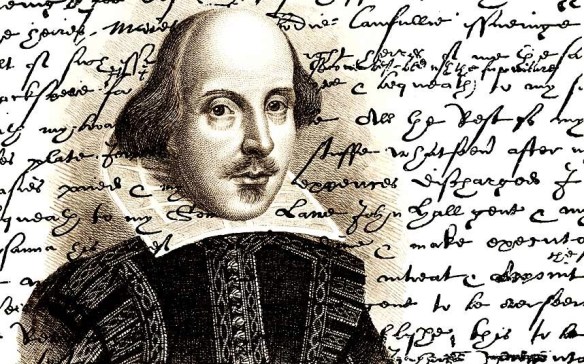
shakespeare_2699766k

William Shakespeare is a name we all know well. We’ve studied his works in school, used words and phrases he coined or popularized, and we’ve seen numerous films, TV shows, and other adaptations inspired by his writing.

But for more than two centuries, there has been a great deal of debate over whether the man known as William Shakespeare actually wrote all of the brilliant works for which he is acclaimed.

There are whole societies dedicated to either rooting out the truth or proffering their candidate for who really wrote the works of Shakespeare. Many names are bandied about, including a who’s who of luminaries at the time, like Sir Francis Bacon, Christopher Marlowe, John Donne, Queen Elizabeth I, Ben Jonson, Edmund Spenser, Anne Hathaway, Sir Walter Raleigh, and perhaps most ardently, Edward de Vere, the 17th earl of Oxford.

[Image courtesy of The Truth About Shakespeare.]

Now, granted, there’s plenty to suggest Shakespeare collaborated with other writers on some of his works, but we’re not talking about collaboration here. We’re talking about ghostwriting some of the most famous works in human history.

But, you may be asking, other than a shared love of wordplay, what does the Shakespearean authorship question have to do with puzzles?

I’m glad you asked.

Over the years, several theorists have reported finding secret codes or ciphers in the text of Shakespeare’s works which hinted toward the true author.

Samuel Morse, a man who knows one or two things about codes, discussed how Sir Francis Bacon had created such codes, probably as part of his spy work, perhaps even going so far as to create an encrypted signature of sorts that appears in multiple Shakespeare works.

According to a BBC America article on the subject:

One scholar at the time went so far as to produce an enormous “cipher wheel” composed of a 1000-foot piece of cloth that contained the texts of Shakespeare and others for easy comparison and decryption. He claimed that by deciphering codes, he’d discovered the location of a box, buried under the Wye River, that contained documents that would prove Sir Francis’s authorship. But a dredging of the area came up with nothing.

[Orville Ward Owen’s cipher wheel. Image courtesy of Wikipedia.]

Now, there’s little doubt that Bacon was a code master, but there’s equally little evidence that he wrote the works of Shakespeare.

Of course, if there are codes in those works, perhaps Shakespeare placed them there himself.

According to a theory by scholar Clare Asquith, Countess of Oxford and Asquith, Shakespeare’s careful and curious word choices were intended to foment subversive political messages and advance his own agenda of strong Catholic beliefs.

Constancy in love was Shakespeare’s way of alluding to the importance of a true faith in the ‘old religion’, she says. More specifically, his puns and metaphors often circled around certain key phrases. For instance, to be ‘sunburned’ or ‘tanned’, as are his heroines Viola, Imogen and Portia, was to be close to God and so understood as a true Catholic.

[Image courtesy of Amazon.com.]

It’s amazing that we know so little about someone so influential. And it’s only natural that we try to fill in the blanks with our own theorists, be they explanations of Shakespeare’s impressive knowledge or possibilities of alternative authorship.

The man himself is a puzzle, and that is irresistible to some, myself included. Are Shakespeare the man and Shakespeare the bard one and the same?

As it turns out, that question might finally have an answer, thanks to the sleuthing of Dr. Heather Wolfe of the Folger Shakespeare Library in Washington, D.C.

The story begins with Shakespeare’s father:

John Shakespeare, from Stratford-upon-Avon, was ambitious to rise in the world. He was certainly not the first Englishman keen to put his origins as a provincial tradesman behind him. Among his contemporaries in Stratford, he was a figure of fun for his social climbing. English class snobbery has a long pedigree.

His son, who would continue the quest for official recognition after his father’s death, also attracted metropolitan disdain as “an upstart crow beautified with our feathers”. In 1601, after his father’s death, Shakespeare the upstart returned to the college of arms to renew the family application for a coat of arms.

He had made a small fortune in the theatre, and was buying property in and around Stratford. Now he set out to consolidate his reputation as a “Gentleman”. Under the rules that governed life at the court of Elizabeth I, only the Queen’s heralds could grant this wish.

[Image courtesy of The Shakespeare Blog.]

And it’s this application for a family coat of arms that provides the connective tissue between the man and the bard. “They point to someone actively involved in defining and defending his legacy in 1602, shortly after his father’s death,” according to Wolfe.

But whether there are codes lurking in the Bard’s works or not, the mystery of the man himself might be the greatest puzzle of all.


Thanks for visiting PuzzleNation Blog today! Be sure to sign up for our newsletter to stay up-to-date on everything PuzzleNation!

You can also share your pictures with us on Instagram, friend us on Facebook, check us out on TwitterPinterest, and Tumblr, and explore the always-expanding library of PuzzleNation apps and games on our website!

An Escape Room in a Box!

[Image courtesy of Escape Game Addicts.]

Escape rooms have been all the rage lately, as teams of people pit themselves against riddles, puzzles, codes, and other challenges in order to escape a room within a certain amount of time. It’s about as close as you’ll get to being MacGyver or Batman in this life, and it can be great fun.

They’ve been around long enough that themed escape rooms are beginning to emerge. From post-apocalyptic and horror themes to hockey, schools, pirates, and more, escape rooms are constantly innovating to keep solvers on their toes.

So when I heard about an upcoming escape-the-room-style event in Chicago, I had to share it with my fellow puzzlers.

Revolution Brewing Tap Room in Chicago will be hosting Creatures on the Loose on December 28, a creation of The Mystery League, and they’ve put a curious twist on the escape-the-room scenario: everything you’ll need is inside a locked briefcase.

From the announcement on Eventbrite.com:

Ten terrible creatures, each from an alternate dimension, have been let loose to wreak havoc on our town. The culprit’s identity and motives are unknown. Hunters have been on the case, snooping around town and collecting evidence. But they too have vanished, leaving just their locked briefcases behind. You will need to break into the briefcase, find the creatures, and figure out who is causing all this mayhem.

Inside the briefcase you will find all the tools you need to solve the mystery, including (but not limited to): a newspaper, a magic wand, a bible, a calculator, a wallet of money, a pile of stocks, a Wonka bar, a leather strap, a code wheel, a map, and an enigmatic computer.

The idea of an escape room that comes to you is an awesome one, and I hope the Mystery League finds great success with this challenge. (And the winning team gets a round of pints as their prize!)

Tickets start at $29 for a 90-minute event, and that sounds like a great deal for a puzzly experience like this. Let me know if you participate! I’d love to hear about it!


Thanks for visiting PuzzleNation Blog today! Be sure to sign up for our newsletter to stay up-to-date on everything PuzzleNation!

You can also share your pictures with us on Instagram, friend us on Facebook, check us out on TwitterPinterest, and Tumblr, and explore the always-expanding library of PuzzleNation apps and games on our website!
Bringing Home an Ancient Mystery: The Voynich Manuscript

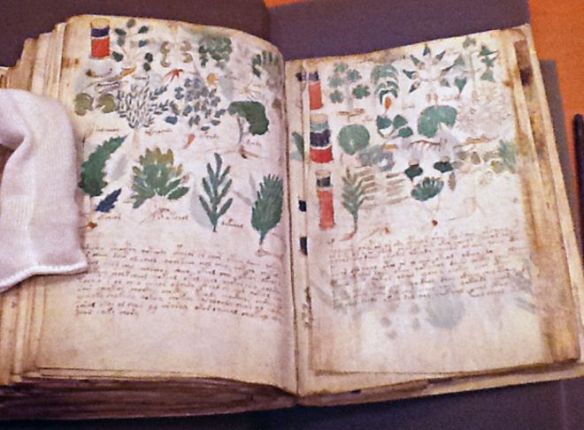
74044725_624_whole-book-white

[Image courtesy of BBC.com.]

If you scour the Internet for great unsolved mysteries of this or any era, the Voynich Manuscript is always one of the top results, and with good reason.

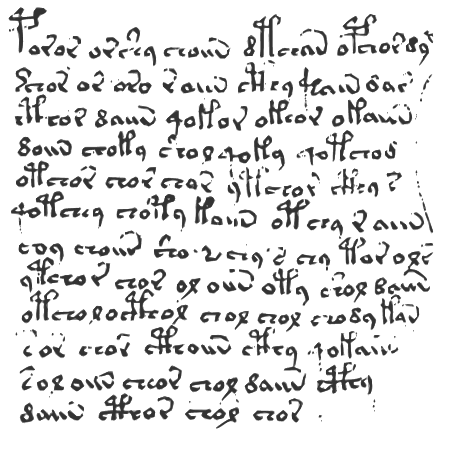
A small hand-written volume, the Voynich Manuscript is believed to have originated in the 15th century (thanks to carbon-dating), and it’s written in an as-yet-undeciphered language.

Both amateur and professional cryptographers have attempted to unravel the mysteries of the unknown language, but all have thus far failed. (Oh sure, some people have claimed in the past that they’ve cracked the code, but none of these efforts have held up to scrutiny.)

Some theorize that instead of an encryption, it’s an invented language or a previously unseen invented written form for an established language.

vmsample

[Image courtesy of Wikipedia.org.]

A few cryptographers have gone so far as to call it unsolvable, while others believe it to be an elaborate hoax or the work of someone afflicted with glossolalia, a written equivalent of speaking in tongues.

And ever since the only known copy was donated to Yale University’s Beinecke Rare Book and Manuscript Library, aspiring solvers have had to rely on online scans of the manuscript in their attempts to crack it.

Until recently, that is.

voynich_manuscript_158

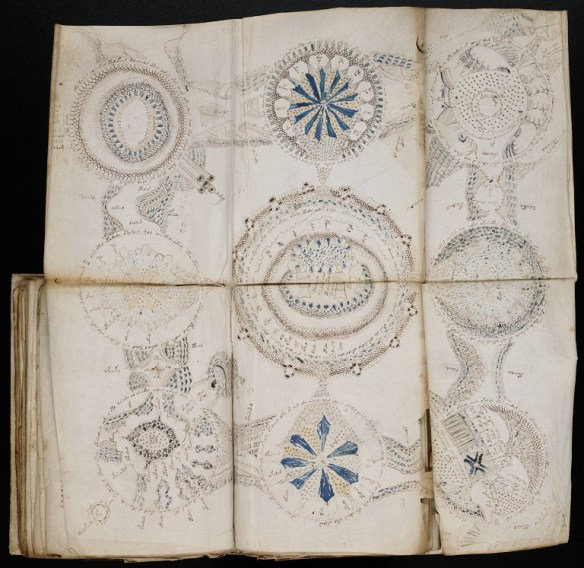
[One of several fold-out pages in the manuscript.
Image courtesy of Wikipedia.org.]

A Spanish publishing house is currently working on a limited run of exacting replicas of the Voynich Manuscript, purportedly including “every stain, hole, [and] sewn-up tear in the parchment.”

Of course, such meticulous work is reflected in the price of each book, which runs roughly $8000 to $9000 a copy. A third of the 898 copies being offered for sale have already been snatched up in pre-orders.

If you’re still hoping for a chance to tackle the mystery but you’re not looking to break the bank, thankfully Yale University Press is offering a $50 trade hardcover edition of the manuscript for sale later this year.

Whether this finally leads to a solution or simply adds new members to the ever-growing list of disappointed or frustrated aspiring solvers, I can’t say. But it’s exciting to see the mystery is alive and well.


Thanks for visiting PuzzleNation Blog today! Be sure to sign up for our newsletter to stay up-to-date on everything PuzzleNation!

You can also share your pictures with us on Instagram, friend us on Facebook, check us out on TwitterPinterest, and Tumblr, and explore the always-expanding library of PuzzleNation apps and games on our website!