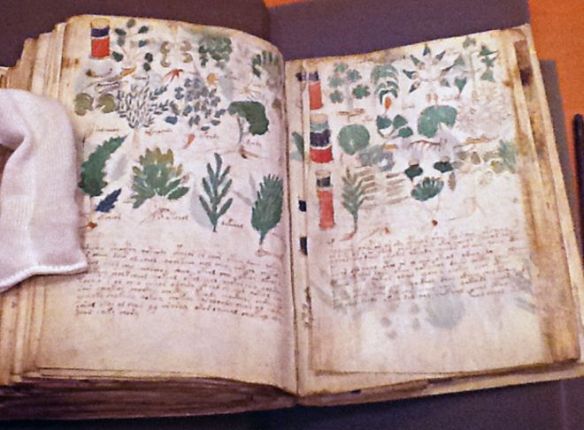
The Voynich Manuscript: Finally Cracked?

[Image courtesy of BBC.com.]

A year and a half ago, I introduced my fellow puzzlers and PuzzleNationers to the Voynich Manuscript, a cryptologic curiosity unlike anything else we’ve seen before. Discovered over a hundred years ago but believed to date back to the fifteenth century, the Voynich Manuscript is a hand-written book that has baffled linguists and puzzlers for decades.

The writing, which reads from right to left, has yet to be identified. It’s unclear if this is some sort of sophisticated code, an unknown or lost language which was then encoded, an invented language, an example of glossolalia (a written equivalent of speaking in tongues), or simply an elaborate hoax.

The only known copy of the text resides in Yale University’s Beinecke Rare Book and Manuscript Library, although Yale has printed replica texts.

From the Yale University website:

Many call the fifteenth-century codex, commonly known as the “Voynich Manuscript,” the world’s most mysterious book. Written in an unknown script by an unknown author, the manuscript has no clearer purpose now than when it was rediscovered in 1912 by rare books dealer Wilfrid Voynich. The manuscript appears and disappears throughout history, from the library of the Holy Roman Emperor Rudolf II to a secret sale of books in 1903 by the Society of Jesus in Rome. The book’s language has eluded decipherment, and its elaborate illustrations remain as baffling as they are beautiful.
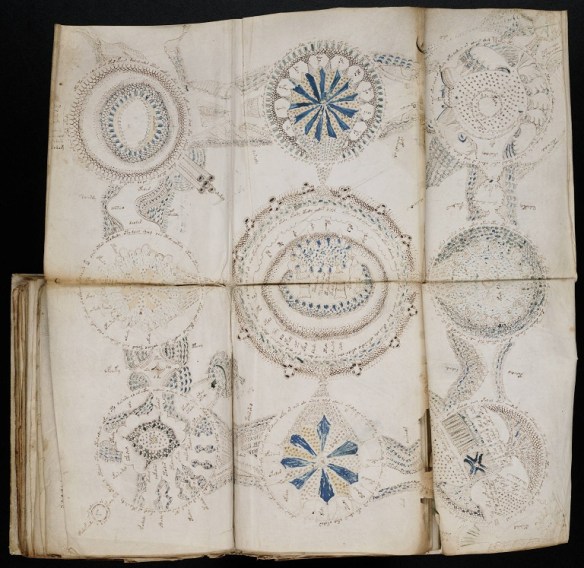
[One of several fold-out pages in the manuscript.
Image courtesy of Wikipedia.org.]

But computer scientists at the University of Alberta believe they’ve finally unraveled some of the mysteries behind the Voynich Manuscript.

They designed an artificial intelligence program with the intent of figuring out the language in the manuscript. The AI analyzed versions of the UN’s Universal Declaration of Human Rights in 400 different languages in order to establish different linguistic patterns to compare against the text of the Voynich Manuscript.

And according to the AI, the text was most likely written in Hebrew.

Now that they had a language to work with, they needed to begin deciphering precisely how that language was encrypted.
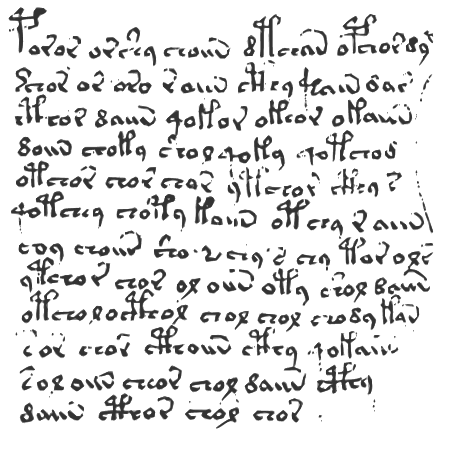
[Image courtesy of Wikipedia.org.]

There have been many theories regarding what form of encryption was employed in the Voynich Manuscript. Some investigators theorized that vowels had been removed from the words in the text in order to obscure their meaning further, while others have suggested writing that has been mirrored or otherwise written backwards. Anagrams and other forms of word manipulation are a common theory, and the University of Alberta team went with a variation on the anagram idea.

They theorized that the encoded words were alphagrams, anagrams where the letters in a word are placed in alphabetical order. (For instance, if VOYNICH was encoded this way, it would read CHINOVY.)

Turning loose the AI once again under these parameters, they found that 80% of the words in the Voynich text could be anagrammed into Hebrew words. They managed to cobble together a possible opening sentence for the text:

“She made recommendations to the priest, man of the house and me and people.”

Is it clunky? Sure. But it’s also a partial translation that has held up to some scrutiny, which is better than most amateur AND professional attempts to crack the Voynich Manuscript have done.

The team is currently hoping to team up with experts in ancient Hebrew and continue the process, but until then, they’re excited to apply their AI to other ancient manuscripts to see what it uncovers.

Although we are a long way from calling the Voynich mystery solved, this is a very intriguing step forward for cryptographers and codebreaking enthusiasts everywhere.


Thanks for visiting PuzzleNation Blog today! Be sure to sign up for our newsletter to stay up-to-date on everything PuzzleNation!

You can also share your pictures with us on Instagram, friend us on Facebook, check us out on TwitterPinterest, and Tumblr, and explore the always-expanding library of PuzzleNation apps and games on our website!
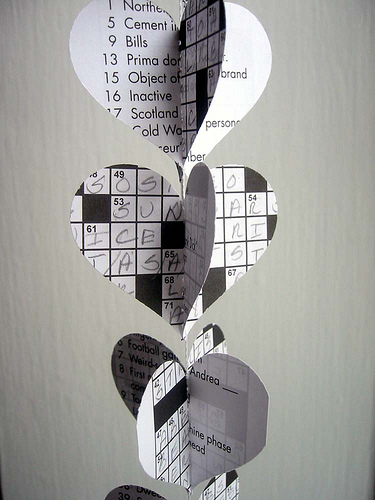
Last-Minute Puzzly Valentine’s Day Ideas!

Valentine’s Day looms large, and sometimes it’s hard to find that perfect way to express your love for that certain someone… particularly if that certain someone is the puzzly type.

But have no fear! We’re here with some terrific last-minute puzzly ideas for Valentine’s Day!

[Image courtesy of YouTube.]

Have you considered a puzzle bouquet? You could grab some newspaper crosswords and origami them into flower shapes for a fun puzzle-fueled spin on a holiday classic.

Or maybe they like coded puzzles? You could write the object of your affection a coded love letter!

All throughout history, people have employed different tricks and techniques to keep their private messages away from prying eyes, and you could do the same! Whether it’s a simple letter-shifting cipher or something more complex, just make sure your message is worth reading. =)

[Image courtesy of Shutterstock.]

Or maybe you’d like to show off how much you know about him or her. Then you could whip up a little scavenger hunt! You could leave clues around leading to a gift, or a romantic dinner, or some other grand finale. Maybe a rose with each clue.

(You could make each clue or destination about your relationship or about your partner, allowing you to show off how well you know them… where you first met, favorite meals, favorite movie… )

If you don’t want to leave things around where anyone could nab them, keep a few small tokens on you, giving one for each destination reached or clue solved. Heck, you could enlist a friend to text clues to your special someone once they’ve reached a particular destination!

For a family-friendly version of the same idea, have the kids help you cut out and hide jigsaw pieces around the house that, when put together, spell out a Valentine’s message, a picture of the family, or a picture of some gift or event to come!

You could even walk around and play Valentine’s Day Bingo.

Go for a walk or take your loved one out to dinner, and see if one of you can get bingo by observing different things. A couple holding hands as they walk, a Valentine’s Day proposal, outrageously priced flowers…

Even on short notice, the possibilities are endless when you put your mind to it. Happy Valentine’s Day, fellow puzzlers!


Thanks for visiting PuzzleNation Blog today! Be sure to sign up for our newsletter to stay up-to-date on everything PuzzleNation!

You can also share your pictures with us on Instagram, friend us on Facebook, check us out on TwitterPinterest, and Tumblr, and explore the always-expanding library of PuzzleNation apps and games on our website!

Puzzles Endanger, Then Save, a Nation: The Spy Who Couldn’t Spell

While working on our multi-part series of posts about the history of codebreaking in America during the 20th century, I mentioned that some of the recent revelations about the National Security Agency were the result of Edward Snowden’s actions during his time as a government contractor.

What you might not know is that he has not been the only contractor to sneak information off of government computers in that fashion: a decade before Edward Snowden, there was Brian Patrick Regan.

Regan was a career soldier in the Air Force who eventually reached the rank of Master Sergeant and worked in signals intelligence.

Buried under hundreds of thousands of dollars in credit card debt, Regan decided his only way out of financial ruin was to try to sell US government secrets to a foreign government. He copied page after page of sensitive documents from national defense systems and snuck them out of his office, eventually amassing more than 15,000 pages, CD-ROMs, and other material in his home.

He would later bury bundles of these documents in various locations, including state parks, concealing the GPS coordinates of these valuables caches through a complicated series of encryptions where letters and numbers became three-digit sets.

You see, Regan had spent a fair amount of time studying cryptography, and fancied himself a top-shelf codemaster.

Regan used another set of encryptions of lesser complexity when he attempted to contact agents of the Libyan, Iraqi, and Chinese governments in order to sell off the treasure trove of secrets he’d amassed during his time at the National Reconnaissance Office.

One of these packets — a collection of three parcels intended for Libya — ended up in the hands of an FBI agent named Steven Carr.

From The Spy Who Couldn’t Spell by Yudhijit Bhattacharjee:

In the first envelope was a four-page letter with 149 lines of typed text consisting of alphabets and numbers. The second envelope included instructions on how to decode the letter. The third envelope included two sets of code sheets.

One set contained a list of ciphers. The other, running to six pages, listed dozens of words along with their encoded abbreviations: a system commonly known as brevity codes. Together, the two sets were meant to serve as the key for the decryption.

Some of the document had already been decrypted by FBI agents, and it revealed a member of the US intelligence community — claiming to be CIA, which was unverified, but definitely someone with top secret access — was trying to sell government secrets.

And this person had terrible spelling.

Brian Patrick Regan suffered from severe dyslexia. And, despite concerted efforts to perfect both his encryptions and his plan to net millions by selling government secrets, that dyslexia would be one of the clues that led Steven Carr to Regan’s doorstep.

It took Carr six months to connect Regan to the Libyan package, but once he did, surveillance on Regan began immediately.

When Regan attempted to board a plane to Zurich in 2001 — intending to meet with Iraqi and Libyan embassy officials — he was nabbed by the FBI and taken into custody.

Again, excerpted from The Spy Who Couldn’t Spell:

On searching Regan, officials found a piece of paper tucked between the inner and outer soles of his right shoe, on which were written addresses of Iraqi and Chinese embassies in Europe. The other materials they found on him and in his belongings were more mystifying. In a trouser pocket, Regan was carrying a spiral pad containing a page with 13 words that didn’t add up to anything: like tricycle, rocket and glove.

He had another 26 random words scribbled on an index card. Among the contents of Regan’s wallet was a piece of paper with a string of letters and numbers that read “5-6-N-V-O-A-I …” And in a folder he was carrying in his duffel bag were four sheets with handwritten lines of three-digit numbers.

FBI cryptanalyst Daniel Olson decoded some of the messages found on Regan when he was captured, but he had failed to unravel the multi-stage encryptions that concealed where Regan had buried his secret parcels. The government knew which state parks, but with acres and acres of possible hiding places, they needed more precise information.

And those parcels were the key, because they weren’t just packages to be sold to the highest bidder. No, those parcels doubled as a ransom in order to secure a better deal for himself with the US government. He wanted to blackmail the government for a reduced sentence.

They were his insurance plan.

As Thomas G. West said in Seeing What Others Cannot See, a book about visual thinking and dyslexia, “It’s not hard for a dyslexic to think ‘out of the box’ because they have never been in the box.”

Thankfully, Regan eventually realized that cooperation was in his best interest, and he revealed that each of the elaborate three-digit codes concealed a backdoor key built into the code itself.

Regan designed them this way so that, if he forgot the actual details of the encryption, all he would need is the starter word, a spark that would unlock the built-in key and help him decode the entire message.

This backdoor key system worked in a similar fashion to the Vigenere cipher, where a keyword or key phrase served as the entry point for a longer string of encrypted text. The trouble is… you need to know the cipher word or source in order to crack the code.

For example, during World War II, German agents in Europe used Daphne du Maurier’s Rebecca as the basis of a code for transmitting intelligence from Cairo to support a campaign by the Axis powers against the Allies in North Africa.

The discovery of the book among the possessions of two German radio operators who didn’t read English ultimately led to the breaking of the code, which in turn led to the capture of the German spies in Cairo.

Regan revealed the cipher words for the various hiding spots in state parks — which used cipher words from sources as peculiar as Regan’s own high school yearbook — and soon, the FBI recovered all but one of the buried parcels.

But Regan couldn’t remember the cipher word for the last one.

Daniel Olson would then step in, having learned some of Regan’s techniques as they uncovered the other parcels, and partially decrypting the remaining message enough to spark Regan’s memory. Regan finally came up with the last cipher key, and the final parcel was recovered.

Yes, once again, puzzly perseverance had saved the day!

Regan was found guilty on two counts of attempted espionage and one of gathering national defense information, and sentenced to life imprisonment with parole. Which, quite honestly, is getting off easy, considering that prosecutors were seeking the death penalty for his treasonous acts. (If prosecutors had gotten their way, he would’ve been the first person executed for espionage since the Rosenbergs in the ’50s.)

For the full story, including more in-depth explanations of Regan’s elaborate encryptions, check out The Spy Who Couldn’t Spell by Yudhijit Bhattacharjee.


Thanks for visiting PuzzleNation Blog today! Be sure to sign up for our newsletter to stay up-to-date on everything PuzzleNation!

You can also share your pictures with us on Instagram, friend us on Facebook, check us out on TwitterPinterest, and Tumblr, and explore the always-expanding library of PuzzleNation apps and games on our website!

Puzzles in Pop Culture: Twin Peaks: The Return

On Tuesday, I concluded a multi-part series about the history of American codebreaking. In a related story, a fellow puzzler pointed out that there might be a new code out there awaiting an enterprising codebreaker.

In a recent episode of the television show Twin Peaks: The Return, there was a brief scene with an airplane flying over a snowy mountain. Sharp-eyed viewers noticed that the plane’s windows seemed to disappear and reappear as it flew.

Naturally, when you have a show that’s all about trying to unravel mysteries and finding deeper meaning in even the most obscure clues, fans leapt onto this possibility and began trying to crack the code of the windows.

There are six windows, and they disappear and reappear numerous times in the brief scene. (There’s also a spot closer to the tail that also appears and disappears.)

[One solver’s breakdown of the plane window pattern.]

Charting out a possible pattern in the windows has led to several intriguing theories. While attempts to translate the pattern into morse code, binary, and other languages have yielded nothing so far, some fans posit that it’s a musical pattern, since one of the characters, FBI agent Gordon Cole, plays a 6-hole flute. (A villain from the original series, Windom Earle, also played a flute.)

While this may simply be a red herring, I suspect there’s more to the window mystery than just providing a distraction in a show littered with distractions.

People have gone so far as to track down the original footage of the plane flying, so they can see what was altered to produce the window pattern:

What do you think, PuzzleNationers? Is there a message or a tune lurking in plain sight on Twin Peaks: The Return? Or is this much ado about nothing?


Thanks for visiting PuzzleNation Blog today! Be sure to sign up for our newsletter to stay up-to-date on everything PuzzleNation!

You can also share your pictures with us on Instagram, friend us on Facebook, check us out on TwitterPinterest, and Tumblr, and explore the always-expanding library of PuzzleNation apps and games on our website!
Puzzle History: Codebreaking and the NSA, part 3

[Image courtesy of NSA’s official Twitter account.]

At the end of part 2 in our series, we left off during the early days of the NSA, as American cryptographers continued to labor under the shadow of the Black Friday change in Russian codes.

You may have noticed that part 2 got a little farther from puzzly topics than part 1, and there’s a reason for that. As the NSA evolved and grew, codebreaking was downplayed in favor of data acquisition. The reasons for this were twofold:

1. Context. You need to understand why given encrypted information is important in order to put it toward the best possible use. As Budiansky stated in part 1, “The top translators at Bletchley were intelligence officers first, who sifted myriad pieces to
assemble an insightful whole.”

2. Russian surveillance and bugging continued to grow more clever and sophisticated, pushing attention away from codebreaking. After all, what good is breaking codes or developing new ones if they can just steal unencrypted intel firsthand by monitoring
agents in the field?

Moving forward, the NSA would continue to pursue all manner of data mining, eventually leaving behind much of the codebreaking and analysis that originally formed the backbone of the organization. But that was in years to come. Cryptography was still a major player in NSA operations from the ’50s and onward.

[The progression of “secret” and “top secret” code words.
Image courtesy of NSA’s official Twitter account.]

In May 1956, NSA cryptanalytic veterans pushed a proposal titled “Recommendations for a Full-Scale Attack on the Russian High-Level Systems,” believing that specially designed computers from IBM could provide the key for cracking the impenetrable Russian cryptography wall. Some cryptographers believed that ever-increasing processor speeds would eventually outpace even sophisticated codes.

By 1960, the NSA had spent $100 million on computers and analytical tools.

The problem? The NSA was collecting so much information that their increasingly small team of cryptoanalysts couldn’t dream of processing even a tiny portion of it.

But the quest for data access would only grow more ambitious.

In the wake of Sputnik’s launch in October of 1957, US signals intelligence would go where no man had gone before. The satellite GRAB, launched alongside Transit II-A in June of 1960, was supposedly meant to study cosmic radiation. (GRAB stood for Galactic Radiation and Background.)

[Image courtesy of NSA’s official Twitter account.]

But it was actually intended to collect radar signals from two Soviet air-defense systems. This was the next step of ELINT, electronic intelligence work. (The younger brother of SIGINT.)

The NSA would later find a huge supporter in President Lyndon Johnson, as the president was heavily invested in SIGINT, ELINT, and any other INTs he could access. This did little to quell the intelligence-gathering rivalry growing between the CIA and NSA.

Of course, that’s not to say that the NSA ceased to do any worthwhile work in codebreaking. Far from it, actually.

During the Vietnam War, NSA analysts pored over North Vietnamese signals, trying to uncover how enemy pilots managed to scramble and respond so quickly to many of the US’s airstrikes conducted during Operation Rolling Thunder.

Careful analysis revealed an aberrant character (in Morse code) in messages that appeared in North Vietnamese transmissions before 90 percent of the Rolling Thunder airstrikes. By identifying when the enemy used that aberrant character, the analysts
were able to warn US pilots whether they were heading toward a prepared enemy or an unsuspecting one during a given sortie.

Other NSA teams worked to protect US communications by playing the role of an enemy analyst. They would try to break US message encryptions and see how much they could learn from intercepted US signals. Identifying flaws in their own procedures — as well as members of the military who were cutting corners when it came to secured communications — helped to make US communications more secure.

[Image courtesy of NSA.gov.]

In 1979, Jack Gurin, the NSA’s Chief of Language Research, wrote an article in the NSA’s in-house publication Cryptolog, entitled “Let’s Not Forget Our Cryptologic Mission.” He believed much of the work done at the agency, and many of the people
hired, had strayed from the organization’s core mission.

The continued push for data acquisition over codebreaking analysis in the NSA led to other organizations picking up the slack. The FBI used (and continues to use) codebreakers and forensic accountants when dealing with encrypted logs from criminal organizations covering up money laundering, embezzlement, and other illegal activities.

And groups outside the government also made impressive gains in the field of encryption, among them IBM’s Thomas J. Watson Research Center, the Center for International Security and Arms Control, and even graduate student programs at universities like MIT and Stanford.

For instance, cryptographer Whitfield Diffie developed the concept of the asymmetric cipher. Joichi Ito explains it well in Whiplash:

Unlike any previously known code, asymmetric ciphers do not require the sender and receiver to have the same key. Instead, the sender (Alice) gives her public key to Bob, and Bob uses it to encrypt a message to Alice. She decrypts it using her private key. It no longer matters if Eve (who’s eavesdropping on their conversation) also has Alice’s public key, because the only thing she’ll be able to do with it is encrypt a message that only Alice can read.

This would lead to a team at MIT developing RSA, a technique that implemented Diffie’s asymmetric cipher concept. (It’s worth noting that RSA encryption is still used to this day.)

[Image courtesy of Campus Safety Magazine.com.]

The last big sea change in encryption came when the government and military realized they no longer had a monopoly on codebreaking technology. Increased reliance and awareness of the importance of computer programming, greater access to computers with impressive processing power, and a groundswell of support for privacy from prying government eyes, led to dual arms races: encryption and acquisition.

And this brings us to the modern day. The revelations wrought by Edward Snowden’s leak of NSA information revealed the incredible depth of government data mining and acquistion, leading some pundits to claim that the NSA is “the only part of government that actually listens.”

Whatever your feelings on Snowden’s actions or government surveillance, there is no doubt that the National Security Agency has grown and changed a great deal since the days of cracking the ENIGMA code or working with the crew at Bletchley Park.

Where will American codebreaking go next? Who knows? Perhaps quantum computing will bring codes so complicated they’ll be impenetrable.

All I know is… it’s part of puzzle history.


I hope you enjoyed this multi-part series on the history of 20th-century codebreaking in America. If you’d like to learn more, you can check out some of the valuable sources I consulted while working on these posts:

Code Warriors: NSA’s Codebreakers and the Secret Intelligence War Against the Soviet Union by Stephen Budiansky

Whiplash: How to Survive Our Faster Future by Joichi Ito

The Secret Lives of Codebreakers by Sinclair McKay


Thanks for visiting PuzzleNation Blog today! Be sure to sign up for our newsletter to stay up-to-date on everything PuzzleNation!

You can also share your pictures with us on Instagram, friend us on Facebook, check us out on TwitterPinterest, and Tumblr, and explore the always-expanding library of PuzzleNation apps and games on our website!
Puzzle History: Codebreaking and the NSA, part 2

[Image courtesy of NSA’s official Twitter account.]

At the end of part 1 of our look at the history of the NSA and American codebreaking, we left off with the pivotal Black Friday event.

On November 1, 1948, all intel coming from monitored Soviet signals went quiet. All traffic on military, naval, and police radio links was replaced with dummy messages. It was such an unprecedented and alarming event that London and Washington briefly considered that it might’ve been the first indication of preparations for war.

According to Code Warriors author Stephen Budiansky:

The full extent of the disaster only became apparent the following spring when real traffic started reappearing on the radio nets, now employing greatly improved — and completely unbreakable — technical and security procedures. The keying errors or other mistakes that had allowed most of the Soviets’ machine-enciphered military traffic to be routinely read by US and British codebreakers for the last several years had been corrected, and the much more disciplined systems that now replaced them slammed the cryptanalytic door shut.

Even the one-time pads that had offered some hope to attentive American codebreakers were updated, eliminating the ability to sort messages by which organization they originated from.

Codemakers had suddenly outpaced codebreakers.

[The Kryptos sculpture outside CIA Headquarters. The NSA cracked
several of its codes before the CIA did. Image courtesy of Slate.com.]

The Office of Naval Intelligence wanted to take over from Signals Intelligence (SIGINT), demanding to see “everything” so they could do the job. They claimed SIGINT should limit their work to message translation, leaving interpretation to “the real experts.” This sort of territorial gamesmanship would continue to hamper government organizations for decades to come.

And that demand to see everything? That probably sounds familiar, in light of the revelations about government data collection and the PRISM program that were revealed in Edward Snowden’s leaks.

Black Friday was the start of all that, a shift from codecracking to the massive data collection and sifting operation that characterized the NSA for decades to come.

More amazingly, there was SO MUCH information collected during World War II that SIGINT was still poring over it all in 1949, decrypting what they could to reveal Soviet agents in the U.S. and England.

The fact that a high-ranking member of British Intelligence at the time, Kim Philby, was actually a Soviet double agent complicated things. After a decade under suspicion, Philby would flee to the Soviet Union in 1963, stunning many friends and colleagues who had believed in his innocence.

[The spy and defector, honored with a Soviet stamp.
Image courtesy of Britannica.com.]

Although the Russians had flummoxed SIGINT, other countries weren’t so lucky. The East German police continued to use ENIGMA codes as late as 1956. Many of the early successes in the Korean War were tied to important decryption and analysis work by SIGINT. Those successes slowed in July of 1951, when North Korea began mimicking Russia’s radio procedures, making it much harder to gain access to North Korean intel.

Finally, the chaotic scramble for control over signal-based data gathering and codebreaking between the government and the military resulted in the birth of the National Security Agency on November 4, 1952, by order of President Truman.

One of the first things the NSA did? Reclassify all sorts of material involving historical codebreaking, including books and papers dating back to the Civil War and even the American Revolution.

[The actual report that recommended the creation of the NSA.
Image courtesy of NSA’s official Twitter account.]

The creation of the NSA had finally, for a time at least, settled the issue of who was running the codebreaking and signals intelligence operation for the United States. And they were doing fine work refining the art of encryption, thanks to the work of minds like mathematician and cryptographer Claude Shannon.

One of Shannon’s insights was the inherent redundancy that is built into written language. Think of the rules of spelling, of syntax, of logical sentence progression. Those rules define the ways that letters are combined to form words (and those words form sentences, and those sentences form paragraphs, and so on).

The result? Well, if you know the end goal of the encoded string of characters is a functioning sentence in a given language, that helps narrow down the amount of possible information contained in that string. For instance, a pair of characters can’t be ANYTHING, because letter combinations like TD, ED, LY, OU, and ING are common, while combos like XR, QA, and BG are rare or impossible.

By programming codecracking computers to recognize some of these rules, analysts were developing the next generation of codebreakers.

Unfortunately, the Russian line was holding. The NSA’s failure to read much, if any, Soviet encrypted traffic since Black Friday was obviously becoming more than just a temporary setback.

Something fundamental had changed in the nature of the Russian cryptographic systems, and in the eyes of some scientific experts called in to assess the situation, the NSA had failed to keep up with the times.


I hope you’re enjoying this look at the early days of America’s 20th-century codebreaking efforts. Part 3 will continue next week, with the sea change from active codebreaking to data mining, plus Vietnam, the space race, and more!


Thanks for visiting PuzzleNation Blog today! Be sure to sign up for our newsletter to stay up-to-date on everything PuzzleNation!

You can also share your pictures with us on Instagram, friend us on Facebook, check us out on TwitterPinterest, and Tumblr, and explore the always-expanding library of PuzzleNation apps and games on our website!