The Crossword From Hell

This is an innocuous looking grid. A smattering of black squares. Classic diagonal symmetry. At first glance, this could be any crossword.

But this isn’t any crossword. This is The Crossword From Hell.

A brilliantly tongue-in-cheek takedown of obscure cluing and other frustrating puzzle conventions, The Crossword From Hell challenges you to come up with, among other things:

–The opposite of “forty”
–Person who did not speak quote
–Color I am thinking of
–Color I will be thinking of for tomorrow’s puzzle
–He batted .219 in 1953
–“… a ______” (Keats)

I have to confess, I love this puzzle. The mix of fill-in-the-blank clues that could be ANYTHING and the incredibly obscure, yet specific, requests for trivial minutiae delightfully skewer the worst crossword constructing practices, particularly crosswordese.

This parody puzzle is the creation of Dr. Karl M. Petruso, an anthropology professor at the University of Texas at Arlington. I reached out to Dr. Petruso regarding his hilariously snarky rejoinder to the puzzle community, and here’s what he had to say about the puzzle:

Yes, that puzzle is my only foray into crossword composition (well, fake composition, truth be told. I did field at least one email from somebody who said he had solved all the clues but one, and he believed that I cheated on that word. I suspected he was pulling my leg…).

Since my grad school days in the ’70s I have been a snooty puzzle solver: only the NYT puzzle, and even then, nothing earlier than Thursday, always in ink. I was able to solve maybe a third of the Saturday puzzles, but it took me well into the next week to do it. I love the clever themes and wordplay in the Sunday puzzles, and could often complete them, but by no means every time.

I decided to take my frustrations out on clues that were at once obscure and too much trouble for someone as lazy as me to remember the words for. Creating that puzzle was very satisfying, kind of like an exorcism or something. I don’t know. I have always thought the web is the perfect place to post snark and work out dark impulses.

Perhaps the funniest thing about this exaggerated crossword is that, to many who struggle with tougher crosswords, it probably doesn’t seem exaggerated at all.

Great crossword puzzles manage to be clever and challenging while sidestepping many of the pitfalls featured in The Crossword From Hell. But this is a wonderfully funny reminder of what you should strive NOT to do.

A huge thank you to Dr. Petruso for his time AND his creative efforts on behalf of puzzlers everywhere.


Thanks for visiting PuzzleNation Blog today! Be sure to sign up for our newsletter to stay up-to-date on everything PuzzleNation!

You can also share your pictures with us on Instagram, friend us on Facebook, check us out on TwitterPinterest, and Tumblr, and explore the always-expanding library of PuzzleNation apps and games on our website!

A Barrage of Brain Teasers!

[Image courtesy of SharpBrains.com.]

One of our favorite pastimes here on PuzzleNation Blog is cracking brain teasers. From riddles to logic problems, we accept challenges from all comers, be they TV detectives or fellow PuzzleNationers!

I got an email a few days ago from a reader who needed help unraveling a few brain teasers from a list she found online. She was proud to have solved most of them, but a few had eluded her.

We’re always happy to assist a fellow puzzler, so let’s take a look at those brain teasers!


In case you want to try them for yourself before we reveal the answers and how to solve each puzzle, I’ll list the original puzzles here and put a nice spoiler-safe break between the questions and the answers.

QUESTION 1: If you have a 7-minute hourglass and an 11-minute hourlass, how can you boil an egg for exactly 15 minutes?

QUESTION 2: Name the next number in the following sequence: 1, 11, 21, 1211, 111221, 312211, _____.

QUESTION 3: Four people want to cross a river, but the only option is a narrow bridge. The bridge can only support two people at a time. It’s nighttime, and the group has one torch, which they’ll need to use every time they cross the bridge. Person A can cross the bridge in 1 minute, Person B in 2 minutes, Person C in 5 minutes, and Person D in 8 minutes. When two people cross the bridge together, they must move at the slower person’s pace. Can all four get across the bridge in 15 minutes or less?

QUESTION 4: During a recent census, a man told a census taker that he had three children. When asked their ages, he replied, “The product of their ages is 72. The sum of their ages is the same as my house number.” The census taker ran to the man’s front door and looked at the house number. “I still can’t tell,” she complained. The man replied, “Oh, that’s right, I forgot to tell you that the oldest one likes chocolate pudding.” The census taker then promptly wrote down the ages of all three children. How old are they?

QUESTION 5: There are five bags of gold that all look identical, and each contains ten gold pieces. One of the five bags has fake gold, though. All five bags are identical, and the real gold and fake gold are identical in every way, except the pieces of fake gold each weigh 1.1 grams and the pieces of real gold each weigh 1 gram. You have a perfectly accurate digital scale available to you, but you can only use it once. How do you determine which bag has the fake gold?


[Image courtesy of AwesomeJelly.com.]

Okay, here’s your spoiler alert warning before we start unraveling these brain teasers.

So if you don’t want to see them, turn away now!

Last chance!

Ready? Okay, here we go!


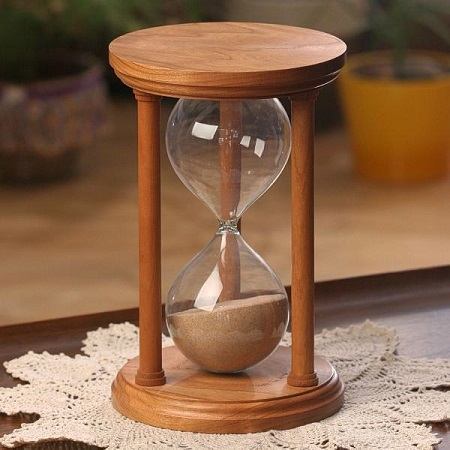
[Image courtesy of Just Hourglasses.com.]

QUESTION 1: If you have a 7-minute hourglass and an 11-minute hourlass, how can you boil an egg for exactly 15 minutes?

A variation on the two jugs of water puzzle we’ve covered before, this puzzle is basically some simple math, though you need to be a little abstract with it.

  • Step 1: Start boiling the egg and flip over both hourglasses.
  • Step 2: When the 7-minute hourglass runs out, flip it over to start it again. (That’s 7 minutes boiling.)
  • Step 3: When the 11-minute hourglass runs out, the 7-minute hourglass has been running for 4 minutes. Flip it over again. (That’s 11 minutes boiling.)
  • Step 4: When the 7-minute hourglass runs out, another 4 minutes has passed, and you’ve got your 15 minutes of egg-boiling time.

QUESTION 2: Name the next number in the following sequence: 1, 11, 21, 1211, 111221, 312211, _____.

The answer is 13112221. This looks like a math or a pattern-matching puzzle, but it’s far more literal than that.

Each subsequent number describes the number before it. 11, for instance, isn’t eleven, it’s one one, meaning a single one, representing the number before it, 1.

The third number, 21, isn’t twenty-one, it’s “two one,” meaning the previous number consists of two ones, aka 11.

The fourth number, 1211, translates to “one two, one one,” or 21. The fifth number, 111221, becomes “one one, one two, two one.” And the sixth, 312211, becomes “three one, two two, one one.”

So, the number we supplied, 13112221, is “one three, one one, two two, two one.”
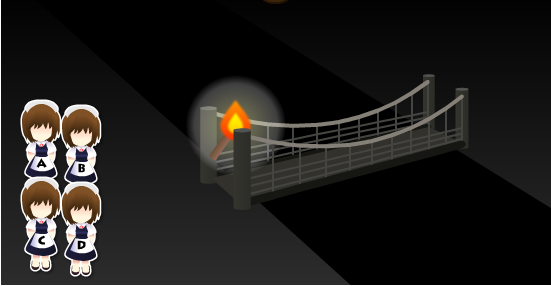

[Image courtesy of Do Puzzles.]

QUESTION 3: Four people want to cross a river, but the only option is a narrow bridge. The bridge can only support two people at a time. It’s nighttime, and the group has one torch, which they’ll need to use every time they cross the bridge. Person A can cross the bridge in 1 minute, Person B in 2 minutes, Person C in 5 minutes, and Person D in 8 minutes. When two people cross the bridge together, they must move at the slower person’s pace. Can all four get across the bridge in 15 minutes or less?

Yes, you can get all four across the bridge in 15 minutes.

This one’s a little tougher, because people have to cross the bridge in both directions so that the torch remains in play. Also, there’s that pesky Person D, who takes so long to get across.

So what’s the most time-efficient way to get Person D across? You’d think it would be so send D across with Person A, so that way, you lose 8 minutes with D, but only 1 minute going back with the torch with A. But that means only 6 minutes remain to get A, B, and C across. If you send A and C together, that’s 5 minutes across with C, and 1 minute back with A, and there’s your 15 minutes gone, and A and B aren’t across.

So the only logical conclusion is to send C and D across together. That’s 8 minutes down. But if you send C back down, that’s another 5 minutes gone, and there’s no time to bring A, B, and C back across in time.

So, C and D have to cross together, but someone faster has to bring the torch back. And suddenly, a plan comes together.

  • Step 1: A and B cross the bridge, which takes 2 minutes. A brings the torch back across in 1 minute. Total time used so far: 3 minutes.
  • Step 2: C and D cross the bridge, which takes 8 minutes. B brings the torch back across in 2 minutes. Total time used so far: 13 minutes.
  • Step 3: A and B cross the bridge again, which takes 2 minutes. Total time used: 15 minutes.

(It technically doesn’t matter if A returns first and B returns second or if B returns first and A returns second, so long as they are the two returning the torch.)


QUESTION 4: During a recent census, a man told a census taker that he had three children. When asked their ages, he replied, “The product of their ages is 72. The sum of their ages is the same as my house number.” The census taker ran to the man’s front door and looked at the house number. “I still can’t tell,” she complained. The man replied, “Oh, that’s right, I forgot to tell you that the oldest one likes chocolate pudding.” The census taker then promptly wrote down the ages of all three children. How old are they?

Their ages are 3, 3, and 8.

Let’s pull the relevant information from this puzzle to get started. There are three children, and the product of their ages is 72.

So let’s make a list of all the three-digit combinations that, when multiplied, equal 72: 1-1-72, 1-2-36, 1-3-24, 1-4-18, 1-6-12, 1-8-9, 2-2-18, 2-3-12, 2-4-9, 2-6-6, 3-3-8, 3-4-6. We can’t eliminate any of them, because we don’t know how old the man is, so his children could be any age.

But remember, after being told that the sum of the children’s ages is the same as the house number, the census taker looks at the man’s house number, and says, “I still can’t tell.” That tells us that the sum is important.

Let’s make a list of all the sums of those three-digit combinations: 74, 39, 28, 23, 19, 18, 22, 17, 15, 14, 14, 13.

The census taker doesn’t know their ages at this point. Which means that the sum has multiple possible combinations. After all, if there was only one combination that formed the same number as the house number, the census taker would know.

And there is only one sum that appears on our list more than once: 14.

So the two possible combinations are 2-6-6 and 3-3-8.

The chocolate pudding clue is the deciding fact. The oldest child likes chocolate pudding. Only 3-3-8 has an oldest child, so 3-3-8 is our answer.

[Image courtesy of Indy Props.com.]

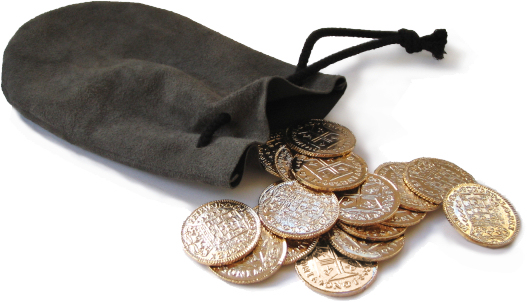
QUESTION 5: There are five bags of gold that all look identical, and each contains ten gold pieces. One of the five bags has fake gold, though. All five bags are identical, and the real gold and fake gold are identical in every way, except the pieces of fake gold each weigh 1.1 grams and the pieces of real gold each weigh 1 gram. You have a perfectly accurate digital scale available to you, but you can only use it once. How do you determine which bag has the fake gold?

With only one chance to use the scale, you need to maximize how much information you can glean from the scale. That means you need a gold sample from at lesst four bags (because if they all turn out to have real gold, then the fifth must be fake). But, for the sake of argument, let’s pull samples from all five bags.

How do we do this? If we pull one coin from each bag, there’s no way to distinguish which bag has the fake gold. But we can use the variance in weight to our advantage. That .1 difference helps us.

Since all the real gold will only show up before the decimal point, picking a different number of coins from each bag will help us differentiate which bag has the fake gold, because the number after the decimal point will vary.

For instance, if you take 1 coin from the first bag, 2 coins from the second, 3 coins from the third, 4 coins from the fourth, and 5 coins from the fifth, you’re covered. If the fake gold is in the first bag, your scale’s reading will end in .1, because only one coin is off. If the fake gold is in the second bag, your scale’s reading will end in .2, because two coins are off. And so on.


Thanks for visiting PuzzleNation Blog today! Be sure to sign up for our newsletter to stay up-to-date on everything PuzzleNation!

You can also share your pictures with us on Instagram, friend us on Facebook, check us out on TwitterPinterest, and Tumblr, and explore the always-expanding library of PuzzleNation apps and games on our website!

The September Deluxe Puzzle Set has arrived!

September is here, Labor Day is around the corner, school is back in session, and we’re celebrating the way we know best: by launching a new puzzle set for the Penny Dell Crosswords App!

Our September Deluxe puzzle set just launched for both iOS and Android users, and it offers the quality solving experience you’ve come to expect from PuzzleNation!

Add some puzzly fun to your long weekend by indulging in this marvelous puzzle bundle, designed for any skill level!

Offering 30 easy, medium, and hard puzzles, plus 5 September-themed bonus puzzles to delight solvers of all skill levels, the September Deluxe puzzle set is the perfect activity for a quiet moment, now that the kids are back in school, or a relaxing few minutes on the porch!

But that’s not all!

That’s right, double down on puzzle goodness with the September Deluxe Combo! That’s 70 puzzles, including September-themed bonus crosswords for your puzzly pleasure!

But maybe you need more! Maybe, just maybe, you’re hungry for more puzzles. And if you want the most bang for your buck, we’ve got you covered with the September Deluxe Bundle! That’s 105 puzzles, three times the crafty clues and cagey crosswords, ready for you to solve!

You can’t go wrong with these awesome deals! PuzzleNation is dedicated to bringing you the best puzzle-solving experience available, with world-class puzzles right in your pocket, ready to go at a moment’s notice! That’s the PuzzleNation guarantee.

Happy solving everyone!


Thanks for visiting PuzzleNation Blog today! Be sure to sign up for our newsletter to stay up-to-date on everything PuzzleNation!

You can also share your pictures with us on Instagram, friend us on Facebook, check us out on TwitterPinterest, and Tumblr, and explore the always-expanding library of PuzzleNation apps and games on our website!

Delving into the BosWords puzzles!

I finally had a chance to sit down and try my hands at the puzzles from the BosWords Crossword Tournament earlier this month. Given the talent involved, I had high expectations, and I was not disappointed.

So let’s put them under the microscope and see what’s what!


Homeroom: Circles of Friends by John Lieb

The unscored opening puzzle in this year’s tournament was a warm-up to get everyone in the mood to solve. Its theme was simple and accessible: The circled letters in each long answer — the first two letters and the last two letters — spelled a synonym for “friend” (DU and DE in DUAL ACTION BLADE).

Interesting grid entries included OLD ELI, TREVOR NOAH, LEMUR, and PONY UP, and my favorite clues were “One taken for a ride” for SAP and “Luke Skywalker saw two from Tatooine” for SUNS.

Puzzle 1: Summer Vacation by Laura Braunstein

A very smooth, very fair solving experience, Puzzle 1 is exactly what the first scored puzzle of a tournament should be. It sets the tone, the difficulty, and whets your appetite for more. The clever use of SCHOOL’S OUT as a revealer for the game — phrases where SCHOOL has been swapped for OUT, as in SECONDARY OUT — even has the pleasant side effect of getting the song stuck in your head.

Interesting grid entries included TROTSKY, CAT SCAN, and X FACTOR, and my favorite clues were “‘Ghostbusters’ vehicle, before it was Ecto-1″ for HEARSE and “They might get smashed at parties” for PINATA.


I have no notes for Puzzle 2, because it wasn’t included in my Solve at Home packet. The puzzle, constructed by Andrew Kingsley and John Lieb, was used in the tournament with Will Shortz’s permission (as it was already earmarked for The New York Times).

The puzzle was published on Wednesday, August 16, if you’re interested.


Puzzle 3: Trade Schools by Brendan Emmett Quigley

It appears that Puzzle 3 will be BosWords’s version of the American Crossword Puzzle Tournament’s infamous Puzzle 5, as this was the toughest themed puzzle in the set. However, as you’d expect from a Quigley puzzle, there was lots of intriguing fill, and a diabolical theme: long phrases that included the name of a college, but the college was swapped with the name of another college in another themed entry.

For instance, the answer THIN WHITE RICE would normally read THIN WHITE DUKE, but Duke was transferred to another line, where instead of BROWN-EYED GIRL, the answer was DUKE-EYED GIRL. All four theme entries had the name of a different college substituted in for the college that would normally appear in that phrase.

I confess, it took me a while to unravel just how this theme worked. Factor in the longer fill entries crossing those themed entries, and you’ve got a tough, topnotch puzzle.

Interesting grid entries included MALFOYS, DAME EDNA, CASSINI, DEEP FRYER, and EPONYM, and my favorite clues were “Egg foo yung, essentially” for OMELET and “It may be used by Colonel Mustard” for ROPE.

Puzzle 4: Why You Failed English by Joon Pahk

This puzzle, which played on those books we were all required to read in school, was lighter than Puzzle 3, but still kept solvers on their toes with engaging fill. (Likening “Of Mice and Men” to “Stuart Little” is hilariously audacious.)

Interesting grid entries included MONSANTO, FAN MAIL, BANFF, and HOHOS, and my favorite clues were “Paper tigers, perhaps” for ORIGAMI and “Long line at a wedding reception?” for CONGA.

Tiebreaker by Andrew Kingsley

This themeless puzzle — intended to settle any ties going into the final — had some impressively long entries crossing at the corners, making for a great solve overall.

Interesting grid entries included CRAPSHOOT, RECHERCHE, PLOT TWIST, EVANESCE, POKEMON, and ARIGATO, and my favorite clues were “Paris was too much for him” for ACHILLES and “Set back?” for SCENERY.

Championship: Final Exam by David Quarfoot

A themeless challenging enough to rival Quigley’s themed Puzzle 3, this tournament closer was well constructed and engaging, really testing solvers’ creativity, wordplay, and vocabulary. I don’t think I would have completed it in the time allotted, let alone fast enough to do well against fellow solvers.

Interesting grid entries included BINGE WATCH, IN LALALAND, DADBOD, TRUMP U, and TEA CADDY, and my favorite clues were “Eventful activities?” for DECATHLONS, “Common note designee” for SELF, and “Floral drawing?” for NECTAR.

There was also a fun, themed bonus puzzle, You’ll Have to Be There by John Lieb, included for At Home solvers, which serves as either a nice closer to the day’s solving or a second warm-up puzzle.


Overall, I was fairly impressed by the puzzles offered at BosWords. They weren’t as freewheeling as the ones typically offered at The Indie 500 or Lollapuzzoola. But they were a little bit easier than the offerings at The American Crossword Puzzle Tournament, which makes this a wonderful intermediate-difficulty event to introduce new solvers to a timed, tournament environment.

It seems like the right mix of challenge and creativity for solvers accustomed to NYT-style solving, and I think the constructors and organizers did one heck of a job putting together the tournament.

Here’s hoping next year’s BosWords is an even greater success.


Thanks for visiting PuzzleNation Blog today! Be sure to sign up for our newsletter to stay up-to-date on everything PuzzleNation!

You can also share your pictures with us on Instagram, friend us on Facebook, check us out on TwitterPinterest, and Tumblr, and explore the always-expanding library of PuzzleNation apps and games on our website!
PN Trivia Scavenger Hunt: Answers & Winner!

[Image courtesy of Alaris Health.]

Thank you to everyone who entered our anniversary trivia scavenger hunt! Plenty of solvers, puzzlers, and PuzzleNationers tried their hand at answering all five questions before the deadline at midnight on Wednesday, and many succeeded!

Alas, there can be only one winner. But before we get to that, let’s look at the answers, shall we?


PuzzleNation Anniversary Trivia Scavenger Hunt

1.) One of my favorite recurring features is Puzzles in Pop Culture, where I explore puzzly moments in television, film, and literature. We’ve discussed Sherlock, Hell’s Kitchen, and even Gilmore Girls in installments of Puzzles in Pop Culture.

Question: How do you solve the four gallons of water puzzle?

Answer: There were actually two answers featured in the August 19, 2014 post “Puzzles in Pop Culture: Die Hard with a Vengeance” referenced in this question. Here’s the answer our winner submitted:

1. Fill the 3-gallon jug and pour the water into the 5-gallon jug.
2. Refill the 3-gallon jug and pour the water into the 5-gallon jug until the 5-gallon jug is full, leaving 1 gallon in the 3-gallon jug.
3. Empty the 5-gallon jug and pour the 1 gallon of water from the 3-gallon jug into the 5-gallon jug.
4. Fill the 3-gallon jug again and empty it into the 5-gallon jug, leaving exactly 4 gallons in the 5-gallon jug.


2.) You can’t talk about puzzles without also discussing games, because there’s so much overlap between the two. Game reviews from a puzzle solver’s perspective have become a part of the fabric of PuzzleNation Blog, as has creating your own puzzles and games from scratch.

Question: What’s the name of the DIY game that only requires a bunch of identical blank pieces of paper (like index cards) and something to write with?

Answer: Discussed in our September 15, 2015 post “DIY Pencil and Paper Puzzles,” this game is known as 1000 Blank White Cards.


3.) Naturally, if you’re going to talk puzzles, Sudoku is going to be part of the conversation sooner rather than later. We’ve not only explored the history of Sudoku here, but we’ve been a part of it, debuting brand-new Sudoku variants created by topnotch constructors.

Question: What do you call two overlapping Samurai Sudoku?

Answer: We posted many different Sudoku variants in our December 4, 2014 post “The Wide World of Sudoku,” but the puzzle in question is known as Shogun Sudoku.


4.) A fair amount of puzzle history, both past and present, has been covered here over the last five years. We’ve examined cryptography in the American Revolution, the Civil War, both World Wars, and beyond. We’ve celebrated the one-hundredth anniversary of the crossword. And we’ve even discussed scandals in the puzzle world.

Question: What are the names of the programmer and crossword constructor who first uncovered the curious pattern of puzzle repetition in USA Today and Universal Uclick puzzles that eventually led to the ouster of Timothy Parker?

Answer: As discussed in a series of posts entitled “Puzzle Plagiarism,” the programmer’s name is Saul Pwanson and the constructor’s name is Ben Tausig.


5.) In the Internet age, memes and fads appear and disappear faster than ever. A picture or a joke or a news story can sweep the world in a matter of hours, and then vanish forever. On a few occasions, the Internet has become obsessed with certain optical illusions, and we’ve done our best to analyze them from a puzzler’s perspective.

Question: The creators of The Dress appeared on what talk show to put the mystery to bed once and for all?

Answer: Discussed on March 6, 2015 in a Follow-Up Friday post, the mystery of The Dress was laid to rest on The Ellen DeGeneres Show.


[Image courtesy of ClipArt Panda.]

And now, without any further ado, we’d like to congratulate our winner, who shall remain nameless. After all, like a lottery winner, she doesn’t want to be mobbed by those hoping for a piece of the action. =)

She’ll be receiving her choice of either a Penny Dell Crosswords App puzzle set download OR a copy of one of the puzzle games we’ve reviewed this year!

Thank again to everyone for playing and for celebrating five years of PuzzleNation Blog with us. We truly could not have done it without you!


Thanks for visiting PuzzleNation Blog today! Be sure to sign up for our newsletter to stay up-to-date on everything PuzzleNation!

You can also share your pictures with us on Instagram, friend us on Facebook, check us out on TwitterPinterest, and Tumblr, and explore the always-expanding library of PuzzleNation apps and games on our website!

PuzzleNation Product Review: Nanofictionary

[Note: I received a free copy of this product in exchange for a fair, unbiased review. Due diligence, full disclosure, and all that.]

We’re used to puzzles where you have to combine pieces to reveal a picture, or you use clues to complete a grid, or you employ deduction to unravel a series of events. It’s far less common for puzzlers to put those skills to use telling a story.

The latest offering from the crafty crew at Looney Labs challenges players to do precisely that: tell a story. More specifically, Nanofictionary tasks you with telling the best story possible from the ingredients available.

And you better do it quickly. Imagine you’re pitching a movie and you’ve only got the length of an elevator ride to sell it to a producer.

Nanofictionary offers up to six players a selection of four decks of cards: characters, settings, problems, and resolutions. Each player draws a starting hand, consisting of two characters, one setting, one problem, and one resolution. Players then try to build an entertaining narrative from the options at hand, by drawing and discarding cards, before declaring themselves ready to pitch.

Here is the first element of strategy in the game: deciding when you’re ready to present your story. If you do so quickly, you secure an earlier slot than the other players. Although this means other players can add additional cards to their hands (and thereby enhance their stories), it also means that ties are settled in favor of players who readied their stories faster. It’s a tradeoff, more cards in the short term vs. a tactical advantage in the long term.

After everyone has assembled their stories, each player has a turn performing their elevator pitch, doing so in the order in which they declared themselves ready. After all the stories are shared, the players then vote for their favorite story. (Naturally, to prevent every player from doing so, you cannot vote for yourself.)

Nanofictionary is an intriguing mix of strategy, luck, and ingenuity. The strategy involves not only when to declare your story ready, but what choices you make to get there. Do you choose the unexpected new card on your turn, or rifle through the cards discarded by the other players? Do you wait for a few other players to declare their stories ready, allowing yourself access to more cards in your hand, or do you go for the tie-breaking advantage you might need?

Luck, of course, comes into play with the cards you randomly draw. Perhaps you’ll end up with elements that quickly form an entertaining tale in your mind. Or perhaps you’ll struggle to ditch the pieces that don’t inspire you, hoping to trade them for a more exciting setting or a problem that makes the most of the characters in your hand.

But, as you might expect, the ingenuity side is where the game comes alive. Just sitting back and watching these delightfully brief (and yet hilariously detailed) stories come to life is a real treat, and quite honestly, it makes the voting aspect so hard. Because with the right group of players, virtually any combination of cards can turn into gold with the right storyteller.

The designers fit a surprising amount of variety and reusability into these four small decks of cards, allowing storytellers to run wild with tales as fantastic as they are ridiculous. It’s not your usual puzzle game, but that’s part of the charm.

Nanofictionary is available now from Looney Labs and select participating retailers for $16.


Thanks for visiting PuzzleNation Blog today! Be sure to sign up for our newsletter to stay up-to-date on everything PuzzleNation!

You can also share your pictures with us on Instagram, friend us on Facebook, check us out on TwitterPinterest, and Tumblr, and explore the always-expanding library of PuzzleNation apps and games on our website!