PuzzleNation Product Review: Lexicon-GO!

[Note: I received a free copy of this game in exchange for a fair, unbiased review. Due diligence, full disclosure, and all that. And this concludes the disclaimer.]

You might think that if you’ve seen one letter-tile game, you’ve seen them all. But you’d be wrong.

Every word-forming game, from great-granddaddy Scrabble on down, has its own quirks and idiosyncrasies, and some of them have tricks up their sleeves that make for a truly unique puzzle game experience.

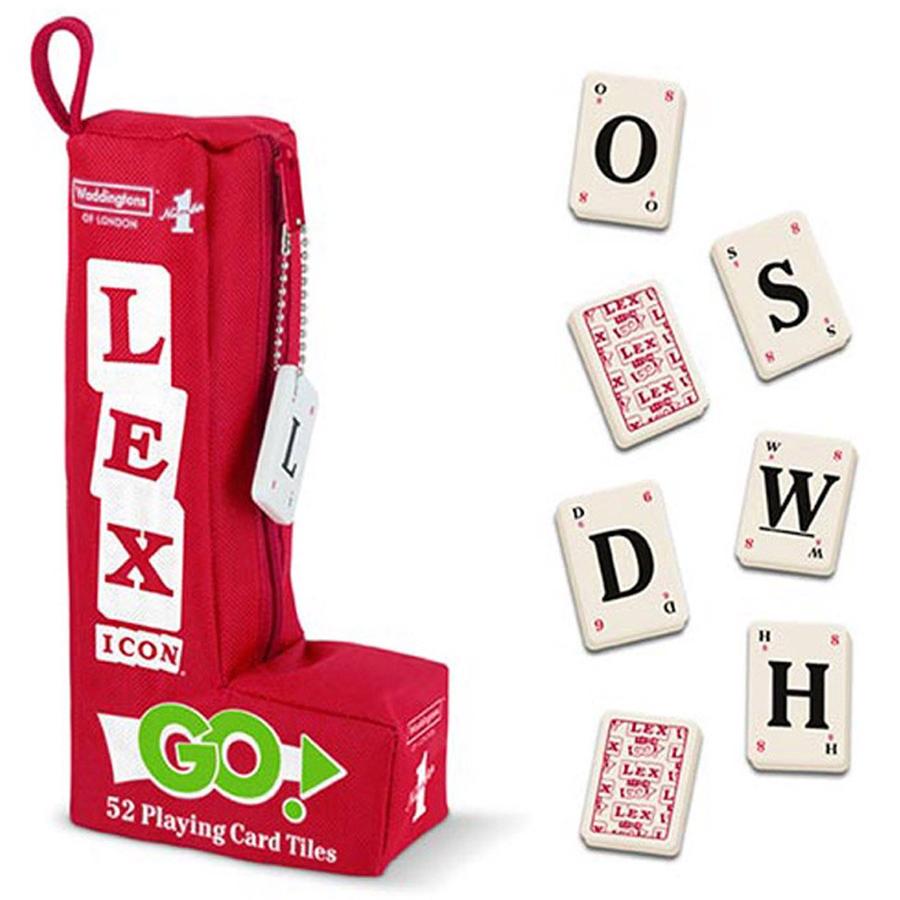
And very few of them have the urgency of Lexicon-GO!, a travel-friendly game distributed by Winning Moves UK.

Designed for 2-4 players, ages 8 and up, Lexicon-GO! is as devilishly simple as it is frenetic.

Each player draws ten tiles from the draw pile, and tries to form words with all ten of them faster than their opponents.

And not just any words will do. There are no one-letter words, plurals, proper nouns, acronyms, and abbreviations allowed as answer words.
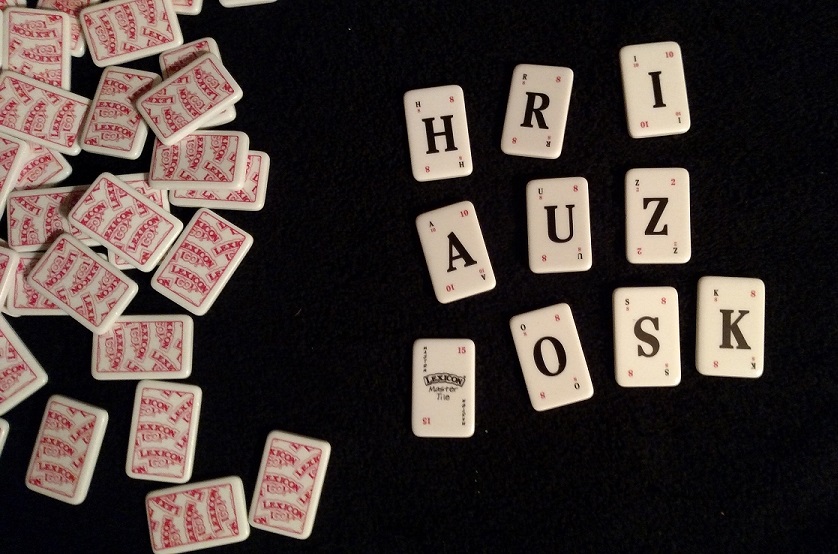
In most letter-tile games, it’s all about your own anagramming and word-forming skills; there’s very little direct interaction with your opponents. (Unless you’re both going for the same tile in the draw pile, that is.)

But Lexicon-GO! rewards both interactive thinking and aggressive, advantageous play. You can add your letters to the words being formed by other players (adding a T to the word SKI below to make SKIT, for instance).

Or you could swap out a letter in another player’s word with one of your own (making ZAP into ZIP and taking the A, or making SKI into SKY and taking the I, for instance).

Of course, this move only works if you’re forming a new, acceptable word. You can’t just throw in any letter and steal one you need.
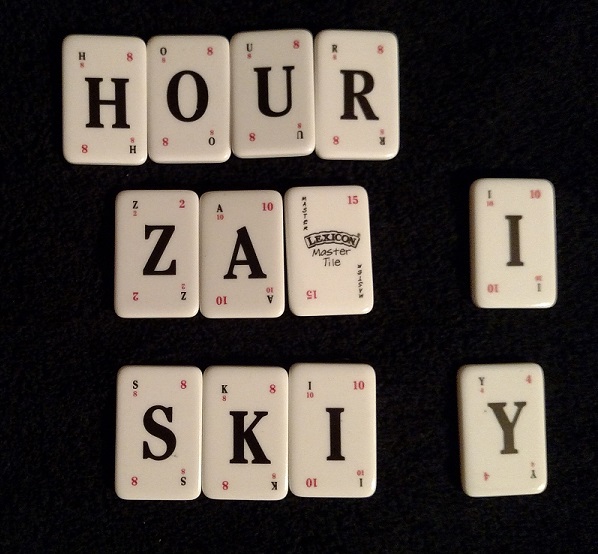
[Once the wild card title is set, it remains that letter for the rest of the round, even if another player steals it. Until this round is done, for instance, the master tile is a P.]

Be the first one to use or dispose of all ten of your letters, and you win the round. The first player to win five rounds wins the game!

(Naturally, we’ve found that most players tend to focus on simply forming their words the fastest, ignoring chances to interact with and/or sabotage their opponents. So we introduced a house rule that every player must either swap a letter with another player’s word or add a letter to another player’s word. It certainly made for more strategic and chaotic gameplay!)

Now, you may have noticed that the tiles also have number values, not unlike the tiles in Scrabble and other tile-scoring games.

That’s because there’s a second path to victory, if you play Original Lexicon (or Master Lexicon) rules, which are helpfully provided with the game.

In Original Lexicon, the rules are the same, including winning a round by being the first to use or dispose of all ten tiles. But instead of everyone else simply conceding the round, they instead add up the point values of their letter tiles. After a few rounds, any player who passes 100 points is out, and the last player standing wins.

That variation makes the game much more tactical. If you know other players are faster at word-forming and anagramming than you, you can mitigate the damage to your score by getting rid of high-value tiles through swapping with the draw pile or adding your letters to the words of other players.

The larger tiles do mean that the game contains fewer letter tiles than other letter-tile games, which might hamper replayability in the long run.

Of course, on the flip side, larger tiles mean that both younger players and older players (who might have visual impairment issues, for instance) can enjoy Lexicon-GO! more than a game with smaller letter tiles.

As always, there’s a trade-off in any design choice.

Lexicon-GO! builds on the strong reputation of the letter-tile games that preceded it, while adding to the genre in engaging, fun ways.

The focus on lightning-quick play (as well as the encouragement to deviously interact with other players) adds some pleasant spice to the genre, rewarding outside the box thinking and puzzle-solving for younger minds and older alike.

This game gives the letter-tile classics a serious run for their money.

Lexicon-GO! is available from Winning Moves UK, Barnes & Noble, Amazon, and other participating retailers.


Thanks for visiting PuzzleNation Blog today! Be sure to sign up for our newsletter to stay up-to-date on everything PuzzleNation!

You can also share your pictures with us on Instagram, friend us on Facebook, check us out on TwitterPinterest, and Tumblr, and explore the always-expanding library of PuzzleNation apps and games on our website!
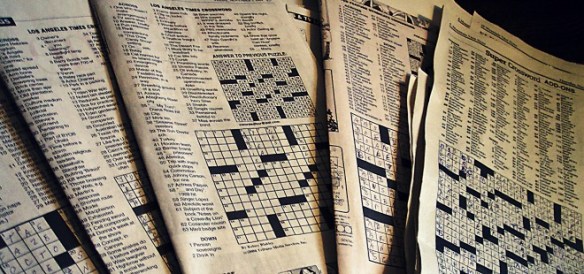
Novelty Crossword Songs!

Although the crossword as we know it celebrates its birthday on December 21, tracing its roots all the way back to 1913, it was the 1920s where crosswords really caught the public eye.

By 1924, crosswords had officially become a fad, inspiring fashion trends (black and white patterns) and moral panics alike.

But it was also the year of the novelty crossword song. Yes, crosswords found their way into the world of music, serving as inspiration for numerous comedic ballads.

Perhaps the most famous of the 1924 crossword songs is the curious “Crossword Mama, You Puzzle Me (But Papa’s Gonna Figure You Out).”

The subject of the song is an ardent puzzle solver, but the singer of the song is more bothered by the fact that he doesn’t have her full attention, painting her as someone who ignores him or flirts with other guys. He is clearly suspicious of her, and expresses his suspicions through crossword clue references.

[Although written and arranged by James V. Monaco and Sidney Clare,
this version of the song was recorded in 1925 by Frank Crumit.]

For example:

Crossword Mama you puzzle me,
But Papa’s gonna figure you out.
You call me honey – that means bee!
Looks like I’ll get stung no doubt.

Your Papa’s gonna crossword you right now,
You better get your answers right.
I heard you mention “butcher” – that means “meat”!
Who you gonna “meet” tonight?

The singer is clearly confused by both crosswords and the object of his affections. It would be best if he just left them both alone for a while.

Given how difficult some people find crosswords, you shouldn’t be surprised that there was a blues song penned about crosswords the same year.

“Cross-Word Puzzle Blues,” penned by Fred Herendeen and performed by The Duncan Sisters, is surprisingly upbeat, as the sisters describe themselves as “criss-cross crazy” and discuss their difficulties solving puzzles. It’s very silly indeed.

Be careful not to confuse this with the jazzier song by D.J. Michaud and Marguerite Bruce, “I’ve Got the Crossword Puzzle Blues,” featuring such tongue-in-cheek downbeat lyrics as “I’m feeling awfully down and cross / I spend all day solving, but I still don’t have a clue.”

(Unfortunately I couldn’t find a decent public recording of this one to share with you.)

There’s a strange recurring theme with these songs where women are primarily the solvers, and the men in their lives are utterly baffled by the pastime.

In a similar vein to the first song, “Cross-Words (Between Sweetie and Me)” is all about a man who feels spurned and underappreciated by his crossword-obsessed lady.

Sorrow has torn at my heart strings
I wonder who is to blame
My sweetie never has time for me
She’s deep in love with a game
Crosswords have made me blue as can be,
Cross, crosswords between my sweetie and me,
She’s been puzzling, don’t seem to care
Whether I’m near her or taking the air
I’m jealous. How can I win sympathy?
I’m hoping she’ll soon need L-O-V-E.

[Recording of Billy Jones from Edison Records, circa 1925]

He goes on to describe how a group of people solving crosswords were so quiet, he thought they had died, and he subsequently broke into the house to make sure they were all right.

Billy clearly has boundary issues, and although his sweetie might be spending too much time with crosswords, at least they’re keeping her away from her weird, weird paramour.


This is just a sampling from a single crossword-obsessed year. I’m sure there are many more puzzle-inspired songs out there. Do you know any? Let us know in the comments section below! We’d love to hear from you!


Thanks for visiting PuzzleNation Blog today! Be sure to sign up for our newsletter to stay up-to-date on everything PuzzleNation!

You can also share your pictures with us on Instagram, friend us on Facebook, check us out on TwitterPinterest, and Tumblr, and explore the always-expanding library of PuzzleNation apps and games on our website!

A Writing Prompt with a Puzzle/Game Twist!

I’m always on the hunt for different ways that puzzles have found their way into pop culture and society in general, and it never ceases to amaze me how ubiquitous puzzles can be.

I recently stumbled across a puzzly reference in a list of writing prompts intended to spark some creative scribbling:

A long while back, the world came to an end, and with it your favourite newspaper. For years you’ve been filling the idle hours between scrounging and scavenging by solving crosswords puzzles. You’ve got 50 years worth of backlogs, but now you’ve completed every single one.

Every single one except the most recent one. The final one, that is. The crossword puzzle that never got released because the world ended.

So now you’re on a journey through the post-apocalyptic wasteland to find the last puzzle, and finally complete your collection.

A dystopian tale with a puzzly hook? Sounds like a can’t-miss YA book to me!

It’s an intriguing pitch — for a story or a roleplaying campaign — and one that reminds me of David Steinberg and the Pre-Shortzian Puzzle Project, as they’re still on the hunt for 142 missing New York Times crosswords that weren’t published in New York.

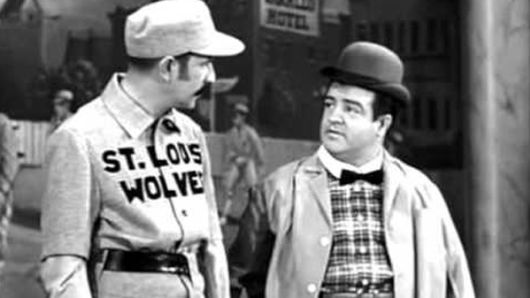
And, naturally, since my mind has wandered to puzzle-and-game-fueled scribblings, I simply must include this board game-inspired take on the classic Abbott and Costello routine “Who’s on First?” that a friend of mine penned. Enjoy!

Customer: Excuse me, do you sell this particular board game whose name I’ve forgotten, it’s like Parcheesi, only smaller and has a Pop-O-Matic dice rolling bubble in the middle.

Clerk: Are you looking for Trouble?

Customer: What? No! Sorry.

Clerk: Ah, we do have that. But without the dice popper.

Customer: What?

Clerk: Sorry.

Customer: No, it’s fine. I just want your opinion of the other game you have, if it’s no trouble.

Clerk: Well, it kind of is. According to some people.

Customer: Sorry?

Clerk: Yes.

Customer: You are fast becoming a source of aggravation.

Clerk: Oh, we have that one, too!

Customer: Argh! What. Game. Were you talking about before, and what’s your opinion?

Clerk: Sorry, and it’s no Trouble, if you ask me.

Customer: Well, great.

Clerk: So do you want that?

Customer: Huh?

Clerk: Or would you prefer Aggravation?

Customer: I’d rather you gave me a clue!

Clerk: Well that game’s nothing like Parcheesi.

Customer: Then why bring it up?

Clerk: I didn’t, you did!

Customer: Look, just… go.

Clerk: We don’t have that, but what about Othello?

Customer: ARGH!


As always, puzzles and games make everything better.

Thanks for visiting PuzzleNation Blog today! Be sure to sign up for our newsletter to stay up-to-date on everything PuzzleNation!

You can also share your pictures with us on Instagram, friend us on Facebook, check us out on TwitterPinterest, and Tumblr, and explore the always-expanding library of PuzzleNation apps and games on our website!

The Diabolical Art of Bar Bets

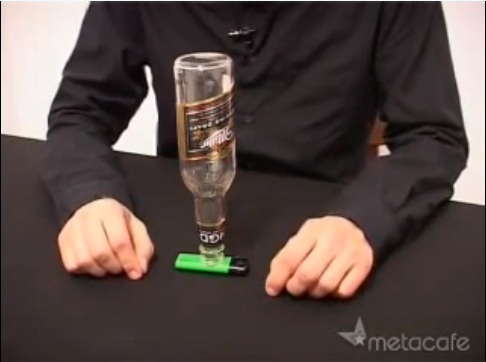
We discuss all sorts of time-honored puzzles and brain teasers here on the blog, but it’s not often that those discussions wander into the arena known as bar bets.

Simply put, bar bets are contests between two parties wherein money or free drinks are wagered on one’s ability to accomplish a given task. Sometimes, that task is answering a bit of trivia, or engaging in a feat of strength.

But more often than not, bar bets are brain teasers designed to separate a fool from his money.

And if you approach them like brain teasers, you have a better chance of holding onto your hard-earned dough.

You see, many of these bar bets are designed more like carnival games than fair wagers; there’s usually a trick involved, and your opponent is wagering on you playing by the rules, rather than out-thinking the game itself.

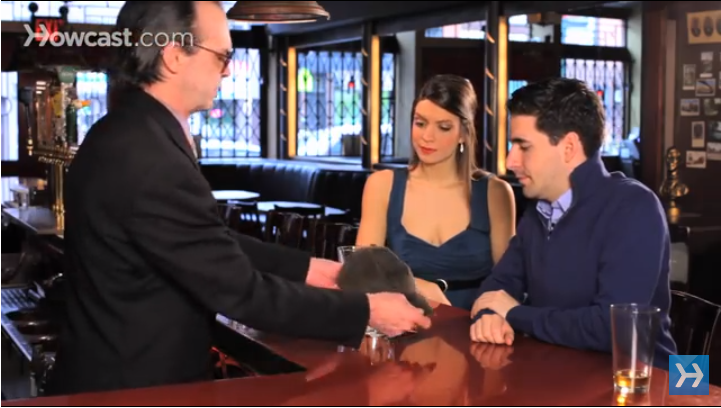
Example: the wager seems simple. There is a drink placed completely beneath a hat. You must drink the drink without touching the hat.

It seems impossible, but that’s where you must get creative. You can crouch down near the hat and make a slurping noise, and then declare that you’ve succeeded in drinking the drink. Your curious opponent is forced to lift the hat to check, and at that moment, grab the drink, down it, and you’ve won.

You adhered to the letter of the wager, but not the spirit. But that’s the name of the game.

Be careful, because some bar bets are based solely on wordplay.

Example: Tell your opponent to get a coin out of their pocket and set it under a drink coaster, ensuring that you don’t see it. The wager? That you’ll be able to tell them the date.

As you wave your hand over the coaster, as if doing a magic trick, simply announce today’s date. After all, you weren’t specific. You just said you’d tell them the date, not necessarily the date on the coin.

A similar one involves wagering that you can stay underwater for any particular length of time. Once you make the wager, simply hold a glass of water over your head for that amount of time.

A little cheap? Sure. But hey, a bar bet is a bet. And the devil is in the details.

Some bar bets, though, come down to technique. You present a seemingly impossible task, and then accomplish it in a clever way.

For example, my favorite bar bet: You have a glass (a wine glass, a shot glass, whatever), with a coaster (or business card) on top of it. Atop the coaster is a cigarette, standing on end. And atop the cigarette is a coin.

The wager? Put the coin into the glass without touching the glass, coaster, cigarette, or coin.

There’s no wordplay, no trickery, and no deceit here. This one is all about gravity.

You see, the coaster and the cigarette are light, while the coin is not. If you crouch down below the glass and blow upward, you’ll be able to push aside the coaster and cigarette, leaving the coin to fall straight down into the now-open glass.

Easy. Once you know how it’s done, that is.


What’s your favorite puzzly wager, fellow puzzlers and PuzzleNationers? Do you have a favorite bar bet, trick, or crafty challenge up your sleeve that leaves others befuddled?

Let us know in the comments below! We’d love to hear from you.


Thanks for visiting PuzzleNation Blog today! Be sure to sign up for our newsletter to stay up-to-date on everything PuzzleNation!

You can also share your pictures with us on Instagram, friend us on Facebook, check us out on TwitterPinterest, and Tumblr, and explore the always-expanding library of PuzzleNation apps and games on our website!

The October PN/Escape 101 Promotion Starts Today!

A few weeks ago, we featured local escape room company Escape 101 in our latest edition of Citizen Shoutout!

And the crew at Escape 101 offered an awesome deal to all PuzzleNation users!

For the entire month of October, if you make a reservation for a room at Escape 101 and you have one of the PuzzleNation puzzle apps on your phone, you can show it to them at the door and they’ll give you a 10% discount on the entire booking!

That’s right, whether it’s Daily POP Crosswords, Penny Dell Crosswords, Penny Dell Sudoku, or Penny Dell Crosswords Jumbo 1, 2, or 3, being a PuzzleNation solver will give you a discount on a terrific solving experience.

You can call or email Escape 101 to reserve a room, or book a room through their website. (It’s always best to do so at least a few days out from your desired date and time, just to give them the best chance to meet your expectations.)

You can check out more of the Escape 101 experience in our Citizen Shoutout post or on the Escape 101 website.

They’ve got something for all skill levels. If you’ve never done an escape room before, the Ice Cream Truck room is the perfect introduction. And if you’re looking for a serious challenge, the Doomsday room will test your puzzly mettle.

With those and two other rooms to choose from, you’re guaranteed to find the right fit for you and your fellow solvers!

Enjoy! And let us know when you do! We’d love to hear from you!

Heck, we might even see you there!


Thanks for visiting PuzzleNation Blog today! Be sure to sign up for our newsletter to stay up-to-date on everything PuzzleNation!

You can also share your pictures with us on Instagram, friend us on Facebook, check us out on TwitterPinterest, and Tumblr, and explore the always-expanding library of PuzzleNation apps and games on our website!

This Puzzle Solves Itself!

The slow, steady march of technological advancement in all fields continues to progress, and the world of puzzles is no exception. In previous blog posts, we’ve discussed not only technological leaps forward in making puzzles (like 3-D printers), but also new developments in solving puzzles.

We’ve joked that robots are coming for our puzzles, thanks to advanced machines and AI programs that can play games like chess, Go, and Scrabble on par with — and sometimes, far better than — human experts.

It’s the same with Rubik’s Cubes and other twisty puzzles. Even though speed solvers continue to break new ground in terms of sheer speed and efficiency, we can’t compete with robots that solve cubes in the blink of an eye.

And now, it seems we’ve reached the natural end of this journey…

A self-solving Rubik’s Cube.

Check it out:

The creation of a Japanese technician and self-styled “hardware hacker,” this Rubik’s Cube is the same size as the traditional cube, but the similarities end there.

Instead of the traditional plastic network of connections that allows you to twist and turn the cube every which way, this cube is packed to the gills with electronics, wiring, a series of motors, and the interconnected pieces that give the Rubik’s Cube its signature movement and flexibility.

A marvel of miniaturization and design, this self-solving Rubik’s Cube clearly has its own built-in solving algorithm. It doesn’t simply memorize the twists employed to scramble the cube and then reverse them; the solution and scrambling are completely different chains of events.

All in all, it’s a thoroughly impressive creation. Of course, if I’d known there were going to be self-solving Rubik’s Cubes, I wouldn’t have wasted so much time trying to solve one myself!


Thanks for visiting PuzzleNation Blog today! Be sure to sign up for our newsletter to stay up-to-date on everything PuzzleNation!

You can also share your pictures with us on Instagram, friend us on Facebook, check us out on TwitterPinterest, and Tumblr, and explore the always-expanding library of PuzzleNation apps and games on our website!