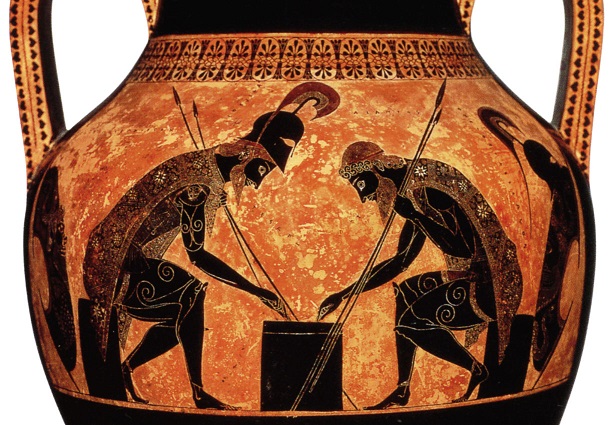
The Curious World of Ancient Board Games

A few weeks ago, we delved into the surprisingly deep history behind games still commonly played today, like Go, chess, and various dice games. But we barely scratched the surface when it comes to ancient gaming. There are numerous games that fell out of favor centuries ago, only to be resurrected in the modern day by game enthusiasts and historians.

In today’s blog post, I’d like to dust off a few of these ancient games and briefly discuss what we know about them. It’s game history time!

[Image courtesy of Wikipedia.]

A popular Viking game whose heyday was between the fourth and twelfth centuries, Hnefatafl was a popular game throughout Scandinavia. This mouthful of a game — sometimes called Viking chess by modern game fans — was so ubiquitous back then that it was mentioned in several of the Norse Sagas.

Amazingly, although game pieces and fragments of game boards have been recovered, no one is entirely sure how the game is played, so rules have been reconstructed based on a similar game called Tablut.

Translated as “board game of the fist,” Hnefatafl is part of a family of games called Tafl games, all of which take place on a checkerboard-style play space with an uneven number of game pieces.
[Image courtesy of Wikipedia.]

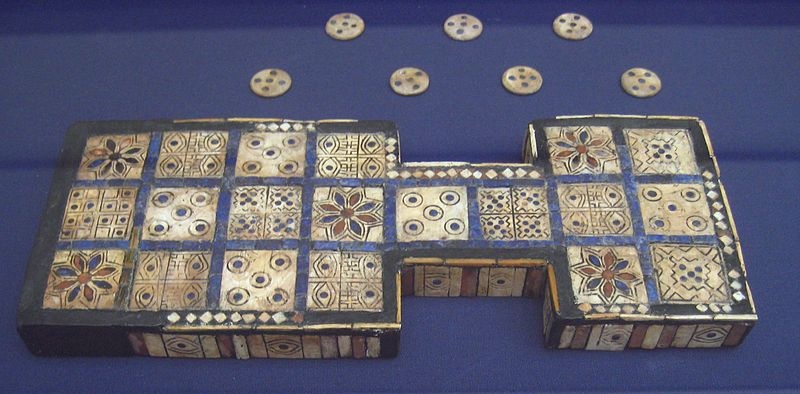
Unlike Hnefatafl, the Royal Game of Ur has survived the centuries pretty much unscathed, thanks to a copy of the rules recorded on a Babylonian tablet. Played in the Middle East centuries ago — in places like Syria and Iran — the Royal Game of Ur was clearly popular, as evidence of the game has been found as far away from the Middle East as Crete and Sri Lanka.

The game and its trappings penetrated deep into Middle Eastern society. An Ur game board was carved like graffiti into a wall in the palace of Sargon II (dating back to the 700s BC). The Babylonian tablet indicates that certain game spaces were believed to be good omens, and could be interpreted as messages from the beyond.

The game was eventually either supplanted by backgammon or evolved into a version of backgammon, depending upon different historical accounts.

[Image courtesy of Chess Variants.com.]

Tori Shogi dates back to 1799 in Japan. Also known as Bird chess — thanks to game tiles named after phoenixes, cranes, and swallows — Shogi is played on a board seven squares wide and seven squares deep.

Unlike many chess variants, Tori Shogi allows for captured pieces to return to play, a nice twist that deepens the familiar gameplay style.
[Image courtesy of Bodleian Libraries.]

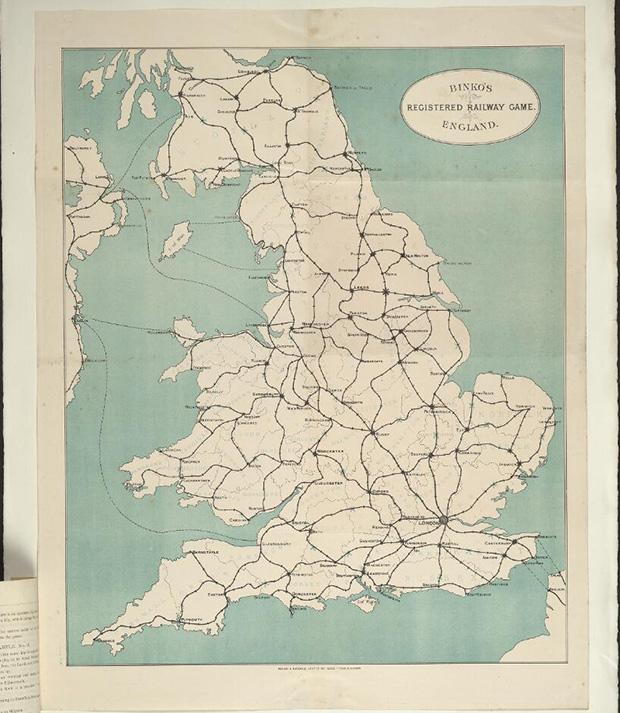
But chess and backgammon aren’t the only games with centuries-old precursors. The geographical game Ticket to Ride also has an aged forebearer in Binko’s Registered Railway Game, which was built around a map of the United Kingdom.

An educational game about placing trains on the map and determining how far they travel, this game has survived the decades relatively unscathed by time.


Those are just four examples of games that were either lost and then rediscovered, or games that fell out of favor, only to be resurrected by curious modern players.

And once again, these games are just the tip of the iceberg. There are centuries-old versions of The Game of Life, Parcheesi, a dating game, checkers, and more when you start digging!

As you can see, games have been a part of human civilization dating back millennia. We were always meant to play puzzles and games, it seems.


Thanks for visiting PuzzleNation Blog today! Be sure to sign up for our newsletter to stay up-to-date on everything PuzzleNation!

You can also share your pictures with us on Instagram, friend us on Facebook, check us out on TwitterPinterest, and Tumblr, and explore the always-expanding library of PuzzleNation apps and games on our website!

Computer Program Teaches Itself to Solve Rubik’s Cubes!

I tried to warn you, fellow puzzlers.

I wrote posts about computer programs that play chess, Scrabble, Go, Atari games, and Jeopardy! I wrote posts about programs that solve crosswords. I even wrote posts about robots that solve Rubik’s Cubes in a fraction of a second.

And they’re getting smarter.

Say hello to DeepCube, an AI program that is now the equal of any master Rubik’s Cube solver in the world at solving 3x3x3 cubes.

And unlike other AI programs that have learned to play games like chess and Go through reinforcement learning — determining if particular moves are bad or good — DeepCube taught itself to play by analyzing each move, comparing it to a completed cube, and reverse-engineering how to get to that move.

It’s labor-intensive, yes, but it also requires no human intervention and no previous information. Chess-playing programs like Deep Blue work by analyzing thousands of previously played games. But DeepCube had no previous history to build on.

It started from scratch. By itself.

And became a Rubik’s Cube master.

In only 44 hours.

Compare that to the 10,000 hours it supposedly takes for a human to become an expert in anything, and that’s a mind-blowing accomplishment.

[Image courtesy of YouTube.]

From the Gizmodo article on DeepCube:

The system discovered “a notable amount of Rubik’s Cube knowledge during its training process,” write the researchers, including a strategy used by advanced speedcubers, namely a technique in which the corner and edge cubelets are matched together before they’re placed into their correct location.

Yes, the program even independently recreated techniques designed by human speed-solvers to crack the cubes faster.

The next goal for the DeepCube program is to pit it against 4x4x4 cubes, which are obviously more complex. But supposedly, deposing human puzzle solvers as the top dogs on the planet isn’t the finish line.

No, this sort of three-dimensional puzzle-solving is only an intermediate goal, with the ultimate endgame of predicting protein shapes, analyzing DNA, building better robots, and other advanced projects.

But first, they’re coming for our puzzles.


Thanks for visiting PuzzleNation Blog today! Be sure to sign up for our newsletter to stay up-to-date on everything PuzzleNation!

You can also share your pictures with us on Instagram, friend us on Facebook, check us out on TwitterPinterest, and Tumblr, and explore the always-expanding library of PuzzleNation apps and games on our website!

PuzzleNation Product Review: Deblockle

deblocklenewpackaging

[Note: I received a free copy of this game in exchange for a fair, unbiased review. Due diligence, full disclosure, and all that.]

Chess, checkers, backgammon, Go, Othello… all of the classic board games rely upon the idea that both players know how the pieces can and will move from round to round. That way, they can strategize, they can prepare defenses, they can circumnavigate your attempts to flummox them. To outmaneuver someone, you have to know how they can maneuver.

But what if your opponent could potentially move in five different ways? How would that alter your strategy? How would that alter your gameplay?

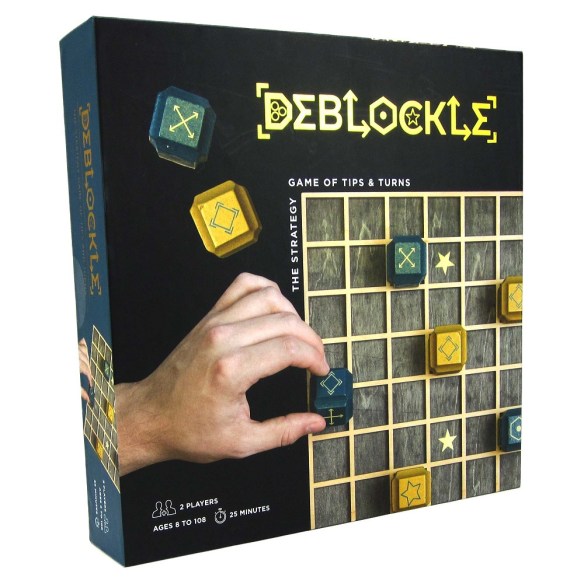
Beware, fellow puzzlers… one-on-one board gaming just got a little more complicated with Deblockle.

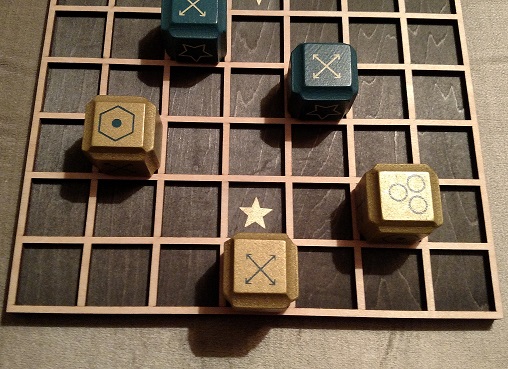
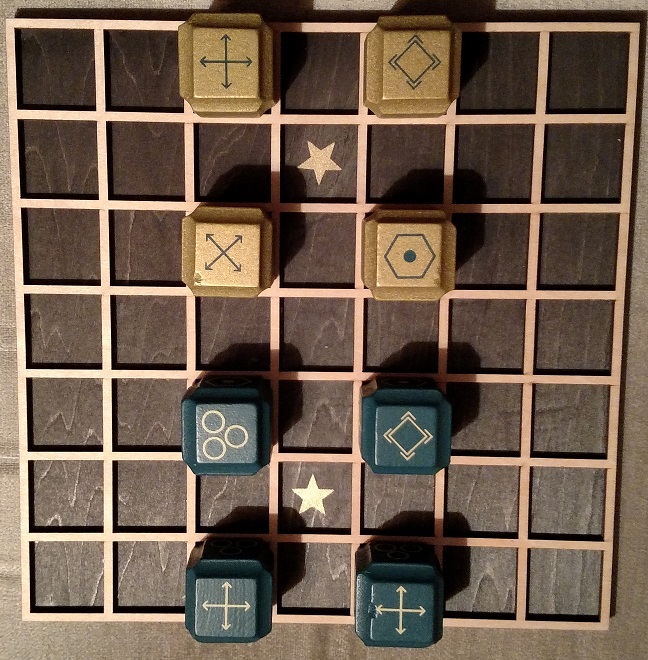
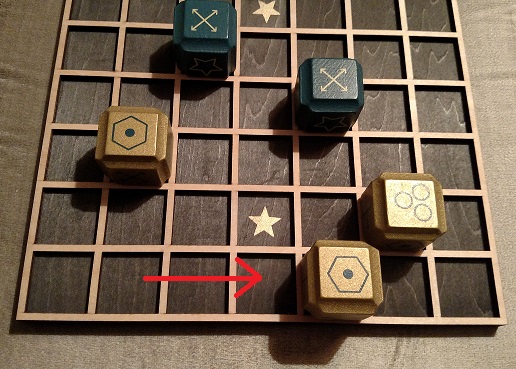
Masterminded by the team at Project Genius, Deblockle pits two players head to head to see who can remove their four blocks from the board first.

That’s right, there aren’t sixteen pieces to keep track of, like in chess, or twelve, like in checkers. There are just four blocks for you, and four blocks for your opponent.

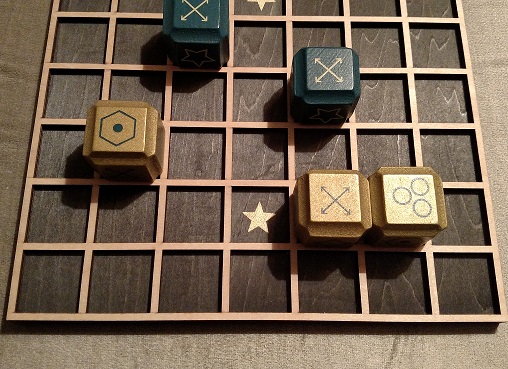
But here’s where things get tricky. Each turn, you have two moves. The first move is to roll one of your blocks into an adjacent space (either vertically or horizontally).

The second move is to place your block according to whichever symbol that landed face-up because of that roll.

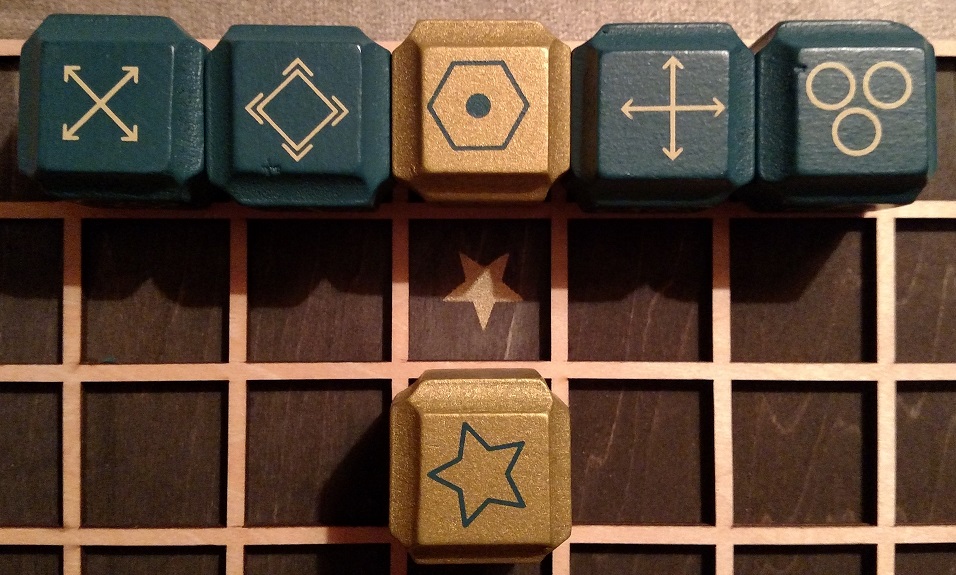
There are six symbols, each with a corresponding action:

  • Stop: your turn is over, there is no second move
  • Cross: move your block one space either horizontally or vertically
  • X: move your block one space diagonally
  • Hoops: move your block three spaces (vertically or horizontally) in any combination, including backtracking over a space you just occupied
  • Slider: move your block either vertically or horizontally until you reach the end of the row or column, or until you’re stopped by another block

With each of those second moves, you’re not rolling the block to reveal a new symbol; you’re picking it up and placing it into its new position.

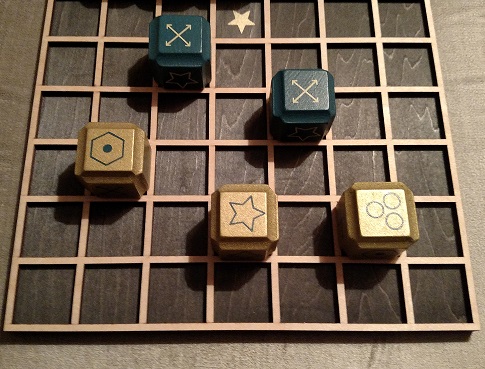
And yes, there are six symbols, and I only listed five above. That’s because the sixth symbol, the star, can only be revealed if you’re rolling onto one of the star spaces on the board. By rolling the block star-side-up onto a star space, you remove the block from play.

That’s the only time you can roll your block star-side-up, and the only time you’re allowed to occupy a star space with your block.

There are only two star spaces on the board, and you can only remove your blocks from the game if you utilize the star space opposite you.

And that’s when things get really tricky. Because it’s entirely likely that your opponent’s blocks will prevent you from rolling onto the symbol you wanted. So you’re puzzling out how exactly to roll and move your blocks so you’ll end up adjacent to the star space with the star symbol waiting to be rolled face-up, and also playing defense to impede your opponent’s efforts to navigate and manipulate the board to their own advantage.

It’s a lot to keep track of, and it makes for an immensely engrossing, engaging puzzle duel for two players. You’ve got the resource management of Risk, the piece placement mechanics of chess, and the defensive gameplay of Stratego and other strategy games.

And since the blocks are placed in their starting positions by your opponent — after rolling them randomly to see which symbol is face-up to start — every game of Deblockle is different. Opening gambits — like those you can learn in chess — are useless, because you won’t know how you can move your blocks initially until your opponent places them.

There is a wonderfully fresh challenge factor to Deblockle that many other head-to-head board games lack. While playing the game over and over will allow you to develop techniques and skills for how to better move your blocks, there are no shortcuts to becoming a better player through sheer repetition, because each opening setup is different.

Project Genius has managed to stuff a massive amount of gameplay, strategy, and style into those four little blocks, and they’ve got a real winner on their hands here.

[Deblockle is available from Project Genius and other participating retailers, for players starting at 8 and up!]


Thanks for visiting PuzzleNation Blog today! Be sure to sign up for our newsletter to stay up-to-date on everything PuzzleNation!

You can also share your pictures with us on Instagram, friend us on Facebook, check us out on TwitterPinterest, and Tumblr, and explore the always-expanding library of PuzzleNation apps and games on our website!

PuzzleNation Product Review: Chessplus

Chess is one of the all-time classic games. Alongside Checkers, Go, Tic-Tac-Toe, and mah-jongg, chess is one of the cornerstones of the genre, one of the first games we’re introduced to, and one of the formative games upon which we build concepts of strategy, timing, and opportunity.

Over the centuries, there have been numerous attempts to reinvent chess or find new ways to play. We’ve talked about puzzly variations on chess in the past, all of which can be played with a standard chess set. (Except for that guillotine set we featured last year.) But if you’re looking for a truly unique chess experience, the team at Chessplus have a simple, elegant game for you.

Chessplus is played under standard chess rules, but with one crucial difference: you can combine your pieces into more powerful ones.

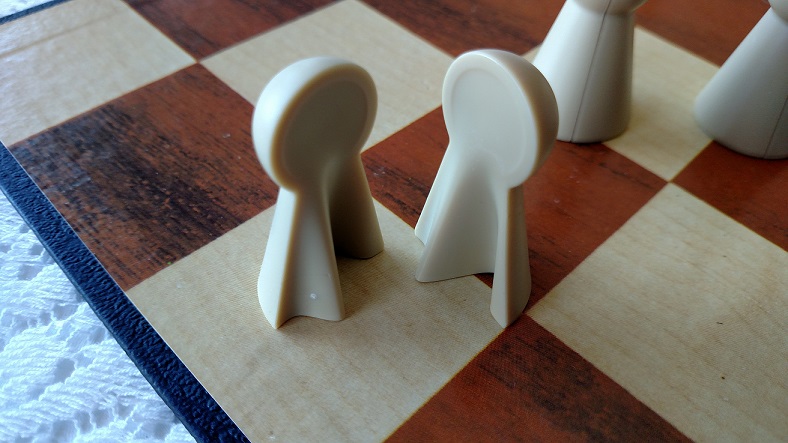
Do you want a pawn that can make less-expected moves, or a knight that can play conservatively? Combine a knight and pawn into a single piece with the abilities of both. Do you need to keep your queen where it is, but still want a versatile piece that can command the board? Easy. Combine a rook and a bishop, and you’ve got a new piece that works just like a queen.

[Only the king is a solid piece. Every other piece can be combined with others.]

Merging pieces not only allows you to take advantage of each component’s abilities, but it can also allow you to more swiftly transport pieces across the board. Instead of a pawn crawling across the board one square at a time, combine it with a rook who can send it straight across the board, where it is then promoted to a queen! Or combine two pawns so you only have to escort one piece across the board safely, then split them again and voila! Two pawns promoted into new queens.

Oh yes, merging the pieces doesn’t link them forever. You can split them at any time. That feature adds another layer to your gameplay, since putting one merged piece into play deep in your opponent’s territory can suddenly become two separated pieces again.

Now, this piece-combining mechanic is a double-edged sword. Yes, you have a more powerful, mobile game piece. (I was very excited to try out combining a knight and a queen, just to make the queen even more dangerous.) But if someone takes a merged piece, you lose BOTH halves, making them as vulnerable as they are valuable. Imagine an opponent capturing my merged knight/queen, so I lose a knight AND a queen in one turn. That could be a devastating loss.

As you’d expect, it took a little while to grow accustomed to these new variant pieces. With so much to keep track of during a normal chess game, pieces with greater mobility make strategy — both offensive and defense — a bit more complicated.

But it was also great fun. Early Chessplus games tend to be faster, more aggressive, because of the greater mobility allowed by some of the merged piece combinations. But once you’ve played a few games, your more traditional chess mindset settles in, and gameplay tends to become more measured and tactical.

Just imagine. A single change that offers a world of new possibilities and challenges. That’s brilliant, in my estimation. Chessplus is a wonderful way to reinvigorate chess if the game has lost its luster for you. And if you are a dedicated player, I think Chessplus will prove to be a welcome change of piece from the traditional game.

[Chessplus sets start at $35.95 (for just the pieces) and are available from the shop on Chessplus.com.]


Thanks for visiting PuzzleNation Blog today! Be sure to sign up for our newsletter to stay up-to-date on everything PuzzleNation!

You can also share your pictures with us on Instagram, friend us on Facebook, check us out on TwitterPinterest, and Tumblr, and explore the always-expanding library of PuzzleNation apps and games on our website!
Monopoly: Pondering the New Cheaters Edition

Monopoly is probably the most famous branded board game in the world. (I include the word “branded” because you can easily argue that Chess or Go or Mah-jongg are equally famous and/or played by as many people.)

There are hundreds of themed variations covering everything from state landmarks to Star Wars. It seems like everyone owns a copy of the game, even if it doesn’t seem to be all that popular these days.

Maybe that’s because we play it wrong. After all, in the instruction book, it plainly states that if a player lands on an unowned property and doesn’t wish to buy it, it immediately goes to auction to the highest bidder. Did you ever play with that rule? It certainly seems like it would speed things up!

And did you know that Edward Parker, former president of Parker Brothers, was quoted as saying that forty-five minutes was the appropriate length for a game?

Forty-five minutes? I can’t remember a single Monopoly game that lasted fewer than two hours.

Then again, maybe it doesn’t matter anymore. Things are about to change. The game is in the news once more after the announcement that Hasbro will be releasing a Cheaters Edition of the game.

[Cheaters that get caught are handcuffed to the board itself!
Image courtesy of USA Today.]

You might consider this to be a shameless attempt to cash in by being “edgy” or lean on cynicism already rampant regarding a game that seems to encourage selfish capitalist choices. That has certainly been the reaction of some game enthusiasts on the Internet.

I read a comment on Facebook where someone was disillusioned by this news, since “by buying this, you acknowledge that you’re playing a board game with someone who is likely enough to cheat that you bought a special version of the game with that exact expectation.”

The commentor went on to share his disappointment in the idea that “your response to that person cheating is not to stop playing games with them, but instead is to shame them by clipping them to the board game as though that were somehow more shameful than getting caught cheating your friends in a game with literally zero at stake.”

That’s certainly one way to look at it — though I suspect that’s partially colored by the fact that this person clearly didn’t enjoy the game in its original form to begin with.

[Image courtesy of Grey Mass Games.]

Of course, there’s an alternative view, one that encourages crafty gameplay over the monotonous steamrolling that many of us experienced in the past with a game like this. (Who doesn’t remember landing on the developed property of an older sibling and getting taken to the cleaners?)

Instead, the game encourages you to think outside the box. In that way, it could become something more akin to a poker game with tells and bluffing, or the casual manipulations you’d find in a round of Sheriff of Nottingham.

According to USA Today, “the game features naughty tasks to complete, such as skipping spaces or removing another player’s hotel from their property without them noticing.”

Since the game’s not out yet, we don’t know how far you’re allowed to go with your chicanery.

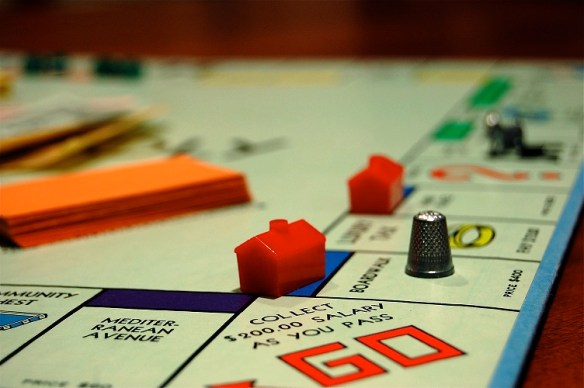
I’m sure some players will try to take more than $200 when they pass Go, but what about…?

  • Can you hide cash up your sleeve in order to avoid playing more Luxury Tax at 20%?
  • Can you gaslight players into forgetting that you mortgaged that property, flipping it over and collecting rent on it once more?
  • Can you bribe other players into letting you pass through their properties without paying?
  • CAN YOU SOMEHOW CHARGE FOR FREE PARKING?

[Image courtesy of Monopoly.wikia.com.]

We’ll have to wait and see.

Will you be picking up the Cheaters Edition of Monopoly, fellow puzzlers? Let us know in the comments section below!


Thanks for visiting PuzzleNation Blog today! Be sure to sign up for our newsletter to stay up-to-date on everything PuzzleNation!

You can also share your pictures with us on Instagram, friend us on Facebook, check us out on TwitterPinterest, and Tumblr, and explore the always-expanding library of PuzzleNation apps and games on our website!
PuzzleNation Product Review: Less

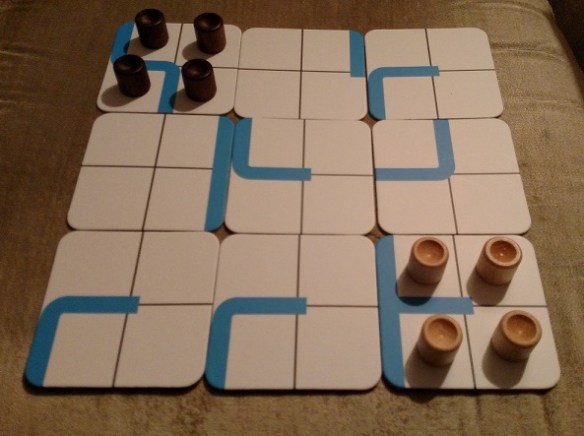
lessgame

There are many games out there that pair nicely with food or drink. Many party games even revolve around this mechanic, like Jason Anarchy’s alcohol-fueled roleplaying game Drinking Quest.

But I think Less is the first game where the playing tiles intentionally double as coasters for your drinks. It feels like a game that could be played in a tavern at a moment’s notice, which lends its minimalist style an old-world gaming charm.

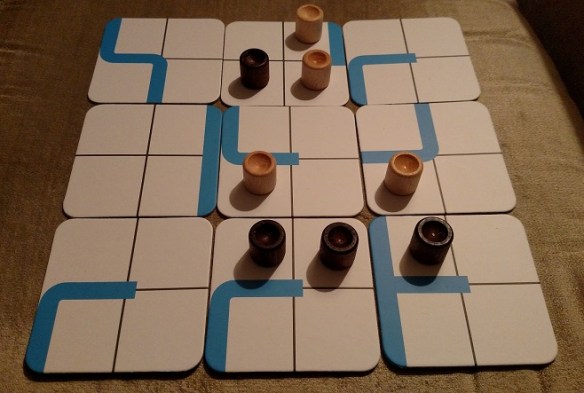
less1

But I’m getting ahead of myself here. Less is a strategy game that combines the tactical planning of chess with the dynamic maneuverability of checkers.

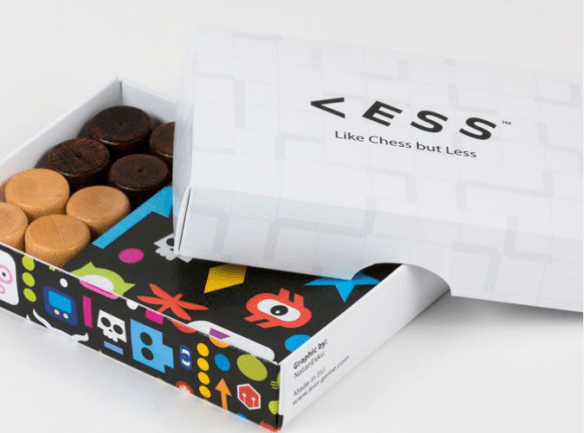
The game consists of 12 tiles and 8 game pieces, 4 white and 4 black. The players randomly select 9 of the 12 tiles and arrange a 3×3 game board. (With 12 tiles and four ways to place each tile, you’re virtually guaranteed a different game board every time you play.)

One player sets up their 4 game pieces in one corner, and the other player sets up their game pieces in the opposite corner. The goal of the game is to move all 4 of your pieces into your opponent’s corner before your opponent can occupy your corner.

less2

To do so, you are allowed three moves per turn. You can use all three moves for a single game piece, or spread them out over multiple game pieces. Moving a piece from one square to a neighboring square is one move. Jumping over a game piece to the next open square is also one move. (Here’s where checkers-style planning comes in handy.)

By now, you’ve probably noticed those blue walls on some of the tiles. Those walls require an extra move to traverse, so moving a game piece over a wall requires two moves. (And if neighboring squares each have a wall between them, jumping that double wall requires all three moves that turn.)

This three-move system offers players loads of options going forward, but your best bet is to arrange a sequence of leapfrog jumps to move your pieces as efficiently as possible across the board. (Unlike chess or checkers, there is no capturing or removing your opponent’s pieces from the board.)

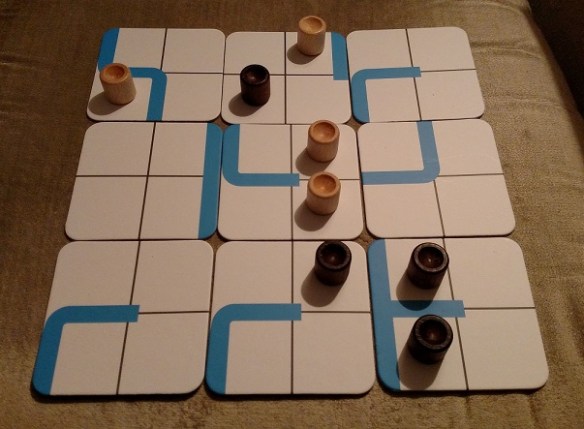
less3

[Here, black has more pieces near the opposing corner, but that blue wall will make it harder to occupy the corner efficiently. Meanwhile, more of white’s pieces are farther away, but there are fewer obstacles to slow those pieces down.]

Mixing a tactical approach with the improvisation that comes with reacting to your opponent’s movements makes Less a very engaging gaming experience, even if a game routinely lasts less than ten minutes. And on the puzzle side of things, figuring out the most efficient way to navigate a path toward your opponent’s corner is great fun, since every game is different, and your opponent has different obstacles to tackle than you do, given the random placement of walls on the board.

Plus, if you’re willing to invest in two copies of the game, you can play with four players, as you and your partner coordinate your efforts across a 4×4 game board in the hopes of occupying your opponents’ corners first.

It’s a game that takes a few minutes to learn and offers near-infinite replayability. It might be called Less, but it feels like a very complete, very satisfying challenge.

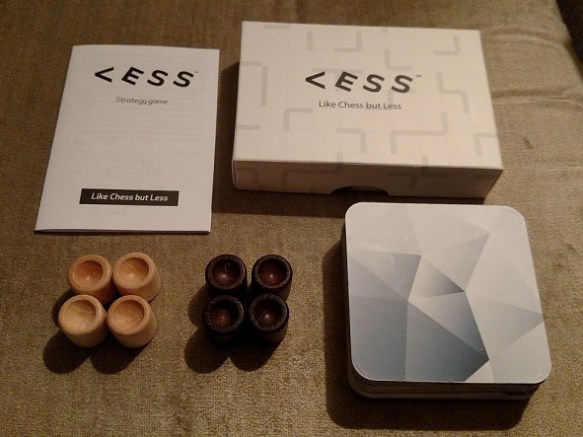
less4

Less is published by InventedFor and is available online at less-game.com (with numerous coaster designs for the reverse side of the tiles). Click here for full details.


Thanks for visiting PuzzleNation Blog today! Be sure to sign up for our newsletter to stay up-to-date on everything PuzzleNation!

You can also share your pictures with us on Instagram, friend us on Facebook, check us out on Twitter, Pinterest, and Tumblr, and explore the always-expanding library of PuzzleNation apps and games on our website!