PuzzleNation Product Review: Back Spin by ThinkFun

[Note: I received a free copy of this game in exchange for a fair, unbiased review. Due diligence, full disclosure, and all that.]

Imagine someone hands you a small puzzle game. You twist and turn it this way and that way, trying to line up all the different colored components so that they match, spinning and manipulating it so that one particular piece falls into place, but by doing so, three others end up somewhere else, and now you have to chase them down.

It probably sounds like I’m describing solving a Rubik’s Cube, but the same description fits cracking the latest puzzle game from ThinkFun: Back Spin.

And you know what? Back Spin is the younger sibling of the Rubik’s Cube that I wish I could’ve tried out first.

[Both sides of Back Spin, with the spheres all mixed up between the two.]

Designed for solvers aged 8 and up, Back Spin only features two sides (front and back) to Rubik’s six, but each of those sides has six small colored chambers, intended to hold matching colored spheres. Rotating the front or the back allows you to line up these chambers and swap spheres between them.

As for the spheres, there are nine different colors to sort; red, yellow, and orange are on both sides, but each side has a different shade of blue, green, and pink/purple, meaning some spheres can go on either side, but some are only meant for the front or the back.

Whether you’re moving colored spheres from back to front or rotating them in overlapping chambers to shift the spheres’ positions within the chamber — a la the sliding tiles in one of those picture puzzles — this is an introduction to chain-thinking and solving, a step up from simpler mechanical brain teasers, but not nearly as daunting as Rubik’s infamous cube.

[Alright, it’s solved! Oh, no, wait, this is only one side. Darn.
There are still spheres misplaced on the other side of the puzzle.]

And although the game is marketed as a single-solver puzzle, you really need two: one to mix all of the spheres up, and the other to unravel it. It’s much more satisfying to conquer the challenge someone else sets out for you than one you set for yourself, because you can’t help but retain some of the steps involved in mixing up the puzzle.

Having someone else mix up the spheres not only allows for a tougher solve, but the process of mixing them up for another solver is just as valuable a puzzling experience as solving it.

[Okay, this time I’ve got it. All the spheres properly placed on both sides. Phew!
(You can also see that there are only two purple spheres, since one chamber
has to allow a sphere to pass from back to front for the puzzle to be solvable.)]

Back Spin is a wonderfully vivid variation on a classic style of puzzle solving, one whose simple mechanics — a wheel that goes back and forth and holes that line up — allow for deep, meaningful, logic-based puzzling.

It encourages exploration and experimentation, staving off both the boredom and the frustration that more difficult brain teasers often spark. It’s a terrific addition to the ThinkFun line-up of puzzle games that teach while you play.

Back Spin is available for $14.99 on the ThinkFun website. To check out previous ThinkFun product reviews on PuzzleNation Blog, click here.


Thanks for visiting PuzzleNation Blog today! Be sure to sign up for our newsletter to stay up-to-date on everything PuzzleNation!

You can also share your pictures with us on Instagram, friend us on Facebook, check us out on TwitterPinterest, and Tumblr, and explore the always-expanding library of PuzzleNation apps and games on our website!

What are you trying to say here?

[Image courtesy of Aaron Walker, Alex Talamo, and the DIG Collective]

A while back, I posted a holiday-themed game where famous Christmas songs were reworded, and I challenged the PuzzleNation readership to unravel them all.

Well, this weekend I was going through a box of old assignments and such from my school days, and I stumbled upon another instance of this kind of rewording puzzle, this time centered around famous sayings and expressions.

Can you figure out the original expressions from these overly verbose rewordings?


1.) A mobile section of petrified matter agglomerates no bryophytes.

2.) Desist from enumerating your fowl prior to their emergence from the shell.

3.) Scintillation is not always identification for an auric substance.

4.) A plethora of culinary specialists has a deleterious effect upon the quality of purees, consummes, and other soluble pabula.

5.) A chronic disposition to inquiry deprived the domestic feline carnivorous quadruped of its vital quality.

6.) It is in the realm of possibility to entice an equine member of the animal kingdom to a source of oxidized hydrogen; however, it is not possible to force him to imbibe.

7.) Persons deficient in the faculty of determining values move with impetuosity into places that purely spiritual beings view with trepidation.

8.) If John persists without respite in a constant prolonged exertion of physical or intellectual effort he will develop into a youth slow and blunted in perception and sensibility.

9.) Immediately upon the absence of the domesticated carnivorous feline, the common house rodent proceeds to engage in sportive capers.

10.) A round vessel made of staves bound with hoops that is destitute of contents is productive of the most deafening din.

11.) Products of ingenuity are the offspring of exigency.

12.) Residents of structures composed of silicate substances should refrain from casting hardened mineral objects.

How did you do? Let us know in the comments section below!


Thanks for visiting PuzzleNation Blog today! Be sure to sign up for our newsletter to stay up-to-date on everything PuzzleNation!

You can also share your pictures with us on Instagram, friend us on Facebook, check us out on TwitterPinterest, and Tumblr, and explore the always-expanding library of PuzzleNation apps and games on our website!

At least there’s no giant boulder chasing you…

[Is this the way out or a costly dead end?]

We’ve tackled all sorts of brain teasers in the past. From the Brooklyn Nine-Nine desert island seesaw to several hat puzzles, from Cheryl’s birthday logic puzzle to a diabolical light switch puzzle, we have conquered all challengers thus far!

But never before have we confronted a puzzle with as much backstory as today’s contender. Ladies and gentlemen and PuzzleNationers of all sorts, today we battle the Temple Tunnel puzzle.

Imagine that you’re a professor leading a group of eight grad students on an expedition into a booby-trap-filled temple.

[No, not THAT professor.]

After two of the students bump into an altar, they activate a trap, sending everyone scrambling for the exits before the temple collapses all around you.

The group finds itself in a room with five tunnels and an hourglass detailing how much time you have to escape. One of them leads back to the altar and the other four are possible routes of escape. Unfortunately, you can’t remember which one it is!

All you remember is that it took approximately twenty minutes to get here from the exit. How do you determine which tunnel is the correct one, and get everyone to safety?

Oh wait, there’s one more little complication. That altar the students bumped into? It released the vengeful spirits of the temple’s king and queen, which have possessed two of your students. So you can’t trust what they say.

So how do you figure out which tunnel is the right one without being deceived by your two compromised students?

[Image courtesy of XKCD.com.]

*deep breath* Wow, that’s quite a setup! So let’s summarize:

  • You have an hour to escape, and four corridors to explore.
  • Each corridor will require 40 minutes to explore: 20 minutes to determine if it’s the exit, and 20 minutes back to report your findings.
  • Whatever groupings you break the team up into, you have two possible liars among them, and no way to determine which ones are the liars before sending them down a tunnel.

For a wonderful animated version of this puzzle, as well as its solution, check out the YouTube video below from TED-Ed:

Now, while the solution itself is quite clever, I can’t help but ask certain questions:

It says that the possessed students can’t harm the others, but can they mislead them with actions as well as words?

I’ve seen several proposed solutions that included not only sending groups down the tunnels, but instructing one or more of them to leave the temple immediately if they find the exit (meaning that not seeing them return would confirm they’d found the exit). But if the liars can simply stay at the dead end, that would be a false confirmation of finding the exit.

The video is ambiguous about this, because it says the spirits will lead them to their doom, but then it also says that the curse only affects their communication.

How does the group know you’re not one of the liars?

The solution is entirely dependent upon you being able to explore a tunnel alone, because that determines the groupings for the other three tunnels. If you have to take someone with you (either an honest student or a liar), that affects your ability to draw proper conclusions from the other groupings. And even if you find the exit, the student with you could lie about it, and there’s no way to prove the truth to the group definitively.

Why not just ask each student individually a question the ancient king or queen wouldn’t know the answer to?

Presumably the spirits of ancient royalty wouldn’t know about the latest episode of NCIS or which version of Windows we’re up to.

In any case, this was a delightful mind-bender, one that has stumped many an intrepid solver. How did you do? Tell us in the comments below!


Thanks for visiting PuzzleNation Blog today! Be sure to sign up for our newsletter to stay up-to-date on everything PuzzleNation!

You can also share your pictures with us on Instagram, friend us on Facebook, check us out on TwitterPinterest, and Tumblr, and explore the always-expanding library of PuzzleNation apps and games on our website!

A puzzle in your pocket

Brain teasers come in all shapes and sizes, but there’s one particular brand of brain teaser that fits in your pocket. Today we’re talking about matchstick puzzles (or toothpick puzzles).

Matches as we know them (relying on friction to ignite, rather than dipping or crushing) were invented in 1826 by English chemist John Walker, and in the decades that followed, numerous improvements were made, especially in terms of safety and ease of use. Matchsticks soon grew ubiquitous and match companies started putting little puzzles on their boxes.

And the matchstick puzzle was born.

(I have no historical documentation to back me up on this, but I suspect that bar bets also played a role in the rise of matchstick puzzles, because the sort of cleverness and trickery that goes into solving some of these puzzles would be perfectly at home in the repertoire of someone looking to con a few free drinks out of fellow tipplers.)

So, for the uninitiated, what are matchstick puzzles?

These are rearrangement or transformation puzzles, where you’re given a certain shape (laid out in matchsticks, toothpicks, straws, pencils, or anything else of equal length), and you have to move the items into another shape or configuration. Sometimes, it’s simply about placing the matchsticks economically, but other times, you have to get crafty and think outside the box to complete your task.

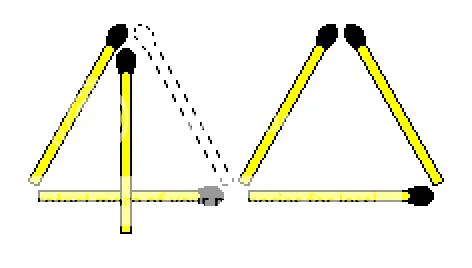
For instance, here’s the first matchstick puzzle I ever remember seeing:

[This image, and the one below, courtesy of Matchstick Puzzles on Blogspot.]

You have two triangles formed from six matchsticks. Move one matchstick to make four triangles.

Now, you could easily use all of these matchsticks to make four triangles, but that would involve moving more than one of them. So clearly there’s something else at work here if you only need to move one to solve the puzzle.

That something, in this case, is a little visual trickery.

As you can see, you turn one triangle into a numeral four, making the matchsticks literally read out “4 triangle.” Sneaky sneaky.

There are literally hundreds of these puzzles if you go hunting for them. (I found a treasure trove of them here.)

A curious variation, though, applies the same rules to mathematical formulas laid out in matchstick form.

Here’s one that’s been making the rounds on Facebook recently:

Now, the big difference between these mathematical ones and the shape ones mentioned above, as far as I’ve found, is that the math ones are far more alternate prone.

For instance, this equation puzzle has at least four solutions that I’ve found:

  • You can move one match to make the 6 a 0, so that 0+4=4.
  • You can move one match from the 6 to the second 4 to make the 6 a 5 and the 4 a 9, so that 5+4=9.
  • You can move one match from the plus sign to the 6 to make the plus sign a minus sign and the 6 an 8, so that 8-4=4.
  • You can move one match from the plus sign to the equal sign to make the plus sign a minus sign and the equal sign a doesn’t-equal sign, so that 6-4 does not equal 4.

As you can see, with matchstick puzzles,  the possibilities are endless and the building blocks — whether matches, toothpicks, Q-Tips, or straws — are easily accessible.

I’ll leave you one more to ponder, this time provided by the folks at IO9:

Using six matchsticks of equal length, create four identical, equilateral triangles. There’s no need for snapping, burning, or otherwise altering the matchsticks.

Good luck!


Thanks for visiting PuzzleNation Blog today! Be sure to sign up for our newsletter to stay up-to-date on everything PuzzleNation!

You can also share your pictures with us on Instagram, friend us on Facebook, check us out on TwitterPinterest, and Tumblr, and explore the always-expanding library of PuzzleNation apps and games on our website!

PuzzleNation Product Review: Strata Sphere

In today’s product review, we look at a puzzle game with a simple premise: get your spheres from the top level of the grid to the bottom before your opponent does. All that stands between you and victory? Four levels of sliding walls and a wily opponent.

Today, we tackle the multi-layered challenge of Strata Sphere.

Strata Sphere is a puzzle game for two players that challenges you to outthink and outmaneuver your opponent in order to get your four spheres through the grid first. Imagine the gravity-fueled fun of Ker-Plunk with the chain-reaction planning of chess, and you’ve got something approximating Strata Sphere.

This game is all about tactics and adaptation. First, you and your opponent take turns placing the twelve sliders into the grid. There are four levels to the grid, each level accommodating three sliders.

As you can see, some of the sliders have holes in different places, and others have no holes at all. Placement of these sliders is only part one of the game, but it’s a crucial one.

Once all twelve sliders are in place, the players choose their color spheres (red or black), and take turns placing them into the columns atop the grid, one sphere per column.

[As you can see, some of the spheres have already dropped to level 2,
thanks to the placement of holes in several of the sliders in level 1.]

Now the real strategy begins, because with each turn, a player may select any slider and pull it out of the grid one notch. (Each slider has three notches, allowing it to interact with three different columns.) As the game progresses, players can also push sliders in one notch.

Whether the slider moves out of the way of a sphere or moves a hole into place so a sphere may drop through, each move has the potential to drop a sphere a level (or two!) closer to freedom.

After one or two games, we actually ended up putting the game on a lazy susan, so we could rotate it, observe the grid more easily, and gain better access to all the sliders.

This form of three-dimensional puzzle-solving is a real challenge, because you’re not just dealing with your opponent’s next move, you’re dealing with all the setup (slider placement, sphere placement) that preceded it. Here’s where your ability to adapt comes into play, because all that strategy can go completely out the window at a moment’s notice.

Tension ratchets up quickly as you and your opponent maneuver back and forth, manipulating the sliders and helping gravity guide your spheres through the grid and toward the open tray below. The first player to free all four of their spheres wins.

Strata Sphere is a puzzle game that’s easily explained to younger players, but one that offers a great deal of complexity for older players as well, taxing your tactical abilities, spatial awareness, and your ability to seize unexpected opportunities when they arise.

Being forced to take turns makes long-term planning more difficult, and the four levels of gameplay will push your visualization skills to the max. (Planning out moves on a chess board is one thing, the multi-tiered slider system of Strata Sphere is quite another.)

The gameplay is engaging, the design is simple and elegant, and I daresay there’s no more satisfying sound than the click of a well-earned sphere hitting the tray, freed. What a treat.

Strata Sphere is for ages 8 and up, available now from Family Games America.


Thanks for visiting PuzzleNation Blog today! Be sure to sign up for our newsletter to stay up-to-date on everything PuzzleNation!

You can also share your pictures with us on Instagram, friend us on Facebook, check us out on TwitterPinterest, and Tumblr, and explore the always-expanding library of PuzzleNation apps and games on our website!

PuzzleNation Product Review: Quarto

Tic-Tac-Toe is probably the first strategy game a child encounters, and it’s a simple concept: get three in a row. Other games expand on this idea, like Connect Four, which increases the pattern to four in a row and adds the vertical play aspect to the game. ThinkFun put their own spin on the idea with All Queens Chess, adding the rules of chess to that Connect Four aesthetic.

And Quarto ups the ante significantly, adding elegance and variety to this particular corner of the puzzle-game genre.

You have a board with sixteen spaces laid out in a 4×4 grid, and your goal is to place four pieces in a row. Sounds simple, right? Sure. But when you look at the playing pieces, it gets a little more involved.

As you can see, across these sixteen differently-shaped pieces, eight different characteristics are possible: light, dark, round, square, solid, hollow, tall, and short. Each piece represents four of these characteristics.

So you have to make a row of four pieces with at least one characteristic in common. It could be four hollow pieces (meaning shape, color, and size don’t matter), four dark pieces (meaning shape, size, and solid/hollow don’t matter), or any of six other possible common factors.

And to add a little more challenge to the gameplay, your opponent chooses which piece you play each round. You have to strategize on the fly, because you never know which piece you’ll be placing next!

For example, here’s a game in progress. There are three dark pegs in a line, so naturally, your opponent picks a light-colored piece, preventing you from taking advantage.

But wait! They accidentally chose a hollow piece, allowing you to complete a line of four hollow pieces in a row! But remember to yell “Quarto!” when you do, or it doesn’t count!

There’s so much strategy wrapped up in such a simple mechanic. Quarto can be explained in a few seconds, but it offers a massive amount of replayability. Especially when you consider how much of the gameplay is happening in your mind as you try to figure out not only what piece to choose for your opponent, but what you might do with whatever piece you’re handed next.

Quarto is a wonderful variation on a classic style of puzzly gameplay. The beautiful playing pieces are well-made and offer plenty of possibilities, and it’s quickly become a favorite in my house as a palate cleanser between longer game sessions.

Quarto was created by Blaise Muller, is published by Gigamic Games, and is available from Marbles: The Brain Store and Amazon.


Thanks for visiting PuzzleNation Blog today! Be sure to sign up for our newsletter to stay up-to-date on everything PuzzleNation!

You can also share your pictures with us on Instagram, friend us on Facebook, check us out on TwitterPinterest, and Tumblr, and explore the always-expanding library of PuzzleNation apps and games on our website!