The spooky app no one has solved!

Do Not Believe His Lies.

Sounds ominous, doesn’t it?

It’s the name of an app that has baffled solvers for more than a year with increasingly complex riddles, puzzles, and challenges.

It starts out simply, with the messages “We were expecting you,” “Your journey begins now,” “We await you on the other side,” and “Good luck” in simple white text on an otherwise pitch black screen.

From the very start, it’s an evocative presentation. It sets the mood immediately.

Then the first puzzle starts. You have to find a code word or phrase hidden on the screen (which is easy if your phone or computer’s brightness is turned all the way up.) When you input the code “The first time,” you get the second puzzle, which is in Morse Code and reads “I saw him there.”

The next puzzle was a scrambled grid, similar to the tile-shifting games many puzzlers know. One player inverted the colors, printed out the puzzle, cut it into squares and solved it that way, leading to this solution:

“The first time I saw him there, I was just a child.”

Here’s where the Halloween-appropriate element emerges. Each solution to these puzzles provides part of an ongoing narrative. Later messages include “I have to go now” and “Be careful friend.”

Anagramming, braille, music theory, cryptography, chemistry… as the puzzles increase in difficulty and complexity, they require an ever-growing skill set, challenging users in impressive fashion.

A dedicated community of solvers has come together to tackle the challenge of Do Not Believe His Lies, and they have fought, clawed, collaborated, and ingeniously solved their way to Puzzle #48, which they believe they’ve cracked, but they’re unsure of where to proceed from here.

[Another DNBHL puzzle, apparently a constellation…]

In an update on October 1, one of these diehard solvers posted this:

Welp, as most of you who have stayed logged in to our IRC channel can attest…we are pretty much out of ideas. But I’ll give a quick update for those of you who don’t regularly sign in…

The newest activity we have noticed has been the “Puzzle Solved” counter on the official DNBHL website. It’s not automatically updated, so we know that the Dev has been lurking around still. But whether it’s just a sign of life, or an unintentional “push” to let us know we have everything we need to progress further…none can say.

He goes on to discuss some of the lingering clues they’ve uncovered, as well as the theory that they’ll have to leave “the app and the old puzzles behind,” meaning the game will venture into the real world and involve physical locations!

The general theory going forward seems to be that the next puzzle is somehow time-sensitive, and cannot be solved before December 31. This does support what the app’s designer said in an interview with IO9:

Matablewski says that he does expect people to beat the game…but not anytime soon. “Not this year though, it’s not how it has been designed,” he told me. “If they work together, and only then … they will find the answer and complete the whole riddle someday next year.”

[These wavy words, upon closer inspection, are mathematical formulas. But to what end?]

Although solvers of this diabolical horror-fueled puzzle app are frustrated, they aren’t disheartened. The same diehard solver quoted above concluded his post with this:

So…until we get something a little better to work with, I think we’re all just taking a break…waiting for a Eureka moment to strike. Don’t get too disheartened though…I’m sure all the friends you’ve made on here will jump right back in to the fray as soon as things get busy again.

You can try Do Not Believe His Lies for yourself here. (For other stories on immersive online puzzle experiences, check out my previous posts on Cicada 3301 and the Portal ARG.)


Thanks for visiting PuzzleNation Blog today! Be sure to sign up for our newsletter to stay up-to-date on everything PuzzleNation!

You can also share your pictures with us on Instagram, friend us on Facebook, check us out on TwitterPinterest, and Tumblr, and explore the always-expanding library of PuzzleNation apps and games on our website!

A ten-digit brain teaser to melt your mind!

I’ve started to develop a reputation as something of a brain-teaser pro, given some of the beastly brain teasers we’ve featured on the blog over the last few months.

And, as such, I’ve started to receive brain teasers from friends and fellow puzzlers, challenging me to unravel them AND explain my methods to the PuzzleNation audience.

I’ve never been one to shirk a challenge, so here we go! This puzzle is entitled Mystery Number, and a little googling after solving it reveals it most likely came from this Business Insider link. (Although their solution is slightly flawed.)

Enjoy!


There is a ten-digit mystery number (not starting with zero) represented by ABCDEFGHIJ, where each numeral, 0 through 9, is used once. Given the following clues, what is the number?

1. A + B + C + D + E = a multiple of 6.
2. F + G + H + I + J = a multiple of 5.
3. A + C + E + G + I = a multiple of 9.
4. B + D + F + H + J = a multiple of 2.
5. AB = a multiple of 3.
6. CD = a multiple of 4.
7. EF = a multiple of 7.
8. GH = a multiple of 8.
9. IJ = a multiple of 10.
10. FE, HC, and JA are all prime numbers.

(And to clarify here for clues 5 through 9, AB is a two-digit number reading out, NOT A times B.)


[Image courtesy of Wikipedia.]

Now, anyone who has solved Kakuro or Cross Sums puzzles will have a leg up on other solvers, because they’re accustomed to dealing with multiple digits adding up to certain sums without repeating numbers. If they see three boxes (which would essentially be A + B + C) and a total of 24, they know that A, B, and C will be 7, 8, and 9 in some order.

[For those unfamiliar with Cross Sums or Kakuro solving, feel free to refer to this solving aid from our friends at Penny/Dell Puzzles, which includes a terrific listing of possible number-combinations that will definitely prove useful with this brain teaser.]

And since the digits 0 through 9 add up to 45, that provides a valuable starting hint for clues 1 and 2 (in which all 10 digits appear exactly once). A multiple of 6 (6, 12, 18, 24, 30, 36, 42) plus a multiple of 5 (5, 10, 15, 20, 25, 30, 35, 40, 45) will equal 45. And there’s only one combination that works.

So A + B + C + D + E must equal 30, and F + G + H + I + J must equal 15.

The same logic applies to clues 3 and 4 (in which all 10 digits appear exactly once). A multiple of 9 (9, 18, 27, 36, 45) plus a multiple of 2 (2, 4, 6, 8, 10, etc.) will equal 45. And there’s only one combination that works.

So A + C + E + G + I must equal 27, and B + D + F + H + J must equal 18.

And now, we jump to clue 9. Since IJ is a multiple of 10, and all multiples of 10 end in 0, we know J = 0.

This tells us something about JA in clue 10. J is 0, which means A can only be 2, 3, 5, or 7.

There may a quicker, more deductive manner of solving this puzzle, but I couldn’t come up with it. I went for a brute force, attrition-style solve.

So I wrote out all of the possibilities for clues 5 through 9, and began crossing them off according to what I already knew. Here’s what we start with:

AB = 12, 15, 18, 21, 24, 27, 30, 33, 36, 39, 42, 45, 48, 51, 54, 57, 60, 63, 66, 69, 72, 75, 78, 81, 84, 87, 90, 93, 96, 99
CD = 12, 16, 20, 24, 28, 32, 36, 40, 44, 48, 52, 56, 60, 64, 68, 72, 76, 80, 84, 88, 92, 96
EF = 14, 21, 28, 35, 42, 49, 56, 63, 70, 77, 84, 91, 98
GH = 16, 24, 32, 40, 48, 56, 64, 72, 80, 88, 96
IJ = 10, 20, 30, 40, 50, 60, 70, 80, 90

Now, we can remove any double numbers like 33 because we know each letter represents a different number.

AB = 12, 15, 18, 21, 24, 27, 30, 36, 39, 42, 45, 48, 51, 54, 57, 60, 63, 69, 72, 75, 78, 81, 84, 87, 90, 93, 96
CD = 12, 16, 20, 24, 28, 32, 36, 40, 48, 52, 56, 60, 64, 68, 72, 76, 80, 84, 92, 96
EF = 14, 21, 28, 35, 42, 49, 56, 63, 70, 84, 91, 98
GH = 16, 24, 32, 40, 48, 56, 64, 72, 80, 96
IJ = 10, 20, 30, 40, 50, 60, 70, 80, 90

[Sorry guys, you’re out.]

And we know that J = 0, so we can remove any numbers that end in zero for AB, CD, EF, and GH.

AB = 12, 15, 18, 21, 24, 27, 36, 39, 42, 45, 48, 51, 54, 57, 63, 69, 72, 75, 78, 81, 84, 87, 93, 96
CD = 12, 16, 24, 28, 32, 36, 48, 52, 56, 64, 68, 72, 76, 84, 92, 96
EF = 14, 21, 28, 35, 42, 49, 56, 63, 84, 91, 98
GH = 16, 24, 32, 48, 56, 64, 72, 96
IJ = 10, 20, 30, 40, 50, 60, 70, 80, 90

And for AB, we know that A can only be 2, 3, 5, or 7, so we can delete any numbers that don’t start with one of those four digits.

AB = 21, 24, 27, 36, 39, 51, 54, 57, 72, 75, 78
CD = 12, 16, 24, 28, 32, 36, 48, 52, 56, 64, 68, 72, 76, 84, 92, 96
EF = 14, 21, 28, 35, 42, 49, 56, 63, 84, 91, 98
GH = 16, 24, 32, 48, 56, 64, 72, 96
IJ = 10, 20, 30, 40, 50, 60, 70, 80, 90

Hmmm, that’s still a LOT of options. What else do we know?

Well, we know from clue 10 that FE and HC are prime numbers. So they can’t be even numbers OR end in a 5. So we can eliminate any options from CD and EF that begin with an even number or a 5.

AB = 21, 24, 27, 36, 39, 51, 54, 57, 72, 75, 78
CD = 12, 16, 32, 36, 72, 76, 92, 96
EF = 14, 35, 91, 98
GH = 16, 24, 32, 48, 56, 64, 72, 96
IJ = 10, 20, 30, 40, 50, 60, 70, 80, 90

Alright, now we need to look at those big addition formulas again. Specifically, we need to look at B + D + F + H + J = 18.

We know J = 0, so the formula becomes B + D + F + H = 18. Now, take a look at our lists of multiples for AB, CD, EF, and GH. Look at the second digit for each. There’s a little nugget of information hiding inside there.

Every D and H digit is an even number. Which means that B and F must either both also be even, or both be odd in order to make an even number and add up to 18.

But, wait, if they were both even, then they would use all of our even numbers, and some combination of B, D, F and H would be 2 + 4 + 6 + 8, which equals 20. That can’t be right!

So let’s delete any even numbered options from AB and EF.

AB = 21, 27, 39, 51, 57, 75
CD = 12, 16, 32, 36, 72, 76, 92, 96
EF = 35, 91
GH = 16, 24, 32, 48, 56, 64, 72, 96
IJ = 10, 20, 30, 40, 50, 60, 70, 80, 90

Okay, we’ve whittled down EF to 2 possibilities: 35 and 91. [Here is where the Business Insider solution goes awry, because they never eliminate one of these two options.]

Clue 10 tells us that FE is a prime number, but that doesn’t help, because both 53 and 19 are prime. So now what?

Let’s return to those starting formulas.

We know that A + B + C + D + E = 30, and our handy-dandy number-combination listing tells us there are six possible ways that five digits can add up to 30: 1-5-7-8-9; 2-4-7-8-9; 2-5-6-8-9; 3-4-6-8-9; 3-5-6-7-9; and 4-5-6-7-8.

Look at the possibilities for A, B, C, D, and E according to our work thus far:

AB = 21, 27, 39, 51, 57, 75
CD = 12, 16, 32, 36, 72, 76, 92, 96
EF = 35, 91

There’s not a single 8 in any of those pairings! And five of our six possible answers for A + B + C + D + E = 30 include an 8 as one of the five digits.

Therefore, 3-5-6-7-9 and A-B-C-D-E match up in some order.

EF is either 35 or 91, but with both 3 and 5 counted among the letters in A-B-C-D-E, EF cannot be 35, so EF is 91. Let’s eliminate any option for AB, CD, GH, or IJ that include 9 or 1.

AB = 27, 57, 75
CD = 32, 36, 72, 76
EF = 91
GH = 24, 32, 48, 56, 64, 72
IJ = 20, 30, 40, 50, 60, 70, 80

Because E = 9, that leaves 3, 5, 6, and 7 as the only possible digits available for A, B, C, and D. So let’s eliminate any combinations that use numbers other than those four.

AB = 57, 75
CD = 36, 76
EF = 91
GH = 24, 32, 48, 56, 64, 72
IJ = 20, 30, 40, 50, 60, 70, 80

We can also eliminate any combinations for GH and IJ that include those four numbers.

AB = 57, 75
CD = 36, 76
EF = 91
GH = 24, 48
IJ = 20, 40, 80

Since our only possibilities for AB use 5 and 7 in some order, CD cannot be 76, so it must be 36.

AB = 57, 75
CD = 36
EF = 91
GH = 24, 48
IJ = 20, 40, 80

So, here are our options at this point:

AB = 57, 75
CD = 36
EF = 91
GH = 24, 48
IJ = 20, 40, 80

All possible solutions for GH include the number 4, so we can delete 40 as a possibility for IJ.

AB = 57, 75
CD = 36
EF = 91
GH = 24, 48
IJ = 20, 80

Let’s look at those formulas one more time. We know A + C + E + G + I = 27.

We also know C = 3 and E = 9, so A + G + I = 15. And the only combination of available digits that allows for that is 5, 2, and 8, meaning AB = 57, GH = 24, and IJ = 80.

So ABCDEFGHIJ = 5736912480.


I don’t think I’ve tackled a puzzle this tough since the seesaw brain teaser!

Thanks for visiting PuzzleNation Blog today! You can share your pictures with us on Instagram, friend us on Facebook, check us out on TwitterPinterest, and Tumblr, and be sure to check out the growing library of PuzzleNation apps and games!

The art (and science) of optical illusions

Visual trickery plays an important role in puzzles. It can be the clever rebus that challenges you to find the words each image represents, or a visual brain teaser that forces you to think outside the box.

But nowhere in the realm of puzzles is visual trickery more obvious or more disconcerting than in optical illusions. Some are simple, like the famous old woman/young woman image above (or this hilarious video version). But others are not only more complex, they’re absolutely mind-bending.

And if we’re talking mind-bending optical illusions, at some point, you have to mention the work of Akiyoshi Kitaoka.

[Akiyoshi Kitaoka’s “A Bulge,” featuring nothing but squares.]

Dr. Kitaoka is a professor of psychology at Ritsumeikan University in Kyoto, Japan, and he has extensively studied biology and psychology. He has quickly emerged as a modern master of optical illusions, utilizing not only shapes and color gradients to trick the eye, but also to simulate motion in a static image!

Two of the techniques frequently cited in his work with illusions are perceptual transparency and visual completion. Both rely heavily on how our brain and eye process the incredible amount of information we perceive every second of every day.

This is probably the most famous example of a visual completion illusion:

Basically, our brain employs mental shortcuts in order to simplify the information. For instance, visual completion (also known as filling-in) occurs when information unavailable to the eye is assumed to be there and mentally added by the brain.

Perceptual transparency, on the other hand, involves how we can perceive one surface behind another.

Check out this amazing photo from a published paper on perceptual transparency, entitled Zen Mountains:

[The mountains in the background look transparent,
even appearing to overlap each other in impossible ways.]

Dr. Kitaoka’s illusions utilize visual shortcuts and processes such like these, but his most famous creations involve a perceptual technique known as the Fraser-Wilcox Illusion, which involves using lighter and darker gradients of black and white in order to trick the eye into perceiving motion. Essentially, moving from dark to light gradually creates the illusion of motion.

Kitaoka’s work, however, maximizes this effect by employing contrasting color schemes in order to challenge the eye further.

Feast your eyes upon “Rotating Snakes,” Kitaoka’s most diabolical optical illusion:

[For the full effect, click the image and
scroll down for a full-screen version!]

By employing color as well, the rotation illusion is even more striking. In all honesty, I can’t look at it too long or my stomach starts to feel a little off-kilter!

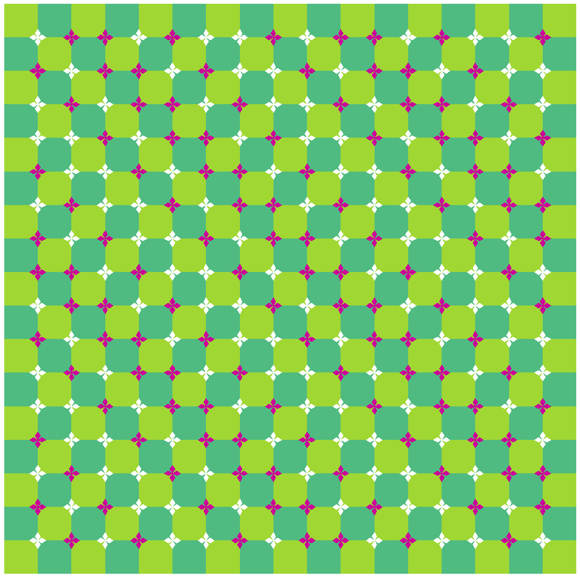
Similarly, Kitaoka tricks the eye into perceiving waves rolling diagonally over this quilt-like sheet in “Primrose’s Field:”

As we understand more about the eye and how it perceives the visual stimuli it receives, as well as more about the brain and how it processes information, I suspect we’ll be able to craft even more convincing, mind-blowing, and unnerving examples of visual sleight of hand.

And undoubtedly, Akiyoshi Kitaoka will be leading the way.


Many thanks to Dr. Kitaoka for granting permission for me to feature three of his illusions in this post. You can check out more of his amazing work on his website, as well as some of his books on Amazon here!

Thanks for visiting PuzzleNation Blog today! You can share your pictures with us on Instagram, friend us on Facebook, check us out on TwitterPinterest, and Tumblr, and be sure to check out the growing library of PuzzleNation apps and games!

The Perils of Puzzling: Alternate solutions!

[Thinking hard. Image courtesy of popsci.com]

The science, fantasy, and science fiction website io9 has a marvelous weekly feature run by Robbie Gonzalez, wherein they tackle brain teasers and riddles both new and old. I’ve explored several of them here on PuzzleNation Blog, most notably the 100 Men in Hats puzzle, which expanded on the Men in Hats puzzle concept from one of our earliest posts.

But one of their latest riddles provided a valuable example of how crucial test-solving and crowd-sourcing can be to a puzzle’s success.

The idea was simple enough: look at the numbers below, and determine what number should take the place of the question mark. The only guideline? The answer was NOT six.

I posted this riddle on our Facebook page on Monday and shared it with fellow editors at the PuzzleNation office, and got all sorts of answers in return.

One solver came up with 5 as the answer, positing that the vertical numbers formed fractions. So, with 1/2 and then 3/4 as the next number, the pattern would be adding 1/4. Adding 1/4 to 3/4 equals 1, and 5/5 equals 1.

There were other solutions that also yielded 5 as an answer, like doing what my friend called a zigzag equation, adding 1 from the top to 4 from the bottom to get 5 on the top as the answer, and then reversing it by adding 2 from the bottom to 3 from the top, getting 5 on the bottom as the missing answer.

A second solver came up with 3 as the answer, adding the top row to equal 9, and then trying to do the same with the bottom row.

Another solver saw them as two separate patterns, where going from 1 to 3 involved adding 2 and going from 2 to 4 involved multiplying by two. Therefore, by this method, the answer is 8. (Yet another solver did the same, except they squared the numbers along the bottom row, leading to 16 as the answer.)

As you can see, there were all sorts of mathematical solutions. When you’re told to ignore the most obvious solution, your mind can create some truly innovative ways of reimagining the information available.

[A head full of numbers. Image courtesy of equip.org]

Several solvers thought outside the box and came up with R, relating the numbers by their positions on a gearshift knob instead of mathematically.

As it turns out, this was the solution the puzzle’s creator initially intended, only realizing later that the puzzle had many possible solutions.

In his own words: The riddle was too open-ended. Whether you interpreted it as a mathematical puzzle, or an automotive design puzzle, it was poorly posed, and that’s on me. Puzzle-posing is an art in and of itself, and it’s easy to mess up. For a solution to be satisfying, the person posing the puzzle needs to provide enough information that the puzzle is unambiguously solvable, but not so much that it gives too much away.

[A proposed layout that points more directly toward the creator’s intended solution.]

Now, as a puzzler myself, I can absolutely empathize with Mr. Gonzalez here. There are plenty of times I’ve created a puzzle or a brain teaser and assumed that everyone would follow the same path I envisioned, considering the solution if not obvious, then at least reproduceable.

But solvers can always surprise you by finding alternate routes to the answer or utilizing a different way of thinking that ends with a second, but still valid solution.

So after a few stumbles and missteps of my own in the past that were similar to the one in today’s puzzle, I now make sure to have another set of eyes on my brain teasers, either during the creation process or as a test-solver afterward.

A second set of eyes can be absolutely invaluable in helping you spot possible alternate solutions.

Thanks for visiting PuzzleNation Blog today! You can share your pictures with us on Instagram, friend us on Facebook, check us out on TwitterPinterest, and Tumblr, and be sure to check out the growing library of PuzzleNation apps and games!

Carroll’s classic conundrum!

After my post on Brain Melters (the diabolical siblings of brain teasers), I’ve had riddles on the brain, one in particular.

There’s a famous riddle that compares a raven and a writing desk. It was first penned by the brilliant, controversial, and utterly ridiculous Lewis Carroll.

The Hatter asked Alice, “Why is a raven like a writing-desk?”
“I give up,” Alice replied. “What’s the answer?”
“I haven’t the slightest idea,” said the Hatter.
Alice sighed wearily. “I think you might do something better with the time,” she said, “than waste it in asking riddles that have no answers.”

It was purposely devised as a riddle with no answer — prime Brain Melter territory — but that hasn’t stopped people from trying to solve it in various silly, pragmatic, and clever ways through the years.

A practical answer is “They both have legs”, but not only is that terribly boring, but it seems to abruptly ignore Carroll’s legacy of whimsy and logodaedaly.

(Come on, it wouldn’t be a truly Lewis Carroll-worthy post without some curious vocabulary. *smiles* And a pat on the back to those who didn’t have to look it up!)

Many people have incorporated assonance, rhyme, and wordplay into their solves. Here are some of the possible solutions people have conjured over the years:

–It is used to carry on work and work carrion.
–Because the raven has a secret aerie and the writing desk is a secretary.
–It understands its tails and quills would nevar [sic] work with the wrong end in front. (This is a variation on the answer Carroll eventually provided)

Carroll himself was quoted as saying that a raven is like a writing-desk “because it can produce very few notes, tho they are very flat; and it is nevar [sic] put with the wrong end in front.”

Despite Carroll’s typically obtuse and curious response, several sources have stated that the correct answer is that “dark wing site” is an anagram for “a writing desk”.

Ignoring all of these possible solutions, I prefer the one I consider the most simple, the most clever, and the most sensible…

How is a raven like a writing desk? Poe wrote on both. =)

Thanks for visiting the PuzzleNation blog today! You can like us on Facebook, follow us on Twitter, check out our Classic Word Search iBook, play our games at PuzzleNation.com, or contact us here at the blog!

Beware the Brain Melter…

meninhats

I’m a huge fan of brain teasers. I love pitting my mind and mental quickness against word puzzles and other challenges, so brain teasers are perfect.

A terrific example of a quality brain teaser appeared here a while back: the Men in Hats problem (pictured above).

It’s a great brain teaser because it’s deceptively simple, but requires careful, outside-the-box thinking to figure out how to solve the puzzle.

But there’s another kind of brain teaser out there that’s not intended to be solved. These are more tricks or bits of wordy gamesmanship than brain teasers. I like to think of them as brain melters.

Here’s an example of a brain melter I tweeted a month or two ago:

True or false? Thare are five mistukes im this centence.

Now, parsing it out, you can see the misspelled “thare” (1), the misspelled “mistukes” (2), the misspelled “im” (3), and the misspelled “centence” (4).

But the statement says there are five mistakes when there are only four, which would make the statement false. If you count “five” as a mistake, then it becomes five mistakes, which makes the statement true. But if five mistakes is true, then saying “five” ISN’T a mistake, so the total goes back to four mistakes, and…

You see? You soon find yourself in a brain-melting loop that never goes anywhere. It’s like the barber who shaves only the townsmen who don’t shave themselves. So does he shave himself? If he does, he doesn’t. If he doesn’t, he does.

Still with me?

Okay, here’s another brain melter. (The one, in fact, that inspired this blog post.)

If you choose an answer to this question at random, what is the chance you will be correct?

A) 25%
B) 50%
C) 60%
D) 25%

At first glance, this seems simple. There are four options, so the chances of being correct should be 1 in 4, or 25%.

But wait. Two of the answers are “25%”, meaning that A AND D could lead to the right answer, so those odds become “50%”.

But “50%” as an answer only appears once, so the chances of choosing “50%” are only 25%.

And if you keep following that chain of thought, you circle around and around and around, going from 50% to 25% and back again while your brain dribbles out your ears and down into your shoes.

Beware the brain melters masquerading as brain teasers, my friends.

Thanks for visiting the PuzzleNation blog today! You can like us on Facebook, follow us on Twitter, check out our Classic Word Search iBook, play our games at PuzzleNation.com, or contact us here at the blog!