
There’s a lot of misinformation out there about the connection between puzzles/games and brain health.
If you’re a puzzle fan, no doubt you’ve seen the onslaught of ads about “brain fitness,” “brain training,” and all sorts of promises about memory help and staving off Alzheimer’s, dementia, and other cognitive conditions.
A casual Google search will turn up dozens of articles online arguing both sides. And so much of the data is inconclusive at best.
But!
There are absolutely benefits to playing puzzles and games in very specific circumstances:
- Tetris has been used by researchers to help people suffering from traumatic flashbacks, a type of post-traumatic stress.
- The University of Exeter conducted a study involving more than 19,000 participants that concluded that adults age 50 and older who regularly solve puzzles like crosswords and Sudoku have better brain function than those who do not.
- An article from Scientific American discussed how crossword solving engages the episodic buffer, one of the mechanisms related to our working short-term memory, our ability to temporarily hold information while performing cognitive tasks.
- Jigsaw puzzle solving can induce a mental state similar to dreaming, one that helps with stress, relaxation, and mood.
The latest exciting possibility of a connection between puzzles/games and health comes from a publication in the Proceedings of the National Academy of Sciences, which reports that playing a three-minute video game has proven effective in identifying patients with depression based on anhedonia.
Anhedonia is the loss of the ability to enjoy things you would normally find pleasure in. Basically, the goal post of “enjoyable” moves, meaning something you previously enjoyed no longer results in the same good feelings it did.
And when you consider that anhedonia is present in an estimated 70 percent of patients with major depression issues, you can see how devastating anhedonia’s moving goal posts would be for someone already struggling with depression.
So how does this game work as a diagnostic tool?
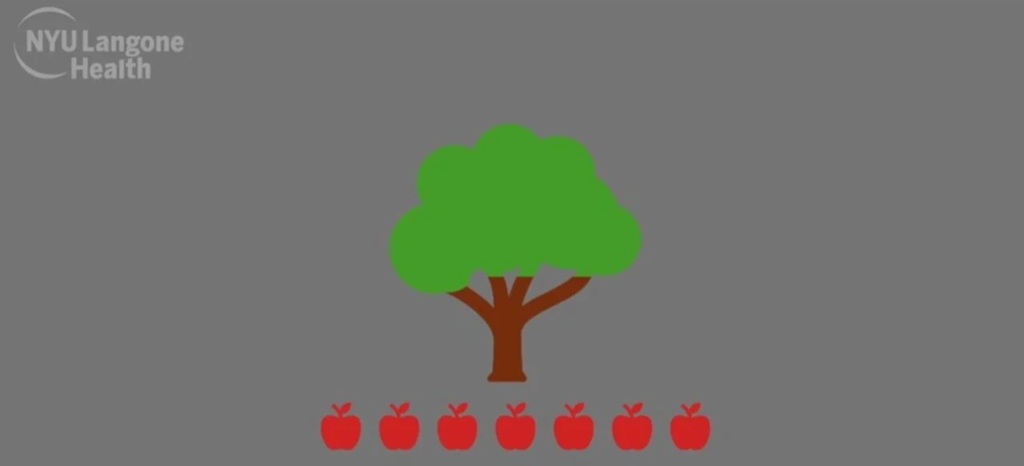
The game challenges the player to collect the most apples from a series of digital trees. With each round of harvesting, fewer apples fall from the tree, and at some point, a player will move on to the next tree.
That moment, that decision point, is where the researchers are focusing their diagnostic attention:
The researchers asked 120 game players—50 diagnosed with major depression and 70 who were not—to compete to collect the most apples falling from digital trees. Researchers use such foraging tasks because reward-seeking circuitry, especially regarding something that looks like food, has been engrained in the mammalian brain by evolution.
And it turns out that the subjects who were previously diagnosed stopped taking pleasure in the game 50 percent sooner than non-diagnosed players.
While the non-diagnosed players would often stick with a tree until its yield dropped to 5 apples, those diagnosed with depression abandoned one tree for the next while the yield was still 8 or 9 apples.

Yes, like most diagnostic tests, this game will probably prove less effective as knowledge of it grows, but it remains a valuable option for researchers.
Dan Iosifescu, MD, a professor in the Department of Psychiatry at NYU Grossman School of Medicine, elaborates on that:
Depression is increasingly thought of as an umbrella term that may include several distinct conditions… Measuring reference points may help us identify a specific subtype of depression linked to anhedonia, clarify its disease-causing brain computations, and tailor treatments.
And we may be able to do this remotely by asking patients, rather than traveling repeatedly for in-person visits, to spend a few minutes per week playing a smartphone game that lets us quickly adjust their treatment.
Greater accessibility of testing is definitely a good thing (although at the moment, the game is not publicly available to try).
Here’s hoping this game and others like it can be used to get specialized help to those who need it.
Do you find certain games and puzzles therapeutic, fellow puzzler? Let us know in the comments section below! We’d love to hear from you.

