Puzzling with the Kids: Blast-A-Way

There aren’t many games featuring bombs that make you want to say “That’s adorable!” Blast-A-Way from Illusion Labs definitely manages this feat. In this cheerful kid-friendly game for the iPad, you control a number of adult “Boxies” — basically boxes with legs — and are tasked with rounding up the little ones, who have gotten lost and need some rescuing.

Each level is essentially an abstract maze, and to navigate the maze you will need several kinds of bombs. You’ve got your basic blow-things-to-smithereens bomb — useful for rescuing little Boxies who have become embedded in a wall, or simply to make a path so you can reach the finish line. There are teleporters, which will blip you over to a different part of the maze, as long as the teleport bomb matches the color it lands on. Rebuilders are anti-bombs: They put back together the parts of the maze you previously blew up.

Add to this further complications: Sheets of colored glass will change the color of your bombs. Portals will send your bombs zipping to the other side of the maze. And some levels will require two Boxies to work together to rescue all the little ones.

The puzzles stay at the softball level for at least half of the game’s 80 levels — a smart kid will have no trouble helping to solve them, or pushing you aside and doing it herself. After the halfway mark, you and your child may well need to think things over for a while, and you might even have to leave a Boxie or two unrescued, the poor little things.

Blast-A-Way is loaded with charm. The levels are richly textured — you’ll have just gotten used to the beauty of the wooden-block mazes, when suddenly you’re on to new levels done up in a sleek metal finish, or upholstered in the soft fabric of a kiddie rumpus room. My daughter says at least once during our play sessions, “I love this music!” And then there are the adorable little Boxies themselves, trying to get your attention with a high-pitched “Over here!” and “Miiister!” Blast-A-Way raises the bar on high-polish puzzling on the iPad.
Puzzles in Pop Culture: The Simpsons

From Stanley’s love of crosswords on The Office to the clever conundrums constantly conjured by the Riddler in various iterations of Batman, puzzles have played roles both big and small in numerous TV shows and films.

But for my money, few shows have made puzzles the centerpiece of storyline development and family interaction quite like The Simpsons.

The first episode that comes to mind — and my personal favorite — is season 9’s Lisa the Simpson.

In the episode, Lisa is stumped by a brain teaser and begins to worry about her intelligence, a concern that is only exacerbated by Grandpa’s revelation of the Simpson Gene, a genetic quirk that caused Homer and Bart’s descent from academic achievement to hilarious idiocy.

In the end, of course, Lisa discovers she’ll be just fine — the defective gene is on the Y chromosome, so only male Simpsons are afflicted — and she conquers the brain teaser.

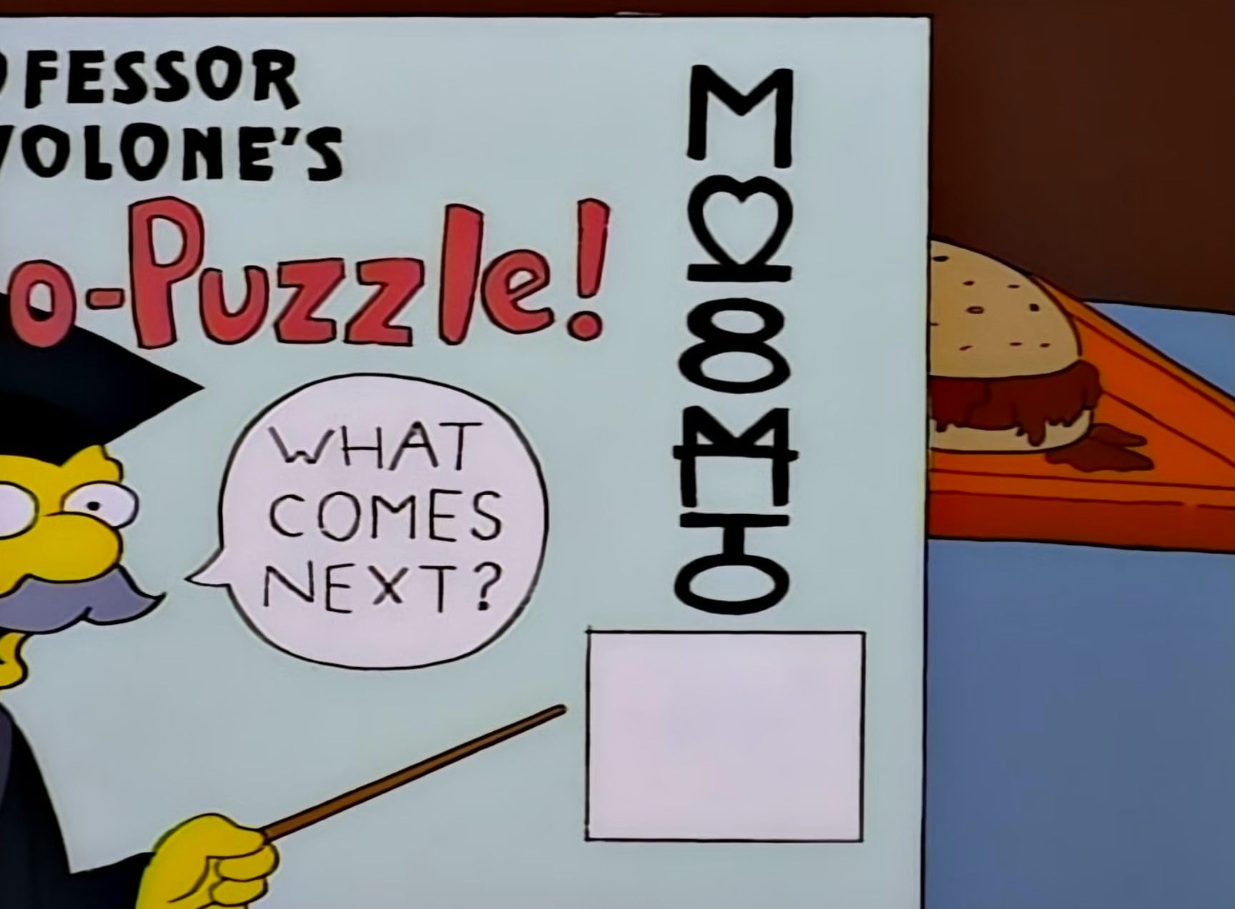
Puzzly themes would continue to crop up in the show from time to time.

For instance, Homer discovers a secret acrostic message from his mother in the newspaper in season 15’s My Mother the Carjacker. But most of the puzzle-centric goodness centered around Lisa.

She indulged in palindromic fun with fellow Mensa members in season 10’s They Saved Lisa’s Brain, as well as an anagramming game in the season 6 classic Lisa’s Rival.

(That’s when I first learned that Alec Guinness anagrams into Genuine Class.)

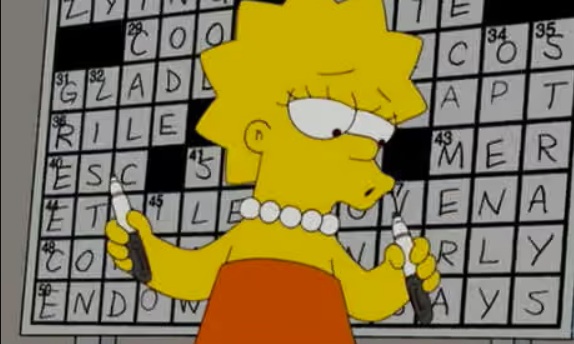
But puzzles wouldn’t again take center stage until season 20’s episode Homer and Lisa Exchange Cross Words.

In the episode, Lisa quickly becomes a crossword fiend, solving all the puzzles she can and eventually entering the Crossword City Tournament.

Trouble brews when Homer bets against her in the championship round, and their relationship fractures.

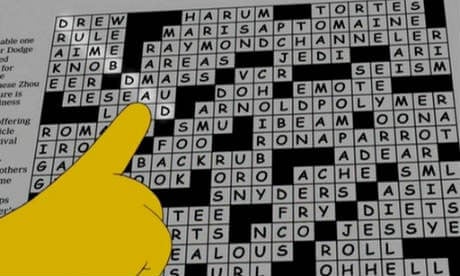
This was a real watershed moment in synergy for the show, since they somehow managed to convince The New York Times to publish the same puzzle in the paper that Homer uses to apologize to Lisa.

(You can click here to see the full puzzle.)

Homer’s hidden message runs along the diagonal, and it’s a brilliantly unobtrusive trick. I’m sure some solvers never even noticed the tie-in. (The puzzle didn’t reference The Simpsons or the episode in any other way.)

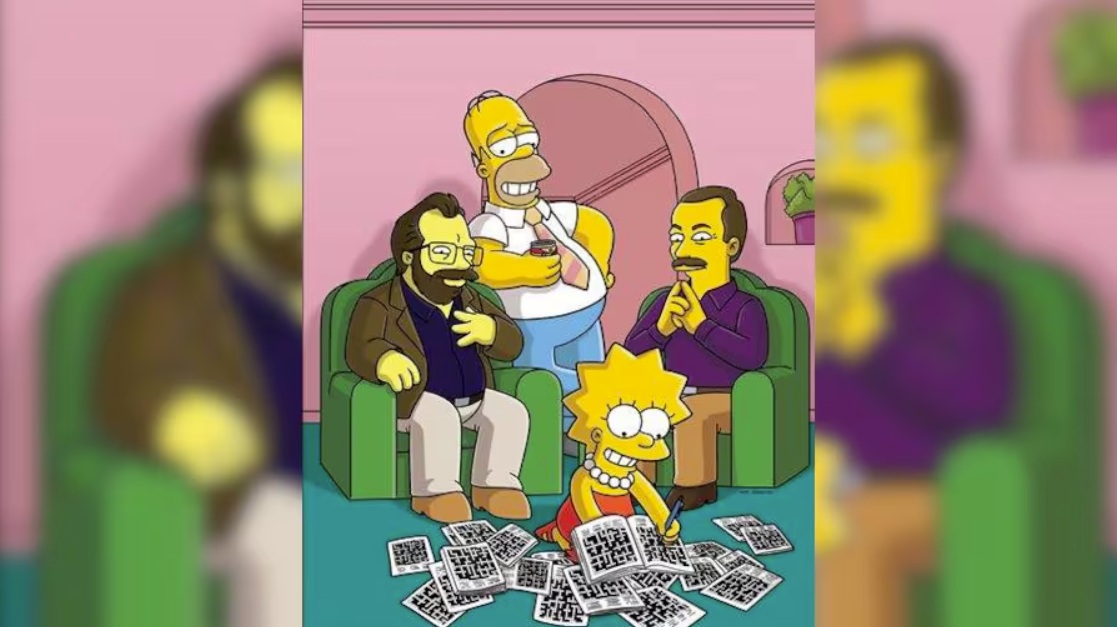
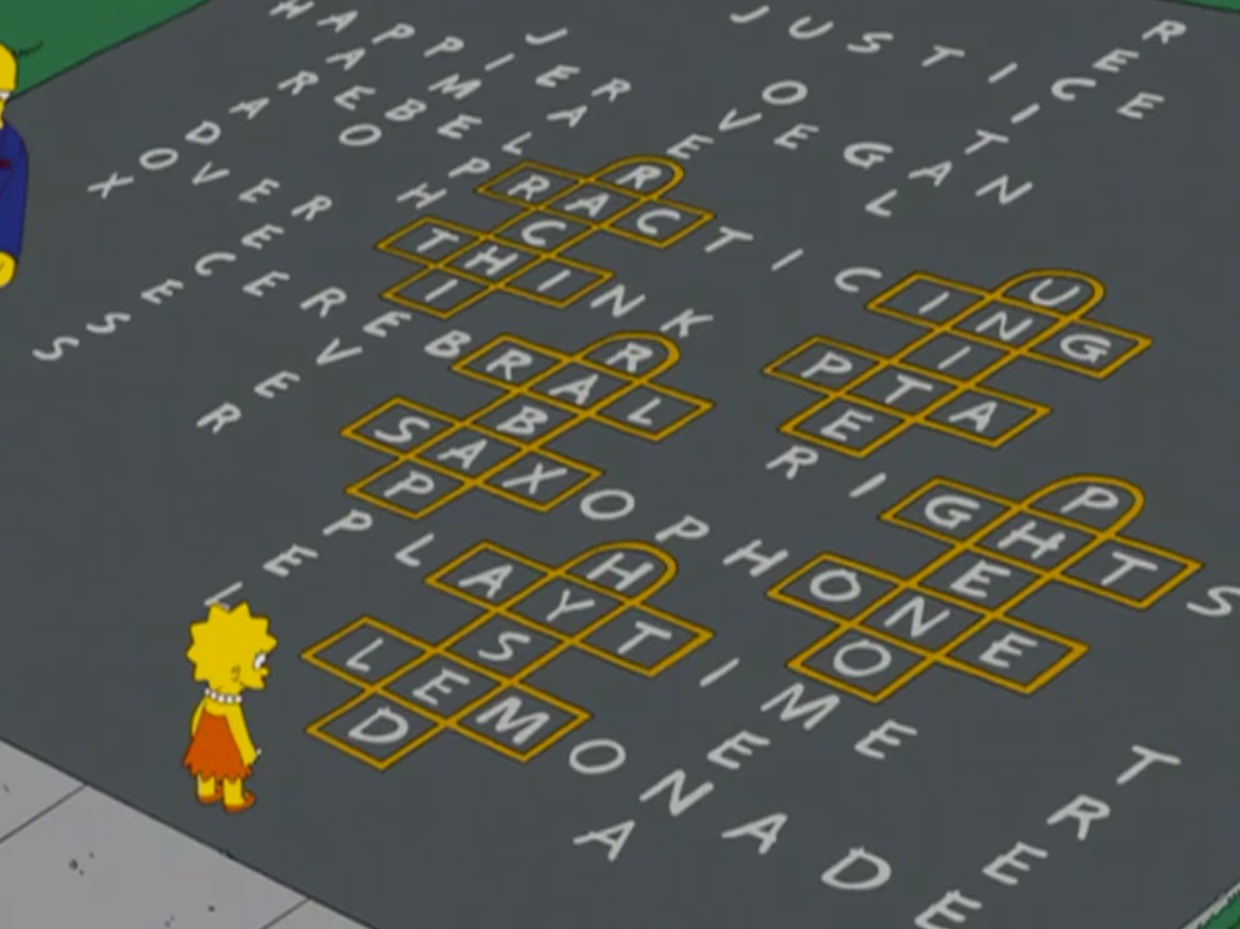
Puzzlemaster Merl Reagle created the puzzle, and Will Shortz oversaw the project. Both also appeared in the episode. (Reagle also created the word crossings for the hopscotch puzzle pictured above.)

It’s a real treat to see puzzles incorporated into a narrative like this. Instead of a time-killer or a mere passing interest, they become linchpins of each story. The puzzles create conflict, drive epiphanies, and bring people together.

It’s a testament to the power of puzzles in pop culture. Plus, they’re just a buttload of fun.

Hope you enjoyed this little (animated) trip down memory lane. Until next time, keep calm, puzzle on, and I’ll catch you again soon.

Tennis, anyone?

How about Pong? While waiting to cross a street in Germany?

Someone has to import this to America ASAP.

The Edited Version

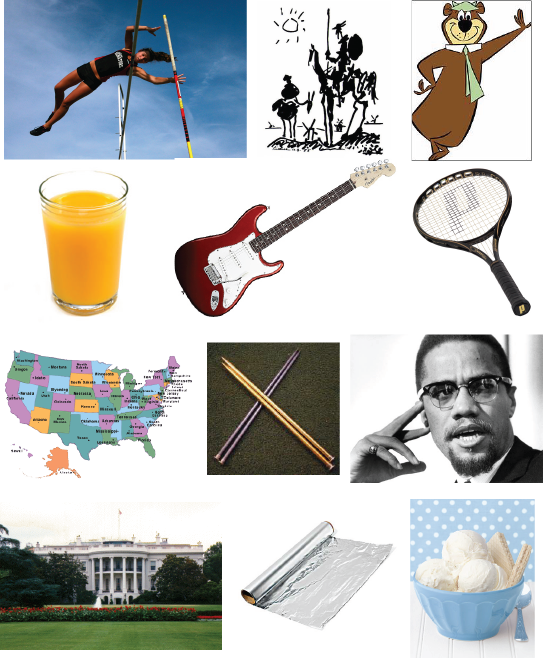
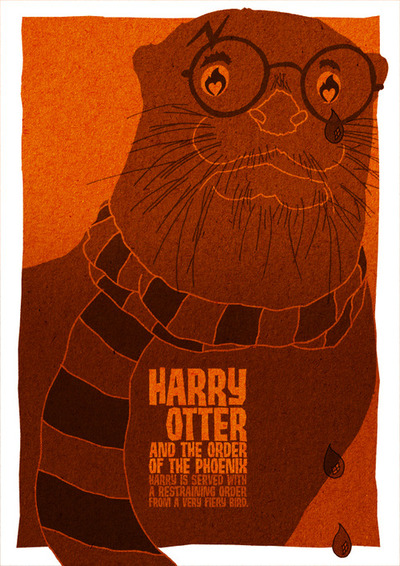
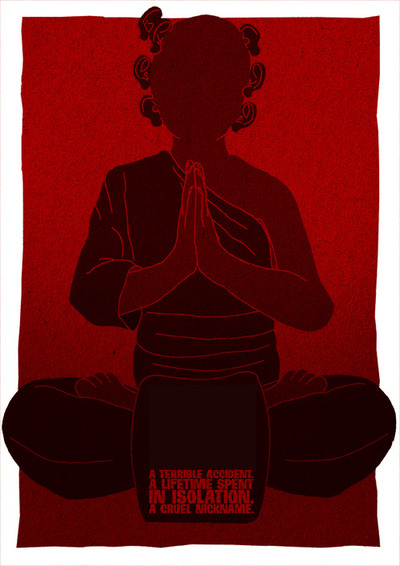
Some clever but anonymous soul has been deleting letters from various movie titles, and creating a poster for each new name. Before you click through to see all of them, can you figure out the title we’ve removed from the poster below?

Hat tip: Neatorama.

The Nerd Potluck Looms Large!

Aloha, fellow puzzlers and solvers galore!

Last week, I mentioned that I’d be attending a Nerd Potluck this coming weekend. It’s a celebration of all things puzzle, game, and nerd-centric, and I’ve been working on a new word puzzle to challenge my fellow attendees.

And as promised, you’re getting the first peek at it. I call the puzzle “Word Personals.”

Word Personals is based on the singular parlance of personal ads and dating slang.

Your standard personal ad looks something like this:

SWM, 31, brown hair, brown eyes, calf muscles of a Roman gladiator, enjoys full contact rock-paper-scissors and the films of Ben Stiller…

The breakdown is pretty simple.

–SWM is short for single white male in standard personal ad jargon. SWF would be single white female. (SBF would be single black female, MWM would be married white male, etc.)
–That’s followed by the person’s age and a brief description.

So my idea was to employ this format, but make the ads themselves word puzzles to be decoded by a solver.

Here’s an example:

SWF, 6, one letter once, one letter twice, and one letter three times, enjoys hanging out and giving people the slip.

Again, the breakdown is pretty simple.

–SW stands for “single word.” (If it was “MW,” it would be “multiple words,” indicating a phrase.)
–The next letter, F, stands for “features,” indicating that characteristics of the word will follow. (If it was “M,” it would be “means,” indicating a definition, synonym, or hint toward the definition would follow.)
–The number that follows is the number of letters in the word or phrase.
–Finally, there’s the description, which is in two parts. The first part, as indicated by “F,” gives some characteristics of the word. The second part is a jokey clue to provide further information.

And there you have it, Word Personals. I’m sure you’ve solved the example one already, so how about we check out a few more?

1) SWM, 8, power or vigor, enjoys vowel conservation and Herculean qualities.

2) MWF, 11, can read backwards and forwards, enjoys formal greetings and the days before holidays.

3) SWF, 4, goes from one syllable to three by adding a letter, enjoys taking car trips in the past tense.

4) MWM, 9, stutter-stop way of talking, enjoys frequent breaks and a certain British inspector.

I admit, It’s a bit esoteric, but I like the concept quite a bit, and I think it’ll be a hit.

Naturally, your thoughts are welcome. What’s confusing? What works? Is it too prone to alternates? Too easy? Too difficult? Your input would be very much appreciated.

In the meantime, I hope Word Personals provided you with a bit of brain-teasing today. So keep calm, puzzle on, and I’ll catch you next time. Wish me luck!