Pizza puzzling!

I ordered pizza the other night, and being a puzzly guy, I couldn’t help but find a puzzle hiding beneath the lid of that pizza box.

The pizza was cut into eight slices, as you’d expect, all of roughly equal size. And I started to wonder: what if you had more than eight people sharing one pizza?

The simple solution would be to cut those pieces down the middle into long, thin pieces. But were there other solutions out there, other shapes that would allow more people equal access to a shared pizza?

So I did a little research, and I stumbled upon this recent Gizmodo article, which discussed a mathematical paper titled “Infinite families of monohedral disk tilings.”

I don’t know about you, but I’m definitely going to start calling pizza slices “monohedral disk tilings.”

Anyway, mathematicians had apparently tackled the pizza problem before, and they believe the solution rests with tessellation, the use of the same shape or symmetrical shapes repeated over and over to fill a given space.

When you think about symmetry and tessellation, you tend to think of straight lines.

But the amazing thing about these solutions to the pizza problem? They all abandon straight lines.

As you can see, there are numerous variations that work from this shield patterning. Since the shields are the same, dividing the shields up into equal parts in different forms yields other solutions.

And that use of arcs (curved lines) instead of straight lines makes patterns that would normally only work in squares, pentagons, and other shapes work for circles, like your friendly neighborhood pizza.

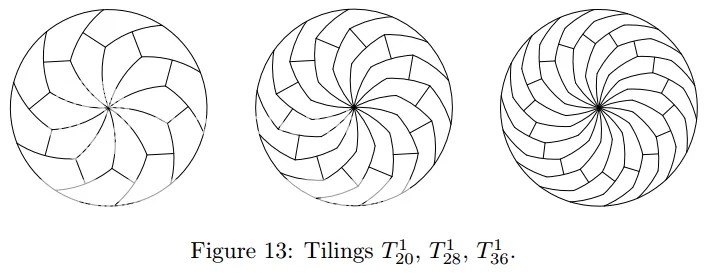
But there are more solutions for the pizza problem lurking out there if you abandon the three-sided piece and try more exotic shapes. Check out these patterns:

Granted, the average pizza slicer isn’t going to be dicing up a pie into 28 or 36 pieces… but it’s nice to know there are options out there, in case a few dozen friends stop by unexpectedly on pizza night.


Thanks for visiting PuzzleNation Blog today! Be sure to sign up for our newsletter to stay up-to-date on everything PuzzleNation!

You can also share your pictures with us on Instagram, friend us on Facebook, check us out on TwitterPinterest, and Tumblr, and explore the always-expanding library of PuzzleNation apps and games on our website!

Dell Collection 11 now available for the Penny Dell Crosswords App!

Hello puzzlers and PuzzleNationers! Happy Monday!

That’s right, it’s a bonus blog post today because we’ve got some exciting news!

Our latest puzzle set for the Penny Dell Crosswords App just launched in the App Store, and it’s one of our best yet!

Say hello to Collection 11! Our first collection of 2016!

Collection 11 offers 150 puzzles for your solving pleasure!

Get the Value bundle, including all 150 puzzles at a special low price, or choose from 5 30-puzzle packs — Penny Press Easy, Penny Press Medium, Penny Press Hard, Dell Easy, and Dell Medium!

Five flavors of crosswords in one package! Start your year off right with some terrific puzzles! How can you go wrong?


Thanks for visiting PuzzleNation Blog today! Be sure to sign up for our newsletter to stay up-to-date on everything PuzzleNation!

You can also share your pictures with us on Instagram, friend us on Facebook, check us out on TwitterPinterest, and Tumblr, and explore the always-expanding library of PuzzleNation apps and games on our website!

It’s Follow-Up Friday: Pixel Puzzle edition!

Welcome to Follow-Up Friday!

By this time, you know the drill. Follow-Up Friday is a chance for us to revisit the subjects of previous posts and bring the PuzzleNation audience up to speed on all things puzzly.

And today, I’d like to return to the subject of puzzle art!

I stumbled across this terrific art print from 30 Squared a while back, and I thought it would make a fun puzzly challenge for the PuzzleNation readership.

We’ve got twelve famous vehicles from movies and television, presented in pixelated form.

Can you identify the TV shows or movies that featured these iconic vehicles? Let’s put your pop culture knowledge to the test!


Thanks for visiting PuzzleNation Blog today! Be sure to sign up for our newsletter to stay up-to-date on everything PuzzleNation!

You can also share your pictures with us on Instagram, friend us on Facebook, check us out on TwitterPinterest, and Tumblr, and explore the always-expanding library of PuzzleNation apps and games on our website!

A crossword like you’ve never seen before

When someone sends me a link, claiming they’ve uncovered the most difficult crossword they’ve ever seen, I’m usually skeptical.

I mean, I’ve seen some diabolical crosswords in my day. From puzzle 5 at the American Crossword Puzzle Tournament and the meta-puzzles lurking in Matt Gaffney‘s Weekly Crossword Contests to the Diagramless and Double Trouble crosswords offered by our friends at Penny Dell Puzzles, it’s hardly tough to find challenging crosswords these days.

But this puzzle, originally created for the 2013 MIT Mystery Puzzle Hunt and made solvable (and rotatable!) online by Greg Grothaus, might just take the cake:

As you can see, there are clues across three sides of the hexagonal grid: the across clues, the down-to-the-left clues, and the up-to-the-left clues.

But these clues are unlike anything I’ve seen before.

It turns out that these are regexps, or regular expressions, sequences of characters and symbols that represent search commands in computer science.

Now, anyone who has used graphing features in Excel or crossword-solving aids on websites like XWordInfo, Crossword Tracker, or OneLook is probably familiar with simple versions of regexp. For instance, if you search C?S?B?, you’ll probably end up with CASABA as the likely top answer.

Of course, the ones in this puzzle are far more complicated, but the overlapping clues in three directions make this something of a logic puzzle as well, since you’ll be able to disregard certain answers because they won’t fit the other clues (as you do in crosswords with the across and down crossings in the grid).

But if, like me, you don’t know much about reading regexp, well then, you’ve got yourself a grid full of Naticks.

If anyone out there is savvy with regexp, let me know how taxing this puzzle is. Because, for me right now, it’s like doing a crossword in a foreign language.

But I’m not the only one who feels this way. When I first checked out the post on Gizmodo, they titled it “Can You Solve This Beautifully Nerdy Crossword Puzzle?” and I laughed out loud when the very first comment simply read “Nope.”

Glad to see I’m not alone here.


Thanks for visiting PuzzleNation Blog today! Be sure to sign up for our newsletter to stay up-to-date on everything PuzzleNation!

You can also share your pictures with us on Instagram, friend us on Facebook, check us out on TwitterPinterest, and Tumblr, and explore the always-expanding library of PuzzleNation apps and games on our website!

The Story Behind Bletchley Park

It’s amazing when you consider the impact one of the most common forms of puzzle solving, cryptography, has had on world history. From the Revolutionary War to World War II, codebreaking was a battlefront as crucial and as exhausting as any contested piece of land on the map.

This was brought into stark clarity recently when I read The Secret Lives of Codebreakers by Sinclair McKay, which chronicles the work and lives of the team members at Bletchley Park who dedicated themselves to cracking the German Enigma code. It’s been said that Bletchley Park’s achievements shortened the war by two or three years. That’s no small feat.

(You know the decryption work done at Bletchley Park was good if it inspired parts of two of Ian Fleming’s James Bond novels. The film The Imitation Game barely scratched the surface.)

From The Secret Lives of Codebreakers:

Here, in these grounds fifty miles to the north of London, they would be introduced to the gravest secret of the war. Every intercepted enemy message — every signal from every captain, commander, military division, battleship, U-boat — all these encrypted communications, jumbled up into seemingly random letters in groups of four and five, and transmitted by radio, were gathered by the many listening posts around the British coastline.

From the Battle of Britain to the Blitz, from Cape Matapan to El-Alamein, from Kursk to the V-1 flying bombs, to D-Day and Japan, the work of Bletchley Park was completely invisible, yet right at the heart of the conflict. It was a key player whose presence, at all times, had to be kept utterly hidden from the enemy.

Imagine working these incredibly intensive sessions, obsessively looking over bits of code for hours at a time, knowing that the fate of the world rested on your shoulders, and a simple transcription mistake could cost lives. It’s a mind-boggling concept.

And the book shed a great deal of light on the decryption work itself. For instance, I had no idea how many variations of the Enigma code they were expected to crack.

The German rule was that no message should be more than 250 letters in length; if it was necessary to send a longer message, it should be split into multiple parts. This was designed to make life more difficult for codebreakers: the longer the message, the easier it might be for such a person to see patterns of letters forming among the apparent chaos.

Thanks to preambles in each Enigma message, codebreakers could at least be organized under different color keys: yellow, green, red, and blue. When they ran out of colors, they named keys after marine life, then birds, then elephants, then insects.

This was a war, and organization was key, no pun intended.

The first big break is known as the Herivel Tip, when one of the Bletchley Park crew deduced that some Enigma machine operators might choose the new day’s settings based on the letters used the previous day. This became a valuable jumping-off point for daily decryption attempts with their own coding device, the bombe machine.

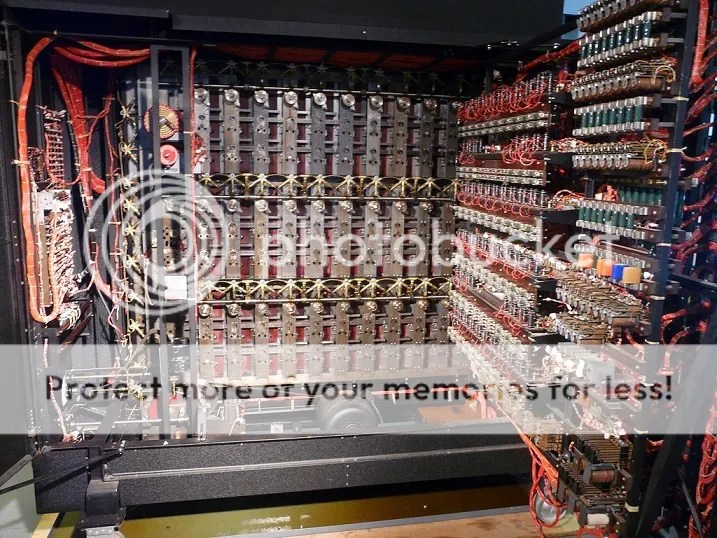
In 1941, the first major Enigma-style code, the Abwehr code, was broken by Bletchley Park. In June of 1941, they broke the Vulture key, which revealed German activity on the Eastern front.

But the Germans were constantly adapting and refining their codes. German paranoia led to submarines using a different code than surface naval vessels. So “Dolphin,” the surface naval code, was not the only code troubling Bletchley Park. “Shark,” the submarine key, was a new concern. Thankfully, when U-559 sank in 1942 and its crew abandoned ship, its Enigma machine and a book of current “Shark” keys was salvaged by Allied forces without German knowledge.

In 1943, they broke “Porcupine,” giving them access to all German air force messages for a few weeks.

Around this time, the German High Command began using another method to transmit encrypted messages, and this became yet another focus of Bletchley Park. The “Fish” or “Tunny” communications were between generals and the Fuhrer himself.

This led to the development of the big brother of the bombe machine, Colossus, which combined the logic engines of a Turing machine with electronic valves that allowed it to read 5000 characters a second, five times faster than the previous top machine.

(While this was going on, Turing himself was developing a new speech encipherment system, Delilah, so named because she was a deceiver of men.)

In January 1945, efforts were still going strong, as Bletchley Park not only cracked the “Puffin” and “Falcon” keys of the German army, but effectively countered attempts by the Luftwaffe to implement new encryptions. By this point, dozens of variations of Enigma had been unraveled by the team.

Of course, decryption wasn’t the only thing accomplished at Bletchley Park.

The grand deception that led to the Normandy invasion was also managed there. They gradually fed false data to German Intelligence about military groups like the First United States Army Group preparing to enter France via the Pas de Calais and the Twelfth British Army into Scandinavia and Turkey. This allowed for D-Day to proceed, as German attention was diverted.

But The Secret Lives of Codebreakers goes beyond their wartime victories. McKay takes us behind the scenes of Bletchley Park to share not only the hard-won achievements of the cryptographers there, but also what daily life was like on the isolated estate. From living conditions and several romances to rivalries and petty feuds caused by high tensions, the book catalogues the realities of such stressful work in richly detailed fashion.

I think my favorite discoveries were related to the off-time of the recruits:

Oliver and Sheila Lawn have especially fond memories of the way that Bletchley-ites contrived to use their leisure time: “There was music,” says Mr. Lawn, “Play readings. And play actings. Quite a bit of amateur dramatics. And concerts of all kinds.”

Highland dancing, madrigals, creating palindromes…they were offered all sorts of activities to help keep spirits up after grueling decryption sessions. Certain musical artists were even invited up to perform there!

When you consider how important their work was and how many years they were sworn to silence about Bletchley Park, these revelations become all the more stunning. This isn’t just a fascinating work of puzzle history, this is history itself.


Thanks for visiting PuzzleNation Blog today! Be sure to sign up for our newsletter to stay up-to-date on everything PuzzleNation!

You can also share your pictures with us on Instagram, friend us on Facebook, check us out on TwitterPinterest, and Tumblr, and explore the always-expanding library of PuzzleNation apps and games on our website!

It’s Follow-Up Friday: Schools and Spheres edition!

Welcome to Follow-Up Friday!

By this time, you know the drill. Follow-Up Friday is a chance for us to revisit the subjects of previous posts and bring the PuzzleNation audience up to speed on all things puzzly.

And today, I’d like to return to the subject of Kickstarter philanthropy!

[Image credit: for-preneur]

I’ve written about crowdfunding a lot in this blog, because over the last few years, platforms like Kickstarter and Indiegogo have changed how many puzzles and games are created, funded, and brought to market.

There’s a virtual board game and card game renaissance stemming from these websites, and many puzzle constructors are bypassing traditional publishing formats and taking their puzzle suites and projects straight to the audience this way.

But there’s also the opportunity to give back to your community in meaningful ways.

I recently stumbled across the Kickstarter campaign for StrataSphere, a strategy puzzle game from Family Games America that really caught my eye.

Like a next-level version of Connect Four and KerPlunk, StrataSphere challenges you to place your sliding tabs in various slots around the cube, then use them to drop your spheres to the bottom layer first.

But what most intrigued me about the project wasn’t the puzzle itself, but one of the crowdfunding options being offered. Instead of just pledging for a copy of the game for yourself, you could pledge a little more money and donate a copy of the game in your name to a school of your choosing. Puzzle philanthropy.

I reached out to the team at FGA to find out more about the project, and had the opportunity to chat with Paulette Hall, communications director for FGA.

Where did the idea for StrataSphere come from?

The game was originally envisioned and developed by German designer Claudia Herz, who originally named it BallCube. Claudia remembers that after spending time sketching and offering the idea to other game publishers she finally made a handmade sample of acrylic glass and presented it at a trade-show not too far from her home.

The reaction and feedback was overwhelming. People wanted to know everything about the game and know where it can be purchased. This is what encouraged her to pursue the project. With a combination of inspiration from Claudia and outer-space, we renamed the game StrataSphere 2.0.

For people unfamiliar with FGA, what sort of puzzles and puzzle-games are your bread and butter? Is StrataSphere a traditional FGA-style puzzle, or is it a new direction for you?

FGA’s tag-line, Learning Through Laughter, has been been incorporated into all of our gift, game, and puzzle products since being established in 1987. StrataSphere 2.0 is not so much a puzzle but a strategy tabletop game that is a more contemporary modern addition to our line of products.

Our more popular items include eco-friendly wooden games and puzzles like Cathedral, Don’t Break The Bottle, and our wood and wire puzzles. While this strategy game is new to FGA, FGA is not new to strategy games.

The option for supporters to donate an additional copy to a school of their choosing is one I’ve never seen before, and I’m surprised more Kickstarter campaigns haven’t utilized it. Is this the first product that has incorporated this sort of program? Is this a long-term goal for FGA going forward?

FGA helped raise funds for actor Ted Danson’s American Oceans Campaign in the late ’80s and early ’90s with their environmental games and puzzles such as Endangered and Colorful Kingdom. A percentage of sales was also given to the ASPCA.

Donations of FGA products go out yearly to schools and organizations. A big part of FGA is our ability to give back, and we wanted to start 2016 with a campaign that will help us continue to do that. Our students are our future, and the state of our school systems has geared our focus of this campaign to get valuable learning material back into our schools and into their hands.

I think this is not only a really exciting puzzle game, but a worthwhile cause as well. You can check out all the details on the StrataSphere Kickstarter page. They’re more than halfway to their funding goal, and I sincerely hope they make it there and beyond.


Thanks for visiting PuzzleNation Blog today! Be sure to sign up for our newsletter to stay up-to-date on everything PuzzleNation!

You can also share your pictures with us on Instagram, friend us on Facebook, check us out on TwitterPinterest, and Tumblr, and explore the always-expanding library of PuzzleNation apps and games on our website!