The Best of All Possible Puzzle/Game Worlds?

newold1

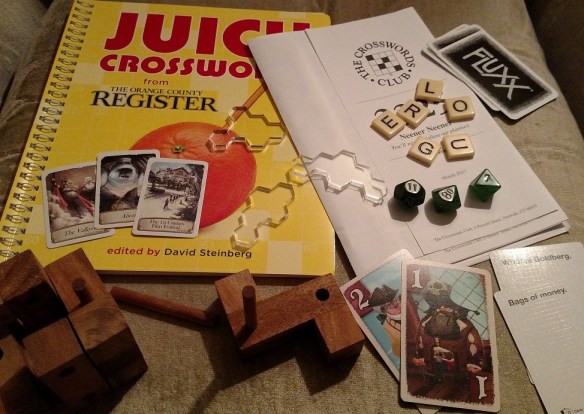
[A sampling of the wide variety of modern puzzles and games. Fluxx cards, Bananagrams tiles, a wooden puzzle box, Pairs cards, David Steinberg’s Juicy Crosswords from the Orange County Register, Timeline cards, last month’s edition of The Crosswords Club, Puzzometry pieces, Cards Against Humanity cards, multi-sided roleplaying dice.]

This is the most exciting time in history to be a puzzler or board game enthusiast.

Think about it. If you want to play a game or solve a puzzle, you don’t have to go any farther than your pocket, since a plethora of puzzly goodness awaits you on your smartphone.

Puzzle apps are our bread and butter here at PuzzleNation, so this might feel like a cheap plug, but honestly, it boggles my mind how much more accessible puzzles and games are now than they were even five years ago.

And the app revolution is only one part of the story.

I was reading a book the other day, as I am wont to do on the long train rides to and from PuzzleNation HQ. Titled The Revenge of Analog, it was all about the cultural response to digital media, highlighting the resurgence of vinyl records, film, and other tangible alternatives to electronic formats.

In the chapter “The Revenge of Board Games,” the author discussed the social aspect of tabletop gaming, and how sitting down with people and playing a game is a far different, more rewarding experience than online gaming and other social media-based interactions. (A fine point to consider, what with International TableTop Day a little more than a week away.)

tabletop2

While I do think that’s partially true, I also think that downplays the ingenuity of the puzzle/game community. I think we’re the best of both worlds.

I mentioned in my Tak review last week that puzzles are being created today that could not have been five or ten or twenty years ago. The advent of 3-D printing and laser cutters for homes and small businesses has brought design, construction, and promotion literally to the doorstep of entrepreneurial puzzlers.

Just last week I received a new edition of Puzzometry in the mail, a perk for supporting a team for a school robotics competition. This laser-cut plastic jigsaw will keep me guessing for hours (if its puzzly siblings are anything to go by), and it was designed and manufactured by a single individual.

newold2

Old and new styles are meshing as never before. Many puzzle constructors are partially or fully supporting themselves via email puzzle subscriptions and direct sales to the customer. Events like the Connecticut Festival of Indie Games are organized and advertised mostly online.

Crowdfunding has leveled the playing field for many companies and designers in both puzzles and games, allowing more products than ever before to enter the market. (According to Kickstarter, tabletop game projects raised $52 million dollars in 2013, and that number has surely gone up in the meantime.)

You’ve got a proper board game renaissance as classic games and styles of play are meshing with new technology, and games from across the world are shared on YouTube, at Friendly Local Game Shops, or even in puzzle cafes like Toronto’s Snakes and Lattes or New York City’s The Uncommons.

Whether you’re a pen-and-paper solver or a Penny Dell Crossword App devotee, a fan of classics like Chutes and Ladders or a proud tabletopper experimenting with the newest games, this is an amazing time to be a puzzler or board gamer.

So keep playing. Keep puzzling. And share that with others.


Thanks for visiting PuzzleNation Blog today! Be sure to sign up for our newsletter to stay up-to-date on everything PuzzleNation!

You can also share your pictures with us on Instagram, friend us on Facebook, check us out on TwitterPinterest, and Tumblr, and explore the always-expanding library of PuzzleNation apps and games on our website!
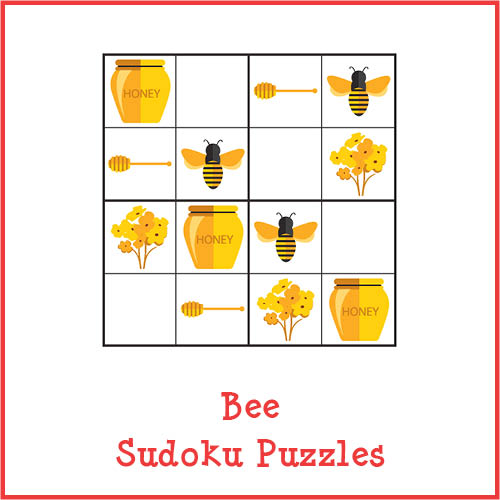
Solving puzzles is the bee’s knees!

bee-sudoku-puzzles-store-product-image

[Image courtesy of Gift of Curiosity.]

As a puzzler, I am on a quest to highlight and recognize the skills and accomplishments of fellow puzzlers. All too often, other outlets restrict this activity to humans and humans alone.

But PuzzleNation Blog has a fine long-standing tradition of celebrating the puzzly accomplishments of non-human puzzlers. In the past, we’ve discussed the puzzle skills evidenced by cats, dogs, crows, cockatoos, and octopuses.

Today, we proudly add another species to that litany of puzzle-cracking creatures: bees.

KONICA MINOLTA DIGITAL CAMERA

[Image courtesy of Rachel Carson Landmark Alliance.]

An article in the peer-reviewed journal PLOS Biology — titled, in true scientific fashion, “Associative Mechanisms Allow for Social Learning and Cultural Transmission of String Pulling in an Insect” — states that bees can not only learn non-natural skills, but teach them to other bees.

This behavior, previously only observed in vertebrates, is a huge step forward for our studies of animal cognition.

Allow me to explain.

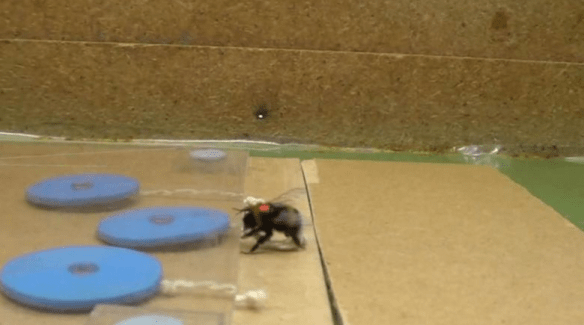
A group of bees were given a non-natural task to complete — pulling a string attached to a blue disc hidden under Plexiglas — in order to earn a drop of sugar water.

In the first test, zero out of 50 bees figured out how to remove the disc. When half of those bees were given a second chance, two of them did figure out how to pull the string and retrieve the disc.

beereuters

[Image courtesy of Reuters.]

The study goes on to describe how the scientists taught the bees to complete the task, and then how these bees (known as innovators) could go on to teach other bees how to do so.

From an article on Natural Science News:

The skill spread quickly and half of the untrained bees gained the ability by learning from the original innovator bee. Even after the original innovator bee died, the skill continued to be passed down to future generations. This was the first recorded case of cultural transmission of a non-natural skill in social insects.

Now, this is all very exciting, but in the midst of all this news coverage and scientific back-patting, I feel like someone’s accomplishments have been overshadowed.

TWO of those bees figured this out on their own. No scientist teachers, no innovator bees, just their own puzzly chops.

Sure, it took two tries, but heck, it takes me more than two tries to solve plenty of puzzles!

And so, on behalf of the vertebrate puzzle-solving community, I’d like to welcome those two bees to our ranks. Other bees may follow, but you were the first. Nicely done.


Thanks for visiting PuzzleNation Blog today! Be sure to sign up for our newsletter to stay up-to-date on everything PuzzleNation!

You can also share your pictures with us on Instagram, friend us on Facebook, check us out on TwitterPinterest, and Tumblr, and explore the always-expanding library of PuzzleNation apps and games on our website!

A puzzly mystery on Lake Coeur d’Alene

Answering questions is an integral part of many puzzles. Whether you’re cracking a brain teaser, solving a riddle, or unraveling a tricky crossword clue, the fun lies in working out the solution.

But sometimes, a puzzly mystery arises somewhere far more unexpected.

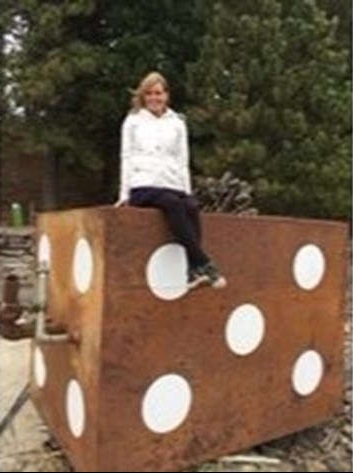
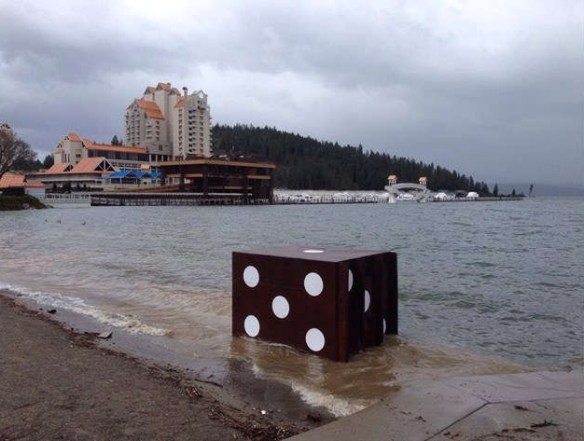
Like the time a giant metal die appeared in the shallow beachside waters of Lake Coeur d’Alene in Idaho last month.

metaldie3_1490055674511_9000943_ver1-0

[All images courtesy of KREM 2 News.]

Reports of the enormous die — which was 6 feet by 6 feet and made of steel — began appearing over the weekend of March 18th, along with photos taken by curious passersby.

It was removed by town officials by the following Monday afternoon, leaving residents baffled.

But a little detective work by locals would later reveal the giant die’s origins.

image6_1490116962939_9005780_ver1-0

Apparently, the metal box itself washed up on the shore on Driftwood Point in 2008, its origins still unknown. The Gridley family, tired of looking at the old thing, decided to decorate it like a gaming cube. This led locals to call the area “Dice Beach.”

Years later, floodwaters washed the giant die away from Dice Beach, and the curiosity landed on a different shore, one mystery begetting another.

The die has now been relocated near a skatepark in downtown Coeur d’Alene, where it still attracts attention and the occasional photo op.

image3_1490116962867_9005779_ver1-0

So keep your eyes peeled, folks. You never know when a puzzly mystery might show up on your doorstep. (Or the beach near your house.)


Thanks for visiting PuzzleNation Blog today! Be sure to sign up for our newsletter to stay up-to-date on everything PuzzleNation!

You can also share your pictures with us on Instagram, friend us on Facebook, check us out on TwitterPinterest, and Tumblr, and explore the always-expanding library of PuzzleNation apps and games on our website!
PuzzleNation Product Review: Tak

6bb7918f3732d73fba879a55065cad0d_original

Puzzles and games are constantly advancing and innovating, incorporating new technologies, new production techniques, and a lengthy legacy to build upon. In this blog alone, we’ve looked at 3-D printed puzzles, logic games that involve actual lasers, and puzzles that were brought to life thanks to internet crowdfunding; none of these were possible fifteen or twenty years ago.

But today’s game is something different. It’s a brand new game that feels like a classic from centuries past, a board game that feels timeless.

Today, we’re reviewing Tak by James Ernest and Patrick Rothfuss.

tak2

You may recognize Rothfuss’s name from his Kingkiller Chronicles novels, including The Wise Man’s Fear, where he first referenced the tavern game Tak. Now, game designer James Ernest has helped him bring the game to life.

Tak has a very simple concept: two players each attempt to build a road connecting opposite sides of the game board. The first player to successfully complete their road wins.

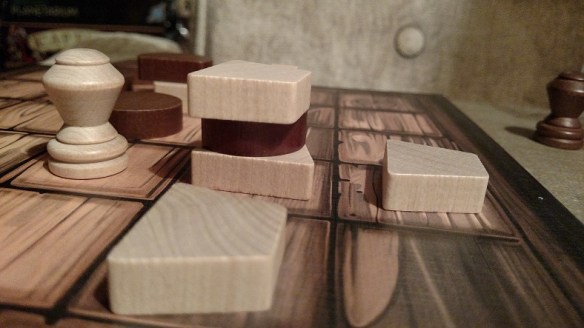
To do so, you place game pieces called stones, one at a time, on various spaces on the board. The stones can either be played flat (meaning they’re part of your road) or standing on edge (meaning they’re a wall, blocking any road’s passage through that space).

tak1

It’s an easily grasped mechanic that allows for a great deal of gameplay flexibility. Since flat stones can be stacked, you can seize control of part of a road by placing your flat stone atop your opponent’s. Then again, your opponent could play his capstone, flatten one of your walls, and instantly make it part of his road.

The game can be played on boards as small as 3×3 and as large as 8×8, allowing for greater difficulty and strategic opportunities. And considering that you can move stacks of pieces (as long as your flat stone tops the stack), that opens the field even more for tactical moves to grant you control of more road.

With so many moves and countermoves available to the player, no two games of Tak feel alike, and even the puzzliest player will no doubt find themselves surprised by a cunning opponent. (And the game encourages this, since your very first move will be to place one of your opponent’s pieces on the board. Each player does this before continuing forward using only their own pieces.)

tak3

This balanced system ensures that players stay engaged until the very last move, making for an elegant play experience that feels earned, win or lose.

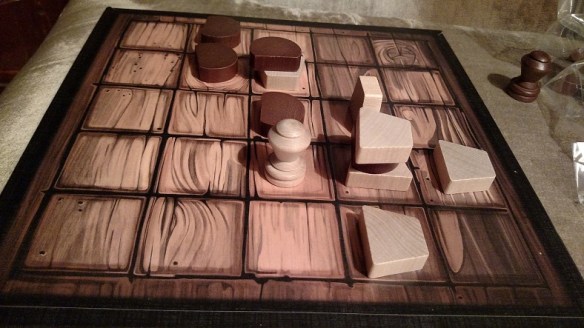
The full title of the game is actually Tak: A Beautiful Game, and it’s hard to disagree. The simple, yet distinct game pieces grant an earthy, homegrown feel to the game, and the gorgeous art (both in the companion book and the Selas 3×3 game board, pictured above) only enhance the experience.

Rothfuss and Ernest have really outdone themselves with this one. Tak feels at home in the 21st century as it would in the 18th. That’s something both rare and special.

The core version of Tak is available through Cheapass Games, and you can find other boards and variations at The Tinker’s Packs.


Thanks for visiting PuzzleNation Blog today! Be sure to sign up for our newsletter to stay up-to-date on everything PuzzleNation!

You can also share your pictures with us on Instagram, friend us on Facebook, check us out on TwitterPinterest, and Tumblr, and explore the always-expanding library of PuzzleNation apps and games on our website!
Don’t Be Alarmed! It’s Just a Puzzly Wake-Up Call!

o-why-hitting-snooze-is-bad-for-your-health-facebook

[Image courtesy of The Huffington Post.]

There’s nothing quite like the grating blare of your alarm clock to rouse you from a sound sleep. But for some people, the alarm isn’t enough.

If you’re adept at whacking the snooze button or shutting off the alarm entirely — intentionally or not, since I’ve definitely done one or both in my sleep from time to time — you might need something a bit more devious to ensure you get up in the morning.

Some place their alarm clock out of reach, so they have to get up to shut it off. One buddy of mine, an adept snooze button-smasher, would return to bed after getting up, so this technique didn’t work.

We found an alarm clock that actually shot a small rocket across the room, and refused to stop beeping until you retrieved the rocket and placed it back on the alarm clock’s launchpad. That seemed to do the trick for him.

But the question remains… how do you make an alarm clock that ensures you’re awake?

As it turns out, puzzles are the solution!

screen_3-310x550

[Image courtesy of I Can’t Wake Up for Android.]

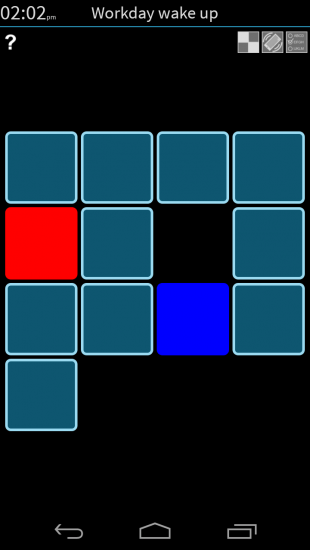
The app is called I Can’t Wake Up, and it requires you to complete a series of puzzly tasks before the alarm shuts off. These can range from memory tasks and placing numbers in order to retyping strings of gibberish or repeating a sequence of clicks Simon-style.

Essentially, you control the difficulty and complexity of the tasks you’re required to solve. So, if you know you NEED to be up for an important meeting in the morning, you can set the alarm to be louder and more diabolical.

I suspect this will start a trend in puzzly alarm apps, where you have to solve a crossword, conquer a Sudoku, or even decrypt a random message in order to stop your alarm.

Either that, or it will become the perfect tool for vengeful wives, husbands, significant others, parents, roommates, and others who are affected by the unreliable morning wake-ups of others.

In any case, I look forward to hearing about it.

81d6a31592aad3a95ccb4ac42bd96022

[Don’t be like this unfortunate stormtrooper… Image courtesy of Pinterest.]


Thanks for visiting PuzzleNation Blog today! Be sure to sign up for our newsletter to stay up-to-date on everything PuzzleNation!

You can also share your pictures with us on Instagram, friend us on Facebook, check us out on TwitterPinterest, and Tumblr, and explore the always-expanding library of PuzzleNation apps and games on our website!

Puzzle My World

[Image courtesy of Reddit.]

For me, one of the best things about puzzle-solving is the a-ha moment.

You’ve been staring at a clue, or a brain teaser, for what feels like forever. You’ve tackled it from seemingly every angle. And you’ve got nothing. You’re stymied. Flummoxed. You know the answer is within your reach, but you just can’t find it.

And then, the a-ha moment strikes. Wheels turn, pieces fall into place. And when the dust settles, you have your solution, and you can’t help but wonder how you didn’t see it sooner.

When puzzly thinking is taken outside the realm of puzzles and games and applied to the real world, it can make those a-ha moments even more enjoyable.

Now look at that image at the top of the page. Did you immediately realize what it was, or did you stare for a bit before having that a-ha moment?

Yes, it’s a map of the world done in the style of artist Piet Mondrian. How cool is that?

Today I’d like to look at a few maps that visualize our world in a different way and let you experience an a-ha moment or two.

[Image courtesy of Mental Floss. Click here for a larger version.]

This first map of the world has all of the familiar landmasses and borders that you know, but it has swapped around the actual countries so that the country’s population is now equivalent to its size.

It’s truly paradigm-altering to see countries like China, India, and Pakistan in those large landmasses, and on the flip side, the Netherlands taking the islands of the former Japan, while Japan moves to a much larger space in Africa.

Plus, there are a few countries that wouldn’t move in this situation, like the U.S., Brazil, Yemen, and Ireland, which is all the more striking when you see so many countries moving around them.

Just imagining the political landscape in this world is mind-boggling!

[Image courtesy of The Edge.ca.]

This next map says more about our culture than our numbers, but it’s still interesting. Here’s part of a map labeled only with song titles that mention these places.

It’s a very clever concept that not only name-checks many terrific songs, but mixes genres and eras of music in surprising ways. If you were to attempt this, how much of the world could you fill in with song titles?

[Image courtesy of Texas.gov. Click here for a larger version.]

And speaking of puzzly map challenges, I’ve got one for you, fellow puzzlers. Here’s a map of the United States.

I challenge you to print out this map and color it in using only four colors. The trick? No neighboring states can be the same color.

Hopefully, accepting this challenge will provide you with a puzzly a-ha moment of your own. Enjoy!


Thanks for visiting PuzzleNation Blog today! Be sure to sign up for our newsletter to stay up-to-date on everything PuzzleNation!

You can also share your pictures with us on Instagram, friend us on Facebook, check us out on TwitterPinterest, and Tumblr, and explore the always-expanding library of PuzzleNation apps and games on our website!