Free RPG Day is one of my favorite events of the year. It helps spread the word about roleplaying games, gives new players a chance to try out games for themselves, and it supports local game shops. It’s a win-win all around.
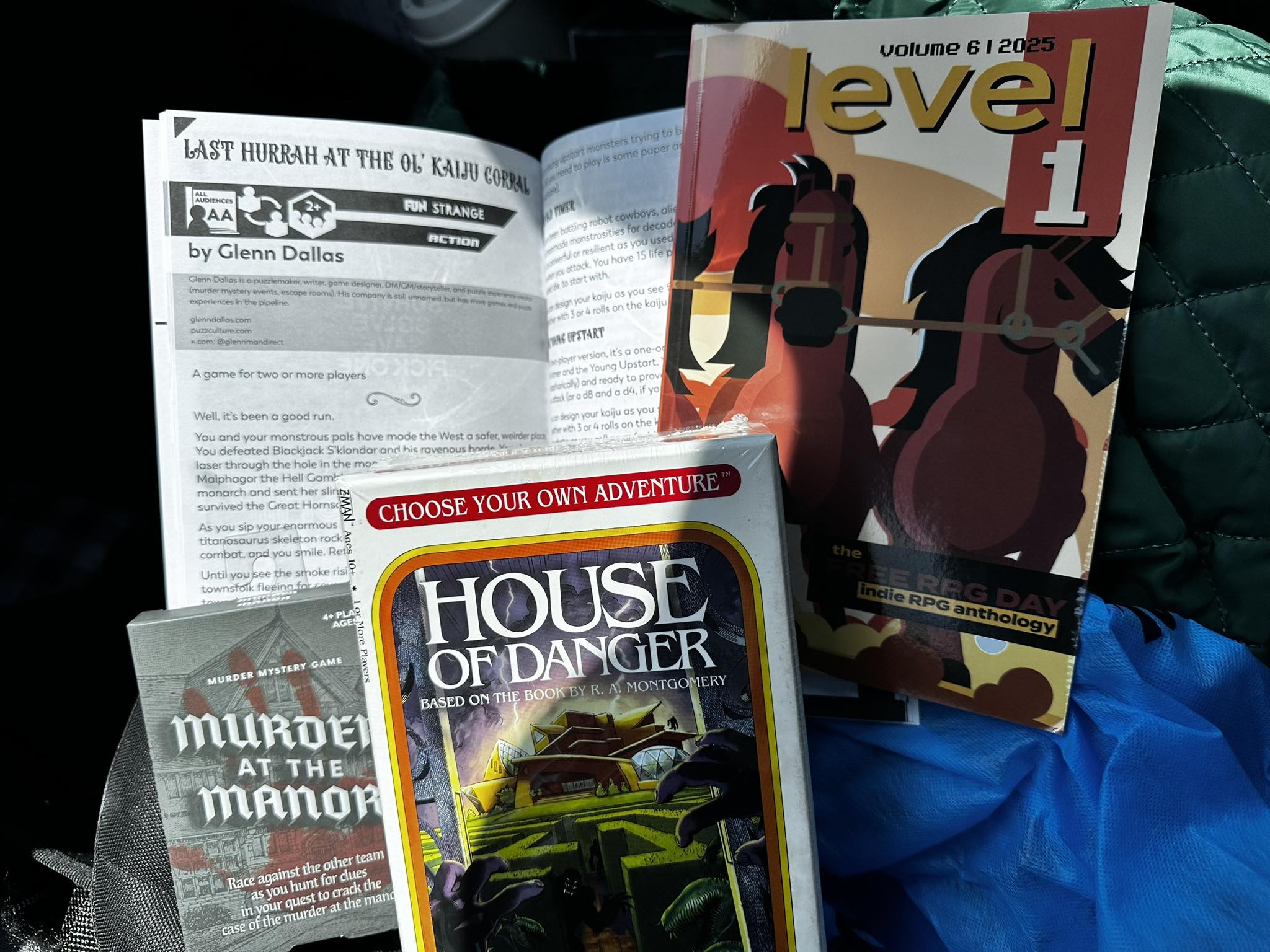
This event means even more to me because, for the last two years, a game I’ve created has been included in 9th Level Games‘ flagship Free RPG Day publication, Level 1.
Each year, the Level 1 anthology has a different theme. Last year’s was programming, and this year’s was How the West Was Lost.
I highly recommend checking it out. The absolute variety of games and play styles inspired by that simple spark of inspiration — How the West Was Lost — shows the versatility of roleplaying games as well as the immense creativity of game designers in the community! I’m proud to once again be included among those eclectic and talented folks.
All the proceeds from this treasure trove of gaming fun will go towards the Level Up Fund, a charitable endeavor intended to grant game designers free use of 9th Level Games’ Polymorph game system, encouraging creators to continue creating games all year round!
Summer is always a fun time for crossword fans who enjoy a good tournament.
Westwords wrapped up a few weeks ago, as did the first World Cryptic Crossword Championship in London. Boswords is less than a week away, Lollapuzzoola is coming up in August, and the 7th Bryant Park Crossword Tournament not long after in September!
And while discussing the Scripps National Spelling Bee with a friend recently, they asked me, as a puzzle guy, if I thought that crosswords could ever become a spectator sport like that.
While crossword tournaments aren’t currently televised, I happily informed him that crosswords are pretty much already a spectator sport.
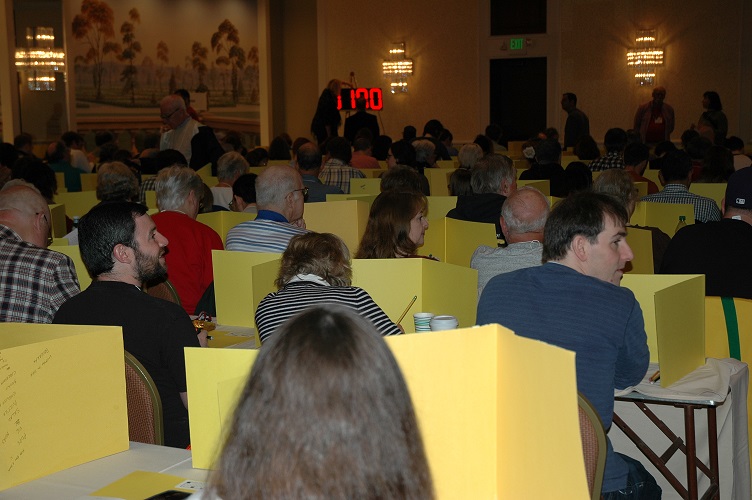
Every year, people at the ACPT not only enjoy watching the live-solved final puzzle, but they get commentary from Greg Pliska and Ophira Eisenberg!
Tournament finals are often live-solved in front of their fellow competitors, adding some drama and showmanship to these wonderful puzzly events.
We’re even getting behind-the-scenes videos on the tournaments now, like this one for Westwords:
But in terms of crosswords as a spectator sport, the World Cryptic Crossword Championship took things a step further.
The final round of the tournament wasn’t a live-solved puzzle, it was a single cryptic-style clue. No crossing letters or grid for context. Just the clue, and the competitor only had ten seconds to solve it before the next competitor took their shot.
I’ve never had to solve a puzzle in front of an audience like all the tournament finalists, but I can imagine it’s nerve-wracking. But giving someone a cryptic-style clue with NO context letters and ten seconds to solve it in front of an audience?
Good lord, thank you for the new anxiety nightmare fuel, WCCC.
That being said, it was an entertaining watch, and another step forward for crosswords as a spectator sport:
What do you think, fellow puzzler? Will we be seeing the ACPT or another puzzle tournament on an ESPN sister channel soon? Or perhaps as an Olympic event?
Let us know in the comments section below! We’d love to hear from you.
Other times, a major portion of an episode revolves around them. We’ve seen this countless times from shows as diverse as The Simpsons and NCIS: New Orleans.
But I didn’t realize an entire plot for world domination once hinged on a puzzle.
Pinky and the Brain was a spinoff of a recurring series of animated shorts from the show Animaniacs, and the concept was simple.
Two mice plotted to take over the world from their lab cage, and their plans were invariably foiled by either Pinky’s idiocy or Brain’s almost magical ability to snatch defeat from the jaws of victory.
The schemes ranged from time travel and mind control to hypnotic songs and (my personal favorite) a papier mache duplicate of Earth.
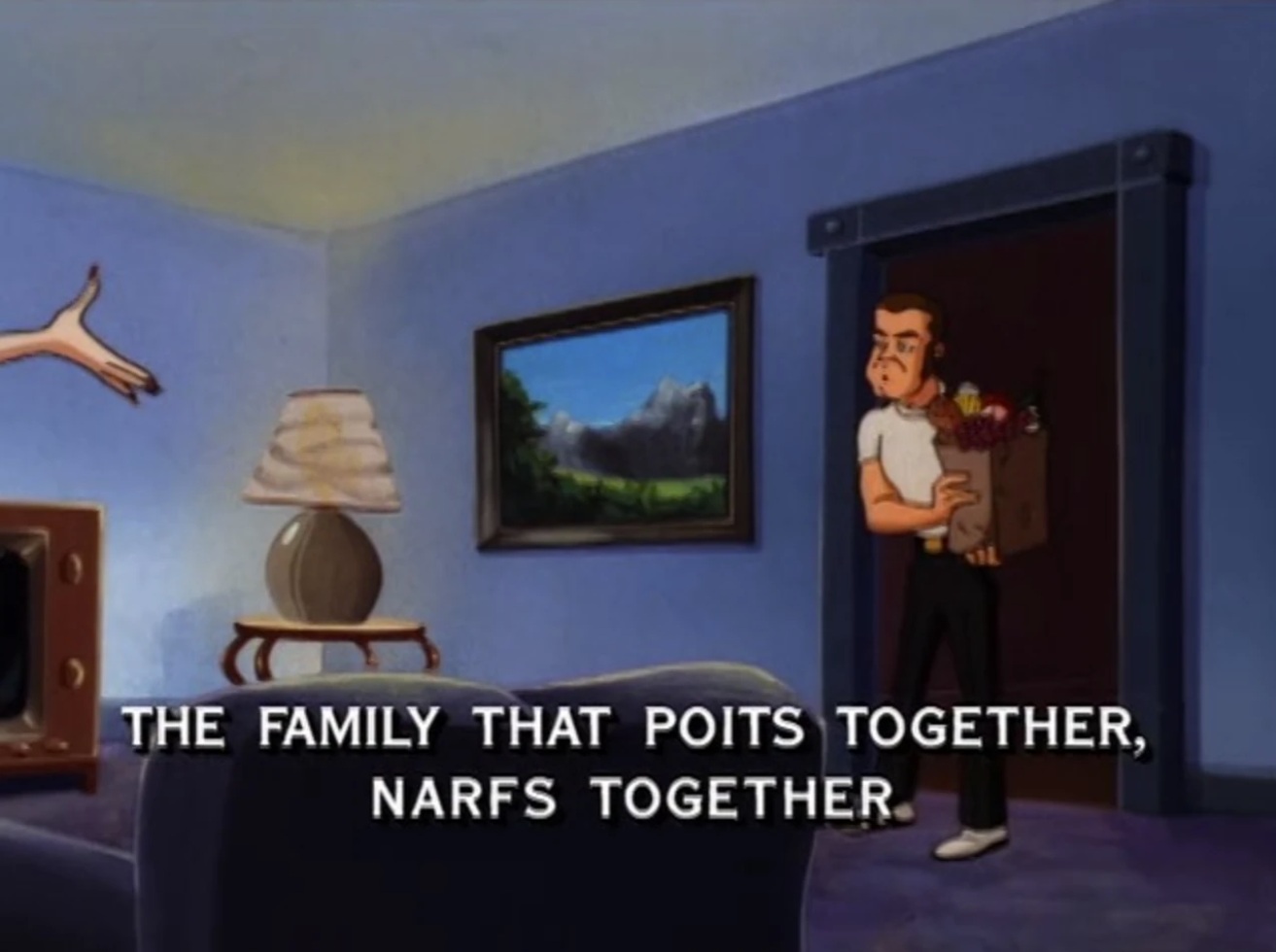
But on February 21st, 1998, the show aired its 53rd episode, The Family That Poits Together, Narfs Together.
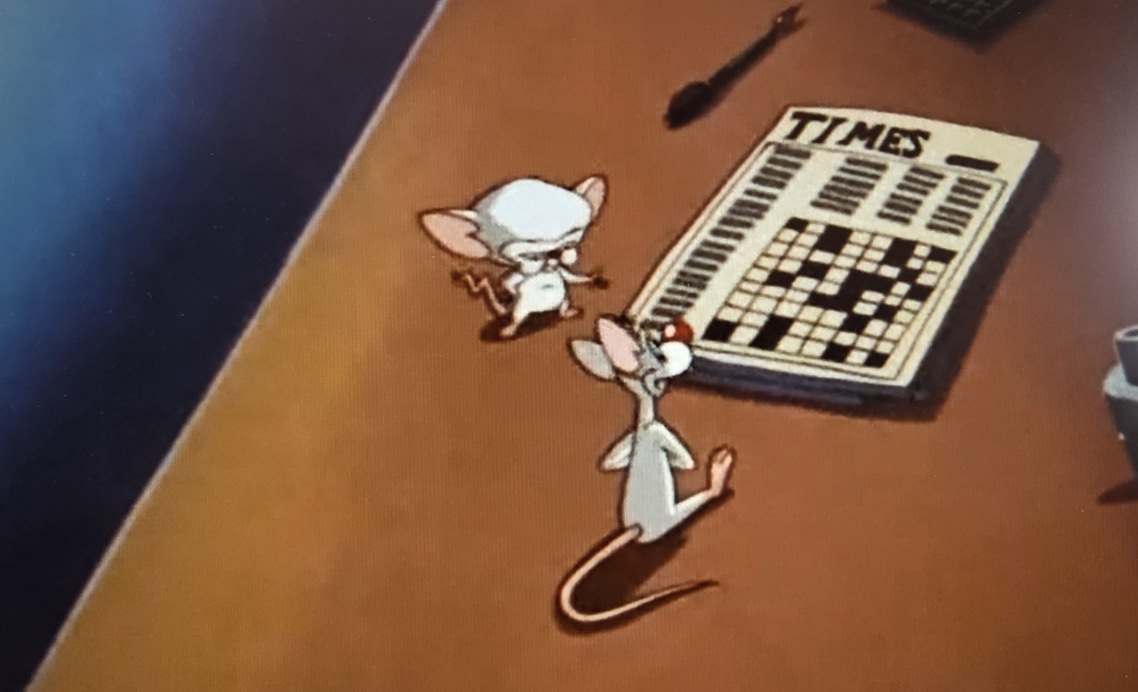
The Brain’s latest plan for global domination targeted the intellectual elite by sabotaging the daily crossword in every newspaper in the world.
Here, I’ll let The Brain explain his diabolical endeavor:
This is the Sunday crossword puzzle. The most educated people all around the world spend hours each weekend deciphering its complex web of interlocking verbiage. But change just one clue, and the whole puzzle becomes impossible to solve…
I will change one clue in the crossword puzzle in every newspaper around the globe, throwing the intelligentsia into a hopeless dither. While they frantically ripple through their dictionaries and thesauri, I will step into the breach, and take over the world!
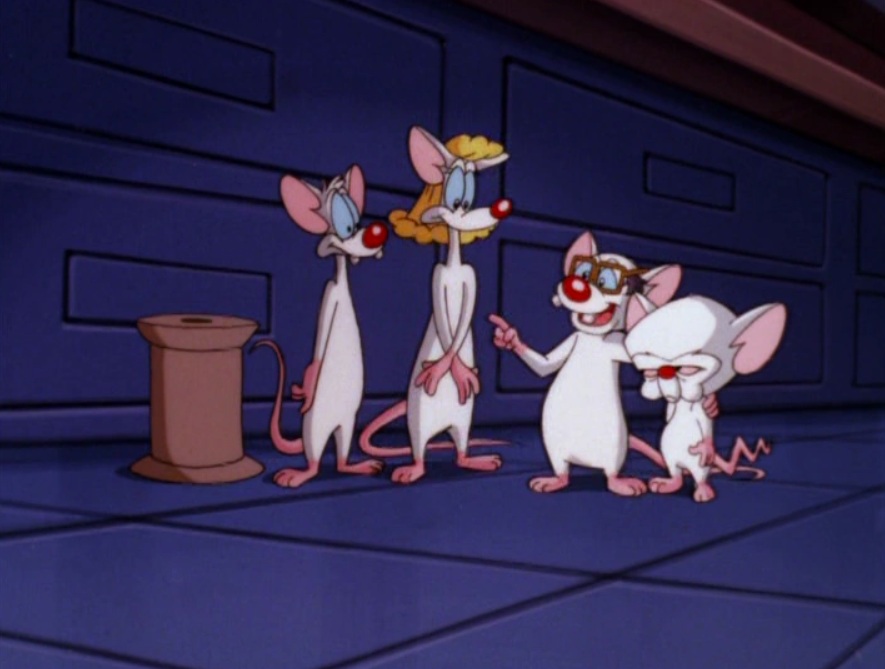
Unfortunately, he needs $25,000 to fund this operation (including the cost of bagels with cream cheese), so he plans to reunite Pinky’s family and put them on a talk show to win the prize for the world’s most perfect family.
Naturally, shenanigans ensue — and Eric Idle plays both Pinky’s mom AND dad, which is very entertaining — but the family actually wins the prize!
A trip around the world valued at $25,000.
The Brain’s dastardly plans have been scuttled once more.
But that does raise the question…
Would it have worked?
(Let’s ignore for the moment the fact that the intelligentsia for the most part aren’t currently in positions of power, especially in the United States.)
In a world before resources like Xwordinfo and online forums where solvers can share their grievances, it could have given the puzzle solvers of the world pause.
Especially on a Sunday, where you’d think at least some of them would be at home and not at their various important duties.
So there could have been a window.
But was The Brain equipped to seize that opportunity? Did he have the manpower to be in all those places? To snatch up those resources and reins of power for himself?
I don’t think so. Not on a budget of $25,000 (which again, covered the crossword modification and snacks, NOT the ensuing power grab). That’s barely gonna cover a few henchmen, even at 1998 prices.
So, sadly, I think the plan would have failed.
BUT!
He would have had the personal victory of denying that moment of solving satisfaction to puzzlers around the world.
Which is arguably even more villainous.
What do you think, fellow solver? Would it have worked? You can watch the episode for free here on Dailymotion.
And to close out today’s post, let’s enjoy an earworm together and listen to that marvelous theme song:
I finally had a chance to sit down and try my hand at the puzzles from this year’s Westwords Crossword Tournament. Given the talent involved amongst the organizers and constructors, I had high expectations, and I was not disappointed.
So let’s put those puzzles under the microscope and see what’s what!
Puzzle #1: Brace for Turbulenceby Kevin Christian
The tournament launched with this 16×15 grid loaded with two-word entries (ROUGH CUT, SAVAGE GARDEN) where the first word (the west word) was a synonym for “wild,” aligning with the revealer WILD WEST.
It was a solid starter puzzle with a nice flow and cluing that knocked any solving ring rust from the competitors and prepared them for the day’s events. My only qualm was the repetition of ALL with ALL EARS and AFTER ALL, but that’s more a personal preference than any fault with the construction.
Interesting grid entries included CAJOLED, SALINAS, BEER RUN, and VALLEJO, and my favorite clues were the dual usage of the clue “Pizzazz” for ZING and BRIO, and “Online ‘Reader’ whose name is hidden in ‘Nunavut News'” for UTNE. Nice bit of Crostic-style cluing there!
Puzzle #2: Suspension of Disbeliefby Willa Angel Chen Miller
The second tournament puzzle was a freestyle 16×15 with a grid-crossing spanner nicely tying the grid together. It was definitely tougher than Puzzle #1, but the stellar fill and engaging cluing made this one of my favorite puzzles of the tournament.
Miller absolutely made the most of this themeless and jammed loads of long entries into an elegantly constructed grid.
Interesting grid entries included DEAR LORD, EGGS BENNY, SAINTLY, and the pair of WE SHOULD TALK and I BLAME YOU, and my favorite clues were “Device that can affect its user’s balance” for ATM, “Big name in construction” for LEGO, “Two objects in a row?” for OARS, and “The rest of the day?” for SIESTA.
Puzzle #3: State Linesby Amie Walker
The third and largest puzzle of the tournament was this 21x puzzle where the themed entries across were clued with state nicknames — “Beehive state?” for GENERATING BUZZ or “Gem state?” for PEARL CLUTCHING) — and crossed entries where the state abbreviation for that state-specific clue was concealed in the down entry. (CA crossed the entry clued “Golden state?” for example.)
This was really smart and well-executed construction, managing it six times in the grid and never feeling shoehorned-in or inorganic. The simple title not only hinted at the cluing but allowed solvers to add “crossing” to “State Lines” subconsciously. This puzzle was a treat.
Interesting grid entries included HAT TIP, BARBIELAND, OBI-WAN, and SATSUMA, and my favorite clues were “Bird with a notable top spin?” for OWL, “What’s rhymed with ‘pretty mama’ in the Beach Boys’ ‘Kokomo'” for BAHAMA, and “This is so you-coded” for DNA.
Wait, right message, wrong West…
Puzzle #4: Go Dubs!by David Steinberg
With this devious 15x, Puzzle #4 in Westwords could build a similar reputation to the eternally-challenging Puzzle #5 at the American Crossword Puzzle Tournament.
The toughest puzzle of the tournament, this very clever entry from Steinberg featured several entries clued with words starting with W where you had to ignore the W to read the actual clue.
For instance, one clue was “Witch”, but the actual clue was “Itch” and the “W” was a directional hint. The answer, HANKERING, had to be entered into the grid facing west, like GNIREKNAH. Each themed entry followed this pattern, giving us EIGHT literal west-running words for Westwords (as confirmed by the revealer)!
Interesting grid entries included ACETIC, RENATA, PRELAW, and VAIO, and my favorite clues were “One thing, or two people” for ITEM and “Performance at 100-120 BPM” for CPR.
Puzzle #5: L.A.byrinthby Nate Cardin
After Puzzle #4’s trickery, it was nice to have some clear directions to follow with Puzzle #5, an 18×15 grid where Cardin’s clues literally directed solvers through a series of LA roadways grayed out in the grid from top to bottom. Each clue containing part of the pathway through the grid was written like someone giving you directions, i.e. “Okay, now take the 101…” for ENTRY LEVEL COURSE.
Using number-based clues that both hint at the answer and feel like proper conversational directions is a narrow tightrope to walk, but Cardin does a terrific job balancing the style with the substance. This felt totally different from every other puzzle in the tournament and the visual element was great fun.
Interesting grid entries included CORONAL, WAVES HI, and SO SORRY, and my favorite clues were “Board game with ‘RuPaul’s Drag Race’ and ‘Scooby-Doo’ versions” for CLUE and the very appropriately thematic “Like one navigating a freeway maze, hopefully” for ALERT.
Puzzle 6: Finalby Caitlin Reid
The final puzzle for the tournament boasts a different set of clues for each of the divisions — Beach and Mountain — and Reid constructed a puzzle with loads of intriguing entries and personality to spare.
The Beach cluing was smooth and accessible while still testing solvers, while the Mountain side offered some very challenging trivia and clever wordplay to keep competitors guessing to the very end.
Interesting grid entries included ROSHAMBO, AU REVOIR (very fitting), LIVE IT UP, COMIC-CON, and ADORBS.
As for favorite clues, here’s a list:
BEACH: “Word before can or tan” for SPRAY BEACH: “Like a town that’s hardly worth a dot on the map” for ONE-HORSE BEACH: “Las Vegas institution with a silent partner?” for PENN AND TELLER MOUNTAIN: “Current law maker?” for AMPERE MOUNTAIN: “Seat in the House of Lords?” for ARSE
Overall, I really enjoyed my first experience with Westwords. (I have the puzzles from the 2024 event but haven’t solved them yet). Solvers have high expectations when it comes to crossword tournaments these days, and the creativity and skill level of the constructors for this year’s Westwords puzzles absolutely did not disappoint.
We got several different puzzles playing on the Westwords gimmick, some delightful visuals, and a host of terrific clues for fresh grid fill and classic crossword words alike.
If you’ve never tackled tournament-style puzzling before, I would highly recommend giving Westwords a try. The puzzles are tricky and fair in equal measure, and I enjoyed the arrangement of puzzle difficulty throughout the day.
West Coast puzzlers, you’re in excellent hands.
Did you attempt this year’s Westwords tournament puzzles, fellow solver? If so, I’d love to hear from you in the comments section below!
Truth is often stranger than fiction, as they say, and as someone who regularly creates quizzes, games, and puzzles for friends to unravel, that’s a core tenet of one of my favorite game styles: Real or Fake Games.
Real or Fake Games are quite simple. I present the player(s) with something — a headline, an animal, a fortune cookie fortune, the plot synopsis of an episode of The Simpsons — and they have to tell me if it’s real or fake.
So today, I’ve crafted a Real or Fake Game for you, fellow puzzler. Below are titles of TV shows, accompanied by a brief description. Can you sort the genuine article from the ones I made up?
Let’s find out!
1: Something Rotten in Denny’s
In this short-lived translation of Hamlet into an American restaurant, Ham tries to endure the mistreatment of management and find happiness while serving big ol’ stacks of pancakes.
2: Small & Frye
Nick Small and Chip Frye are a private-eye team with a twist. Frye has the ability to shrink to six inches in height, which gives him a slight advantage in investigating cases.
3: The Secret Diary of Desmond Pfeiffer
A black English nobleman is chased out of England due to gambling debts and becomes President Abraham Lincoln’s valet during the civil war. Oh, and it’s a comedy. About slavery.
4: Byrds of Pray
A comedy about all the shenanigans involved in running a small-town church that’s ALL about the fundraisers, this stars George Gaynes as Reverend Nehemiah Byrd, a bumbling priest who means to do good… but does it badly.
5: Occasional Wife
When his boss won’t promote unmarried men, Peter strikes a deal with a pretty young woman named Greta Patterson. If Greta pretends to be Peter’s wife, in return Peter will pay for her art lessons and set her up in an apartment two floors above his. (All their scampering up and down the fire escape gave the unnamed man who lived in the apartment between them — credited as Man-in-Middle — quite a bit to watch!)
6: Dial S for Santa
Yeah, this one has Santa Claus helping his detective daughter solve crimes in his off-time during the year. By checking the naughty list, sneaking into houses through the chimney, and occasionally throwing coal to distract bad guys, Santa (played by Ed Asner) and a young Teri Polo give this one socks.
7: The Second Hundred Years
A 33-year-old prospector in 1900 is buried in a freak Alaskan avalanche. 67 years later another avalanche thawed him out and he was returned alive to his astonished 67-year-old son and 33-year-old grandson. Although chronologically Luke was 101 years old, physically he was still 33 years old, just like his grandson. The two looked nearly identical but acted nothing alike.
8: The Vidocq Society
Appearing on TV two decades before true crime conquered the world, this short-run pseudo-documentary follows volunteer detectives and off-duty law enforcement solving cold cases. Too gritty for the time, people would be ALL over this one nowadays.
9: The Same Deep Waters as You
In the heyday of the soap opera boom, a harbor town is a haven for smuggling, betrayal, and sexy PG trysts. Featuring a little-seen cameo from young Tom Hanks, as well as soap opera powerhouses Eric Braeden and Deidre Hall, this late ’70s offering only lasted two seasons.
10: Mr. Smith
A top secret formula bestows upon an orangutan the power of speech and an IQ of 256. Now smarter than most humans, the orangutan formerly known as Cha Cha was given the name Mr. Smith and a job with the United States government as a consultant, advising top-level politicians on the most classified of subjects. He dressed in suits and wore glasses.
11: Woops!
An ensemble comedy about the six least likely survivors of a nuclear accident. The series was set in the aftermath of accidental global nuclear war, started when two boys playing with a toy at a parade accidentally set off a nuclear missile, which soon led to a nuclear apocalypse.
12: The Carolina
A sinister drama about a hotel frequented by celebrities (based on the Dakota), The Carolina jammed drug abuse, murder, and satanic rituals into only eight episodes, ending on a completely bonkers note when a secret spiral staircase in the basement leads directly to Hell!
13: West Virginia, MD
Three years before Dr. Quinn, Medicine Woman and The Adventures of Brisco County, Jr., we got a funny frontier doctor with a cowboy twist in West Virginia, MD. This gun-toting doctor was screwed out of his reputation and ventured west to help out during the gold rush. Kind to Indians and women (SHOCKER), this show only lasted one season.
14: Flockstars
A group of eight celebrities engage in sheepherding. The stars, which included actresses, a rapper, and a Paralympic athlete, were mentored by sheepherding experts. Its one saving grace was how attractive the shepherds who mentored the celebrities were.
15: Poochinski
The touching story of a police officer whose soul is absorbed into a flatulent bulldog’s body after he is killed in the line of duty. Voiced by Peter Boyle, Stanley Poochinski is easily the weirdest crime show character in history.
16: Dead at 29
One of the first edgy cable dramas, this one-season wonder features a young woman on the run from the government after escaping a lab after being experimented on. When a plague causes half the population to die the day before their 30th birthday, Callie Sparrow discovers that she and other subjects were helping the government CREATE the plague, not cure it.
17: Pour One Out
A middle-aged bartender (played by James Cromwell) has a knack for getting people to admit their secrets, and he teams up with (you guessed it!) a police detective to solve mysteries in a gritty Gotham-esque New York City neighborhood. But when they discover a mob boss is immune to his powers, they must go on the run to protect themselves and take Big Vinnie down.
18: Manimal
This single-season NBC sci-fi show followed Dr. Jonathan Chase, who inexplicably had the power to turn into any animal at will, and used his power to solve crime.
19: The Cuddlebugs!
What if bed bugs, but cute? This failed kids show featured the weird world between your mattress and the boxspring, and for some reason was populated with brightly colored bugs. For totally understandable reasons, this one only lasted 30 episodes.
20: Oh Sit!
The original title of this series was Extreme Musical Chairs. Basically, contestants compete in ridiculous obstacle courses while a live band plays in the background, and their performance determines how much money they win.
Were you able to tell the real TV shows from the figments of my imagination? Did you remember some of these short-lived television disasters? Let me know in the comments section below, I’d love to hear from you!
Years ago I wrote a blog post discussing how crosswords have to walk a tightrope, balancing topicality and freshness vs. familiarity and family-friendly content.
I mentioned that older solvers may decry newer names, slang, terminology, or pop culture references, while younger solvers will bemoan not just older references they consider passe, but long-established crossword-friendly words they quickly tire of seeing.
And it’s frustrating to still encounter an elitist mentality when it comes to certain crossword solvers.
Now, you’re obviously allowed to have preferences when it comes to grid fill and cluing. But there’s a line, and these elitists stomp across it, barking all the way.
I’ve had commenters rant about the “ignorant ghetto language” in the LA Times crossword, citing “sup,” “did,” and “street cred.” And recently, a commenter shared their annoyance at pop culture references in crosswords, claiming that “doing a puzzle is a test of one’s general knowledge of history, science, and the arts.”
And I’m sorry, but that’s simply untrue. Doing a puzzle — specifically a crossword — is a test of one’s ability to answer clues, deduce words from letter placement, and test one’s vocabulary and knowledge of MANY facets of culture, pop or otherwise.
Different venues will provide different solving experiences, and you’re welcome to cherry-pick your crossword outlets that fit your preferences, but you don’t get to wholesale dismiss other puzzles, grid fill, clues, and content simply because you consider it beneath you.
If we construct a puzzle for the average solver, are we really constructing a puzzle for anyone at all? Or has all the life been sucked out of the puzzle, all the potential for anyone to connect with its quirks?
I love seeing a constructor’s preferences, humor, and interests reflect in a puzzle’s grid fill and cluing. There’s such personality to it!
And it’s a very slippery slope to want puzzles limited to what YOU consider relatable.
Years ago, I was amazed when anyone outside the tri-state area had heard of Action Park, but now, thanks to a documentary about that now-infamous entertainment venue, I wouldn’t be surprised to hear it referenced by someone from either coast of the US or beyond!
Mystery Science Theater 3000, the beloved comedy show where a presenter and their robot chums throw zingers at z-grade movies, used to be famed for its Wisconsin- and Minnesota-specific references and humor. As a teenager from Connecticut, I didn’t get all of them (thankfully, a friend from Wisconsin was able to fill those knowledge gaps for me), but I still very much enjoyed the show.
Later, when it was brought back through Kickstarter campaigns and a Netflix revival, writers from outside the Wisconsin/Minnesota area got to add their experiences and references to the show. Some fans complained that it was no longer their niche little treat, but I for one loved hearing references from my pop cultural childhood that never would’ve graced an MST3K episode from years past.
It’s fine not to know something. It’s not a flaw.
I certainly have my weaknesses when it comes to certain topics and fields of interest. Anyone matched up against me in Learned League should be rooting for questions about flowers, artists, and the names of athletes. I haven’t put in the time to educate myself on those topics, so I can’t be mad when I don’t get some of those trivia questions.
But when it comes to crosswords, I don’t get angry when I don’t know an entry or a reference. I look it up and learn and move on. Hardly a week goes by without learning a new word or phrase from Puzzmo crosswords and cluing. Heck, I’ve lost count of the cultural references and names I’ve learned from collections like A Trans Person Made Your Puzzle and Juliana Pache’s Black Crosswords!
There’s no shame in not knowing something.
There SHOULD, however, be shame in refusing to learn. There SHOULD be shame in excluding things that don’t fit YOUR definition of “culture.” To dismiss pop culture, to dismiss the unfamiliar, is to limit yourself and diminish the art of crosswords.
To argue, as that commenter did, that “sports, transient celebrities, and TV shows” aren’t part of general knowledge or are somehow inferior to their definition of “culture” is unfortunately fighting the tide of how culture works.
Puzzles are constantly evolving as we evolve, and whether you call it culture or pop culture, it all belongs in a crossword grid. We should be making puzzles MORE inclusive, not less.
In closing, I am inspired one last time by our commenter, who said that “a quote from Virginia Wolfe is more resonant than the title of a children’s book written by a former model or ice skater.”
So let’s wrap up this post with a quote from both Virginia Woolf and a quote from a children’s book with quite the resonant title, shall we?
“Lock up your libraries if you like; but there is no gate, no lock, no bolt that you can set upon the freedom of my mind.” — Virginia Woolf, A Room of One’s Own
“I’ll solve a puzzle, read a book, and learn a fun new fact!” — Jessica Hische, Tomorrow I’ll Be Brave

 PuzzCulture