It’s National Puzzle Day!

Hello hello, fellow puzzlers and PuzzleNationers! It’s National Puzzle Day (aka International Puzzle Day), and we hope you’re having a fabulous time!

As you might expect, we’re overjoyed to be celebrating this puzzliest of days with you, and we’ve got a few things going on today in honor of the holiday!

There are promotions running on both the PuzzleNation Facebook page AND the Daily POP Crosswords Facebook page, so be sure to check them out! Or simply click this link for full details on today’s National Puzzle Day free coins promotion!

And that’s not all! We’ve organized an online puzzle hunt for you as well! Step 1 begins below, so why not take a few minutes and see if you can unravel an app-fueled puzzly challenge!

How are you celebrating National Puzzle Day, fellow puzzlers? Let us know in the comments below!


National Puzzle Day Puzzle Hunt: Step 1!

To complete this leg of the puzzle hunt, you’ll need to solve today’s Daily POP Crosswords App free daily puzzle.

Once you’ve solved it, keep the grid handy, because we’re going to test your anagram skills! Ready? Here we go!

Add and subtract letters from the Grid Words to form answers to the Clues. Start with the first Grid Word, subtract 2 letters, and rearrange the remaining letters to form the answer to the first Clue.

Carry over the letters you subtracted to the blanks on the next line. Now add them to the second Grid Word, subtract the number of letters indicated, and rearrange the remaining letters to form the second answer. Continue solving this way until you’re left with your final answer.

Once you’ve completed the puzzle, take your answer word (all lowercase) and plug it into the blank in this web address: https://blog.puzzlenation.com/npd-________.

If you’ve solved the puzzle correctly, that completed link will take you to the next part of the Puzzle Hunt!

Good luck!

[Note: remember to keep track of those answer words/grid words with red asterisks next to them! You’ll need them later!]

The 2018 WPF Sudoku Grand Prix Is Here!

That’s right, puzzle fans! The World Puzzle Federation, international arbiter of many puzzle competitions across the globe, invites you to test your puzzly skills from home against the world’s top solvers!

Today marks the first of eight rounds in the Sudoku tournament that will determine the rankings for the Sudoku Championship held later this year.

And although only members of the WPF are active competitors for those rankings, you can still solve each round’s puzzles and see how you fare against the best in the world!

As stated on the WPF website:

All the logical puzzles and Sudoku fans can take part and compare their results with the world’s top players without leaving the comfort of their home.

You can expect first class puzzles prepared by the top puzzle authors from all over the world. Most of the authors contributing to the GP have also prepared puzzles for the past World Puzzle / Sudoku championships. The puzzles in the Grand Prix will be designed for all the players with different solving skills, for beginners as well as for the world’s best players.

The Netherlands team have prepared the Sudoku puzzles for Round 1, which will be available from noon on January 26, 2018 (GMT + 1 hour) to 11:59 PM on January 29, 2018 (GMT + 1 hour).

So what do you say, PuzzleNationers? Do you accept the challenge of the Sudoku Grand Prix?

Let us know in the comments below! We’d love to hear from you!


Thanks for visiting PuzzleNation Blog today! Be sure to sign up for our newsletter to stay up-to-date on everything PuzzleNation!

You can also share your pictures with us on Instagram, friend us on Facebook, check us out on TwitterPinterest, and Tumblr, and explore the always-expanding library of PuzzleNation apps and games on our website!

A Real-Life Treasure Hunt Awaits You…

[Image courtesy of Go.ActiveCalendar.com.]

Who can resist participating in a real-life treasure hunt?

I certainly can’t. I’ve organized them in role-playing games and as part of birthday celebrations, creating maps, riddles, and puzzles in order to challenge friends to locate hidden loot in both imaginary and real locations over the years.

From The Goonies and The Treasure of the Sierra Madre to National Treasure and the Indiana Jones series, treasure hunts are a part of our collective cultural imagination. People hunt in their attics for forgotten antiques and prowl flea markets and thrift shops for unexpected bounties.

So is it any wonder that a few intrepid souls out there are still pursuing treasures hidden over three decades ago as a publicity stunt?

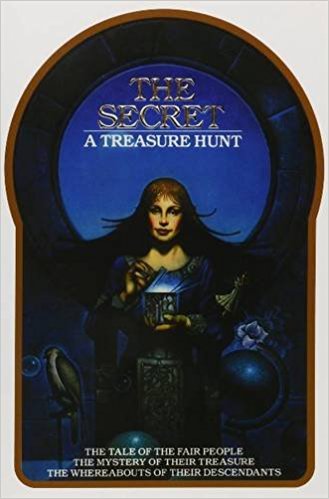
[Image courtesy of Amazon.]

In 1981, when author Byron Preiss launched a puzzly scavenger hunt to promote the release of his new fantasy book The Secret, he had no idea he’d just fired the starting pistol on one of the greatest unsolved puzzles in history.

Twelve plexiglas boxes were hidden around North America, each protecting a ceramic container that, in turn, held a key to a safe deposit box containing an actual gemstone.

The book contains twelve paintings and twelve poems. Solvers were expected to figure out which poems to pair with which images, and then decipher them in order to reveal the locations of the keys.

Preiss believed that all twelve boxes would be found relatively quickly.

Only two have been recovered in the thirty-plus years since then, one in Chicago’s Grant Park and the other in Cleveland’s Cultural Gardens.

[Image courtesy of Vice.]

This image is believed by some treasure hunters to point to one of the boxes being hidden in Milwaukee’s Lake Park, but thus far, no box has been recovered there.

There are entire forums online dedicated to parsing the various poems and images in The Secret, plumbing them for hidden clues and vetting theories from fellow treasure hunters.

Unfortunately, the cleverness of Mr. Preiss isn’t the only opponent for these hunters. Time itself is against them.

It’s safe to assume that the missing ten boxes are also buried in public parks and other spaces open to the public. But parks get renovated. Landscapes change. Hell, some parks are repurposed and paved over!

So how many of those prizes are no longer within easy reach of a shovel’s blade, even if you do unravel the mysterious clues available? How many were tossed aside as curious garbage by disinterested work crews during renovations?

As The Secret and the treasure hunt it inspired fade into history, so too do the chances of anyone recovering those keys and claiming those gemstones for themselves.

[My thanks to friend of the blog Darcy Bearman for reminding me of this marvelous puzzly mystery, as well as Josh Gates and his Travel Channel show Expedition Unknown for reminding her.]


Thanks for visiting PuzzleNation Blog today! Be sure to sign up for our newsletter to stay up-to-date on everything PuzzleNation!

You can also share your pictures with us on Instagram, friend us on Facebook, check us out on TwitterPinterest, and Tumblr, and explore the always-expanding library of PuzzleNation apps and games on our website!

The Curvature Blindness Illusion Strikes!

Optical illusions are puzzles for the eye. They reveal how different combinations of images — light and shadow, shape and density, foreground and background — can trick viewers into seeing something unexpected.

And we are still discovering new illusions that deceive and delight us.

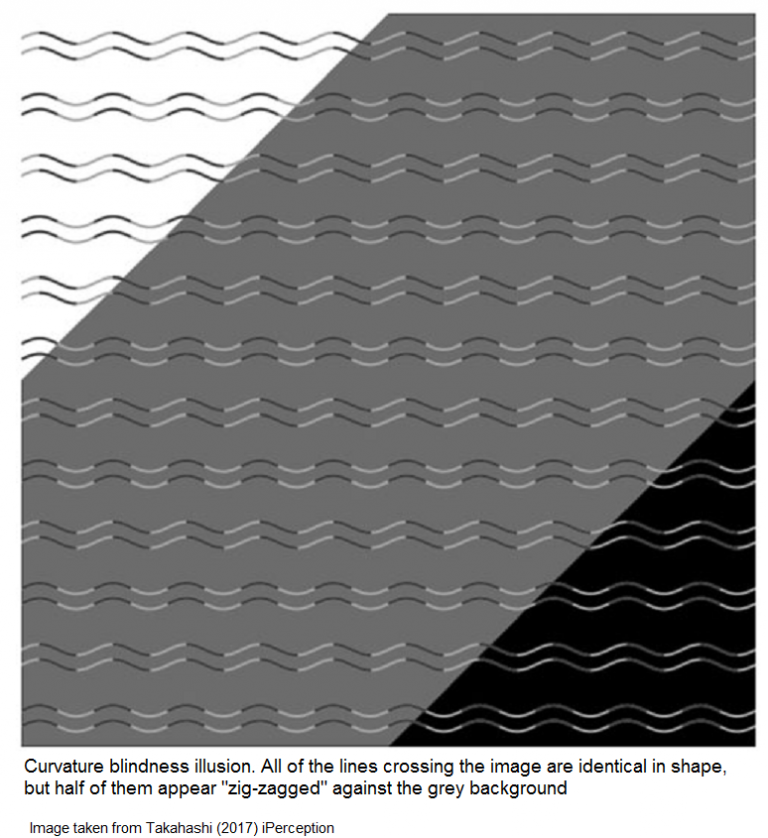
In the above image, pairs of wavy lines run horizontally across the screen. In the white and black corners, they’re fine. But in the gray area, half of those wavy lines suddenly look like zigzags.

The only difference? The alternating pattern of light and dark patches on each line. In lines where the peaks of the waves are dark and the valleys are light, the wavy pattern remains.

But when the dark and light patches are the ascending and descending parts of the wave, our eyes interpret them as lines forming corners instead of wavy lines.

This is known as the curvature blindness illusion.

As with many optical illusions, this is all about contrast. The white and black backgrounds allow you to view the alternating pieces as one continuous wavy line, whereas the gray background forces you to regard those alternating pieces as individual segments.

Those individual segments are granted the illusion of three-dimensions, and our minds process the lighter ascending line and the darker descending line as “walls” forming a corner, rather than the rising and falling of a sine wave.

It’s amazing how distinctly different the pairs of lines look with just those small variations. Even knowing how I’m being manipulated, it’s still hard to convince myself that I’m not actually seeing what I’m seeing.

Very cool stuff.


Thanks for visiting PuzzleNation Blog today! Be sure to sign up for our newsletter to stay up-to-date on everything PuzzleNation!

You can also share your pictures with us on Instagram, friend us on Facebook, check us out on TwitterPinterest, and Tumblr, and explore the always-expanding library of PuzzleNation apps and games on our website!

Consider the Pencil…

We spend a lot of time talking about pencil-and-paper puzzles here on the blog, but it’s rare for us to focus on the “pencil” part of that pairing.

Whether you prefer a regular pencil or a mechanical pencil for your puzzling, there’s no denying that having an eraser is a pretty comforting feature. (Although there is a certain confidence exuded by solving in pen.)

But how much do you actually know about everything that goes into making that classic solving tool?

Well, The New York Times has you covered. They recently posted an in-depth look behind the scenes of the production process at the General Pencil Company, and the photographs alone, like the one featured above, are fascinating.

From the article:

Such radical simplicity is surprisingly complicated to produce. Since 1889, the General Pencil Company has been converting huge quantities of raw materials (wax, paint, cedar planks, graphite) into products you can find, neatly boxed and labeled, in art and office-supply stores across the nation: watercolor pencils, editing pencils, sticks of charcoal, pastel chalks. Even as other factories have chased higher profit margins overseas, General Pencil has stayed put, cranking out thousands upon thousands of writing instruments in the middle of Jersey City.

The vivid, full-color photos in the gallery are accompanied by thoughtful musings on the writing process itself, making the article a quick, thoughtful read that’s worth your time.

Here’s one more snippet that stuck with me:

In an era of infinite screens, the humble pencil feels revolutionarily direct: It does exactly what it does, when it does it, right in front of you. Pencils eschew digital jujitsu. They are pure analog, absolute presence. They help to rescue us from oblivion… When you hold a pencil, your quietest little hand-dances are mapped exactly, from the loops and slashes to the final dot at the very end of a sentence.

That excerpt about simplicity reminds me of a classic exchange from The West Wing:

Leo McGarry: We spent millions of dollars developing a pen for the astronauts that would work in zero gravity. Know what the Russians did?
Toby Ziegler: Used a pencil?
Leo McGarry: They used a pencil.

And although that story about millions spent on a space pen has been thoroughly debunked, the point remains.

Pencils get the job done.


Thanks for visiting PuzzleNation Blog today! Be sure to sign up for our newsletter to stay up-to-date on everything PuzzleNation!

You can also share your pictures with us on Instagram, friend us on Facebook, check us out on TwitterPinterest, and Tumblr, and explore the always-expanding library of PuzzleNation apps and games on our website!

The Robots Are Here and They Can Spell

[Image courtesy of World of Weird Things.]

I warned you, fellow puzzlers. You can’t say I didn’t warn you.

The robots are coming, and they want our puzzles and games.

Let’s look at the hit list:

  • Deep Blue defeated Russian chess grandmaster Garry Kasparov under standard chess tournament time constraints
  • IBM’s supercomputer Watson bested previous Jeopardy! champions Brad Rutter and Ken Jennings to nab a million-dollar prize
  • An AI program called DeepMind taught itself to play several Atari games with superhuman proficiency
  • There are several robots constructed out of LEGOs that solve Rubik’s Cubes in seconds flat
  • Dr. Fill, the crossword-solving computer program, competes at the American Crossword Puzzle Tournament, and in a matter of five years, it has jumped from 141st place in the 2012 tournament to 11th place in the 2017 tournament
  • Just last year, an AI developed by Google, AlphaGo (a product of DeepMind), twice defeated Ke Jie, the 19-year-old Go tournament champion ranked number one in the world

And Scrabble fans, you’re the next ones in the crosshairs of the machines.

During last week’s Consumer Electronics Show (CES), the Industrial Technology Research Institute out of Taiwan debuted the IVS Robot — aka The Intelligent Vision System for Companion Robots — a machine capable of defeating human competitors at Scrabble.

[Image courtesy of ABC News.]

Instead of tiles and a standard Scrabble board, the IVS reads letter cubes (similar to a child’s alphabet blocks) played on a slightly larger gameboard. But time limits for play and standard rules still apply.

From an article on Engadget:

It’s hard not to be impressed by all the moving parts here. For one, the robot has to learn and understand the rules of the game and the best strategies for winning. It also needs to be able to see and recognize the game pieces and the spots on the board. That means it can read the letters on the cubes and identify the double-letter and triple-word score spots.

And, last but not least, it needs the dexterity to place the pieces on the board and not disturb the existing letters — which is especially difficult when you’re laying down two words next to each other to rack up those two-letter combos.

A quick Google search confirms that the robot bested practically every reporter, tech-savvy or otherwise, that crossed its path.

In the video below, North American Scrabble champion Will Anderson teams up with reporter Lexy Savvides to battle the robot, but a technical error prevents the game from getting very far:

Still, you can see the potential here. I’m sure it won’t be long before the IVS Robot is making appearances at Scrabble tournaments, attempting to establish machine dominance over another puzzly activity.

Stay strong, fellow puzzlers.


Thanks for visiting PuzzleNation Blog today! Be sure to sign up for our newsletter to stay up-to-date on everything PuzzleNation!

You can also share your pictures with us on Instagram, friend us on Facebook, check us out on TwitterPinterest, and Tumblr, and explore the always-expanding library of PuzzleNation apps and games on our website!