PuzzleNation Product Review: Constellations

Plenty of games offer ambitious goals for the players to achieve. You become a real estate tycoon in Monopoly, a castle owner in Castellan, and a time-traveling adventurer in U.S. Patent Number 1. You could traverse the country in The Oregon Trail, save the world in Pandemic, or conquer it in Risk. That’s part of the magic of games.

But what if you could build the night sky? What if you could harness the stars themselves, assemble constellations, and place them into the heavens above?

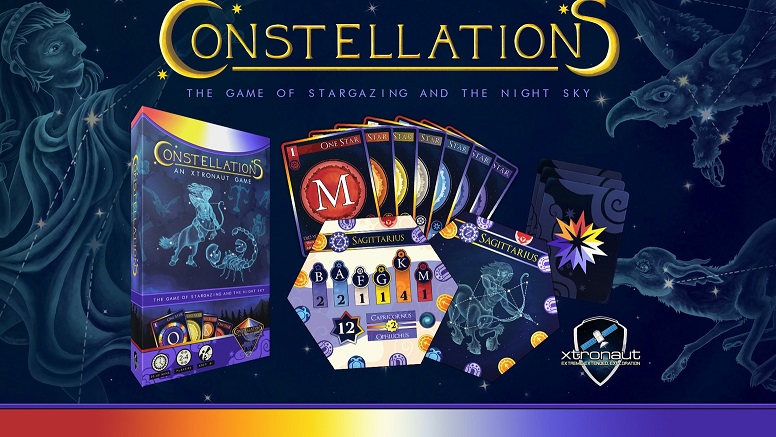
Now that is a puzzly endeavor worthy of your attention. And that’s the concept behind the game in today’s product review. We’ll be trying out Constellations by Xtronaut Enterprises.


Constellations combines the resource management card game mechanics of Just Desserts with the pattern-matching tile play of Carcassonne to create an educational and engaging play experience.

Each player starts with five star cards. Each star card represents a different type of star (or in some cases, two of that type of star). The star cards are used to assemble various constellations in order to score points.

The game begins with one constellation already placed in the sky, as well as three possible constellations to build. Players may reserve one of the three constellations, making it their primary goal and removing it from play for the other players.
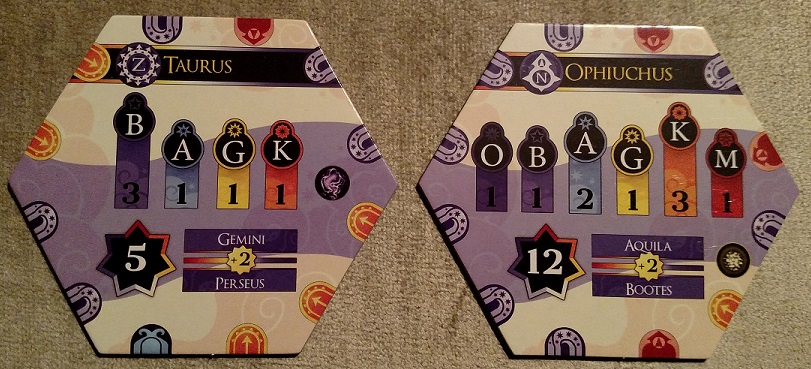
As you can see in the picture above, different constellations require different combinations of star cards. Some constellations are simpler, so they’re worth fewer points. Other constellations have higher values, but more complex combinations of star cards, which may be harder or more time-consuming to collect.

[One constellation tile, plus the star cards played to complete it. As you can see, you can use extra stars as needed (like a Two B-Type Stars card above), as well as using O cards as wild cards (as I did for the two A-type stars needed to complete this constellation.]

Once a player has gathered all of the star cards necessary to complete the constellation, they then must play it in the night sky, placing it adjacent to one or more of the constellations already completed.

You score points by placing a constellation so that the gemstones along the edges match the neighboring constellation(s), and there are additional points available for placing constellations beside other constellations (as they would appear in the actual night sky). For instance, Leo Minor offers a two-point bonus when placed next to either Leo or Lynx.

Different arrangements of gemstones around the edges of the constellation tile require you to be crafty when and where you place your tile, since more matching gemstones means more points.

[In this layout, Taurus was added perfectly, matching gemstones with both Perseus and Ophiuchus. Pegasus, on the other hand, matched Perseus nicely, but only matched one gemstone with Orion.]

Unfortunately, you have to play a completed constellation, and sometimes the gemstone patterns don’t match up at all. If that’s the case, you’ll lose two points for a constellation played out of place. (Once again, the closer you get to placing your constellation as it would actually appear in the night sky, the better it is for your game.)

All of the game’s mechanics are designed around actual science, which is a very cool touch. The star cards include “Did You Know?” facts about each type of star, and the instruction booklet also includes a short guide to stargazing, star classification, and little write-ups for each constellation included in the game. (There’s even a criss-cross-style crossword on the back page!)

Constellations is great fun, requiring strategy, timing, and puzzly observational skills in order to effectively play the game. The educational aspect doesn’t detract from the gameplay at all, and the alternate rules offered in the back (as well as rules for shorter and longer gameplay times) offer an impressive amount of replay value.

All in all, Constellations mixes card games and tile games with ease, and it makes for a fun and mellow gameplay experience.

[Constellations is available from Xtronaut Enterprises and other select retailers.]


Thanks for visiting PuzzleNation Blog today! Be sure to sign up for our newsletter to stay up-to-date on everything PuzzleNation!

You can also share your pictures with us on Instagram, friend us on Facebook, check us out on TwitterPinterest, and Tumblr, and explore the always-expanding library of PuzzleNation apps and games on our website!
Introducing New Players to Roleplaying Games!

A month or so ago, there was a marvelous article on Amazing Tales about how to make your child’s first role-playing game amazing.

Although the article was geared toward introducing younger players to the world of roleplaying games, the advice can be easily adapted and expanded to include new players of all ages. So today, I thought I would take the five points introduced by Amazing Tales and do just that.

So if you’re a new or inexperienced game-runner / dungeon master, or if you’ve only run games for people with previous experience playing roleplaying games, this is the place for you.

(And this advice should fit no matter what sort of game you’re running. Is it classic Dungeons & Dragons? Supernatural? Zombie horror? Space adventure? Knights of the Round Table? Explorers? Pirates? Monster hunters? Modern spies? Thieves in the Victorian era? No matter what setting or characters, this advice is universal.)

#1 Keep cool

It’s easy for the person running a roleplaying game to have high expectations for themselves and the story they want to craft. You want your new players to have fun. You want them to immerse themselves in telling a story. You want them to be excited and come back for more.

But that’s a lot of pressure to put on yourself, and a stressed or nervous game master can lead to stressed or nervous players. So don’t set the bar so high. Sit back and let the players interact; sometimes, you can engineer a scenario that allows for this, like a tavern scene. Or you can create an instant threat and let them jump into the action and work together to solve a problem as a bonding experience.

Don’t be afraid to take opportunities to ask if anyone’s confused. A first game is introductory by nature, and if someone feels left behind early on, it can be hard to catch them up later, or to make them feel included if they’re not gelling with the other players.

Sometimes when I’m starting a new game with new players, I’ll hold what I call a “session zero,” a safe game before the game kicks off, where the characters can play in the environment, interact, and test out the actual mechanics of playing (particularly if there’s a magic system or some other aspect of the game that might not be intuitive).

#2 Keep it small

You want your players to feel immersed but not overwhelmed, so party size (the number of players) is an important consideration. I try to keep my number of new players to three or fewer, because it can be hard to give meaningful attention to a larger number of players. It’s like a classroom; you want the ratio of experienced voices to students to be as small as possible, so you can get that one-on-one time to answer questions and help them find their footing.

For me, the ideal group for a newcomer-heavy game is two (or three) new players, one (or two) experienced players, and myself running the game. That way, each new player is balanced by someone with greater experience. You can even have a buddy system to get them acclimated.

A smaller group also means less time for players to sit out while other players get the spotlight. Never let the new players feel shortchanged or like their voices aren’t as important as those of the more experienced players. After all, if you’re an experienced player, you’re going to feel more comfortable speaking up and venturing forward than a new player might.

[Image courtesy of Lewis Brown.]

#3 Say yes to their ideas

Now, obviously, you can’t say yes to every idea a player has or the story could descend into nonsense. But trust your players’ instincts.

Let them wander down the paths they find most interesting. It might not be the path you intended, and it might take them longer to get to the desired end point, but it’s always better for players to reach a story point organically, rather than railroading them to the place and time you want. Even new players can sense when they’re being strong-armed in a certain direction, and that can leave a bad taste in players’ mouths.

Be flexible. I’ve always found that, no matter how thoroughly I think I’ve mapped out an adventure, my players (both new and experienced) excel at finding paths I hadn’t considered. That requires me to be quick on my feet, and I enjoy the challenge of pitting my wits, improvisational skills, and imagination against those of my players.

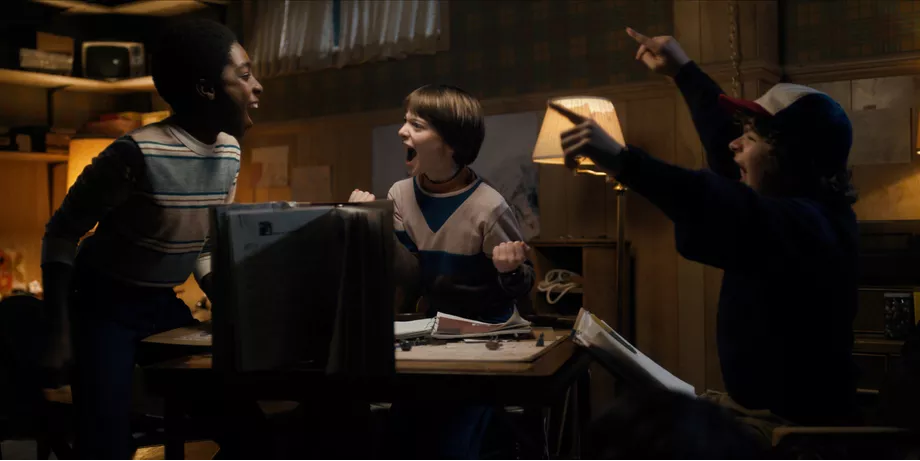
A roleplaying game is like a Choose-Your-Own-Adventure novel writ large… whenever possible, let them feel in control of their players, their story, and their destiny.

[Image from Stranger Things courtesy of The Verge.]

#4 Take them where they want to go

This might feel like a repeat of the previous note, but it’s not. This point is a reminder to always consider the characters your players are playing. What are their strengths? What goals do they have? What are they hoping to experience and accomplish?

Plenty of game runners, myself included, can get so wrapped up in the story WE want to tell that we forget that it might not mesh with the story our players want to participate in.

Give them moments to shine. Give the fighters a chance to fight, give the magicians opportunity to ply their craft, and give the puzzlers puzzles to solve. If characters have wings, let ’em fly.

[Image courtesy of Digital Trends.]

#5 Make the ending awesome

No matter how simple the adventure starts — a theft, a murder, the discovery of a treasure map, the descent into a trap-laden dungeon — make sure the ending is memorable. You want the quest, however short or long, to feel worthwhile.

You can try the old cliffhanger trick in the hopes of leaving them wanting more, but that can come back to bite you if the players are dissatisfied that their first adventure doesn’t feel complete. Instead, give them a sense of accomplishment.

Martin at Amazing Tales said it well:

Make sure your child’s first ever role-playing game features an epic ending. Face to face with the villain on a cliff edge as the counter ticks toward zero; returning the stolen jewels to the temple moments before sunset while pursued by ghosts; wrestling the controls of the star-ship from the pirate moments before it crashes into the sun. That kind of epic.

You don’t necessarily need to go epic, but certainly make it memorable. Nothing sells a big win like giving the bad guy a funny line before he turns to ash.


Here’s hoping this advice encourages aspiring dungeon masters and storytellers to get out there, find some players, and spin some marvelous adventure yarns. (Or maybe it’s inspired some new players to try roleplaying themselves!)

What’s your favorite memory from your early roleplay sessions, fellow puzzlers? (Either as a game runner or player.) Let us know in the comments section below!


Thanks for visiting PuzzleNation Blog today! Be sure to sign up for our newsletter to stay up-to-date on everything PuzzleNation!

You can also share your pictures with us on Instagram, friend us on Facebook, check us out on TwitterPinterest, and Tumblr, and explore the always-expanding library of PuzzleNation apps and games on our website!
Hashtag! You’re Out!

You may be familiar with the board game Schmovie, hashtag games on Twitter, or @midnight’s Hashtag Wars segment on Comedy Central.

For years now, we’ve been collaborating on puzzle-themed hashtag games with our pals at Penny Dell Puzzles, and this month’s hook was #PennyDellBaseballPuzzles, mashing up Penny Dell puzzles with players, teams, terminology, and all things regarding America’s pastime!

Examples include: Right of Wade Boggs, Mookie AlphaBetts Soup, and, of course, Triple Play.

So, without further ado, check out what the puzzlers at PuzzleNation and Penny Dell Puzzles came up with!


Puzzly Players!

Railroad Ty Cobb

Ty-in Cobb

Cy-lacrostics

Daisy Dean

Satchel Solution Paige

Warren Spanners

Denard Spanners

Dwight Gooden Deal

Jeff Mixed Bagwell

Crypto-Trivias Jackson

Willie Starspell

Seaver Words

Earl Weaver Words

Pine David Cone

Bo “knows the odds” Jackson

Goose Tile

Harry Caray-Overs

KenKen Griffey, Jr.

Rollie Fingers of the Dice

IchiRoll of the Dice

Roll of the Dice-K

Ichiro Sudoku

Phil Crypto-Zooto

Go Catfish Hunter

Willie Word Maze / Word Mays / Willie Maze

The Say That Again Hey Kid

Ron Cey That Again

Let’s close out this category with some player facts!

  • Hall of Famers: Al Draw the Ka-line, Bill Maze-roski, and Ozzie Smith aka “The Wizard Words of Oz”
  • Anagram Lloyd was an important reliever in the Yankees 1996 World Series run.
  • The Yankees and Mets in the 1970’s had Bill Sudoku who played catcher and first base.

Puzzly Teams!

Mudville 9 of Diamonds

Arizona Nine of Diamondbacks

Arizona Diamond Rings

Tampa Bay Sunrays

Cubbles

Yan-Keyword


Puzzly Baseball Lingo!

Seventh Inning Stretch Letters

All-Starspell game / All-Star Codebreaker / All-Star Categories

Home Runs

Picker-Upper Decker Home Runs

Puzzle Home Run Derby

Three Strikes of a Kind

ERABC’s

Dugout of Place / Pitchout of Place

Bullpen Spiral / Bullpen’s-Eye Spiral

Bull Pencil Pusher

Who’s Calling The Bullpen?

What’s Left? Field

Slide-Into-Home-O-Gram / Slider-O-Gram

Window Box score / Shadowbox score

Diamond Nine

Bad Hop, Skip, and Jump

In and Around the Horn

A Few Fielder’s Choice Words

In and Aroundfielder

Give and Take a Pitch

Pitcher This

Pitching Match-Up

Small Change-up / Changeupaword

Trade-Offspeed Pitch

All Mixed Up and Away

Down the Middle of the Road

At the Block Letters

12-to-6 Drop-Ins

High and Insiders

Split-Finger Personalities

Full Countdown

Fourbagger Fit

Grand Slam Tour

Ball Fore ’n’ Aft / Ball Four Corners

Letter Perfect Game / Perfect Game Fit

Perfect Hit

Hits & Pieces

Batter’s Boxes

Battergrams

Word Player to be named later

Letter Power hitter

Line Drive ‘Em Up

Draw the Line Drive

Crack of the Battleships

Throwback-to-backs

Bat Around the Bend

Word-A-Bat

Bases, Please.

Base to Base

Grounds-Roulette Double / Grounds-Rule Double Trouble / Ground Rule Double Occupancy

Right of FenWay / Which FenWay Words

Heads & Tailgates

In the Middle Innings

Word Playoffs

Crossword Series

World Series Ringers

Bookworm-Burner

Three-DL Crossword

Heading-ers

Quotefall Classic

Four Hot Corners / Can of Four Corners

Fill-Innings

Doubleheader Delight

The Nine of Baseball Diamonds

Dial-It-Up-A-Grams!

Balkworms

Old Timer’s Bowl Game

Take Me Out to the Ballgame From There

Take(me)outs to the Ballgame

TakeTrouts

Takeoutslide

Take-out Slide-O-Rama

Dash-It and Run

“Buy me some peanuts and Crackerjacks…”

If a pitcher has men on base, he may opt to pitch from the Stretch Letters.

Baseball: A Film by Kenken Burns


And, as always, there are those participants who go above and beyond in their masterful punnery!

A few offered up some puzzly calls:

  • And there goes Hank Aarrrooound the Block to Add One to his Homeruuuns!
  • Alfred got 3 books and he’s out….he should of ordered more puzzles…back to the bullpen

Naturally, we couldn’t have some fun with baseball without a certain Abbott and Costello routine getting referenced…

“GUESS WHO’s on first, WHAT’S MY NAME is on second, YOU KNOW THE ODDS is on third…”

[Note: someone else also offered “What’s Left on Second?”]

One intrepid puzzler offered this advertisement for players with, shall we say, chemistry:

Were you Suspended and Sentenced for Steroids? Did you hit too many Home Runs? Well just Dial-A-Gram 1-800 ALL-FRAMED because those are some Barry Common Bonds you have there!

We even got some pun-filled trivia!

In the old time parks like Wrigley Field and Fenway, you can see the SCOREBOARD in which they use PLACE CARDS to create a DIGITAL DISPLAY.

I’ll never forget my favorite Yogi Berra quote: When you’re coming and going to a fork in the middle of the road, take a letter.


Alas, there is simply no topping this all-time puzzly classic…

Take me out to the ALL FRAME,
Take me out with the CROSS PAIRS
Buy me some PATCHWORDS and CRACKERJACKS
I don’t care if I never get THROWBACKS
Let me root, root, root for the HOME RUNS,
If they don’t win it’s a FRAMEwork,
For it’s one, two, three strikes, you’re ROUNDABOUT
At the old BOWL GAME


Have you come up with any Penny Dell Baseball Puzzles entries of your own? Let us know! We’d love to see them!

Thanks for visiting PuzzleNation Blog today! Be sure to sign up for our newsletter to stay up-to-date on everything PuzzleNation!

You can also share your pictures with us on Instagram, friend us on Facebook, check us out on TwitterPinterest, and Tumblr, and explore the always-expanding library of PuzzleNation apps and games on our website!

First Look: Puzzle, A Film About Finding the Right Pieces

[Image courtesy of Steven Teagarden.com.]

Satisfaction. Nothing encapsulates the feeling of completing a puzzle quite like the word “satisfaction.”

Whether we’re talking about crosswords, brain teasers, mechanical puzzles, or jigsaw puzzles, it’s a gratifying feeling to write that final letter, place that final piece, make the final twist/move/connection and unlock the solution.

“When you complete a puzzle, you know you have made all the right choices.” That idea is at the heart of a new movie coming out next month entitled Puzzle.

[Image courtesy of IMDb.]

From one of the press packets for the film:

Agnes, taken for granted as a suburban mother, discovers a passion for solving jigsaw puzzles, which unexpectedly draws her into a new world – where her life unfolds in ways she could never have imagined.

The film stars Kelly MacDonald (who you might know from Brave, Boardwalk Empire, Gosford Park, or Trainspotting), Irrfan Khan (Life of Pi, Slumdog Millionaire, In Treatment, and Jurassic World), and David Denman (The Office, Angel, 13 Hours, and Logan Lucky), but even from the brief glimpses offered in the trailer, this is clearly Kelly MacDonald’s show.

Transitioning from a warm reception at Sundance to wider release in July and August, the film looks like a wonderful character piece, a nice bit of counterprogramming after the usual summer blockbuster fare.

I’m looking forward to seeing the film when it’s released — it opens July 27th in select theaters — and I’ll write a full review for the blog when I do.

But in the meantime, check out the trailer, and if you’re intrigued, spread the word.


Thanks for visiting PuzzleNation Blog today! Be sure to sign up for our newsletter to stay up-to-date on everything PuzzleNation!

You can also share your pictures with us on Instagram, friend us on Facebook, check us out on TwitterPinterest, and Tumblr, and explore the always-expanding library of PuzzleNation apps and games on our website!

Winning Monopoly With Math!

I’m always on the hunt for tips to make myself a better puzzler and gamer. Sometimes you stumble across those tips in unexpected places.

For instance, I was reading, of all things, a book about mathematics and Christmas — The Indisputable Existence of Santa Claus: The Mathematics of Christmas — and inside, I found a statistical analysis of the best strategy for winning a game of Monopoly.

Yes, we’ve discussed this topic before, but even that previous deep-dive into the mechanics of the game wasn’t as thorough or as revealing as the work by Dr. Hannah Fry and Dr. Thomas Oleron Evans in this Christmas-fueled tome of facts and figures.

They started with a breakdown of how your first turn could go, based on dice rolls. This is the same breakdown as in our previous post, but with some important differences. For instance, they also considered the chances of going to jail after multiple doubles rolls.

Also, they covered the statistical impact of how landing on card spaces can affect where you land on your first turn. The Community Chest is a curveball, because of the possible sixteen cards, three will send you somewhere on the board: Go, Mediterranean Ave, and Jail.

A simple statistical analysis is complicated even further by the Chance cards — nearly half of the sixteen cards send you elsewhere: Go, Income Tax, St. Charles Place, Pennsylvania Railroad, Illinois Ave., Jail, and Boardwalk.

If you extrapolate forward from this point, you uncover some interesting patterns:

The orange property set benefits from all the ex-cons leaving their cells, and after their next turn the reformed criminals will likely end up somewhere between the reds and yellows… Illinois Avenue, with its own dedicated Chance card directing people to it, gets an extra boost, making it the second most visited square on the board.

The property that is visited least frequently is Park Place, where players spend just 2.1% of their time.

Check out this graph. This shows potential earnings from each complete color set, with the dotted line marking the point where your purchase of the property is canceled out by how much the property has earned in rent thus far. Everything above that is profit.

As you can see, blue and brown properties start close to the dotted line, because they’re affordable to buy and build on. The standouts on this graph are New York Avenue (which earns $30 a roll up through thirty rolls statistically) and Boardwalk, which is an expensive investment, but pays off handsomely down the line, remaining the top earning spot past thirty rolls.

Of course, that’s only single properties, and you can’t build on single properties. Let’s look at a chart for full color set revenue:

Some of our previous findings change radically. Boardwalk’s rating drops significantly, because of Park Place’s relative infrequency of being landed on (as we mentioned above).

So which properties should you nab to give yourself the best chance of winning? Well, that depends on how long the game lasts.

The average game of Monopoly takes approximately thirty turns per player, so the larger the number of players, the longer the game will last.

So, for a two-player game, your best bet is to go after the light blue or orange sets, since they’re better in the short term, and the odds are in your favor if the game stays short.

In a three- or four-player game, the orange and red sets are better, because the game is likely to last a while.

And if five or more people are playing, you’re really playing the long game, so the green set becomes your best chance for success.

What about building on those properties? Well, Fry and Evans considered that as well. If you’re playing against multiple opponents and know you’ll be in for a long game, then you definitely want to buy and place houses. But don’t fear if the first house takes a long time to start paying for itself.

As it turns out, your best strategy is to put three houses on your properties as quickly as possible, because the third house is the fastest to recoup on investment. So once the three houses are in place on each property, you can rest for a bit and regenerate your bank before investing further.

And there you have it. Better gaming through mathematics! The only thing better would be, well, playing practically any other game.

Kidding! (But not really.)


Thanks for visiting PuzzleNation Blog today! Be sure to sign up for our newsletter to stay up-to-date on everything PuzzleNation!

You can also share your pictures with us on Instagram, friend us on Facebook, check us out on TwitterPinterest, and Tumblr, and explore the always-expanding library of PuzzleNation apps and games on our website!
Turn Your Smartphone Into a Rubik-Solving Sidekick?

I just can’t resist a bit of Rubik’s Cube news.

We’ve covered Rubik’s Cubes a lot on this blog. We’ve seen them solved underwater, while being juggled, during a skydive, and one move at a time by strangers on a world tour. And yes, we’ve seen them solved in increasing faster times, both by humans and machines.

The human record hovers around the five-second mark, while the machine record stands at .38 seconds, which is brain-meltingly fast.

Now there’s a new tool on the market to up your Rubik-solving game like never before. It’s called GoCube, and it’s on Kickstarter right now.

GoCube is a Rubik’s-inspired twisty puzzle that is Bluetooth-enabled in order to interact with a phone or tablet. It offers real-time updates on your solving progress — which corresponds to areas of the physical cube that light up — as well as carrying a whole host of other features.

You can use it as a training tool to teach you the tricks of the solving trade, whether you’re just learning how to solve a twisty puzzle or you have aspirations of being a speed-solver.

GoCube’s connectivity even allows you to compete in head-to-head solves with other users. Plus you can use the cube as a controller for mini-games, in dexterity challenges, and more.

This seems like an impressive step forward for twisty puzzles. Although the price tag is pretty hefty — the basic Kickstarter package starts at $69 (although the creators claim it will retail for $119) — the campaign has already blown past its initial goal of $25,000. It currently sits at over $400,000 in Kickstarter-backed funds with over a month to go.

Puzzles continue to grow and adapt to the modern technological revolution in unexpected and fascinating ways. I can’t wait to see what tech-savvy puzzlers cook up next.


Thanks for visiting PuzzleNation Blog today! Be sure to sign up for our newsletter to stay up-to-date on everything PuzzleNation!

You can also share your pictures with us on Instagram, friend us on Facebook, check us out on TwitterPinterest, and Tumblr, and explore the always-expanding library of PuzzleNation apps and games on our website!