The Art of Metal Brain Teasers

[Disentanglement puzzles, courtesy of Mr. Puzzle Australia.]

When we talk about people creating puzzles, certain standard materials come to mind.

Pen and paper. A computer program like Crossword Compiler. For brain teasers and puzzle boxes, wood is common. Recently, 3-D printers have made it possible to create plastic puzzles the likes of which no one has seen before.

But we rarely talk about metal.

When it comes to disentanglement puzzles, metal is where it’s at. Wood and plastic pieces can flex under pressure, making them more susceptible to a forced solution where one wasn’t intended. But with metal puzzles, you’ve pretty much only got one option: solve it as intended.

Metal brain teasers like those pictured above started out simply, made from twisted nails and used as puzzles in pubs for bar bets. (Some brain teasers made today still mimic the appearance of nails in honor of this rustic style of puzzling.)

They can be basic or complex, depending on how many pieces are involved, but the goal is usually to separate each puzzle into its component pieces.
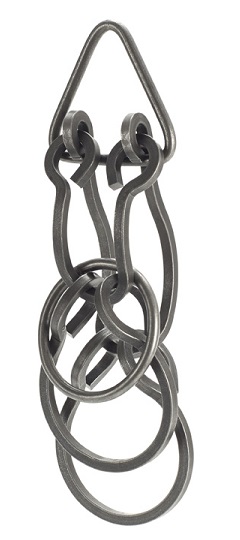
Of course, these puzzles might look slight when compared to the heavy-duty ones produced by companies like our friends at Tucker-Jones House, whose Tavern Puzzles line combine complexity with artful craftsmanship to create some impressive and daunting puzzles.

Instead of completely dismantling the puzzle, Tavern Puzzles usually have a single element — a ring, a heart shape, a triangle — that you must free from the rest of the metal pieces.
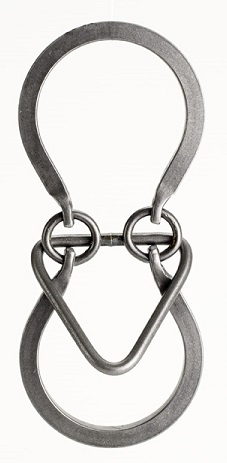
[They have Valentine’s Day-themed puzzles too!]

But when it comes to metal puzzles, it’s hard to top this recent masterpiece by metalsmith Seth Gould.

This is Coffer.
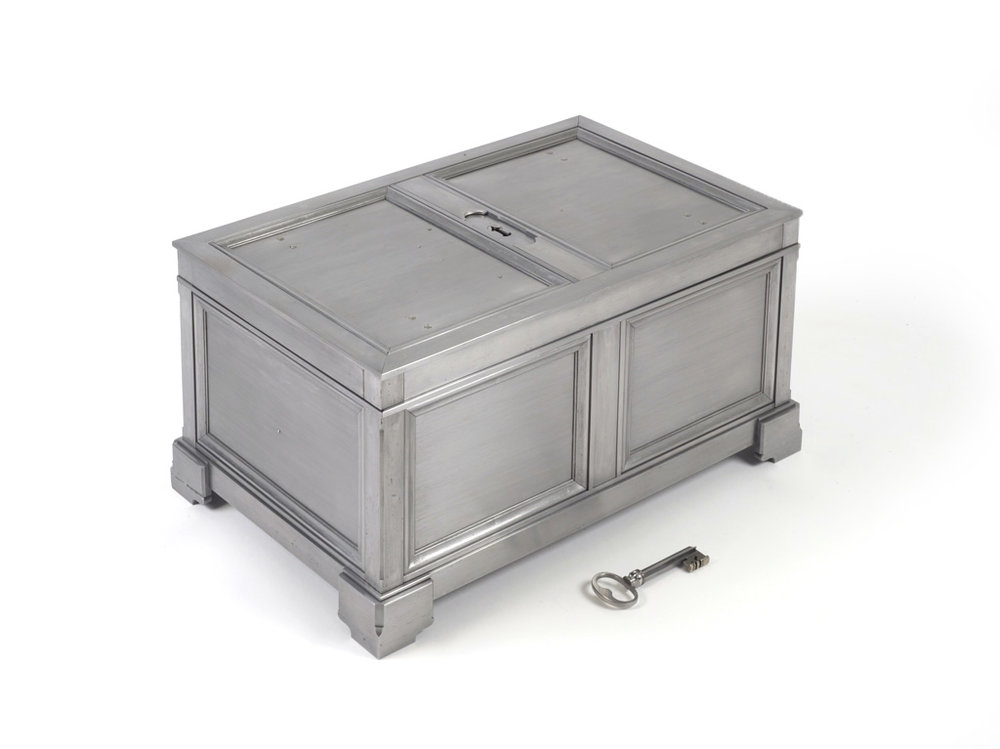
Yes, it looks like a simple chest and key, but as you’ve no doubt figured out, there’s far more to Coffer than meets the eye.

This puzzle took over two years to design and create, and it’s made from iron, steel, and brass.

Every piece was crafted by Gould himself, inspired by designs from between the 17th and 19th centuries, and the puzzle mechanism itself is his own design:

I received a BFA in Jewelry and Metalsmithing Design, and during the end of my time in school I became interested in forging. In fine metals I found that I worked well with the precision needed to create quality work, and in forging I was drawn to the malleability of the material and the scale in which I could work.

It was not until I visited Musée Le Secq Des Tournelles in Rouen, France shortly after graduation that I realized how those two interests could intersect. The locks and utilitarian objects I saw there were unlike anything I had ever seen, and still influence me today.

Now that is the ultimate in DIY puzzling.

Filmmaker Jesse Beecher chronicled the construction process and has posted a wonderful video on Vimeo that shows how much love and labor went into this marvelous metal puzzle:

Constructors and puzzle designers are continuing to push the envelope when it comes to mind-blowing, beautiful brain-teasing creations, and whether we’re talking paper, wood, metal, or 3D printing, there seems to be no limit to what puzzly minds can bring to life.


Thanks for visiting PuzzleNation Blog today! Be sure to sign up for our newsletter to stay up-to-date on everything PuzzleNation!

You can also share your pictures with us on Instagram, friend us on Facebook, check us out on TwitterPinterest, and Tumblr, and explore the always-expanding library of PuzzleNation apps and games on our website!

Answers to our National Puzzle Day Starspell!

For National Puzzle Day (aka International Puzzle Day), we laid down the gauntlet for you, fellow puzzlers.

We challenged you to put your vocabulary skills and your word-forming knowhow to the test with a Starspell puzzle specially constructed for the holiday (as it featured all the letters in the phrase INTERNATIONAL PUZZLE DAY)..

The goal was to form common six-letter words by moving from letter to connected letter in the Starspell diagram. You were allowed to repeat letters, but only so long as you left the letter first and then came back to it.

We found 28 six-letter words. Did you find more than that?

Here’s our list: ALATED, ATONED, DEALER, DELETE, DENIED, DENOTE, DEPEND, EATERY, ELATED, EYELET, LAUREL, LENDED, LENDER, NEATEN, NEATER, NOTATE, PEALED, PENDED, REDEAL, RED-EYE, REINED, RELATE, RENDED, RENDER, REPEAL, REPEAT, TENDED, TENDER.

Did you find any that we missed? Let us know in the comments section below! We’d love to hear from you!


Thanks for visiting PuzzleNation Blog today! Be sure to sign up for our newsletter to stay up-to-date on everything PuzzleNation!

You can also share your pictures with us on Instagram, friend us on Facebook, check us out on TwitterPinterest, and Tumblr, and explore the always-expanding library of PuzzleNation apps and games on our website!

PuzzleNation Product Review: Thinking Putty Puzzle

[Note: I received a free copy of this game in exchange for a fair, unbiased review. Due diligence, full disclosure, and all that. Yada yada disclaimer.]

ThinkFun has been pushing the envelope for years when it comes to logic puzzles. Whether we’re talking lasers, electrical circuits, colors, shadows, or gravity, they continue to find innovative ways to test the puzzly skills of their customers.

And the subject of today’s review is no exception. It takes a very simple idea — connecting colored dots on a grid — and adds a tactile, intriguing twist.

Let’s take a closer look at their newest offering, Thinking Putty Puzzle.

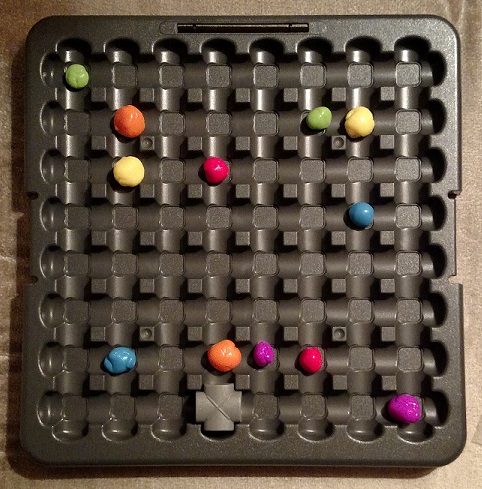
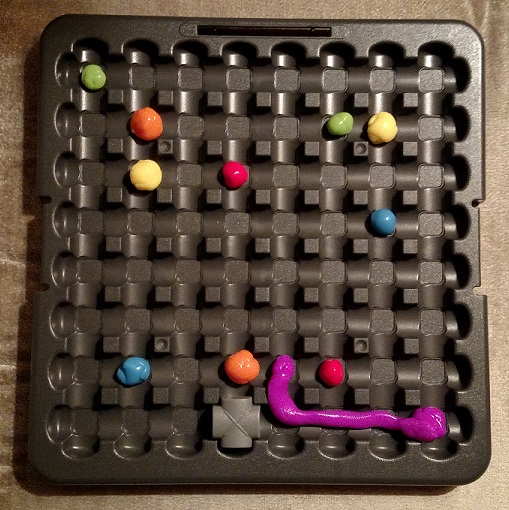
In Thinking Putty Puzzle, the solver has to connect the colored dots to their matching counterparts on the grid. They do so by bending, stretching, and shaping packets of putty into lines that connect the dots.

But those paths cannot cross. That would be too easy. Instead, the solver must map out how to connect the dots without crossing.

(There are bridge pieces that allow the putty paths to pass over or under each other, but otherwise, the paths cannot interact.)

And so, a simple connect-the-dots game becomes an engaging puzzle that involves careful planning and use of the grid space.

It looks like a lot of available space, but it fills up faster than you’d think with six paths to draw.

As you can see, the puzzle consists of a playing grid (which doubles as storage for the game and the putties), six colors of Crazy Aaron’s Thinking Putty (including a ThinkFun exclusive Binary Blue color), three bridge pieces, three blocking pieces (representing obstacles to be circumvented), and the 60 challenge cards.

The Challenge Cards increase in difficulty as you work your way through the deck. Beginner and Intermediate Challenges give way later to Advanced and Expert puzzles that will have you wracking your brain to twist, turn, and maneuver your six putty paths around the playing grid.

Each Challenge Card tells you where to place the colored dots to connect, as well as any bridge or blocking pieces are part of the grid.

From there, it’s all up to you. How do you proceed with 12 points to connect?

Maybe you start by connecting the nearest ones in order to figure out how to best use the remaining space.

Or perhaps you work out which dots will need to use the outermost paths and place those, so that the interior remains open for trickier maneuvering.

It’s easy to pull the putty until it’s stringy, which makes it harder to manipulate. Instead, I found it worked best to pull quickly and forcefully, almost suddenly, rather than gradually. It makes quite a satisfying SNAP sound when you’ve done it right, and there’s no stringy mess to clean up.

Also, be careful to avoid letting the various colors touch. The putty happily sticks to itself, so any pieces that intermingle are VERY difficult to separate.

That being said, the putty doesn’t adhere at all to the playing area, making the set up for the next puzzle — or clean up when you’re done puzzling — easy as could be.

(I, for one, was grateful that the sparkles in the Binary Blue didn’t rub off. When I first saw the glitter, it gave me Christmas card flashbacks.)

In terms of the actual puzzle-solving, strategy plays a bigger role here than you might expect. Honestly, it’s more like playing Risk or Chess than your solving usual logic puzzle.

For instance, once you’ve placed the red path in our example, your eyes naturally turn to the upper left corner, where green, orange, and yellow dots await. You need to place the green path in such a way that it doesn’t block or cut off access to the yellow or orange dots.

By thinking about the spaces needed to get in or out of those dots, it helps you eliminate bad paths to take, because in this puzzle, knowing where your path SHOULDN’T be is just as valuable as knowing where it should be.

Thinking Putty Puzzle takes the satisfaction of jigsaws and other physical puzzles to another level. While placing a jigsaw puzzle piece is cool, it’s not as cool as kneading the colored putty into a new path and tracing it onto the grid as part of your solve.

I expected to get a little bored with it after a while, but I didn’t. Watching the grid fill up with completed paths and seeing the puzzle come together never got old. On the contrary, the escalating difficulty made it all the more fulfilling to conquer each card and squish the putty back into a single lump while I prepped the next Challenge Card.

So, if you’re looking for a fun and accessible way to get younger solvers into puzzles — or you just prefer your logic puzzles to be more hands-on than the usual pencil-and-paper variety — then you’re sure to enjoy Thinking Putty Puzzle.

[Thinking Putty Puzzle is available from ThinkFun and other participating retailers.]


Thanks for visiting PuzzleNation Blog today! Be sure to sign up for our newsletter to stay up-to-date on everything PuzzleNation!

You can also share your pictures with us on Instagram, friend us on Facebook, check us out on TwitterPinterest, and Tumblr, and explore the always-expanding library of PuzzleNation apps and games on our website!

It’s National Puzzle Day!

Hello hello, fellow puzzlers and PuzzleNationers! It’s National Puzzle Day (aka International Puzzle Day), and we hope you’re having a fabulous time!

As you might expect, we’re overjoyed to be celebrating this puzzliest of days with you, and we’ve got a few things going on today in honor of the holiday!

You can log into either the Penny Dell Crosswords App or the Daily POP Crosswords App for terrific deals, so be sure to check them out!

And that’s not all! We’ve got a marvelous little puzzle for you as well!


Today we’re testing your vocabulary skills and your Boggle mastery with a Starspell puzzle!

The goal is to form common six-letter words by moving from letter to connected letter in the Starspell diagram. A letter may be repeated in a word, but only after leaving it and coming back.

The letters in today’s puzzle, appropriately enough, all come from the phrase INTERNATIONAL PUZZLE DAY!

We found 28 six-letter words. How many can you find?

Good luck!

How are you celebrating National Puzzle Day, fellow puzzlers? Let us know in the comments below!


Thanks for visiting PuzzleNation Blog today! Be sure to sign up for our newsletter to stay up-to-date on everything PuzzleNation!

You can also share your pictures with us on Instagram, friend us on Facebook, check us out on TwitterPinterest, and Tumblr, and explore the always-expanding library of PuzzleNation apps and games on our website!

A National Puzzle Day Event a Few Days Early!

Tuesday is National Puzzle Day, aka International Puzzle Day, but as it turns out, a day is simply not enough for the folks at Barnes & Noble. They have been celebrating National Puzzle Month for the whole of January!

And tomorrow, January 26th, all 630+ Barnes & Noble stores will be hosting a puzzle contest to celebrate National Puzzle Day/Month!

All ages are invited to participate in a variety of puzzle activities with fellow players; complete jigsaw puzzles from start to finish; jump in on a fun word search; or challenge your vocab with crosswords.

We’re also featuring Curious Jane activities full of ideas! Participating players will get a free activity booklet to take home—while supplies last.

Don’t miss this special offer for puzzle fans: Buy 1, Get 1 50% Off All Dell Penny Puzzles from January 25th to January 27th, in stores only.

There’s still time to sign up for their event; check out their Facebook, Instagram, or website for more details.

Not only that, but I can tell you for a fact that the puzzles they’re offering for the event itself are top-notch! How can I be so sure?

Well, our friends at Penny Dell Puzzles are the ones who crafted those marvelous puzzles for the participants! How cool is that?

Will you be attending the #BNPuzzleParty tomorrow? Let us know in the comments below! We’d love to hear from you!


Thanks for visiting PuzzleNation Blog today! Be sure to sign up for our newsletter to stay up-to-date on everything PuzzleNation!

You can also share your pictures with us on Instagram, friend us on Facebook, check us out on TwitterPinterest, and Tumblr, and explore the always-expanding library of PuzzleNation apps and games on our website!

The Gold Bar Logic Puzzle!

[Image courtesy of Pinterest.]

As many of our long-time readers know, we’re happy to accept the challenge of any brain teaser, riddle, mind tickler, or puzzle that is bedeviling one of our fellow PuzzleNationers.

So when someone suggested that I tackle the Birthday Paradox brain teaser, I said it was a terrific idea for a post. (As such, I mentioned it in the Facebook post I write every Monday running down the upcoming blog posts for the week.)

I sat down to write it… and I had this unshakable sense of deja vu. I thought maybe I was just overly familiar with the topic, since I’ve explained it to other puzzle fans before, just not here.

But the idea just kept nagging at me. And with good reason.

A quick blog search later, and it turns out the Birthday Paradox brain teaser is a terrific idea for a post. Which is why I wrote a blog post about it. Nearly four years ago.

My apologies to everyone expecting the Birthday Paradox brain teaser today, but I’d rather not double-down on this faux pas.

Thankfully, that wasn’t the only brain teaser someone has suggested to me recently.

[Image courtesy of Law.com.]

So, in lieu of a brain teaser we’ve already covered, let’s look at another devious brain teaser. Join me as we tackle the challenge of the Gold Bar Logic Puzzle.

You’re out traveling and stumble upon a quaint little hotel.

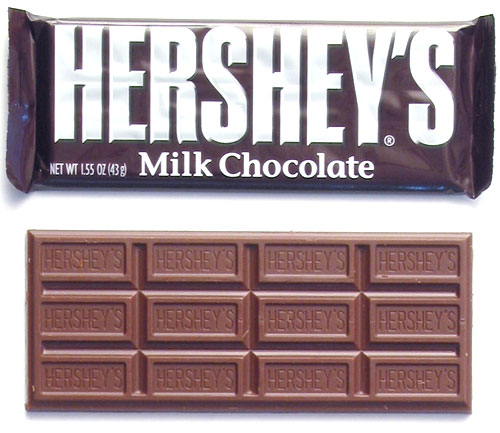
You decide to stay there for seven nights. For some reason, the only currency you have with you is a solid gold bar that is notched into seven separate segments, sort of like a candy bar.

[Kinda like this. But gold.
Image courtesy of American Icons Temple.]

Luckily, the front desk agrees to let you pay in gold segments. You need to pay the hotel daily for each night you stay.

What is the fewest number of times you must cut your gold bar so that one segment is paid to the hotel every day?

I’ll give you some time to consider the puzzle before breaking down the answer for you.

Good luck!

Hint: You are allowed to ask for change, but the only gold they have is what you’ve given them. This isn’t a quaint little inn in Dubai.

And no, you can’t just give the hotel clerk the whole bar (or what hasn’t been cut off previously) each day and make the clerk do the cutting. The whole idea is that you’re the one doing the cutting.

Did you get it? Good!

And if not, no worries, I’ll meet you halfway.

The answer is two cuts. Just two.

Can you figure out how to cut the gold bar to make your stay work out?

Okay, hopefully you’ve unraveled the puzzle by now, because it’s answer time. Here we go!

You need to cut the gold bar in order to pay the clerk each night, but you don’t need to waste a lot of time slicing through gold. You just need to be clever in how you distribute it.

  • Night One: Cut off one notch of gold from your bar and pay the clerk. You have 6 notches of gold left.
  • Night Two: Cut off two notches of gold from your bar and pay the clerk. Since you’ve paid double, the clerk gives you back your notch from Night One as change. You have 5 notches of gold left (the block of 4 notches and the single notch).
  • Night Three: Pay the clerk with the single notch of gold. You have 4 notches of gold left (in one uncut block).
  • Night Four: Pay the clerk with your four-notch bar of gold. Since you’ve overpaid, the clerk gives you back your notch from Night Three and the two-notch block from Night Two. You have 3 notches of gold left.
  • Night Five: Pay the clerk with the single notch of gold. You have 2 notches of gold left (in one uncut block).
  • Night Six: Pay the clerk with the two-notch block of gold. Again, you’ve paid double, so the clerk gives you back your single-notch block.
  • Night Seven: Pay the clerk with the single notch of gold.

Two cuts, seven nights. Pretty efficient if you ask me!


So, how did you do? Let us know in the comments below, we’d love to hear from you!

[Note: In doing a little research, it appears this logic puzzle was created by Ray Epstein and Ben Kovler, and it appears in their book Fundrum My Conundrum: A Book of Riddles.]


Thanks for visiting PuzzleNation Blog today! Be sure to sign up for our newsletter to stay up-to-date on everything PuzzleNation!

You can also share your pictures with us on Instagram, friend us on Facebook, check us out on TwitterPinterest, and Tumblr, and explore the always-expanding library of PuzzleNation apps and games on our website!