Puzzle(r)s in Pop Culture: Superhuman

Superhuman is a television show on FOX that combines elements of game shows and talent shows, wherein people with exceptional mental abilities are tested on the air, competing for a $50,000 grand prize.

The show has featured exhibitions of memorization, visual acuity, math and puzzling skills, and more, offering people the rare opportunity to show off the mind’s amazing capabilities. (It also bucks the trend of modern reality competition shows by not having the contestants judged by a smug British man.)

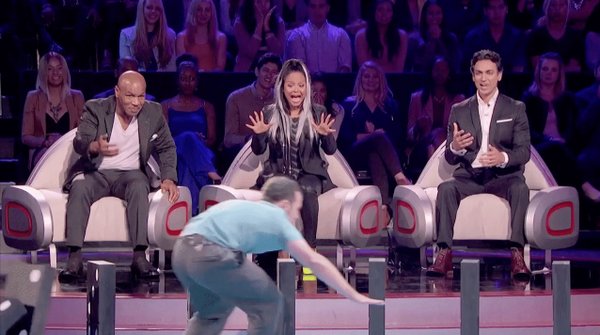
Actor Kal Penn hosts the show, and the three panelists who comment on performances and help choose the winner are boxer Mike Tyson, singer Christina Milian, and neuroscientist Dr. Rahul Jandial.

And on last week’s episode, “All Parts Extraordinary,” a face familiar to puzzlers and crossword fans appeared on the show: Tyler Hinman.
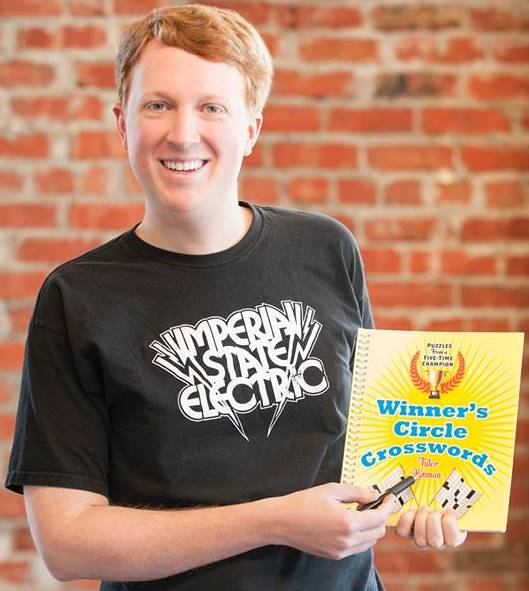
The former 5-time American Crossword Puzzle Tournament champion was pitted against four other contestants with impressive mental abilities.

Chris Authement, a math whiz, was tasked with adding up all the pips on giant dominoes as they fell, correctly counting 535 pips in the time allotted.

Tatiana Marquardt, a mother of three with impressive memory recall, was tasked with memorizing five days of scheduling for three different kids. Each day had four activities. The judges then randomly chose a child and a day of the week, and she had to pack their backpacks for each day’s agenda. And she nailed all three days.

Dave Farrow, a computer scientist with a focus on robots, memorized a grid of 108 blue and red balloons (laid out in an 18×6 grid). Then, based on the judge’s choices, he was asked to recall the color of a particular balloon, the pattern of a particular column of balloons, and finally, a particular row of balloons. Recited backwards. And he did so.

Luke Salava, a lawyer with a knack for facial recognition, had to learn the faces of 100 members of the studio audience. Then, three of those people were removed, and that entire section of the audience was reshuffled. His task was to identify the three new people in the crowd. And he did so with ease.

When it was Tyler’s turn to show off his puzzly skills, he had a serious challenge ahead of him.

This grid of crisscrossing 5-letter words can only be completed with the letters in a 9-letter word provided alongside the grid. But Tyler had five of these grids to solve, and he wasn’t told which of the five 9-letter words went with which grid.
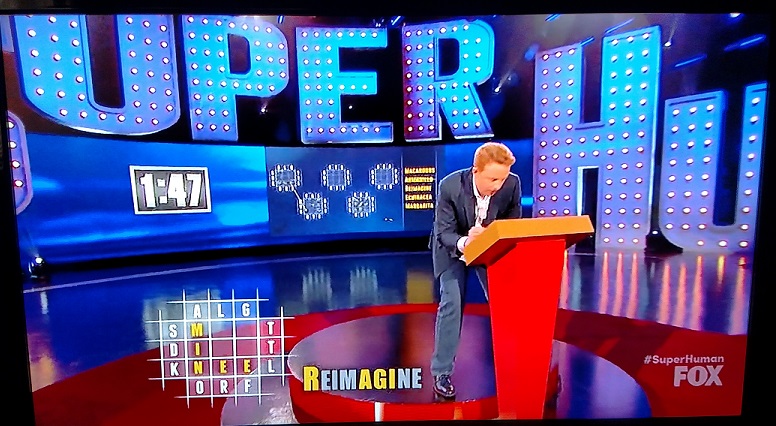
Oh, and he only had 3 minutes and 30 seconds in which to solve all five grids.
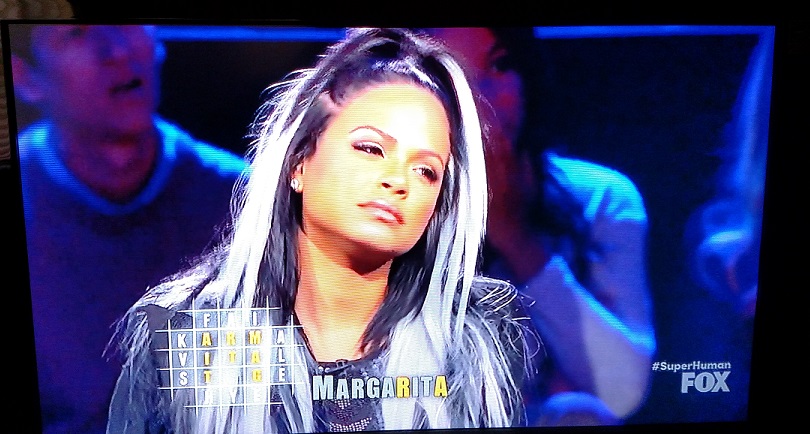
He went right up to the wire, but solved all five grids, showing off not only his deductive reasoning, but his vast vocabulary and his speed-solving technique, honed by years of crossword solving and tournament competition.
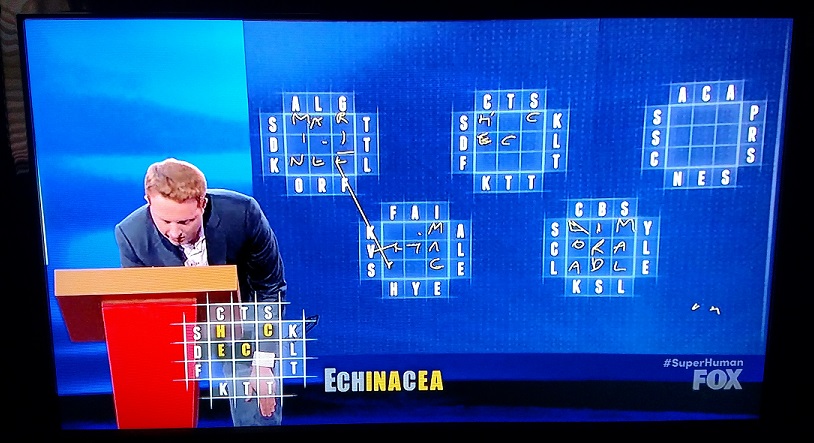
After all five competitors had their time to shine, the judges narrowed the field to three: Chris, Dave, and Tatiana. And the audience voted electronically for the winner: Dave Farrow, master of balloons.

Honestly, I thought both the judges and the audience picked wrong. Tyler was the only one who really had to work out his technique in front of the crowd, showing missteps and false paths that he corrected on the fly.

He actually talked through the process as he solved, which to me was more engaging and interesting.
Don’t get me wrong, the acts of memorization were very impressive, but only Tyler and math whiz Chris were really under a time limit. (Tyler’s was literal, while Chris’s was kinetic, since the dominoes were toppling.)

Also, I can’t believe that Luke didn’t at least make the top three, let alone win. 100 faces to memorize and reshuffle in your head? That’s mind-boggling to me.

Alas, such is the flying fickle finger of fate. Still, it was a strong showing for a world-class puzzler, an exhibition of puzzly talent that did not fail to impress.


Thanks for visiting PuzzleNation Blog today! Be sure to sign up for our newsletter to stay up-to-date on everything PuzzleNation!

You can also share your pictures with us on Instagram, friend us on Facebook, check us out on TwitterPinterest, and Tumblr, and explore the always-expanding library of PuzzleNation apps and games on our website!
Puzzles in Pop Culture: Twin Peaks: The Return

On Tuesday, I concluded a multi-part series about the history of American codebreaking. In a related story, a fellow puzzler pointed out that there might be a new code out there awaiting an enterprising codebreaker.

In a recent episode of the television show Twin Peaks: The Return, there was a brief scene with an airplane flying over a snowy mountain. Sharp-eyed viewers noticed that the plane’s windows seemed to disappear and reappear as it flew.

Naturally, when you have a show that’s all about trying to unravel mysteries and finding deeper meaning in even the most obscure clues, fans leapt onto this possibility and began trying to crack the code of the windows.

There are six windows, and they disappear and reappear numerous times in the brief scene. (There’s also a spot closer to the tail that also appears and disappears.)

[One solver’s breakdown of the plane window pattern.]

Charting out a possible pattern in the windows has led to several intriguing theories. While attempts to translate the pattern into morse code, binary, and other languages have yielded nothing so far, some fans posit that it’s a musical pattern, since one of the characters, FBI agent Gordon Cole, plays a 6-hole flute. (A villain from the original series, Windom Earle, also played a flute.)

While this may simply be a red herring, I suspect there’s more to the window mystery than just providing a distraction in a show littered with distractions.

People have gone so far as to track down the original footage of the plane flying, so they can see what was altered to produce the window pattern:

What do you think, PuzzleNationers? Is there a message or a tune lurking in plain sight on Twin Peaks: The Return? Or is this much ado about nothing?


Thanks for visiting PuzzleNation Blog today! Be sure to sign up for our newsletter to stay up-to-date on everything PuzzleNation!

You can also share your pictures with us on Instagram, friend us on Facebook, check us out on TwitterPinterest, and Tumblr, and explore the always-expanding library of PuzzleNation apps and games on our website!

PuzzleNation Product Review: Roller Coaster Challenge

ThinkFun’s products are all about learning through experimentation. Whether you’re making music note-by-note with Compose Yourself, mastering the basics of programming in Robot Turtles, or tackling complete-the-path puzzles with marbles, lasers, robots, or electronic circuits, kids and adults alike get the chance to put their puzzly chops to the test.

Roller Coaster Challenge is the largest, most ambitious ThinkFun puzzle game to date, featuring several dozen pieces and challenge cards galore to test your ability to bend momentum and gravity to your will as you complete unfinished roller coaster tracks!

[With multiple track lengths, posts for building support pylons, 90-degree turns to navigate, and even a loop you can construct, you’ve got all the ingredients you need for a roller coaster worthy of the name.]

The concept is fairly simple. You have challenge cards that offer a starting layout. You’re given the beginning and ending points of the track, and some pieces in between. You are also told which pieces you’ll need to use to bridge the gaps and finish the track. Now it’s up to you to place them correctly and then test your creation with the little red roller coaster car.

Not only is the building plate bigger than those in any previous ThinkFun puzzle game, but the sky is the limit as you build onwards and upwards in order to solve your challenge card and give your little roller coaster car the ride of its life!

The challenge cards serve as the perfect introduction to solving the game’s puzzles, teaching the solver how to identify pieces by length, how to avoid missteps, and even how to get the most out of the available pieces.

But the challenge cards are just the beginning. Roller Coaster Challenge encourages you to develop your own roller coaster layouts, and even share them with the company!

After battling my way through numerous challenge cards of all difficulties — ranked from easy to super hard — I began indulging my creative side by constructing my own layout.

Naturally I had to go above and beyond, trying to weave two tracks together so one would use the loop, and the other would rocket the roller coaster car through the loop and over a gap before reuniting with the track itself.

[OSHA would shut down my roller coaster so fast…]

In terms of scale, creativity, and sheer visual panache, Roller Coaster Challenge is the most ambitious and impressive ThinkFun puzzle game to date. The DIY encouragement built into the solving experience really adds something extra to the enjoyable (and sometimes challenging) layouts provided by the game’s designers.

Roller Coaster Challenge was the result of ThinkFun’s first venture into crowdfunding, and when it came time to go big or go home, they went big, and solvers reap the benefits with this dynamic, fun product.

Roller Coaster Challenge is available through ThinkFun and other vendors for the very affordable price of $29.99.


Thanks for visiting PuzzleNation Blog today! Be sure to sign up for our newsletter to stay up-to-date on everything PuzzleNation!

You can also share your pictures with us on Instagram, friend us on Facebook, check us out on TwitterPinterest, and Tumblr, and explore the always-expanding library of PuzzleNation apps and games on our website!

Crossword Tournaments Galore!

Crossword fans, be aware! There are TWO crossword tournaments looming in the near future!

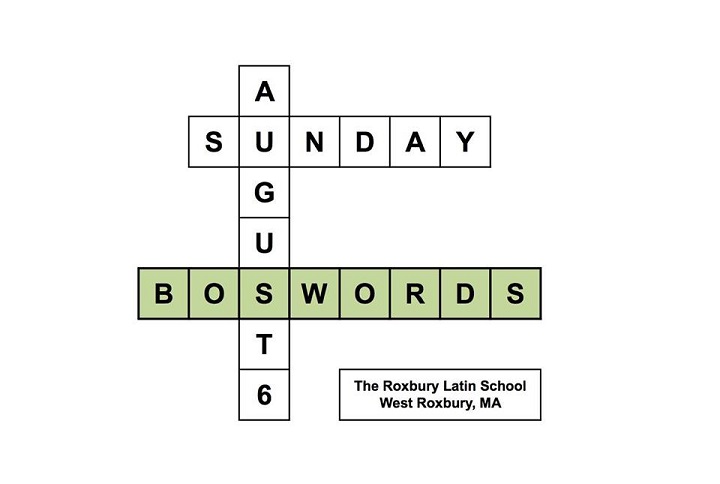
The first is a newcomer to the crossword scene, the BosWords Tournament! Sunday, August 6, marks the inaugural event, and registration is officially open!

The format is simple. Three divisions — Expert, Amateur, and Pairs (allowing you to team up to solve) — pit their puzzly minds against clever clues and crafty constructors.

Competitors will complete four themed puzzles made by constructors Laura Braunstein, Andrew Kingsley, John Lieb, Joon Pahk, and Brendan Emmett Quigley, and then the top three solvers will take on a championship themeless by David Quarfoot.

And it’s super affordable! BosWords is asking for $20 for adults and $10 for students. That’s a steal!

You can check out their Facebook page for full details!

[Lollapuzzoola organizer and puzzle constructor Patrick Blindauer,
either counting people down or throwing puzzly gang signs.]

And, of course, it wouldn’t be summer without Lollapuzzoola! And Saturday, August 19, marks the tenth edition of the tournament!

The marvelous indie offspring of the American Crossword Puzzle Tournament, Lollapuzzoola is a favorite of both solvers and top constructors, all of whom descend upon New York City to enjoy what can only be described as “the best tournament held in New York on a Saturday in August.” (At least, that’s what they say on their website.)

The format is similar to BosWords. Competitors are placed in one of three divisions: Express (solvers with tournament experience), Local (other solvers), and Pairs.

But if you can’t make it to NYC that weekend, worry not! There’s an At-Home Division that will allow you to participate as if you were there! You’ll get your puzzles by email the day after the actual tournament for a very reasonable $15 fee!

It’s one of the highlights of the puzzle world each year, and I’m definitely looking forward to tackling the puzzles! They’re a diabolical treat each and every year! (For a full rundown of the event, check out this interview with Local Division winner and friend of the blog Patti Varol!)

Are you planning on attending BosWords, Lollapuzzoola, or solving from home? Let me know! I’d love to hear from you!


Thanks for visiting PuzzleNation Blog today! Be sure to sign up for our newsletter to stay up-to-date on everything PuzzleNation!

You can also share your pictures with us on Instagram, friend us on Facebook, check us out on TwitterPinterest, and Tumblr, and explore the always-expanding library of PuzzleNation apps and games on our website!

Our Fourth of July Deluxe Puzzle Set is Here!

Hello puzzlers and PuzzleNationers! Happy Independence Day!

And we’re celebrating the Fourth of July the way we know best: by launching a new puzzle set for the Penny Dell Crosswords App!

Our July Deluxe puzzle set just launched for both iOS and Android users, and it’s one of our best yet!

Take a break from the fireworks and barbecue to tackle this patriotic puzzle bundle, designed for any skill level!

Offering 30 easy, medium, and hard puzzles, plus 5 July-themed bonus puzzles to delight solvers of all skill levels, the July Deluxe set is just what the doctor ordered to scratch that puzzly itch!

But that’s not all!

That’s right, double down on puzzle goodness with the July Deluxe Combo! That’s 70 puzzles, including July-themed bonus crosswords for your puzzly pleasure!

But maybe you need more! If you want an explosive deal on PuzzleNation-quality crosswords, we’ve got you covered with the July Deluxe Bundle! That’s 105 puzzles, three times the terrific content and crafty cluing, loaded and ready for you to solve!

You can’t go wrong with these awesome deals! PuzzleNation is dedicated to bringing you the best puzzle-solving experience available, with world-class puzzles right in your pocket, ready to go at a moment’s notice! That’s the PuzzleNation guarantee.

Happy solving, and happy Independence Day everyone!


Thanks for visiting PuzzleNation Blog today! Be sure to sign up for our newsletter to stay up-to-date on everything PuzzleNation!

You can also share your pictures with us on Instagram, friend us on Facebook, check us out on TwitterPinterest, and Tumblr, and explore the always-expanding library of PuzzleNation apps and games on our website!
PuzzleNation Product Review: Less

lessgame

There are many games out there that pair nicely with food or drink. Many party games even revolve around this mechanic, like Jason Anarchy’s alcohol-fueled roleplaying game Drinking Quest.

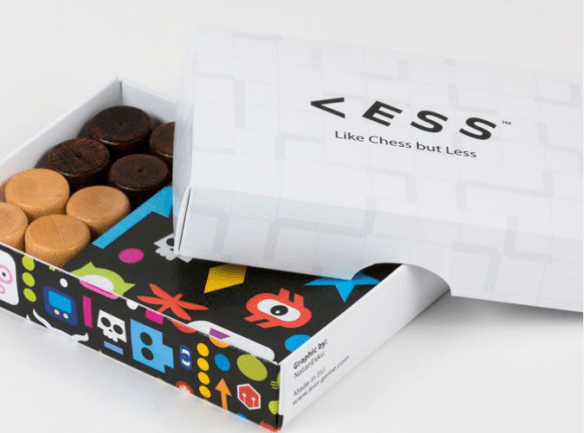
But I think Less is the first game where the playing tiles intentionally double as coasters for your drinks. It feels like a game that could be played in a tavern at a moment’s notice, which lends its minimalist style an old-world gaming charm.

less1

But I’m getting ahead of myself here. Less is a strategy game that combines the tactical planning of chess with the dynamic maneuverability of checkers.

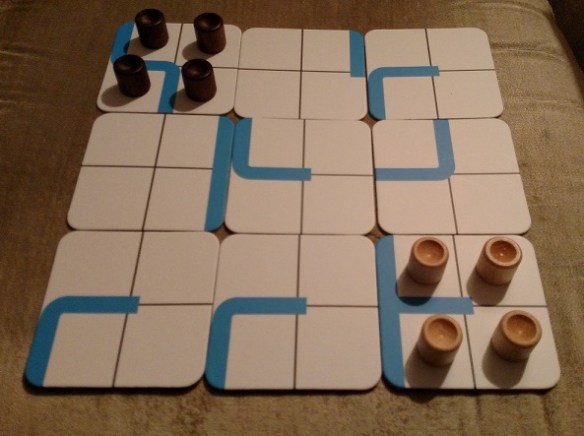
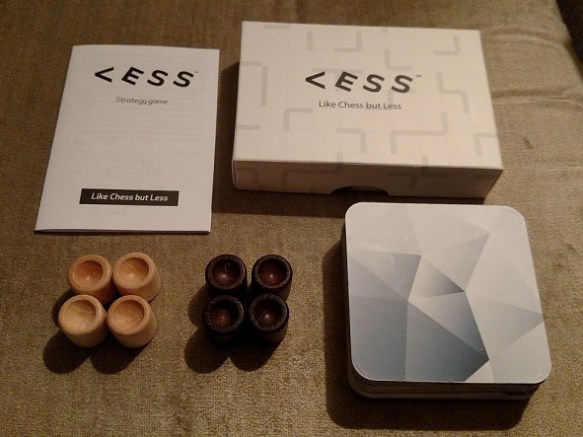
The game consists of 12 tiles and 8 game pieces, 4 white and 4 black. The players randomly select 9 of the 12 tiles and arrange a 3×3 game board. (With 12 tiles and four ways to place each tile, you’re virtually guaranteed a different game board every time you play.)

One player sets up their 4 game pieces in one corner, and the other player sets up their game pieces in the opposite corner. The goal of the game is to move all 4 of your pieces into your opponent’s corner before your opponent can occupy your corner.

less2

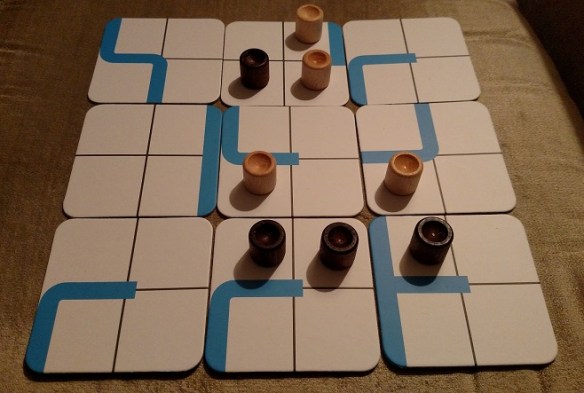
To do so, you are allowed three moves per turn. You can use all three moves for a single game piece, or spread them out over multiple game pieces. Moving a piece from one square to a neighboring square is one move. Jumping over a game piece to the next open square is also one move. (Here’s where checkers-style planning comes in handy.)

By now, you’ve probably noticed those blue walls on some of the tiles. Those walls require an extra move to traverse, so moving a game piece over a wall requires two moves. (And if neighboring squares each have a wall between them, jumping that double wall requires all three moves that turn.)

This three-move system offers players loads of options going forward, but your best bet is to arrange a sequence of leapfrog jumps to move your pieces as efficiently as possible across the board. (Unlike chess or checkers, there is no capturing or removing your opponent’s pieces from the board.)

less3

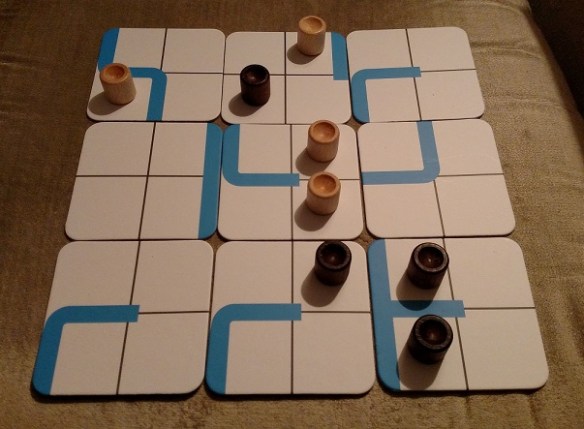
[Here, black has more pieces near the opposing corner, but that blue wall will make it harder to occupy the corner efficiently. Meanwhile, more of white’s pieces are farther away, but there are fewer obstacles to slow those pieces down.]

Mixing a tactical approach with the improvisation that comes with reacting to your opponent’s movements makes Less a very engaging gaming experience, even if a game routinely lasts less than ten minutes. And on the puzzle side of things, figuring out the most efficient way to navigate a path toward your opponent’s corner is great fun, since every game is different, and your opponent has different obstacles to tackle than you do, given the random placement of walls on the board.

Plus, if you’re willing to invest in two copies of the game, you can play with four players, as you and your partner coordinate your efforts across a 4×4 game board in the hopes of occupying your opponents’ corners first.

It’s a game that takes a few minutes to learn and offers near-infinite replayability. It might be called Less, but it feels like a very complete, very satisfying challenge.

less4

Less is published by InventedFor and is available online at less-game.com (with numerous coaster designs for the reverse side of the tiles). Click here for full details.


Thanks for visiting PuzzleNation Blog today! Be sure to sign up for our newsletter to stay up-to-date on everything PuzzleNation!

You can also share your pictures with us on Instagram, friend us on Facebook, check us out on Twitter, Pinterest, and Tumblr, and explore the always-expanding library of PuzzleNation apps and games on our website!