PN Trivia Scavenger Hunt: Answers & Winner!

[Image courtesy of Alaris Health.]

Thank you to everyone who entered our anniversary trivia scavenger hunt! Plenty of solvers, puzzlers, and PuzzleNationers tried their hand at answering all five questions before the deadline at midnight on Wednesday, and many succeeded!

Alas, there can be only one winner. But before we get to that, let’s look at the answers, shall we?


PuzzleNation Anniversary Trivia Scavenger Hunt

1.) One of my favorite recurring features is Puzzles in Pop Culture, where I explore puzzly moments in television, film, and literature. We’ve discussed Sherlock, Hell’s Kitchen, and even Gilmore Girls in installments of Puzzles in Pop Culture.

Question: How do you solve the four gallons of water puzzle?

Answer: There were actually two answers featured in the August 19, 2014 post “Puzzles in Pop Culture: Die Hard with a Vengeance” referenced in this question. Here’s the answer our winner submitted:

1. Fill the 3-gallon jug and pour the water into the 5-gallon jug.
2. Refill the 3-gallon jug and pour the water into the 5-gallon jug until the 5-gallon jug is full, leaving 1 gallon in the 3-gallon jug.
3. Empty the 5-gallon jug and pour the 1 gallon of water from the 3-gallon jug into the 5-gallon jug.
4. Fill the 3-gallon jug again and empty it into the 5-gallon jug, leaving exactly 4 gallons in the 5-gallon jug.


2.) You can’t talk about puzzles without also discussing games, because there’s so much overlap between the two. Game reviews from a puzzle solver’s perspective have become a part of the fabric of PuzzleNation Blog, as has creating your own puzzles and games from scratch.

Question: What’s the name of the DIY game that only requires a bunch of identical blank pieces of paper (like index cards) and something to write with?

Answer: Discussed in our September 15, 2015 post “DIY Pencil and Paper Puzzles,” this game is known as 1000 Blank White Cards.


3.) Naturally, if you’re going to talk puzzles, Sudoku is going to be part of the conversation sooner rather than later. We’ve not only explored the history of Sudoku here, but we’ve been a part of it, debuting brand-new Sudoku variants created by topnotch constructors.

Question: What do you call two overlapping Samurai Sudoku?

Answer: We posted many different Sudoku variants in our December 4, 2014 post “The Wide World of Sudoku,” but the puzzle in question is known as Shogun Sudoku.


4.) A fair amount of puzzle history, both past and present, has been covered here over the last five years. We’ve examined cryptography in the American Revolution, the Civil War, both World Wars, and beyond. We’ve celebrated the one-hundredth anniversary of the crossword. And we’ve even discussed scandals in the puzzle world.

Question: What are the names of the programmer and crossword constructor who first uncovered the curious pattern of puzzle repetition in USA Today and Universal Uclick puzzles that eventually led to the ouster of Timothy Parker?

Answer: As discussed in a series of posts entitled “Puzzle Plagiarism,” the programmer’s name is Saul Pwanson and the constructor’s name is Ben Tausig.


5.) In the Internet age, memes and fads appear and disappear faster than ever. A picture or a joke or a news story can sweep the world in a matter of hours, and then vanish forever. On a few occasions, the Internet has become obsessed with certain optical illusions, and we’ve done our best to analyze them from a puzzler’s perspective.

Question: The creators of The Dress appeared on what talk show to put the mystery to bed once and for all?

Answer: Discussed on March 6, 2015 in a Follow-Up Friday post, the mystery of The Dress was laid to rest on The Ellen DeGeneres Show.


[Image courtesy of ClipArt Panda.]

And now, without any further ado, we’d like to congratulate our winner, who shall remain nameless. After all, like a lottery winner, she doesn’t want to be mobbed by those hoping for a piece of the action. =)

She’ll be receiving her choice of either a Penny Dell Crosswords App puzzle set download OR a copy of one of the puzzle games we’ve reviewed this year!

Thank again to everyone for playing and for celebrating five years of PuzzleNation Blog with us. We truly could not have done it without you!


Thanks for visiting PuzzleNation Blog today! Be sure to sign up for our newsletter to stay up-to-date on everything PuzzleNation!

You can also share your pictures with us on Instagram, friend us on Facebook, check us out on TwitterPinterest, and Tumblr, and explore the always-expanding library of PuzzleNation apps and games on our website!

PuzzleNation Product Review: Nanofictionary

[Note: I received a free copy of this product in exchange for a fair, unbiased review. Due diligence, full disclosure, and all that.]

We’re used to puzzles where you have to combine pieces to reveal a picture, or you use clues to complete a grid, or you employ deduction to unravel a series of events. It’s far less common for puzzlers to put those skills to use telling a story.

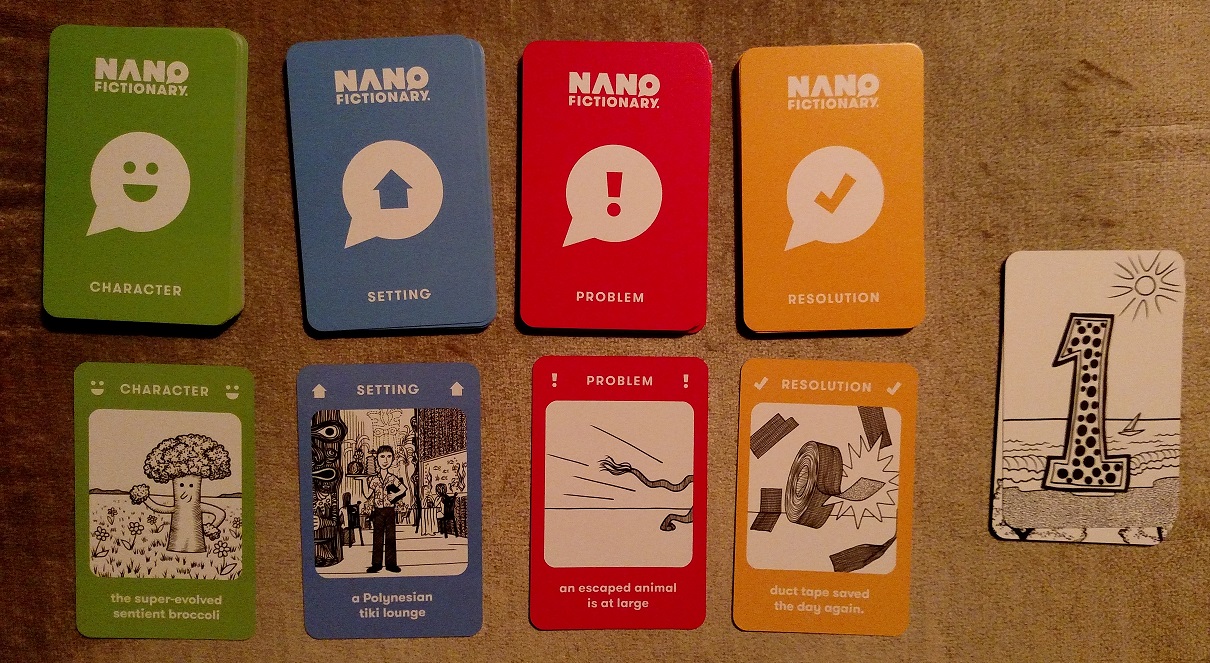
The latest offering from the crafty crew at Looney Labs challenges players to do precisely that: tell a story. More specifically, Nanofictionary tasks you with telling the best story possible from the ingredients available.

And you better do it quickly. Imagine you’re pitching a movie and you’ve only got the length of an elevator ride to sell it to a producer.

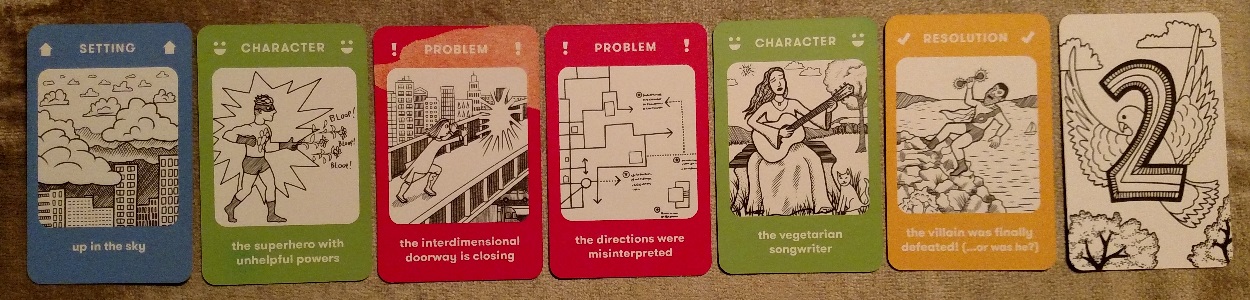
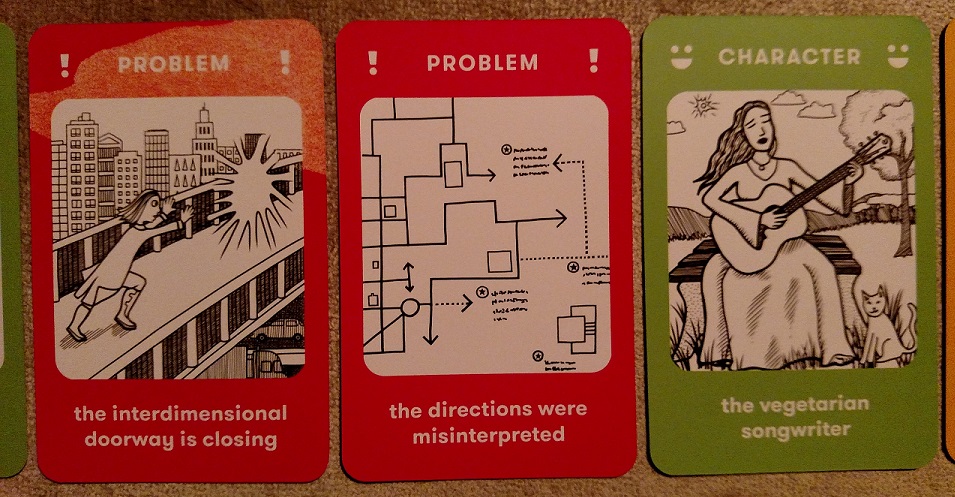
Nanofictionary offers up to six players a selection of four decks of cards: characters, settings, problems, and resolutions. Each player draws a starting hand, consisting of two characters, one setting, one problem, and one resolution. Players then try to build an entertaining narrative from the options at hand, by drawing and discarding cards, before declaring themselves ready to pitch.

Here is the first element of strategy in the game: deciding when you’re ready to present your story. If you do so quickly, you secure an earlier slot than the other players. Although this means other players can add additional cards to their hands (and thereby enhance their stories), it also means that ties are settled in favor of players who readied their stories faster. It’s a tradeoff, more cards in the short term vs. a tactical advantage in the long term.

After everyone has assembled their stories, each player has a turn performing their elevator pitch, doing so in the order in which they declared themselves ready. After all the stories are shared, the players then vote for their favorite story. (Naturally, to prevent every player from doing so, you cannot vote for yourself.)

Nanofictionary is an intriguing mix of strategy, luck, and ingenuity. The strategy involves not only when to declare your story ready, but what choices you make to get there. Do you choose the unexpected new card on your turn, or rifle through the cards discarded by the other players? Do you wait for a few other players to declare their stories ready, allowing yourself access to more cards in your hand, or do you go for the tie-breaking advantage you might need?

Luck, of course, comes into play with the cards you randomly draw. Perhaps you’ll end up with elements that quickly form an entertaining tale in your mind. Or perhaps you’ll struggle to ditch the pieces that don’t inspire you, hoping to trade them for a more exciting setting or a problem that makes the most of the characters in your hand.

But, as you might expect, the ingenuity side is where the game comes alive. Just sitting back and watching these delightfully brief (and yet hilariously detailed) stories come to life is a real treat, and quite honestly, it makes the voting aspect so hard. Because with the right group of players, virtually any combination of cards can turn into gold with the right storyteller.

The designers fit a surprising amount of variety and reusability into these four small decks of cards, allowing storytellers to run wild with tales as fantastic as they are ridiculous. It’s not your usual puzzle game, but that’s part of the charm.

Nanofictionary is available now from Looney Labs and select participating retailers for $16.


Thanks for visiting PuzzleNation Blog today! Be sure to sign up for our newsletter to stay up-to-date on everything PuzzleNation!

You can also share your pictures with us on Instagram, friend us on Facebook, check us out on TwitterPinterest, and Tumblr, and explore the always-expanding library of PuzzleNation apps and games on our website!
Get Into the Puzzly Swing of Things with Swinger!

Puzzles are infinitely adaptable. They’ve gone from riddles to pen and paper puzzles to mechanical puzzles made of wood, steel, plastic, and onward into video games, and now, apps on your phone. More puzzle apps than ever before are available on all platforms; it’s the new frontier of puzzle-games.

One of the puzzle apps that has recently been making some waves in the online market is Swinger, an addictive little puzzly delight.

In Swinger, your goal is to capture the little blue sparkling objects known as balls. To do so, you must tag them with a swinging arm that moves back and forth at your command.

Tap on one of those green rings to anchor one end of your swinger, and it will circle that ring like the spoke of a bicycle wheel. You can tap that same green ring to change direction, swinging your swinger back and forth as needed.

Navigate the ever-changing landscape of green rings to capture the balls, but be careful to avoid the obstacles that crop up over time, because they’ll block your swinger and damage your overall score.

A fun mix of quick reflexes and clever strategy, Swinger is all about adapting to your environment. Timing is key as your swinger swings toward each blue ball, before you tap another ring to move it, either to avoid one of the obstacles or to snag the next ball on the screen. You might even find yourself flipping the grid around in order to jump your swinger from one ring to another!

The concept is simple, but the gameplay grows increasingly complex with each passing screen as the obstacles become more bothersome and the swinger varies in size from ring to ring.

It’s an interesting mechanic that I haven’t seen in app form before. (For long-time video game fans, it has the feel of advanced platform games like Bionic Commando, Ratchet & Clank, or Super Mario Galaxy!)

Swinger is available from PiPiPass Studios on Google Play for Android devices.


Thanks for visiting PuzzleNation Blog today! Be sure to sign up for our newsletter to stay up-to-date on everything PuzzleNation!

You can also share your pictures with us on Instagram, friend us on Facebook, check us out on TwitterPinterest, and Tumblr, and explore the always-expanding library of PuzzleNation apps and games on our website!
A PuzzleNation Anniversary Scavenger Hunt!

[Image courtesy of ClipArt Panda.]

On Tuesday, I waxed nostalgic on the five-year anniversary of PuzzleNation Blog and all the amazing, curious, puzzly adventures we’ve shared.

So when it came time to conjure up an idea to celebrate the day in question, I wanted to do something appropriately puzzly.

And I think I’ve got it.

I have five trivia questions for you. The answers to all five have been featured in some of the most popular, most shared, most visited posts in the history of the blog.

Consider this a trivia scavenger hunt, and the blog is your realm to explore. (Though there will be clues on where to begin your search.)

Answer all five questions AND include links to the posts in which you found the answers, and you’ll be in the running to win a terrific prize in honor of our five-year bloggiversary!

So, without further ado, let’s get to it!


[Image courtesy of Alaris Health.]

PuzzleNation Anniversary Trivia Scavenger Hunt

1.) One of my favorite recurring features is Puzzles in Pop Culture, where I explore puzzly moments in television, film, and literature. We’ve discussed Sherlock, Hell’s Kitchen, and even Gilmore Girls in installments of Puzzles in Pop Culture.

Question: How do you solve the four gallons of water puzzle?

2.) You can’t talk about puzzles without also discussing games, because there’s so much overlap between the two. Game reviews from a puzzle solver’s perspective have become a part of the fabric of PuzzleNation Blog, as has creating your own puzzles and games from scratch.

Question: What’s the name of the DIY game that only requires a bunch of identical blank pieces of paper (like index cards) and something to write with?

3.) Naturally, if you’re going to talk puzzles, Sudoku is going to be part of the conversation sooner rather than later. We’ve not only explored the history of Sudoku here, but we’ve been a part of it, debuting brand-new Sudoku variants created by topnotch constructors.

Question: What do you call two overlapping Samurai Sudoku?

4.) A fair amount of puzzle history, both past and present, has been covered here over the last five years. We’ve examined cryptography in the American Revolution, the Civil War, both World Wars, and beyond. We’ve celebrated the one-hundredth anniversary of the crossword. And we’ve even discussed scandals in the puzzle world.

Question: What are the names of the programmer and crossword constructor who first uncovered the curious pattern of puzzle repetition in USA Today and Universal Uclick puzzles that eventually led to the ouster of Timothy Parker?

5.) In the Internet age, memes and fads appear and disappear faster than ever. A picture or a joke or a news story can sweep the world in a matter of hours, and then vanish forever. On a few occasions, the Internet has become obsessed with certain optical illusions, and we’ve done our best to analyze them from a puzzler’s perspective.

Question: The creators of The Dress appeared on what talk show to put the mystery to bed once and for all?


Our Trivia Scavenger Hunt will run until midnight EST next Wednesday, August 23rd. You can submit your answers (plus links) in the comment section here, or contact us on any of our social media platforms: Facebook, Twitter, Instagram, wherever!

Good luck, and happy puzzling!


Thanks for visiting PuzzleNation Blog today! Be sure to sign up for our newsletter to stay up-to-date on everything PuzzleNation!

You can also share your pictures with us on Instagram, friend us on Facebook, check us out on TwitterPinterest, and Tumblr, and explore the always-expanding library of PuzzleNation apps and games on our website!
5 Years of PuzzleNation Blog!

This week, we’re celebrating five years of PuzzleNation Blog.

That’s kind of amazing to me. Five years. Almost seven hundred and fifty posts I’ve written here.

I’ve unraveled brain teasers and explained pop culture references. I’ve accepted the challenges of fellow puzzlers and foreign governments alike. I’ve delved into history and tried to predict the future. I’ve celebrated the 100th anniversary of the crossword puzzle, and learned more about them than I ever could have imagined.

I’ve had the privilege of announcing new puzzles for the first time ever. I’ve gone to crossword tournaments and conventions, I’ve interviewed all sorts of amazing, creative people. I’ve spread the word about brilliant puzzles, fantastic games, and numerous worthy causes and crowdfunding efforts. I’ve even reported on important news in the puzzle-game industry.

During my time as a puzzler, I’ve seen puzzles leap from pen-and-paper to apps in your pocket. I’ve seen Sudoku rise up and sweep across the globe as a genuine cultural phenomenon.

I’ve engaged in scavenger hunts that crossed oceans and tried to crack riddles from the past. I’ve wondered what the next century holds for crosswords, and if we’ll ever run out of Sudoku.

When I pushed for PuzzleNation to start a puzzle blog, my goal was to create a place that would become a hub for all things puzzly. Yes, obviously, I wanted to recruit users for our puzzle apps and sell puzzle sets galore, but I also wanted to play a role in building and contributing to the puzzle-game community.

Puzzlers come from all walks of life. They like all sorts of puzzles, from mechanical brain teasers to pen-and-paper classics. Some channel their puzzly energies into art, or music, or games. Some seek ever-more-challenging conundrums to solve. And some just enjoy a fun little puzzle in their pocket during a cup of coffee.

I’m proud to have welcomed all of them to PN Blog as fellow puzzlers and PuzzleNationers. It’s been a blast, and I have no doubt it will continue to challenge and engage me for years to come.

Thanks for taking this ride with us. Happy puzzling, friends.

And stay tuned. We’ve got something fun and festive in store for you Thursday to celebrate. =)


Thanks for visiting PuzzleNation Blog today! Be sure to sign up for our newsletter to stay up-to-date on everything PuzzleNation!

You can also share your pictures with us on Instagram, friend us on Facebook, check us out on TwitterPinterest, and Tumblr, and explore the always-expanding library of PuzzleNation apps and games on our website!

PuzzleNation Product Review: Color Cube Sudoku

[Note: I received a free copy of this product in exchange for a fair, unbiased review. Due diligence, full disclosure, and all that.]

Sudoku is one of the most popular pen-and-paper puzzles in the world. It’s found in numerous daily newspapers, puzzle books, and smartphone apps.

After years of tackling regular Sudoku, Extreme Sudoku, Word Sudoku, Mega Sudoku, Samurai Sudoku, Geometric Sudoku, Sum-Doku, and numerous other variations, you’d think the puzzle community at large would’ve exhausted every possible version of Sudoku.

Enter the crafty folks at ThinkFun, who have put a unique spin on another Sudoku variant: Color Sudoku. In Color Sudoku, you have nine colors to arrange instead of numbers.

ThinkFun has upped the ante with Color Cube Sudoku, their latest puzzle-game, by combining the twisty-turny cube possibilities of a Rubik’s Cube with Sudoku-style deductive solving.

It seems like a simple enough set-up. You’ve got a tray and nine multi-colored cubes. Each cube has four of the six possible colors: green, red, blue, yellow, orange, and white. And it’s up to you to arrange the nine cubes in the grid in a 3×3 pattern so that each color only appears once in each row and column.

But that arrangement already introduces complications. Unlike a pen-and-paper puzzle, where you can place any number (or in this case, any color) in any square you choose, the preset color arrangements on each cube limit your choices.

If you need a blue square in the first row, sixth column, given the cubes available to you, you might end up with a second yellow square in your row. Which means, instead of needing a new cube, you need to change one of the cubes you’ve already placed and try again.

What once seemed simple now offers a greater challenge.

But, like many ThinkFun puzzle-games, the more you play around with the possibilities, the more you begin developing new strategies and get into the psychology of the puzzle itself.

Once you’ve placed a few of the cubes, next-level deductive reasoning kicks in, and you can eliminate certain possibilities and begin working more than one step ahead at a time.

For instance, if you’ve placed two cubes in a column, you’ll know you need to change one of the cubes if the third cube will need a green spot in both columns. Since that’s impossible, even without placing the third cube, you know you need to change one of the two you’ve already placed. Which means you’re preventing wasted moves and pushing closer to an actual solution.

Whether you’re tackling Color Cube Sudoku alone or with partners, whether you’re trying to crack a regular 6×6 pattern or taking a whack at some of the variant challenges they suggest — like knight’s paths and other difficult patterns — this is a deduction puzzle that feels like play instead of work.

When I tested this out with a fellow puzzler, we immediately began playing it in a slightly more competitive way. One of us would place a cube, and then the other would place a cube, and we would keep going until no cube could be placed.

You can end the game there, or you can take it a step further, and introduce rules where moving or shifting previously-placed cubes becomes part of the game in order to extend the puzzly gameplay. Heck, if you go long enough, it eventually becomes a race to see who can actually solve the Color Cube Sudoku layout first!

The designers state that there are 2,641,807,540,224 different ways to arrange the 9 cubes, and with seemingly endless variation in such a simple set-up, this is one puzzle-game you can put down and return to numerous times without burning out or feeling like you’ve conquered it forever.

Color Cube Sudoku is available for $19.99 from ThinkFun and select retailers!


Thanks for visiting PuzzleNation Blog today! Be sure to sign up for our newsletter to stay up-to-date on everything PuzzleNation!

You can also share your pictures with us on Instagram, friend us on Facebook, check us out on TwitterPinterest, and Tumblr, and explore the always-expanding library of PuzzleNation apps and games on our website!