What Are Your Board Game House Rules?

house-rules

[Image courtesy of Bell of Lost Souls.]

Many board games are meticulously designed, every aspect playtested dozens if not hundreds of times to ensure the optimal play experience no matter what choices the players make, how the dice roll, or how the various game mechanics interact.

But, of course, any game that becomes a household favorite is bound to be played so often that new rules and styles of play emerge. Maybe they’re designed to even the playing field for new or younger players. Maybe they’re designed to extend the gameplay time. Maybe they’re designed to inject new life into a game that has lost some of its sparkle.

We call these modifications “house rules,” and virtually every household has them, for one game or another.

There’s arguably no game that’s subject to more house rules than Monopoly.

Did you grow up with the rule that all fees and fines collected go in the center of the board, and are then collected by the first player to land on Free Parking? I certainly did. (And interestingly, studies have shown that this house rule lengthens an already long game experience, rather than shortening it or evening the playing field, potentially making the game worse.)

Maybe you get a bonus if you land directly on Go. Maybe your assets are frozen when you’re in jail and you can’t collect any rent money you earn. Maybe you allow the utilities to collect 5% of any player-to-player transactions over $200. But certainly, there’s at least one variant rule that your family considers standard.

(Monopoly once held a contest where players submitted house rules and five of them were added to a special House Rules edition of the game.)

The best house rule for Monopoly I’ve encountered is called “the mugging rule.” If someone lands on a space that is currently occupied, that player can choose to mug the player already there. They take turns rolling the dice, and if the mugger rolls higher, they steal $100. If the person being mugged rolls higher, the mugger goes to jail.

unocards

Another game rife with house rules is Uno.

Back in 2019, I wrote a post about the official Uno Twitter account declaring that you cannot stack Draw 2 or Draw 4 cards.

It turns out, one of the most famous rules in Uno is a house rule. An incredibly common one, to be sure, but not standard at all.

And there are a host of other house rules in Uno. Playing a Zero card rotates everyone’s hands in the direction of play. So if the game is going left, you hand your cards to the player on your left and receive the hand from the player on your right.

Playing a 7 allows you to swap hands with the player of your choice.

Instead of drawing a single card if you can’t play, some households require you to keep drawing until you can play a card. Which would cause your hand to balloon quickly!

The crew at No Rolls Barred tried out a classic rules Uno game versus an all-house rule game, and a single round of the house rules game lasted nearly an hour!

HiveMind

[Image courtesy of The Board Game Family.]

Naturally, our in-office game group has all sorts of house rules we’ve added to games we play frequently.

My favorite is probably the bonus rule we added to Hive Mind.

Hive Mind is kind of like Scattergories, where you have a given topic and you’re trying to write an answer down for it. But instead of being unique, your goal is to match as many other players as possible.

Unfortunately, sometimes that doesn’t work out, and if you have a knack for not matching players — like I do — then our house rule comes in handy.

Everyone votes on their favorite answer that didn’t match anyone, and that person gets bonus points. It’s rarely enough to tip the scales entirely, but it often ensures that players last longer, and in Hive Mind, that’s always a plus.

stack of games

[Image courtesy of StoreMyBoardGames.com.]

What are some of your favorite board game house rules, fellow puzzlers and PuzzleNationers?

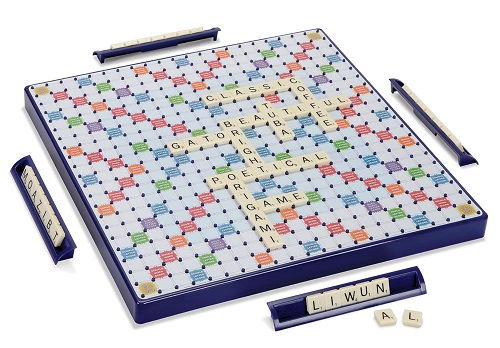
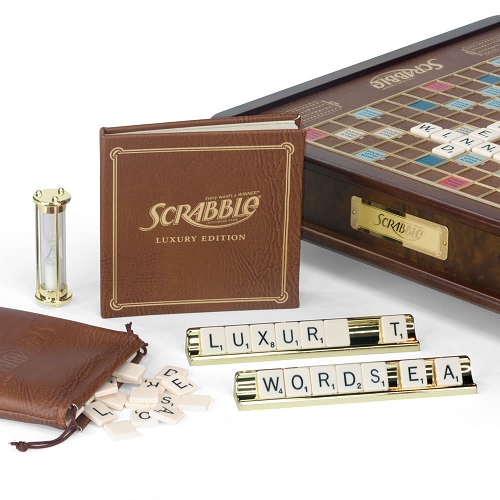
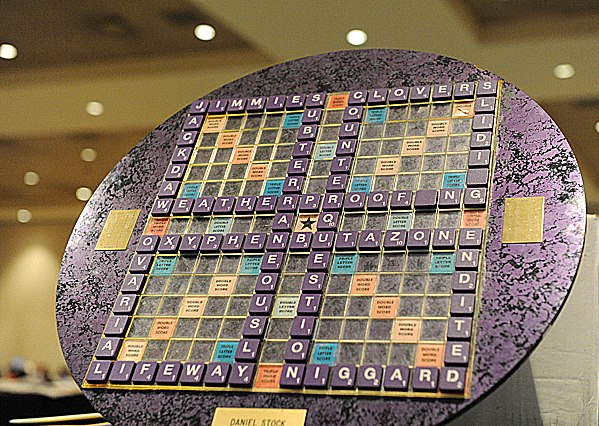
Do you let the person who can make the longest word go first in Scrabble, ensuring lots of places to add letters? Do you try to chase the killer down in Clue after they’re revealed?

Let us know in the comments section below! We’d love to hear from you.


Thanks for visiting PuzzleNation Blog today! Be sure to sign up for our newsletter to stay up-to-date on everything PuzzleNation!

You can also share your pictures with us on Instagram, friend us on Facebook, check us out on TwitterPinterest, and Tumblr, and explore the always-expanding library of PuzzleNation apps and games on our website!

PuzzleNation Product Review: ThinkFun’s Block Chain

block chain intro

[Note: I received a free copy of this game in exchange for a fair, unbiased review. Due diligence, full disclosure, and all that.]

Mechanical brain teasers can be incredibly complex, requiring many steps all taken in a particular order to achieve a goal. They can be devious, hiding components from sight and forcing you to deduce or luck your way into maneuvering the brain teaser in a certain fashion or from a certain angle.

But they can also be fairly simple in design and still retain a level of challenge and difficulty that makes the a-ha moment when you solve it just as sweet.

One of the traits that most ThinkFun puzzles or brain teasers have is accessibility. There’s nothing hidden from the solver. What you see is what you get, even if the path forward isn’t exactly clear.

The only thing that separates success from failure with a ThinkFun brain teaser is patience and puzzly skill. From age 8 to age 80, everyone starts on the same playing field.

block chain 2

This is exemplified by their latest brain teaser, Block Chain.

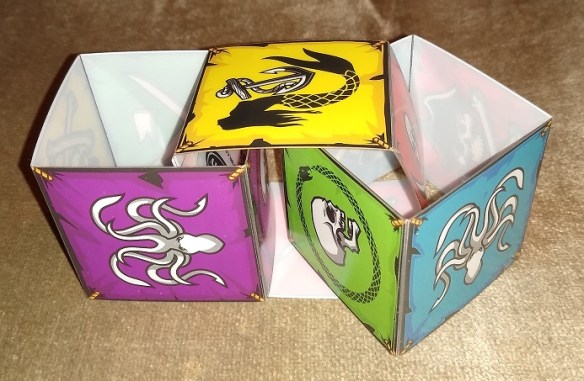
The concept is simple. You have three linked four-sided blocks. You can rotate each one independently of each other to show different faces.

block chain 3

You can also tilt the outside blocks in the chain up or down so that they slide over the center block, or swing the outside blocks so that they slide into the center block.

block chain 4

By swinging one block in and tilting the other block over, you create a single cube with different images on each face. Your job is to spin, swing, tilt, and tinker with each block chain until you form a cube that fulfills a certain condition.

And each package contains three different challenges for solvers to tackle.

block chain 1

One simply requires you to make all six sides match to fit one of two possible themes. For instance, this pirate-themed one could be all gold coin patterned, or all treasure chest patterned, depending on which side you twisted, swapped, and slid into place. So there’s two puzzles here, one on each side.

The second follows a more Rubik’s Cube-style solve style, as you have to manipulate the block chain so that a different color appears on every side of the cube.

The third involves multiple paths on each four-sided block, so you have to twist and maneuver the blocks so that the paths line up properly along each edge where the paths “meet.”

This was the most difficult of the three, because the patterning required much more attention from the solver. After all, you aren’t just matching a side — like the colored or themed ones — so the positioning of each block in the chain is more exact and deliberate than it is for the other cubes.

robot 1

Block Chain brain teaser sets come in different themes — pirate, robot, and unicorn, for instance — adding a really fun visual aesthetic to what could be a fairly bland-looking puzzle. And their relative simplicity helps them serve as marvelous introductory puzzles for new solvers.

Although older solvers will blow through these fairly quickly, I definitely found myself returning to them more than once, enjoying the simple tactile joys of maneuvering the blocks around and over each other to make different shapes. They’re essentially a puzzly little fidget cube you can idly toy with as you solve!

Once again, ThinkFun has managed to walk that tightrope and balance simplicity of design with satisfying solving to create a delightful puzzling experience. Block Chain brain teasers have already become a welcome addition to my desk, keeping my hands occupied while I puzzle over the day’s obstacles.

[Block Chain costs $10.99 and is available through ThinkFun and Amazon.]

unicorn 1


Thanks for visiting PuzzleNation Blog today! Be sure to sign up for our newsletter to stay up-to-date on everything PuzzleNation!

You can also share your pictures with us on Instagram, friend us on Facebook, check us out on TwitterPinterest, and Tumblr, and explore the always-expanding library of PuzzleNation apps and games on our website!

A Video Game Puzzle That Baffled People Twice, Thirty Years Apart

confused

In the past, we’ve discussed the topic of intuitive puzzles vs. non-intuitive puzzles.

Non-intuitive puzzles used to be the bane of many video game fans — so much so that they spawned an infamous trope, That One Puzzle, describing a puzzle with a solution so utterly non-intuitive that it bordered on the nonsensical. One of the most infamous came from the Monkey Island series, where you needed a wrench, but instead of just finding one, you had to hypnotize a monkey with a banana on a metronome and use IT as your monkey wrench.

See what I mean about nonsensical?

These days you’re more likely to encounter a non-intuitive puzzle in an escape room or other physical puzzly activity than a video game.

But today, we have a doozy of an example for you. This non-intuitive puzzle managed to baffle people twice… thirty years apart.

2209927-nes_startropics

StarTropics was a video game released for the 8-bit Nintendo Entertainment System in 1990. It featured a protagonist named Mike, who was visiting his scientist uncle in the South Seas. Mike wielded a yo-yo and had to search for his missing uncle, eventually exploring the island, the ocean, and outerspace along the way.

The game became famous for a non-intuitive puzzle that baffled many players. At one point in the game, you needed to find a three-digit code to utilize a transceiver your uncle had in his shoe. The only clue was “dip my note in water.”

But there was no way to do this in-game.

The solution was simple, but eluded many players because it wasn’t in-game. It was something the players actually had to do.

You see, there was a physical letter from the uncle included with the instruction manual to the game. That was the note you had to dip in water to reveal the three-digit code.

startropicscode-featured-1200x900

So, yes, the game did tell you what to do, but it’s not intuitive because at no other point in the game do you have to do something outside the diegetic space of the game. It’s not like you need to jump up and down to make your character jump.

This sort of fourth wall breaking puzzling can certainly add to the gameplay, but it’s also very confusing for players not familiar with the concept.

For instance, more than one escape room game I’ve encountered outwitted and baffled some players by utilizing images on the game box itself (or even the bar code) as part of a puzzle. Since this is “outside” what the player has been told is part of the game — the components inside the box — this is clever, but also unexpected. (An entire video game, File://maniac, was built around this concept.)

That puzzle was confusing enough for players, but it got worse almost thirty years later.

In 2019, the game was ported over to the Nintendo Switch, the latest Nintendo console, allowing a new generation of gamers to rediscover this cult-classic 8-bit adventure.

startropics-nes-105

Except they forgot about the puzzle and the letter and the dipping into water thing.

So there was literally no way for new players to solve the puzzle, because there was no letter included with the instructions.

This wasn’t the first time StarTropics had been ported over to a new console. But it was the first time they forgot to do something to help players with the letter puzzle. Often, it was a digital copy of the letter, complete with an animation of it being “dipped” into water and revealing the code.

But the Switch version didn’t have that.

So players were stuck.

There’s creating a really non-intuitive outside-the-box puzzle, and then there’s breaking the game entirely by removing the only clue to the solution.

So yeah, StarTropics. A charming game, but baffling in all the wrong ways… twice… thirty years apart.


Thanks for visiting PuzzleNation Blog today! Be sure to sign up for our newsletter to stay up-to-date on everything PuzzleNation!

You can also share your pictures with us on Instagram, friend us on Facebook, check us out on TwitterPinterest, and Tumblr, and explore the always-expanding library of PuzzleNation apps and games on our website!
A Delicious New Twist on Rubik’s Famous Cube?

Rubik’s Cube solving has come a long way since Erno Rubik built his prototype out of wood in 1974.

Top solvers are so fast that they need specially designed cubes that spin fast enough to match their fingers. We’ve seen them solved blindfolded, underwater, while being juggled, and during a skydive.

We’ve chronicled dozens of variations on the classic model, covering everything from larger cubes (4×4, 5×5, even 17×17!) to different shapes like spheres, pyramids, and dodecahedrons.

Heck, with the 3-D printing revolution, people are designing and making their own Rubik’s Cube-style twisty puzzles from the comfort of home!

Still, every once in a while, the thought crosses my mind that I’ve probably seen everything that people can do with Rubik’s Cubes, short of one being solved during a spacewalk or on the moon.

And then someone goes and invents a Rubik’s Cube that looks like Maruchan instant noodles.

megahouse rubik

Yes, say hello to the Midori no Tanuki twisty puzzle.

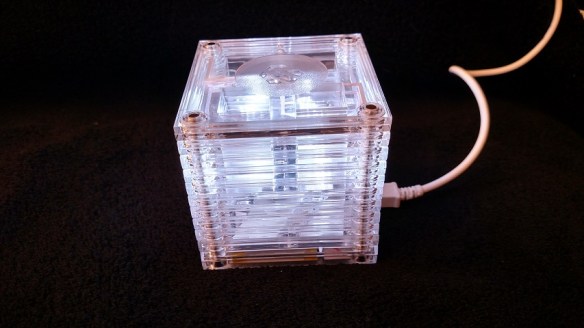
What appears to be a traditional package of Maruchan Midori no Tanuki instant soba noodles is instead one of the fiendish Rubik’s-style puzzles ever devised.

midori-no-tanuki-rubiks-cube-instant-noodles-japan-soba-puzzle-3

It works like a standard Rubik’s Cube — a 3×3 twistable cube — but five of the six sides are based on a 3D scan of noodles. Only the top is distinguished by a tempura disk “atop” the noodles.

You would think this would make solving it easier. After all, who cares what the five virtually identical sides look like as long as you can arrange the pieces of the tempura disk on top?

midori-no-tanuki-rubiks-cube-instant-noodles-japan-soba-puzzle-1

But apparently, that’s not the case at all. There is only one arrangement of this six-sided cube that allows for the tempura disk to be properly formed. So you don’t have five sides you can disregard. Instead, you’re essentially solving five sides blindfolded while focusing on the top one.

That sounds like a challenge worthy of modern Rubik’s Cube solvers. Hopefully we start seeing reports of folks tackling this daunting brain teaser, and we can begin to get a sense of how long it takes to solve and how difficult the average puzzler would find it.

midori-no-tanuki-rubiks-cube-instant-noodles-japan-soba-puzzle-5

All we know for now is that we’re not supposed to pour water on it, no matter how delicious it looks.

What do you think, fellow puzzlers? Would you accept the challenge of the Midori no Tanuki puzzle? Is it really as difficult as reported, or do you think it’s just a lot of hype to sell a puzzle? Let us know your thoughts in the comments section below! We’d love to hear from you.


Thanks for visiting PuzzleNation Blog today! Be sure to sign up for our newsletter to stay up-to-date on everything PuzzleNation!

You can also share your pictures with us on Instagram, friend us on Facebook, check us out on TwitterPinterest, and Tumblr, and explore the always-expanding library of PuzzleNation apps and games on our website!
It Was His Sister, In the Living Room, With the…

We’re one week into 2021, but if you’ll indulge me for a moment, I’d like to share one last bit of puzzle fun from 2020.

Every household has their holiday traditions. Maybe it’s who you see on Christmas Eve or who puts the star on the tree, who lights the first candle on the menorah or who says grace at the dinner table.

It’s no different when it comes to puzzly holiday traditions. One friend challenges his kids to a puzzle hunt Christmas morning before they open their gifts. Another couple I know gives each other games for Christmas, and then invites certain friends over that evening for a holiday game night. (Naturally, this year, they did so over Zoom.)

I recently stumbled across another puzzle/game-fueled holiday tradition and I wanted to share the story with my fellow PuzzleNationers.

One Christmas, six years ago, a young man received a candlestick from his sister as one of his gifts. It was in a black box with a purple ribbon. He was very confused. He didn’t understand this gift at all.

The next year, he received another strange gift: a spool of rope.

And so it went each year. Another Christmas, another strange gift.

He soon cottoned on to the pattern, though, and began to look forward to each year’s new offering.

This year, she completed the set for him:

Yes, every Christmas, his sister got him one of the weapons from Clue, a favorite movie from their childhood, inspired by the classic board game Clue/Cluedo. Pictured above are the gifts in order, from the candlestick first to the revolver last.

One can’t help but wonder what their parents thought when the pipe, the knife, or the revolver arrived. But hey, maybe they’re Clue enthusiasts as well.

A lot of people plan ahead for Christmas. But planning ahead for six years? Now that’s puzzly commitment.


Thanks for visiting PuzzleNation Blog today! Be sure to sign up for our newsletter to stay up-to-date on everything PuzzleNation!

You can also share your pictures with us on Instagram, friend us on Facebook, check us out on TwitterPinterest, and Tumblr, and explore the always-expanding library of PuzzleNation apps and games on our website!
Looking Forward to the Year in Puzzles and Games!

We spent this week looking back on the year that was 2020, celebrating the resilience, innovation, creativity, and kindness that makes the puzzle community so unique and remarkable.

But today, on the first day of 2021, it feels appropriate to turn our gazes forward instead of back, looking ahead for what’s to come.

And for our fellow puzzlers and PuzzleNationers, there are already exciting developments awaiting us all in the new year.


If you didn’t participate in either the Boswords crossword tournament or the Boswords 2020 Fall Themeless League last year, you might not have heard about this yet, but the intrepid puzzlers from Boswords are already launching their next solve-from-home puzzly endeavor…

The Winter Wondersolve.

On Sunday, January 31st, participants will have four puzzles awaiting them — three themed crosswords and a themeless — designed by top-notch constructors.

Registration opens tomorrow, so be sure to visit Boswords.org for all the details!

(And that’s not all! They’ve also announced a Spring Themeless League, a date for their traditional summer tournament, and the return of the Fall Themeless League later in the year! That’s loads of puzzly goodness to look forward to!)


acptlogo

Speaking of crosswords and tournaments…

After being forced to postpone and then cancel the 2020 edition of the American Crossword Puzzle Tournament outright, Will Shortz and the tournament’s organizers announced the following a few days ago:

In most years, registration for the American Crossword Puzzle Tournament opens on January 1. This year, though, we’re going to wait to see how the fight against the pandemic goes before deciding how to proceed.

Our hope is that, with widespread vaccinations, enough people will feel safe in attending an in-person crossword event in April to have it be worthwhile. We won’t know about that for some time.

Whatever happens, in-person or not, we’re planning at least a major online crossword event in April. We hope you’ll take part in some form.

Whether this means an in-person event — which seems optimistic — or a sequel to last year’s Crossword Tournament From Your Couch, we cannot say. But we will certainly keep you posted on any and all updates.


But it’s not just the world of puzzles that will be celebrating and finding new ways to bring fans together in 2021. The folks at Looney Labs will be marking their twenty-fifth year on the calendar in 2021. Yes, twenty-five years of Looney Labs and twenty-five years of Fluxx!

To mark the occasion, Looney Labs has a plethora of events and promotions planned throughout the year. There is a limited run of special anniversary cards and copies of a miniature version of Fluxx available with web store purchases, plus new game releases planned and much more!

The team at Looney Labs is also welcoming fans like never before with a series of one-of-a-kind Zoom experiences for game enthusiasts. You can purchase tickets for these Silver Jubilee events to play games virtually with the game designers and crew from Looney Labs! There are tutorials, full game sessions, previews of new games, and more planned for each one!

Tickets for the first Silver Jubilee event go on sale at their online store at noon Eastern on Tuesday, January 5th, and there will be more throughout the year!


The year is barely a day old and there’s already so much to look forward to!

We have also heard that some of our favorite constructors will be releasing new puzzle books in the coming weeks and months.

When you factor in all of the puzzles we can expect in major and independent outlets throughout the year — not to mention the puzzles we’ll be producing for our own apps like Daily POP Crosswords and Daily POP Word Search — 2021 is certainly looking bright for solvers of all ages!

And we look forward to sharing in all of that puzzle-fueled fun with you, PuzzleNationers. Happy puzzling!


Do you know of any puzzle or game events coming in 2021 that we missed? Let us know in the comments section below. We’d love to hear from you!

Thanks for visiting PuzzleNation Blog today! Be sure to sign up for our newsletter to stay up-to-date on everything PuzzleNation!

You can also share your pictures with us on Instagram, friend us on Facebook, check us out on TwitterPinterest, and Tumblr, and explore the always-expanding library of PuzzleNation apps and games on our website!