PuzzleNation Reviews: Get Lucky and Kill Doctor Lucky

For as long as Cheapass Games has been around, they’ve been synonymous with the character Dr. Lucky. More specifically, the many, MANY times players have tried to help Dr. Lucky shuffle off the mortal coil, since the very first game produced by Cheapass Games was the award-winning Kill Doctor Lucky.

Although years have passed and rules have changed, people are still trying to kill that oddly fortunate fellow, and today, we review two puzzly games that will give you ample opportunity to try your luck at a touch of murder at Lucky Mansion.

In the Get Lucky card game, an adaptation of the original board game, two and six players are pitted against each other at a most peculiar dinner party. (The fact that everyone is trying to dispatch the host is what makes it so peculiar.)

Each player has two characters to work with. In each round, you have the choice of drawing a card, playing a card, swapping a character, or trying to kill Dr. Lucky. Drawing cards gives you the chance to acquire weapons, motives, or opportunities, all in the hopes better equipping you to commit the perfect crime.

Each card has a score that links up with one of the game’s fifteen characters. So if you’re playing Winstead Beadle (who has the number 5 on his card), any motive, weapon, or opportunity card with a 5 on it is doubly valuable to you, making it more likely that your attempt to kill Dr. Lucky will succeed!

As Dr. Lucky circulates among the various guests, you and your fellow players will continuously try to take his life, like Wile E. Coyote pursuing the Road Runner over and over again. The other players may thwart your efforts by sacrificing cards to foil your murder attempt.

This balance of active and defensive play creates a game of both strategy and opportunity, making it a terrific step up from deductive games like Clue. And the game is designed to be played in 20 minutes,

Of course, if you’re looking for something a bit more involved, you’re welcome to give the Deluxe Anniversary Edition of Kill Doctor Lucky a try.

Now, as you might expect, there are similarities between the card game Get Lucky and the board game Kill Doctor Lucky. The goal, for instance, is the same.

But in Kill Doctor Lucky, murder is a private matter. You have to eliminate Dr. Lucky without any player in sight. Another player can’t be in the same room as you and the doctor when you make your attempt, and being able to observe the murder from another room also foils your attempt. (There are even variant rules that allow for Dr. Lucky’s dog or cat to impact gameplay.) The beautiful fold-out game board really helps bring this mechanic to life.

Each turn, you can move and you can act. Moving is simply traveling throughout Lucky Mansion, whereas acting either involves drawing cards OR attempting to kill Doctor Lucky.

There are move cards (which make it easier to traverse the mansion), weapon cards (which make your murder attempts deadlier), and failure cards (which come in handy when you’re trying to prevent other players from killing Dr. Lucky before you do).

To make things even more challenging, Doctor Lucky moves after every turn, so you have to factor that into your strategy. (Some players stay where they are, allowing the good doctor to come directly to them.)

Kill Doctor Lucky builds on the streamlined rules of the card game, offering many more options for places to encounter the Doctor, greater challenge in offing the doctor, and deeper strategy in isolating Dr. Lucky and keeping lookyloos away. Plus, each failed attempt to kill him can help you later on, providing additional “reasons” for wanting the doc dead.

And in terms of presentation, the artwork is topnotch, adding so much to the ambiance and style of the game. It feels like an old-timey murder mystery full of colorful characters, except one where the murder hasn’t happened yet.

In both games, terrific gameplay is enhanced by hilarious cards (complete with snarky world-building and outrageous asides) that are all too appropriate for the macabre task at hand. Get Lucky and Kill Doctor Lucky are terrific ways to add a subversive bit of fun to your game night.

[Get Lucky is available through the Cheapass Games website and on Amazon.com. Kill Doctor Lucky is also available through the Cheapass Games website and on Amazon.com.]


Thanks for visiting PuzzleNation Blog today! Be sure to sign up for our newsletter to stay up-to-date on everything PuzzleNation!

You can also share your pictures with us on Instagram, friend us on Facebook, check us out on TwitterPinterest, and Tumblr, and explore the always-expanding library of PuzzleNation apps and games on our website!

New Sudoku App!

Oh yes, the Sudoku revolution has come to your phones and tablets! Say hello to the new Penny Dell Sudoku app, available for both iOS and Android users!

This free app is loaded with terrific Easy, Medium, Hard, and Expert puzzles from our friends at Penny Press and Dell Magazines, who have been creating Sudoku puzzles longer than anyone! (Heck, Dell Magazines was the original publisher of Sudoku, dating back to 1979!)

With four difficulty settings to choose from, this app fits solvers of every age and experience level! You’re guaranteed to find the right Sudoku puzzle for you.

Bonus features include a timer to clock your solving speed, hints to point out errors or help you when you’re stuck, and a dynamite help section to walk new solvers through cracking their first Sudoku puzzle!

And to celebrate the release of this terrific new app, we’re holding a contest!

How do you enter? Well, it couldn’t be simpler! Just click this link or the picture below to sign up for our PuzzleNation Newsletter!

Not only will you be entered into the contest to win an in-app promo code for the Penny Dell Sudoku app, but you’ll also get all of the articles, updates, and terrific bonus content from our Newsletter, delivered right to your mailbox! It’s a win-win and completely free!

This contest will run until midnight, November 24, 2016 (aka Thanksgiving night), and we’ll announce five winners the following Monday, November 28, 2016!

The new Penny Dell Sudoku app is an exciting addition to our puzzle library, and we know whether you’re an iOS user or an Android user, you’ll absolutely love it!

Happy solving, fellow puzzlers and PuzzleNationers!


Thanks for visiting PuzzleNation Blog today! Be sure to sign up for our newsletter to stay up-to-date on everything PuzzleNation!

You can also share your pictures with us on Instagram, friend us on Facebook, check us out on TwitterPinterest, and Tumblr, and explore the always-expanding library of PuzzleNation apps and games on our website!

Contest details: No purchase necessary to enter. One entry per person, please. We are not responsible for entries that are not received. Entries must be submitted by 11:59 PM on November 24, 2016. The information you provide will only be used to notify winners and be entered into the PuzzleNation newsletter email mailing list. Must be 18 to participate. If selected as winner, you must respond to notification email or phone call with mailing address to receive prize.

PuzzleNation Reviews: Linkee and Mr. Lister’s Quiz Shootout

[Note: I received free copies of these games in exchange for a fair, unbiased review. Due diligence, full disclosure, and all that.]

The folks at Bananagrams are synonymous with letter-tile games like Pears in Pairs, Zip It, and of course their flagship product, but today they’ve brought us something a little different. Instead of flashing your anagram skills or showing off your well-honed Scrabble techniques, these games will test your trivia knowledge, your ability to play well with others, and how shrewd a strategist you are.

In this post, we’ll be reviewing Linkee and Mr. Lister’s Quiz Shootout!

linkee1

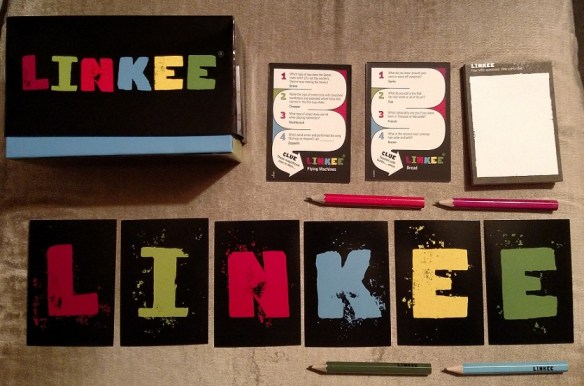
Linkee is a trivia game for three or more players. (Up to 30, apparently!) Each trivia card has a letter on the back, and the goal of the game is to acquire enough letter cards to spell “LINKEE.”

One person acts as the Question Master, while the other players (or teams, if you prefer) each grab a pencil and pad. The Question Master shows the players what letter they’re playing for, then poses each of the four questions on the card. The players write down the answers and try to figure out what theme links the four answers.

linkee-1

The first player or team to shout out “LINKEE!” and identify the link gets the letter card. You can shout out “LINKEE!” at any point, but if you’re wrong, you’re out until the next card is played. So confidence and boldness has to be tempered with strategy.

That’s what makes the game more intriguing than your average trivia game. It’s not just knowing the answers to individual trivia questions; it’s figuring out the link between them, and doing so before your opponents.

If the four answers aren’t enough for any player or team to figure out the link, the Question Master reads a clue at the bottom of the card.

linkee2

Although this can be a fun game for a few players, it really shines when you can get four teams going at once, because the shouting and competitiveness really brings out the fun of the game. (Thankfully, you don’t need to get both the yellow and green Es. That was the difference maker in one game this weekend.)

Although I’d rate the trivia as fairly easy for the average board game fan or puzzler in your household, some of it is not geared toward younger players — I doubt the 8- or 10-year-olds in your house know about the Rat Pack or Malala Yousafzai, for instance — so that’s something to consider.

Otherwise, this is the rare trivia game that’s more about speed and association than about straight-up trivia knowledge.

mrlister

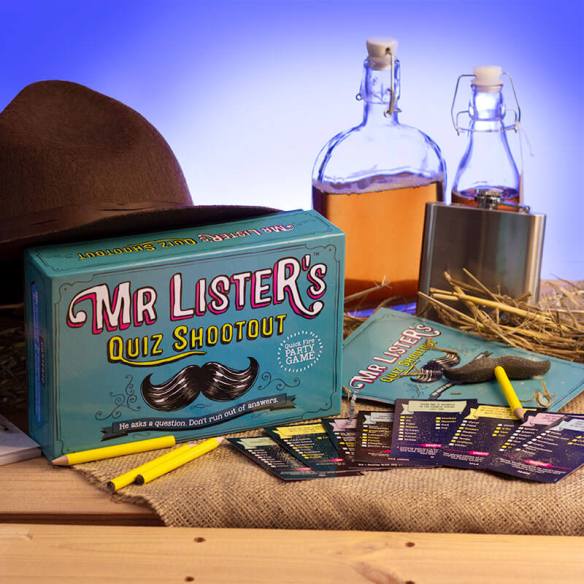
Mr. Lister’s Quiz Shootout follows a similar format to Linkee, but has a completely different flavor.

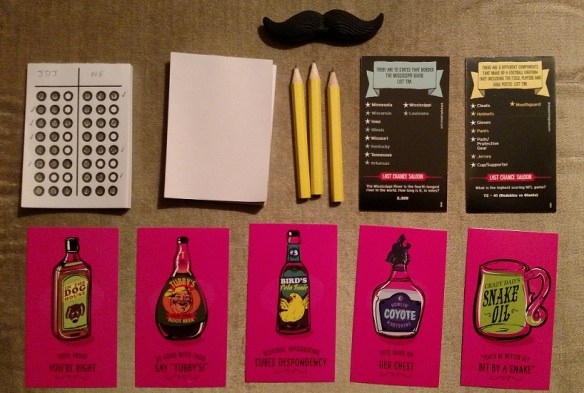
Here, instead of a Question Master, you have Mr. Lister, the mustachioed bartender. Instead of spelling out LINKEE, you’re trying to acquire five different drinks, which are on the backs of the question cards. Again, players get a pad of paper and a pencil.

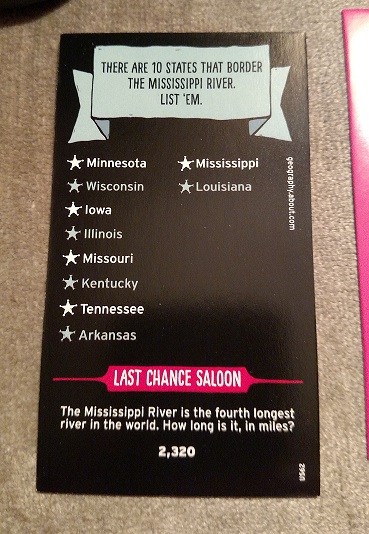
The main difference is that instead of figuring out the link between trivia questions, the teams must instead try to figure out which entries appear on the card, in the manner of Family Feud. For instance, a card could list “Americans’ 10 Favorite Cheeses.” Now the teams have a brief bit of time in which to write down which cheeses they think are in that top ten.

mrlister1

Once the teams have made their lists, it’s time for the shootout! The first team selects one of the answers they’ve jotted down and tells Mr. Lister. If the answer is on the card, Mr. Lister marks it as a hit. If not, Mr. Lister marks it as a miss. Then the other team takes their first shot.

After both teams each take three shots, the team with the most hits wins the card. If there’s a tie, Mr. Lister reads the tie-breaking Last Chance Saloon trivia question at the bottom of the card. Each team writes down their answer, and whichever team is closest to the correct answer wins the card.

mrlister2

This game feels more like a night of bar trivia than a round of your favorite trivia board game, and the old-timey saloon shtick is delightful. (Throwing in a mustache eraser that fits on atop the pencil is just the icing on the cake.) This is reinforced by the awesome box design, which features several bullet holes that go all the way through to the other side. It’s a simple gag, but an effective one, a highlight in game design for me.

Unfortunately, the gameplay was marred slightly by a few themed categories that were unclear or otherwise poorly explained. (The loose definition of “amusement parks” and “ethnic groups” led to some acrimony during one session, especially since these were trivia hounds, who are nitpickers and hair-splitters by nature. In the future, I recommend any Mr. Listers read through the card beforehand in order to avoid similar issues.)

Whether you prefer list building or associative thinking, both of Bananagrams’ latest trivia offerings will make welcome additions to your gaming arsenal.

[Linkee is available at Barnes & Noble, Amazon.com, and on the Bananagrams website. Mr. Lister’s Quiz Shootout is available at Target and on the Bananagrams website.]


Thanks for visiting PuzzleNation Blog today! Be sure to sign up for our newsletter to stay up-to-date on everything PuzzleNation!

You can also share your pictures with us on Instagram, friend us on Facebook, check us out on TwitterPinterest, and Tumblr, and explore the always-expanding library of PuzzleNation apps and games on our website!

It’s Follow-Up Friday: Funding and Fright edition!

Welcome to Follow-Up Friday!

By this time, you know the drill. Follow-Up Friday is a chance for us to revisit the subjects of previous posts and bring the PuzzleNation audience up to speed on all things puzzly.

And today, I’ve got some updates and answers for you!

First off, I want to say congratulations to Patrick Blindauer, whose Piece of Cake Crosswords Kickstarter campaign was funded by solvers hungry for quality puzzles without the obscurities and crosswordese!

It was down to the wire, but the campaign raised the final $10,000 in just seven days to pass the funding goal and ensure that 52 terrific puzzles will be wending their way to solvers all over the world!

In fact, the first one has already arrived in solvers’ inboxes! I can’t wait to see what Patrick has up his sleeve for the next 51 weeks!


And now, on to the answers!

On Monday, I posted a video by musician, comedian, and pun-enthusiast Ali Spagnola where she assembled twenty Halloween themed (or just generally spooky) songs and challenged you to name them all.

How did you do?

1. “Thriller” — Michael Jackson
2. Ghostbusters theme — Ray Parker Jr.
3. “Sweet Dreams (Are Made of This)” — Eurythmics
4. “Time Warp” — The Rocky Horror Picture Show
5. “The Monster” — Eminem ft. Rihanna
6. “Monster Mash” — Bobby “Boris” Pickett and the Crypt-Kickers
7. “The Phantom of the Opera” — Andrew Lloyd Webber
8. The Addams Family theme
9. “This Is Halloween” — The Nightmare Before Christmas
10. The Twilight Zone theme
11. Little Shop of Horrors theme
12. “Crazy Train” — Ozzy Osbourne
13. Scooby Doo, Where Are You? theme
14. “Everybody (Backstreet’s Back)” — Backstreet Boys
15. “Enter Sandman” — Metallica
16. “Somebody’s Watching Me” — Rockwell
17. “Disturbia” — Rihanna
18. “Heads Will Roll” — Yeah Yeah Yeahs
19. “Hungry Like the Wolf” — Duran Duran
20. “The Devil Went Down to Georgia” — The Charlie Daniels Band

Admittedly, I didn’t get all of them — the Ghostbusters theme eluded me, and I don’t think I’d ever heard Rihanna’s “Disturbia” — but I got all of the others! Not too shabby!


Thanks for visiting PuzzleNation Blog today! Be sure to sign up for our newsletter to stay up-to-date on everything PuzzleNation!

You can also share your pictures with us on Instagram, friend us on Facebook, check us out on TwitterPinterest, and Tumblr, and explore the always-expanding library of PuzzleNation apps and games on our website!

PuzzleNation Reviews: ThinkFun’s Circuit Maze and Clue Master

[Note: I received free copies of these games in exchange for a fair, unbiased review. Due diligence, full disclosure, and all that.]

Deduction is one of the most powerful puzzle-solving skills, and honestly, it’s a difficult one to develop.

“If this, then that” thinking involves holding several pieces of information in your head at once, eliminating red herrings and unhelpful possibilities until you’re left with one solution that fits all the requirements. (Every Sudoku puzzle is an exercise in deduction, after all.)

And today, we’ve got two new ThinkFun products to review that are centered around learning the art of deduction in different ways: Clue Master and Circuit Maze.

Clue Master is centered around a 3×3 grid that the solver must fill with nine dog toys: three bones, three balls, and three bowls. Each symbol comes in three colors — green, red, and blue — leaving us with nine unique pieces to place in our grid. (The solving style is very similar to their Brain Fitness puzzle game Chocolate Fix.)

Completing the grid is the only way to open the secret door of Tippy the dog’s doghouse, returning the friendly, blocky puppy to his rightful place in the back yard. (Hence the dog toys.)

The instructions, puzzles, solutions, game board, and pieces are all contained within the single spiral-bound game book, making this one of ThinkFun’s most portable products yet. The magnetic pieces are fairly sturdy, as is the game board, so it will hold up nicely to the rigors of travel (and being stuffed into various carry-on bags).

The gameplay itself is all about interpreting the clues provided with each challenge card. Some clues give you colors only, others shapes only, and the occasional clue is centered around a given piece’s location on the grid.

Once you graduate from the Beginner and Intermediate difficulty levels, you’ll face a new wrinkle: negative clues. Negative clues are layouts that must be avoided, so instead of telling you where to place a piece, they tell you expressly where NOT to place a piece, ratcheting up the difficulty.

Clue Master truly lives up to the “8 to adult” age range of the product. The Beginner puzzles walk you through simple deduction techniques, allowing younger minds and new solvers alike the chance to get accustomed to that sort of if-then chain-solving.

For a bit more of a challenge, let’s check out Circuit Maze.


ThinkFun has a solid track record when it comes to maze games that involve some level of logic or deduction, whether it’s learning optics with Laser Maze Jr. (or the original Laser Maze) or navigating the three-dimensional twists, turns, and drops of Gravity Maze.

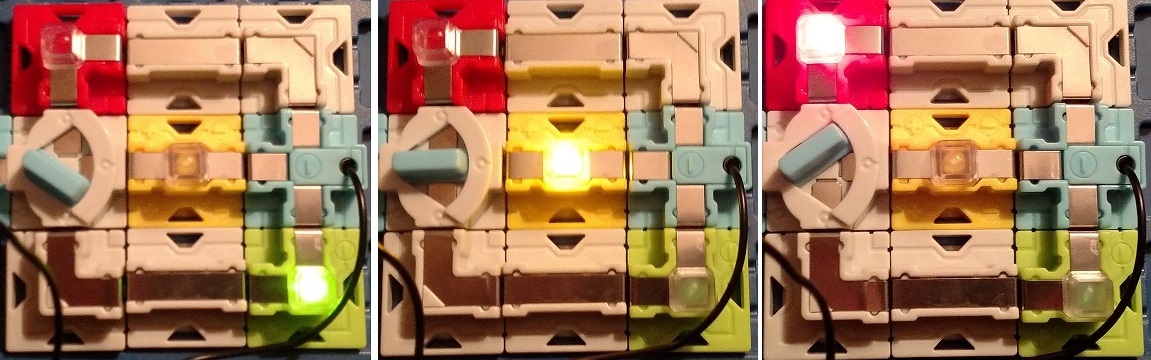
Now, they’ve turned their attention to current and electricity with Circuit Maze, challenging solvers to use switches, connective pathways, and light-up relays to complete the partially-built circuits on each of the game’s challenge cards.

One of the more intriguing twists built into Circuit Maze is that your starting and ending points are a pair of connected pieces: the blue positive piece containing the batteries and the blue negative piece that closes the circuit. The current has to flow from positive to negative, so that means your light-up relays (which are also marked with + and – paths) can only be placed in certain configurations.

To add to the difficulty, oftentimes one of the two blue starting and ending pieces is NOT set in the challenge cards, so you won’t necessarily know what your starting or ending point is, placing another obstacle between you and successfully closing the circuit and ensuring your relays light up as needed.

The switch is another delightful wrinkle on the ThinkFun logic maze formula, since each setting can have its own unique requirements.

For instance, the above setup requires a different relay to light up for each switch setting (meaning that the switch’s first setting lights up the red, its second setting lights up the yellow, and its third setting lights up the green). These multiple goals make building your pathway more challenging and really forces you to think about how to use each piece to its utmost.

[Here the completed circuit causes each relay to light up with a flip of the switch.]

The challenge cards range from Beginner, which offers introductory tricks and lessons, to Intermediate, Advanced, and Expert puzzles, each with their own obstacles.

Sometimes, you know where a piece is placed, but not which direction it should face. Other times, you have to create pathways that will allow multiple relays to light up at once, and others where nothing lights up at all.

In the Advanced-level challenge card below, the solver has to make sure that the red relay always lights up, no matter what setting the switch is on, but other switch settings also have to light up either the yellow or green relays. It’s quite a mental workout!

Circuit Maze definitely rivals Gravity Maze as the most challenging ThinkFun product to date, but it’s a very worthwhile challenge to tackle. This is next-level deductive thinking, plotting out paths that accomplish different tasks at different times, all while maintaining a complete circuit and matching positive and negative current paths.

This serves as a strong follow-up to the deduction lessons new solvers learned in Clue Master, making for a solid one-two punch of logical puzzling the whole family can enjoy together (or you can play by yourself)!

Clue Master and Circuit Maze are both available this holiday season at Amazon or Target!


Thanks for visiting PuzzleNation Blog today! Be sure to sign up for our newsletter to stay up-to-date on everything PuzzleNation!

You can also share your pictures with us on Instagram, friend us on Facebook, check us out on TwitterPinterest, and Tumblr, and explore the always-expanding library of PuzzleNation apps and games on our website!

Halloween Hallowhimsy!

Hello there, fellow puzzlers and PuzzleNationers!

It’s Halloween, that spookiest of holidays, and I’ve got two puzzly videos loaded with today’s traditional tricks and treats!

The first video comes from musician and comedian Ali Spagnola, who has created a masterful mashup of 20 tunes loaded with Halloween spirit! Can you name all 20 songs?

I’m a little disappointed that Warren Zevon’s “Werewolves of London” didn’t make the cut, but otherwise, this is awesome.

The second video comes from domino artist and friend of the Blog Hevesh5, who has created a new domino chain to celebrate All Hallow’s Eve in eerie, energetic fashion!

Whether it’s ghosts or goblins, ditties or dominoes, we hope you have a marvelous Halloween!


Thanks for visiting PuzzleNation Blog today! Be sure to sign up for our newsletter to stay up-to-date on everything PuzzleNation!

You can also share your pictures with us on Instagram, friend us on Facebook, check us out on TwitterPinterest, and Tumblr, and explore the always-expanding library of PuzzleNation apps and games on our website!