

There’s nothing quite like a treasure hunt to spark the imagination. From The Treasure of the Sierra Madre to the adventures of Indiana Jones, from tales as far back as Poe’s “The Gold-Bug” to stories as recent as an episode of NCIS: New Orleans last year, a treasure hunt can turn a crime story or an adventure tale into an irresistible narrative for the ages.
Thankfully, there are a few treasure hunts lurking out there in the real world, offering clever solvers the chance to live out their own adventure. In the past, we’ve explored the mystery of Forrest Fenn’s Rocky Mountain treasure, we’ve chronicled efforts to locate all of Byron Preiss’s The Secret treasures, and we’ve suggested tactics for cracking Jason Rohrer’s A Game for Someone hunt.
But as intriguing as those hunts are, none of them have spanned more than a century of searching. (Without resulting in unfortunate demises, that is. We’re looking at you, Oak Island.)
No, that singular honor belongs to a treasure hunt known as the Beale Ciphers.
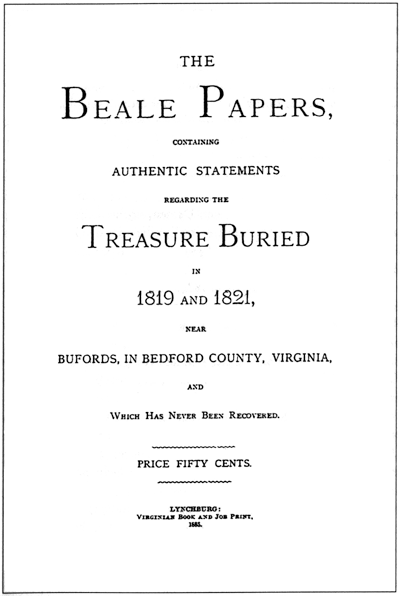
As the story goes, a man named Thomas J. Beale buried a treasure trove of gold and silver somewhere in Bedford County, Virginia, in the early 1800s. Beale then encrypted the location of the treasure, the contents of the treasure, and the names of those he wished to have the treasure. Beale handed off those encryptions to an innkeeper, then vanished, never to be seen again. (His promise of later providing the key for the ciphers was never fulfilled.)
The innkeeper failed to crack the ciphers, then held onto them for decades before passing them along to an unnamed friend before his death. The unnamed friend spent twenty more years trying to unravel the encryptions (managing to solve the second of the three encrypted messages). Eventually, the friend published the encryptions and the story of Beale’s treasure in a pamphlet he began selling in 1885.
So, how do the ciphers work?
It’s simple, really. Take a book, pick a given page, and number all of the words on the page. (Or just start at the beginning of the book.)
If you’re using A Tale of Two Cities, for instance:
1 It
2 was
3 the
4 best
5 of
6 times,
7 it
8 was
9 the
10 worst
11 of
12 times…
So, using the first letters of each word (and the corresponding number), the word BOW could be encrypted 4 11 8 or 4 11 2 or 4 11 10.
This grants people in the know two advantages. The code is incredibly difficult to break on its own, because unlike a cryptogram (or any other message encrypted with a Caesar cipher or a one-to-one relationship between coded letters), each appearance of a given letter could be a different number, not the same one over and over.
Plus, if you know the key (the book and page number), decoding it requires no puzzly skill at all.
It’s diabolical and effective, as proven by Beale’s trio of ciphers, since only one has been cracked (because the solver stumbled upon the Declaration of Independence as the key).

[The second Beale cipher.]
The decrypted text from the second cipher:
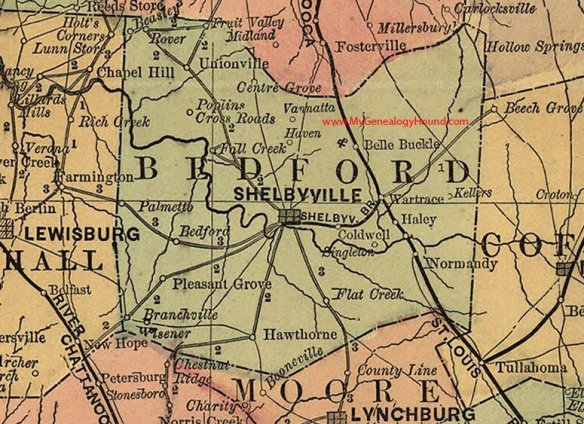
I have deposited in the county of Bedford, about four miles from Buford’s, in an excavation or vault, six feet below the surface of the ground, the following articles, belonging jointly to the parties whose names are given in number three, herewith:
The first deposit consisted of ten hundred and fourteen pounds of gold, and thirty-eight hundred and twelve pounds of silver, deposited Nov. eighteen nineteen. The second was made Dec. eighteen twenty-one, and consisted of nineteen hundred and seven pounds of gold, and twelve hundred and eighty-eight of silver; also jewels, obtained in St. Louis in exchange to save transportation, and valued at thirteen thousand dollars.
The above is securely packed in iron pots, with iron covers. The vault is roughly lined with stone, and the vessels rest on solid stone, and are covered with others. Paper number one describes the exact locality of the vault, so that no difficulty will be had in finding it.
Of course, there are some problems there, even with the cipher that treasure hunters consider solved. You see, there are some irregularities with the solution. Not only are there four misspellings in the translation, but a variation on the original Declaration of Independence must be used or the cipher doesn’t decode correctly.
Now, mistakes happen. (As we learned with the story of Brian Patrick Regan.) But if there are mistakes in the two unsolved ciphers as well, that only makes the chances of finding the proper key even slimmer, because a mistake in the early numbers of the code might convince someone that they’ve got the wrong key, even if they have the right one!
Do you find that challenge daunting, fellow puzzlers? It’s understandable if you do. The other two ciphers have resisted the best efforts of even master cryptographers and cryptanalysts.
Given that the Declaration of Independence was the key for the second cipher, many aspiring treasure hunters have tried using other famous historical documents as possible keys for the other ciphers, including the Magna Carta, the Constitution, the Monroe Doctrine, and more, as well as the plays of Shakespeare and the Lord’s Prayer.
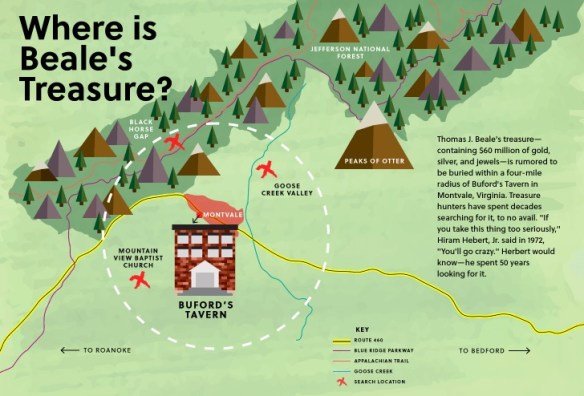
There are also plenty of reasons to doubt that this treasure exists at all. (The same question marks hang over some of the other treasure hunts we’ve mentioned, like Forrest Fenn’s.)
There are questions regarding the language in the pamphlet, where the gold was supposedly found, why Beale would bother encrypting the names of the people he wanted to inherit the treasure, and even whether Beale himself ever existed in the first place. (Famous skeptic and investigator of the supernatural Joe Nickell believes the pamphlet is a fraud.)
But does that mean the ciphers are? Not necessarily.
An analysis in 1970 by Dr. Carl Hammer of Sperry-UNIVAC indicated that the number patterns are not random. He believed that further attempts at cracking the ciphers would be worthwhile.
Heck, even our old codebreaking friends Elizebeth Smith Friedman and her husband William tried to unravel the Beale ciphers, but without success. She called the ciphers “a diabolical ingenuity designed to lure the unwary reader.”

And, of course, not every hunter has come away empty-handed. One team of treasure hunters stumbled upon a cache of Civil War artifacts while hunting for Beale’s trove.
So what do you think, PuzzleNationers? Is the Beale treasure real? Will it ever be found? Let us know in the comments section below! We’d love to hear from you.
Thanks for visiting PuzzleNation Blog today! Be sure to sign up for our newsletter to stay up-to-date on everything PuzzleNation!
You can also share your pictures with us on Instagram, friend us on Facebook, check us out on Twitter, Pinterest, and Tumblr, and explore the always-expanding library of PuzzleNation apps and games on our website!

 PuzzCulture