Tile style puzzling!

Tile puzzles and tile games have been with us for centuries, but I daresay they’ve never been as prominent in our game/puzzle culture as they are these days.

Let’s start with the basics: dominoes.

Chinese Dominoes, which are slightly longer than the regular ones pictured above (not to mention black with white pips), can be traced back to writings of the Song Dynasty, nearly a thousand years ago. Dominoes as we know them first appeared in Italy during the 1800s, and some historians theorize they were brought to Europe from China by traveling missionaries.

The most common form of playing dominoes — building long trains or layouts and trying to empty your hand of tiles before your opponent does — also forms the core gameplay of other tile-based games, like the colorful Qwirkle, a game that combines dominoes and Uno by encouraging you to create runs of the same shape or color.

A tile game with similarly murky origins is Mahjong, the Chinese tile game that plays more like a card game than a domino game. (Mahjong is commonly compared to Rummy for that very reason.)

Mahjong has been around for centuries, but there are several different origin stories for the game, one tracing back to the Ming Dynasty (1368-1644), another to the days of Confucius (500 BC). The gameplay itself is about matching tiles (called melds) to build winning hands.

Rummikub, another tile game (but with numbers instead of characters on the tiles) also resembles card games in its gameplay, and anyone who has played Texas Rummy or Go Fish will instantly recognize the gameplay of building runs (1, 2, 3, 4 of the same color, for instance) and sets (three 1s of different colors, for instance).

All of these games employ pattern matching and chain thinking skills that are right in the puzzler’s wheelhouse, but some more modern tile games and puzzles challenge solvers in different ways.

The game Carcassonne is a world-building game wherein players add tiles to an ever-growing landscape, connecting roads and cities while placing followers on the map in order to gain points. Here, the tiles form just one part of a grander strategic puzzle, one encouraging deeper plotting and planning than some other tile games.

The Settlers of Catan also involves tile placement, but as more of a game starter, not as an integral part of the gameplay. Both Fluxx: The Board Game and The Stars Are Right employ tile shifting as a terrific puzzly wrinkle to their gameplay.

Our friends at Penny/Dell Puzzles have a puzzle combining crosswords and tiles, Brick by Brick, which encourages the solver to place the “bricks” on the grid and fill in the answers.

And, of course, I’d be remiss if I didn’t mention the most popular electronic tile game in modern memory, Tetris.

Tetris — which turns 30 this year! — requires quick thinking, good spatial recognition, and an ability to plan ahead (especially for those elusive four-block pieces that can eliminate four rows at once!). There are plenty of puzzles that employ similar tiles — Blokus, tangrams, and pentominoes come to mind — but none that have engendered the loyalty of Tetris.

Last but not least, there are the sliding-tile puzzles. These puzzles take all the challenge of tile placement games like Dominoes and add a further complication: the tiles are locked into a frame, so you can only move one tile at a time.

Frequently called the Fifteen Puzzle because the goal is to shift all 15 numbered tiles until they read out in ascending order, sliding-tile puzzles are chain solving at its best. Whether you’re building a pattern or forming a picture (or even helping a car escape a traffic jam, as in ThinkFun’s Rush Hour sliding-tile game), you’re participating in a long history of tile-based puzzling that has spanned the centuries.

Heck, even the Rubik’s Cube is really a sliding-tile game played along six sides at once!

[Be sure to tune in on Thursday, when I explore tile-based word games like Scrabble!]

Thanks for visiting the PuzzleNation blog today! You can like us on Facebookfollow us on Twitter, cruise our boards on Pinterest, check out our Tumblr, download our puzzle iBooks and apps, play our games at PuzzleNation.com, or contact us here at the blog!

Bigger really is better, sometimes…

giantsudoku

[A massive Sudoku grid, created to promote a Sudoku gameshow in England in 2005.]

There’s just something about puzzles on a grand scale. From the Great Urban Race’s citywide scavenger hunts to the Internet-spanning curiosity that is Cicada 3301, puzzly ambition makes for some truly mindblowing experiences.

But those are puzzles of staggering complexity and scope, not actual physical size. When it comes to sheer dimensions, you have to go building-size.

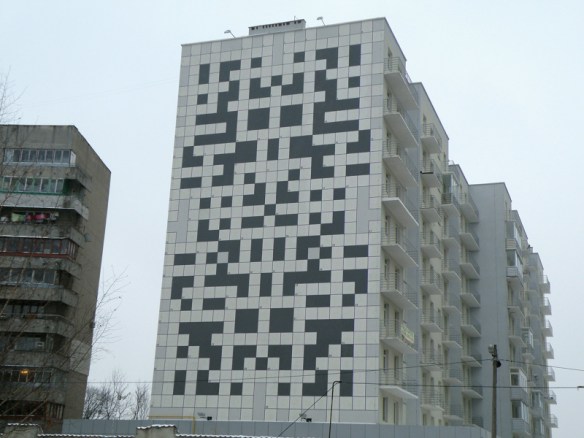
There is, of course, the solvable crossword from Lviv, Ukraine, where the grid takes up the entire side of an apartment building, with clues hidden all over the city. It’s a brilliant tourism move and a terrific challenge (especially if you don’t read Cyrillic).

OLYMPUS DIGITAL CAMERA

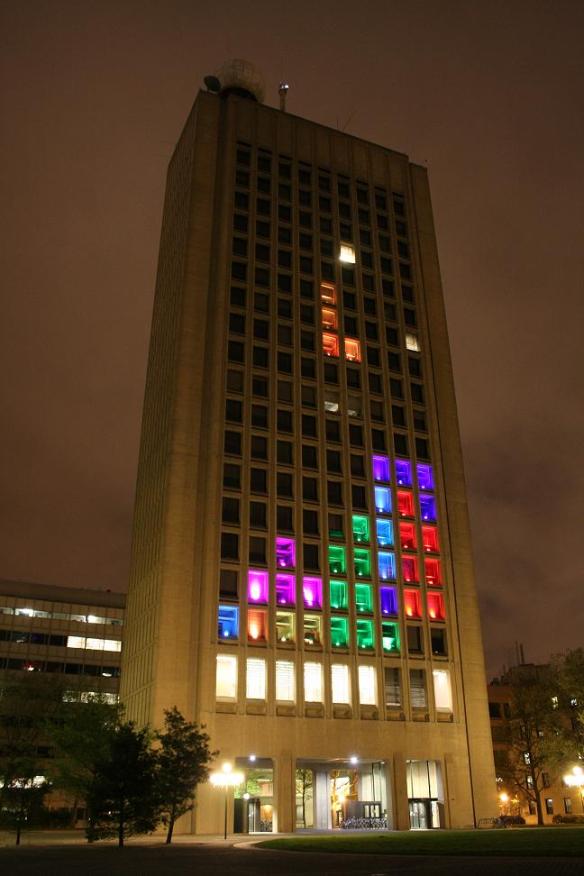
There was also the classic MIT hack from 2012 where ambitious miscreants transformed one side of the Green Building into a multicolored, playable Tetris game. (I recently learned that students from Brown University in Rhode Island accomplished a single-color version of the same feat back in 2000. You can find video of both hacks here.)

tetris1_img6080

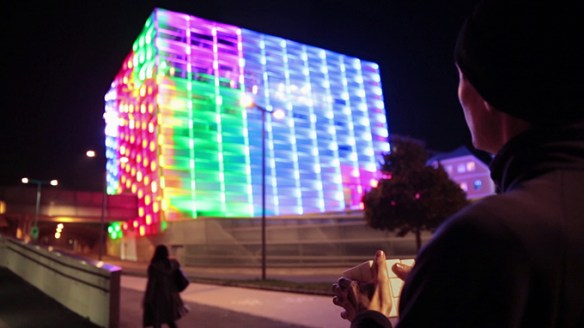
But Javier Lloret has upped the ante with Puzzle Facade, an art installation which transforms the Ars Electronica building in Linz, Austria into a solvable Rubik’s Cube.

Using a small handheld cube as an interface, a solver can manipulate the cube and watch the same changes carried out across two entire sides of the building in full color.

rubikbuilding

As you might expect, having only two sides of the cube available makes for a greater solving challenge, but who cares when you’re lighting up a building with every twist and turn!

It’s a fantastic meeting of puzzly fun and electronic wizardry, and the latest in a grand tradition of massive-scale creativity. I cannot wait to see what intrepid puzzlers come up with next.

Thanks for visiting the PuzzleNation blog today! You can like us on Facebookfollow us on Twitter, cruise our boards on Pinterest, check out our Tumblr, download our Classic Word Search iBook (recently featured by Apple in the Made for iBooks category!), play our games at PuzzleNation.com, or contact us here at the blog!
Where brilliance meets joyous frivolity…

Two weeks ago, we celebrated the 29th birthday of Tetris in a blog post, and I referenced the famous MIT prank where a giant game of Tetris was played on the side of a building.

This prank is one of the most recent in a long line of “hacks”, and MIT students have performed some impressive feats of creative whimsy along the way.

From a fire hose drinking fountain in 1991 to the installation of a shower stall in a common area in 1996, from turning the dome into R2-D2 (as pictured in our opening picture) to the “discovery” of an elevator in the remains of the demolished Building 20 (purportedly leading to a secret subbasement), these are top-tier pranks executed by some of the cleverest students in the world.

The Great Dome is often the palette of choice for MIT hacks, having featured a Triforce from the Legend of Zelda video games, the TARDIS from Doctor Who (which appeared all around campus), a fire truck, the Batman symbol, and numerous other Hack endeavors.

Here, the Apollo lunar lander looks down on a statue of Athena also added by industrious students. (Apollo watching over Athena, how apropos.)

One year, board games invaded campus. Giant versions of Cranium, Mousetrap, and Settlers of Catan appeared around campus, and all of the helpful maps around campus were altered to feature Risk gameplay.

Another time, an enormous game of Scrabble appeared on the wall, complete with MIT-inspired words fluttering in the breeze.

To honor the posting of XKCD’s 1000th comic — a comic that has also made appearances on this blog — XKCD comics appeared all over campus, often spelling out “1000”.

A Newton’s Cradle with imagery inspired by the Portal video game series appeared in 2012

But the best part of MIT hacks? Wondering just how the heck they managed to pull it off without anyone seeing. Like the urban legends behind stories of cars disassembled and reassembled in a professor’s office, the technological wizardry and sneaky cunning required for these marvelous pranks makes MIT Hack enthusiasts fellow puzzlers in spirit AND practice.

A milestone worth celebrating.

It was #5 on G4’s Top 100 Video Games of All-Time countdown, and has been consistently ranked as one of the top games of all-time by IGN, EGM, and gamers of all ages.

It’s Tetris, and it’s turning 29 this week. Yes, Alexey Pajitnov’s incredibly addictive puzzle game baby is ready to start freaking out about the future because it’s almost 30.

Tetris combines the quick reaction time and coolness under pressure of video games with several aspects of puzzlesolving to create a marvelous puzzle game experience.

Firstly, you have the improvisation and adaptability necessary for other tile-placement puzzle games like Scrabble (or Words with Friends for the app-savvy in the audience). But utilizing pieces very similar to those in a pentominoes puzzle — as I discussed a few weeks ago — you also have a spatial puzzle aspect reminiscent of a Brick by Brick.

(FYI, here’s a sample puzzle, provided by our pals at pennydellpuzzles.com.)

From scientific studies linking gameplay with lessened post-traumatic stress to utterly inspired pranks turning buildings into playable surfaces, Tetris has left an indelible mark on both puzzle culture and pop culture. (Plus, I suspect it’s made us all a little better at packing up the car for long trips.)

Happy Birthday, Tetris.