When they appear in sitcoms, escape rooms are played for laughs and sentimentality, true to their common real-life role as a fun diversion and a team-bonding activity. On the other hand, horror media has a lot to say about the sinister side of being trapped in a room and dependent on only your wits to free you; a whole bevy of twenty-first-century films depict escape rooms from Hell. Consider the horrific potential of pairing claustrophobia with psychologically intricate tasks, and it makes sense that the recent rise of escape rooms as a pastime would be accompanied by a rise in twisting that pastime for terrifying purposes.
Escape room horror is not, however, a new concept, despite the modern appellation. Before No Escape Room (2016), Riddle Room (2016), Escape Room (2018), Escape Room (2019), Escape Room 2: Tournament of Champions (2020), and even before Fermat’s Room—which came out in 2007, the same year as the first documented real-life escape room—there was the 1997 movie Cube. In Cube, six strangers are trapped within a harrowingly booby-trapped setup of cubic rooms, and must rely on math and logic to escape death.
“It’s like something out of that twilighty show about that zone,” Homer said before entering his three-dimensional predicament in this Halloween episode of The Simpsons.
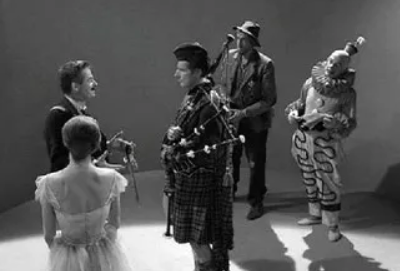
I am not here to recommend that you watch Cube, not unless you’re a fan of creative, vivid gore. Still, it is remarkable as a precursor to escape room horror directly inspired by actual escape rooms. Back in 1994 when director and writer Vincenzo Natali first completed the script, the closest relative to Natali’s vision was the Twilight Zone episode “Five Characters in Search of an Exit.”
“Five Characters” originally aired in December 1961, sandwiched between episodes about time travel and World-War-II-era body-swapping. Compared to those premises, the episode’s set up is simple. Frustratingly so; the lack of bells and whistles is the source of the horror. The characters who wake up trapped together don’t even have names: they are simply, according to narrator Rod Serling, “Clown, hobo, ballet dancer, bagpiper, and an army major—a collection of question marks.”
These question marks play out the episode in essentially a featureless void. There are no brainteasers or riddles to unravel, no booby traps to dodge or calculations to perform. Rather, the puzzles are both larger and more bare-bones, existential: who are they, where are they, and is it possible to be somewhere else? Is it worth it to be somewhere else?
We might also call this story an example of bottle episode horror. In a 2014 interview,New Girl showrunner Elizabeth Meriweather said about the bottle episode, “Background Check,” “For a bottle episode, the stakes have to be very, very high, or else you’re feeling the claustrophobia of not leaving the loft.” This is a good rule of thumb for a sitcom, but what about a horror show, wherein you want to feel the claustrophobia? I’d argue that high stakes are just as necessary for bringing the claustrophobia home as for obscuring its presence; the line between effective comedy and effective horror, here, is thin.
The Community episode “Cooperative Calligraphy” makes no effort to obscure the claustrophobia of the situation; rules were made to be broken.
Does “Five Characters” offer the emotional depth and palpable claustrophobia necessary to bring out the horror of the situation? A review posted on The Twilight Zone Project seems divided on the issue, speaking to the episode’s building suspense but also calling the characters “cartoonish” and the twist “cheap.” “Five Characters,” you see, concludes with the reveal that the clown, hobo, ballet dancer, bagpiper and army major aren’t just playing a game of escape; they themselves are playthings, dolls in a charity toy drive bucket.
I have seen this episode several times, and still don’t know what exactly to make of this twist. What meaning can be gleaned from it, what metaphor? Uncertain what exactly the cast’s toy status tells us about humanity or anything else that lofty, I’d rather think of the episode as an historical artifact, and situate the concept of the players as the playthings in the context of the escape room and/or bottle episode horror television that has followed in its wake. Stay tuned for next week, when I examine a clear, modern descendant of “Five Characters in Search of An Exit.” (No, it’s not Cube.) Let the suspense build . . .
In 2011, speculative CBS thriller Person of Interest began with the premise that a computer genius named Finch (played by Michael Emerson) had built an AI that could tell when acts of violence were about to occur in New York City. In order to intervene, he hired a former special operative named Reese (Jim Caviezel). The only information that the AI ever provides is a social security number; each episode, this leaves Finch and Reese to solve the central question: does this SSN belong to a victim of an impending crime, or a perpetrator? Do they need to be stopped, or saved?
Solving this question typically involves a veritable cornucopia of guesswork, research, hacking, plot twists, and pieces of paper taped to walls and connected by webs of string (one of my favorite TV tropes, featured in Supernatural and It’s Always Sunny in Philadelphia). Chess also features prominently, as do various secretive systems of communication. No episode is quite as likely to appeal to your inner solver, though, as season four, episode two, “Nautilus,” which aired on September 30th, 2014.
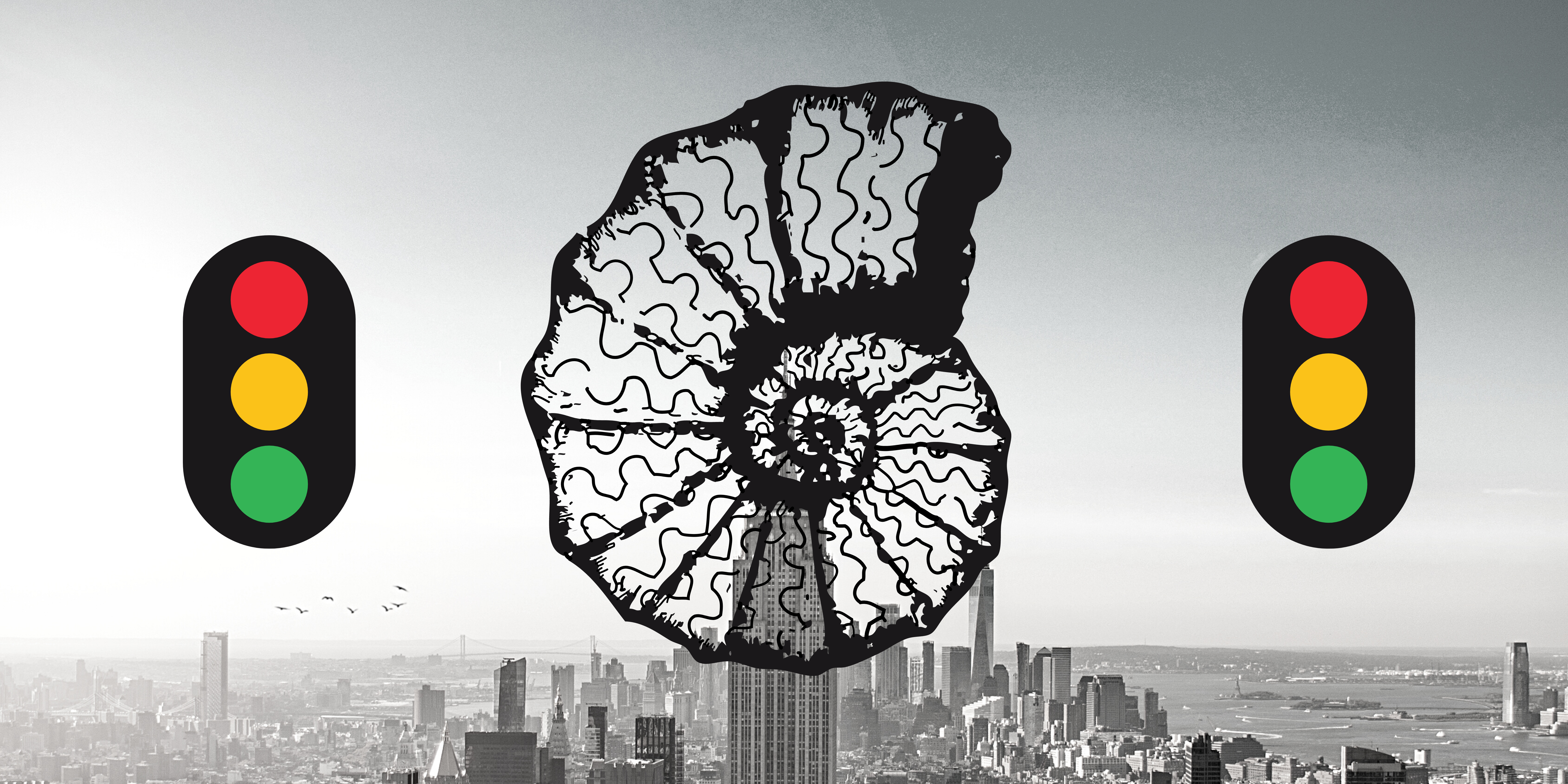
In this episode named for its chambered nautilus shell motif, Finch and Reese receive the SSN for chess grand master and college student Claire Mahoney (Quinn Shephard). She’s AWOL from school and chess in pursuit of a mysterious game’s prize. The game began with a post on an obscure message board: an image of a nautilus, captioned, “If you seek enlightenment, be the first to walk through the chambers.” There was data hidden in the image of a nautilus, and it sent Claire off down the rabbit hole.
Following her, Finch watches as she pulls a tab of paper from a lost dog sign, with a nautilus watermarked behind the numbers. After calling the number leads to nothing, Finch realizes: “It’s not a phone number . . . it’s multiplication.” Multiplying produces GPS coordinates, pointing to a location in Harlem.
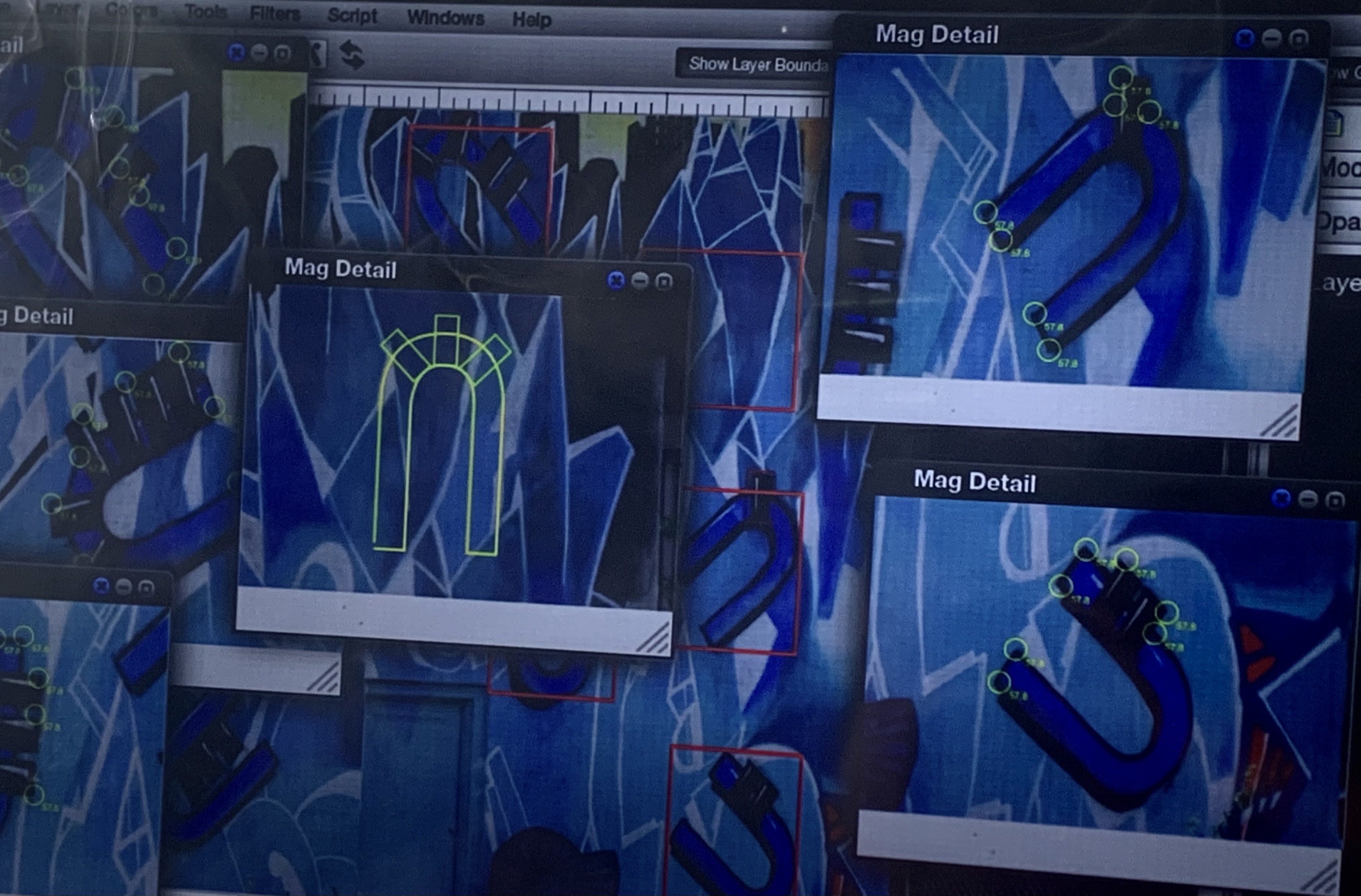
There, a mural of seemingly random shapes (painted by artist Apache Gonzalez) covers a wall. Once again, there’s the nautilus. Back in his office, Finch studies a photo of the mural, finally recognizing it as a variation on a Bongard Problem. He explains, “This particular type of puzzle presents two sets of diagrams. The diagrams in the first set share a common feature. The blocks never overlap with the curved lines. Conversely, in the second set, the blocks do touch the curves, but there’s another common element.”
Reese interjects, “There’s a different number of blocks in each diagram.”
“Using this pattern,” Finch continues, “I can fill in the blank space with the only number of blocks left out, which is three, thus solving the puzzle, creating a sort of three-pronged arch.” Googling, Reese finds a matching photo of an arch in Central Park.
That night, Claire is near the arch, standing in traffic. When Reese interrogates her about her apparent death wish, they’re interrupted, but later, the answer comes to light. If you stand at the right point in the street, banners for “motorcycle safety month” visually blend together to show the faint image of a nautilus. Beneath the nautilus: pictures of traffic lights that Finch correctly identifies as the equivalent of Braille dots. They spell out, “184th and 3rd.”
Claire’s next found in a biker bar at 184th and 3rd, staring at a bulletin board decorated in gang logos. One features a skull with nautiluses for eyes; letters surround the skull in a seemingly random arrangement. At an otherwise dead end, Reese sits at his desk, rewriting the letters over and over, seeking a scrambled word, until Fusco (Kevin Chapman) determines that the letters refer to musical notes, forming the tune to “New York, New York.” Reese is able to deduce a location: the Empire State Building’s observation deck.
Here on out, the puzzles become simpler, less compelling; from a Doylist standpoint (referring to author Sir Arthur Conan Doyle’s perspective, as opposed to fictional character John Watson’s), we might assume that the writers have decided that it’s time for the plot to dominate, turning the puzzles into mere perfunctory means to an end. I’m convinced, however, by the Watsonian explanation, that Claire has sufficiently proven herself, and the AI game-master is content now to lead her by the hand.
But why the nautilus shell? In the episode, computer hacker Root (Amy Acker) refers to the nautilus as one of nature’s examples of a logarithmic spiral. It’s commonly also referred to as an example of the golden ratio, but as explained in “Math as Myth: What looks like the golden ratio is sometimes just fool’s gold,” that’s not so true. Is that they key—that the prize Claire seeks is fool’s gold?
The episode’s primary puzzles have been solved, and the series has come to an end (though it can be streamed on HBO Max). Still, this one question of the nautilus’ significance remains. What is the symbolic connection between a nautilus shell’s chambers and the “enlightenment” the game promises? Is enlightenment encoded in the logarithmic spiral, or in something more particular to the mollusk itself? I don’t have the answers, but as the nineteenth-century poem “The Chambered Nautilus” by Oliver Wendell Holmes Sr. shows, Person of Interest’s screenwriters were not the first to see something spiritual in the nautilus, and I doubt they’ll be the last.
In closing, I offer the following excerpt from Melissa Febos’ Body Work: The Radical Power of Personal Narrative to mull over in your own pursuit of the nautilus shell’s deeper meaning:
The spiral does not belong to the nautilus shell, unless it also belongs to the whirlpool, the hurricane, the galaxy, the double helix of DNA, the tendrils of a common vine. If there are golden ratios that govern the structures of our bodies and our world, then of course there must be such shapes among the less measurable aspects of existence.
Every month, we play some sort of game with not only our fellow puzzlers and PuzzleNationers, but with our friends at Penny Dell Puzzles as well.
Often, this takes the form of a hashtag game, mashing up the topic of the month with entries to Penny Press and Dell Magazines puzzles, titles, and so on.
This time around, we had a different challenge in mind: coming up with a puzzle-infused theme song for Penny Dell Puzzles!
And friends, they certainly did not disappoint.
So, without further ado, check out what these puzzlers came up with!
We start off today’s collection with some punny takes on classic TV theme songs!
I’ll Be Here & There For You
Love Is All Around the Block
Welcome Back, Kakuro
Where Everybody Knows Your Crypto-Names
Keep It Movin’ On Up / Movin’ On Ups and Downs
There’s No Places, Please Like Home
Split & Splice is Painless
Tossing & Turning and Scrambled Up
Three from Nine to Five
We’re the Chipsmunks
Nothing’s Gonna Stoplines Me Now
From this point forward, it’s not just titles, it’s puzzly lyrics as well!
Check out this brief yet delightful entry, to the tune of Britney Spears:
Oops I did it again I wrote with a pen, got lost in the grid Oh Penny, Penny Oops you think I’m so lost Switched Down with Across I need a-nother hint
One intrepid puzzler pitched a nostalgic look at the puzzly past. This one is to the tune of “Those Were The Days” from “All In The Family.”
Boy, the way Word Seeks are made The clever way that Tiles are laid Solvers like us, we got it made These are Word Games And you know Say That Again Even do ’em with a pen Cryptograms can be done, even a page of KenKen You don’t need no calculator When you solve your Sudoku later Gee, all our Fill-Ins look greater These are Word Games!
I’ll let our next contributor handle their own introduction. Take it away, fellow puzzler!
You want a theme song? Hold onto your wimple, Maria! I’ve got your theme song right here:
♫♪♫♪♫♪♫♪♫♪♫♪♫♪♫♪♫♪♫♪♫♪♫♪♫♪♫♪♫♪♫♪ How do you solve a puzzle like a crossword? How do you fill a grid, across and down? What’s a five-letter word that means “an earth tone”? An ochre? An umber? A camel? A beige? A brown?
Many a thing you know you’d like to write there, Many a clue you ought to understand. A book that can make you think: Use pencil or pen and ink! How do you choose the best from your newsstand?
Oh, how do know you’ve got the tops in puzzles? Penny Press made the book that’s in your hand! ♫♪♫♪♫♪♫♪♫♪♫♪♫♪♫♪♫♪♫♪♫♪♫♪♫♪♫♪♫♪♫♪
Another marvelous entry was set to the tune of Frank Sinatra’s “My Way” and is known simply as… the Solver’s Theme:
And now, the end is near And so I face the final clue My friend, I’ll say it clear I’ll take my prize, of which I’m due I’ve solved the puzzles full Fraught with joy and dismay And more, much more than this I did it my way
Regrets, I’ve had a few But then again, too few to mention I did what I had to do And saw it through without exemption I penned each solve complete Each careful letter along the way And more, much more than this I did it my way
Yes, there were times, that Crypto-Zoo When I bit off more than I could chew But through it all, when there was doubt I ate it up and finished Turnabout I faced it all, and I stood tall And did it my way
I’ve circled, I’ve erased and cried I’ve had my Fill-Ins, Tossing and Turning And now, as tears subside I find that I am always learning To think I did all that And may I say, not in a shy way Oh, no, oh, no, not me I did it my way
For what is a solver, what has he got? If not himself, then he has naught To say he finished Spinwheel But sought help for Square Deal The record shows I took the blows And did it my way
Yes, it was my way
Here’s a toe-tapping puzzly entry submitted to the tune of “867-5309”:
Penny, Penny has puzzles for you Our magazines have a ton of fun clues Sudoku, Word Seeks, and Crosswords galore Your favorite puzzles, oh we’ve got them all!
Penny, you’ve got our number When you need Three from Nine Penny, just call our number
Penny, Penny has Puzzle Derby Fill-Ins and Places, Please will make you so happy Try out Double Trouble or Blockbuilders Challenge your imagination with Exploraword
Penny, you’ve got our number When you need Diamond Mine Penny, just call our number
We’ve got it (We’ve got it) We’ve got it Tiles, Place Your Number, and Quotefalls We’ve got it (We’ve got it) We’ve got it For a Good Time, for a Good Time call!
As a closer, here’s one the kids can enjoy, as one creative puzzler submitted a piece to the tune of “Old McDonald Had a Farm”:
Penny Pub makes puzzles fun, oh lets go do one With a COLORING BOOK here and a COLORING BOOK there, here a COLORING BOOK there a COLORING BOOK everywhere you see a COLORING BOOK
Penny Pub makes puzzles fun, oh lets go do one With a CROSSWORD here and a CROSSWORD there, here a CROSSWORD there a CROSSWORD everywhere you see a CROSSWORD
Penny Pub makes puzzles fun, oh lets go do one With a FILL-IN here and a FILL-IN there, here a FILL-IN there a FILL-IN everywhere you see a FILL-IN,
Penny Pub makes puzzles fun, oh lets go do one With a LOGIC here and a LOGIC there, here a LOGIC there a LOGIC everywhere you see a LOGIC,
Penny Pub makes puzzles fun, oh lets go do one With a VARIETY here and a VARIETY there, here a VARIETY there a VARIETY everywhere you see a VARIETY,
Penny Pub makes puzzles fun, oh lets go do one With a WORD SEEK here and a WORD SEEK there, here a WORD SEEK there a WORD SEEK everywhere you see a WORD SEEK,
Penny Pub makes puzzles fun, oh lets go do one With a WORD SEEK here and a WORD SEEK there, here a WORD SEEK there a WORD SEEK everywhere you see a WORD SEEK,
a VARIETY here and a VARIETY there, here a VARIETY there a VARIETY everywhere you see a VARIETY,
a LOGIC here and a LOGIC there, here a LOGIC there a LOGIC everywhere you see a LOGIC,
a FILL-IN here and a FILL-IN there, here a FILL-IN, there a FILL-IN everywhere you see a FILL-IN,
a CROSSWORD here and a CROSSWORD there, here a CROSSWORD, there a CROSSWORD everywhere you see a CROSSWORD,
a COLORING BOOK here and a COLORING BOOK there, here a COLORING BOOK there a COLORING BOOK everywhere you see a COLORING BOOK …
Penny Pub makes puzzles fun, oh lets go do one
Did you have a favorite Penny Dell Puzzly Theme Song, fellow puzzlers? Or an idea of your own? Let us know in the comments section below! We’d love to hear from you!
It’s always interesting when TV shows incorporate puzzles into their stories. Not only do we get to see what Hollywood (and by extrapolation, the general public) thinks about a given puzzly experience, but we learn more about the characters when they face a particular puzzle or challenge.
This is especially true for sitcoms and comedies, since they usually have less time to focus on the puzzling and therefore put the spotlight on character relationships.
And it occurred to me that there are a number of different shows over the last few years that have featured the characters in escape room-style puzzle settings.
Why don’t we take a look at how accurately these puzzly experiences were portrayed, how difficult the room appeared to be, and what the characters’ solving skills were like?
Please enjoy as we explore fictional escape rooms from TV in our latest edition of Puzzles in Pop Culture!
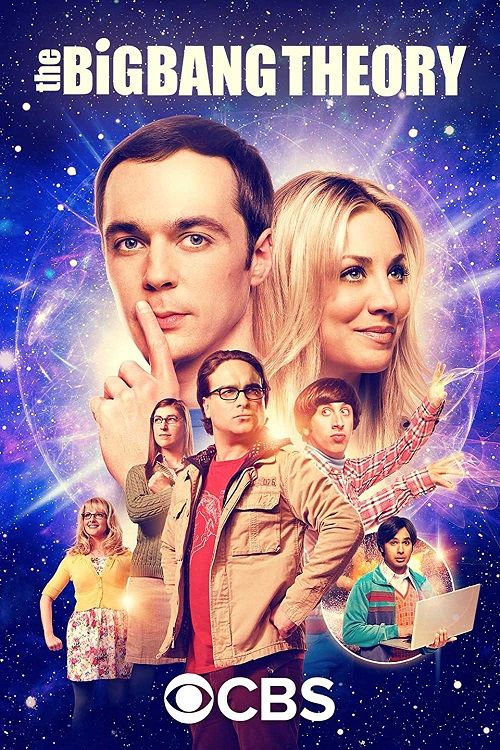
For our first offering, we turn to the CBS juggernaut The Big Bang Theory. Over the years, TBBT has featured puzzly activities like giant Jenga, a holiday-fueled session of Dungeons & Dragons, and a scavenger hunt with puzzly clues.
So I wasn’t surprised that their take on escape rooms was the same: fairly accurate, but simplified and streamlined for a mainstream audience.
The room in TBBT is pretty spacious, moreso than pretty much any escape room I’ve seen. But the level of detail is easily something achievable for high-end rooms. Also, I’ve heard about escape rooms with actors playing zombies before, so this is legit.
(In fact, one I heard about in Washington D.C. had a zombie on a chain; the chain got longer the more time solvers took to crack puzzles, cutting the room in half at one point!)
We don’t get to see much of their solving, as they allude to puzzles conquered instead of showing us, so it’s hard to gauge difficulty. But given that most of the characters featured in the scene hold doctorates, we can safely assume the puzzles were middle-of-the-road or slightly harder.
However, the episode ignores the fact that you’re trying to escape the room in a certain amount of time. The characters seemed disappointed by their impressive performance, but they probably posted one of the top times in that room’s history. Nothing to sneeze at.
Another show that hasn’t shied away from puzzly content is the former FOX and current NBC hit Brooklyn Nine-Nine. This comedy/drama set at a New York City police precinct has featured a seesaw brain teaser, a crossword-fueled arson mystery, and several multilayered heist storylines set around Halloween.
Puzzle enthusiast Captain Holt invites his fellow officers out to an escape room, and is dismayed when the disinterested Gina and the bumbling Hitchcock and Scully end up being his only fellow players. The group is immediately hampered by Hitchcock wasting two of their three hints, and Holt accidentally wasting the third.
The hint system is usually not as rigid in escape rooms. Three hints is common, though many places allow you to ask for more; sometimes there’s a time penalty, sometimes not. Also, the room in B99 is a three-hour challenge, which was a surprise. The standard time is an hour, though I’ve seen rooms push it to ninety minutes.
The group has also clearly not tried the classic escape room method of “touch everything,” because an hour and a half into the game, having found only one of the four keys needed to escape the room, Holt has not yet investigated the bright red phone sitting out in the open.
This is another escape room where difficulty is tough to judge. Unfortunately, we’re not given enough details on the first key (which involves some sort of chess puzzle) and the fourth key to really gauge the room. But despite the rocky start, the lovable team of misfits manages to escape.
Accuracy rating: 3/5
Room difficulty: 2/5
Character solving skills: Holt gets a 3.5/5, everyone else gets a 2/5.
Next, let’s turn our eyes to It’s Always Sunny in Philadelphia.
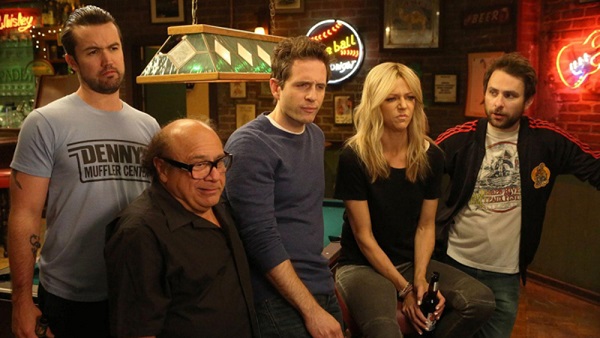
The characters in this darkly comedic show all consider themselves devious masterminds, but for the most part, they tend to get in each others’ way and foil their own schemes through silly self-sabotage. Although a few impressive schemes do come to fruition over the years, it’s hard to consider this group a crackerjack team of puzzle solvers.
This escape room breaks the mold quite a bit, since the company brings the escape room trappings to the apartment of two of the characters. This is much more elaborate than any escape room set you can buy for the home, and I don’t know of any companies that deliver an escape room to the house.
You might think this home field advantage would be a boon, but instead, all chance of cooperation immediately goes out the window. One pair takes the key to a lock, the other pair takes the lock, and they spend the entire time negotiating instead of solving.
[Image courtesy of IMDb. Because of the language involved, I couldn’t use an actual video clip and keep the blog post family friendly.]
Once they actually agree to collaborate and open the lock, they discover a list of tasks for them to complete, and they have virtually no time left to do so. (Our only hint to the room’s difficulty comes from the fact that Dee has completed the room beforehand, so it can’t have been too difficult.)
They claim victory when Sweet Dee falls out a window after getting trapped in her brother Dennis’s bedroom. In order to check on Dee’s status, the game runner opens the door and the remaining players consider it a win.
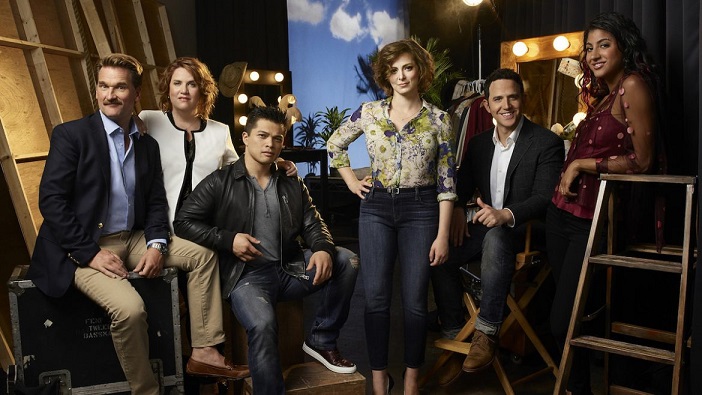
The final entry in our comedic quartet of escape room episodes comes from the musical CW show Crazy Ex-Girlfriend. This romantic drama, comedy, and coming-of-age story often features characters breaking out into elaborate song and dance routines, and many of the songs have become modern classics.
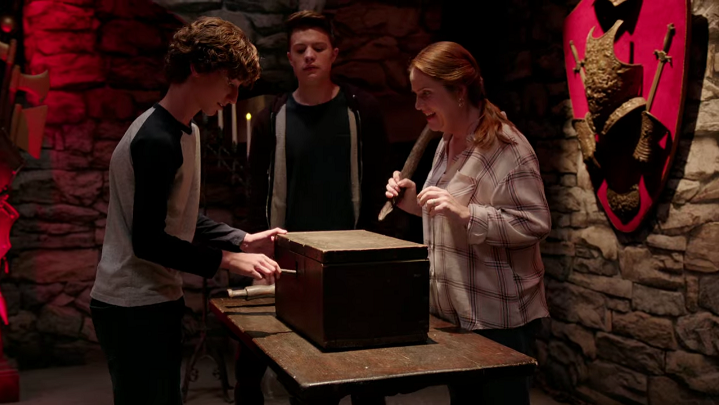
The show didn’t tackle puzzly content often, and indeed, the escape room in question is a b-plot in this particular episode, as main character Rebecca offers her escape room experience to friend Paula and her two disinterested sons.
The escape room is medieval-themed and huge, with lots of great set pieces and detail. The mix of exploring, touching things, solving puzzles, cooperating, and placing objects in particular places are all very traditional escape room moments.
Though I was a little disappointed that the elements of the final puzzle are sitting out in plain sight the whole time. You could easily ACCIDENTALLY solve the last puzzle first and be out in minutes.
But Paula’s sons prove to be able puzzlers, attentive and clever, revealing things about themselves that Paula didn’t know. (In fact, the entire escape room subplot is all about Paula learning about who her sons have become, which is Puzzly Storytelling in Sitcoms 101.)
They all escape, having found new common ground, and it’s easily the most delightful ending of the four escape room scenarios we’ve looked at today.
Accuracy rating: 4/5
Room difficulty: 3/5 (the final puzzle is a long anagram, which is pretty tough, but the rest of the room is easy)
Character solving skills: 4/5
What did you think of this look at escape rooms from TV, fellow puzzlers? Should we look at more fictional escape rooms and see how they hold up?
I’ve heard Bob’s Burgers has one, as well as Schitt’s Creek. Let us know in the comments section below! We’d love to hear from you.
The thirteenth edition of Lollapuzzoola, as is tradition, arrived on a Saturday in August, but for the first time ever, it was hosted online to allow tournament solving from home. As one of the highlights of the puzzly calendar, I was glad to see it make the virtual jump, as Boswords did before it.
I was not in virtual attendance, but I did sign up for the Next Day Division puzzle packet. Last weekend, I finally had a chance to sit down and try my hands at this year’s tournament puzzles, and I was not disappointed. Lollapuzzoola continues to push the envelope with inventive themes and unique spins on how to bring crosswords to life.
This year’s theme was “Don’t Touch That Dial!” so every puzzle had something to do with television or TV channels, and the constructors were clearly inspired in all sorts of ways. Let’s take a look at what they came up with.
Instead of Brian Cimmet’s usual Twinlets puzzle as a warm-up, this year featured two practice puzzles. The first, constructed by Patrick Blindauer and entitled “I Want My MTV,” allowed solvers to hit the ground running.
The accessible theme — adding the letter M to established TV shows, a la SCOOBYDOOM or AMERICAN MIDOL — is the sort of fun and frivolous idea to spark solver imaginations and ready them for a proper day of puzzling.
Interesting grid entries included DATUM and I’LL BE BACK (as well as some nice misdirection with YEE-haw instead of HEE haw), and my favorite clue was “Traffic cop?” for NARC.
The second practice puzzle, a themeless mini constructed by Brian Cimmet, offered a slight uptick in difficulty and a nice preview of the sort of solving tournament attendees would see in the final.
Interesting grid entries included BOBA TEA, ORCHESTRATE, and ROLLED R (as well as tournament constructor STELLA Zawistowski getting referenced!), and my favorite clue was “One of three in ‘Alexander and the Terrible, Horrible, No Good, Very Bad Day'” for COMMA.
Puzzle 1: Soap Operas by Brooke Husic
The competition puzzles kicked off with this terrific opener, a 17×13 grid that showed off the flexibility and creativity of construction and grid design that keeps Lollapuzzoola fresh. (Also, I’m a sucker for a punny start to a tournament, so the theme was a plus for me.)
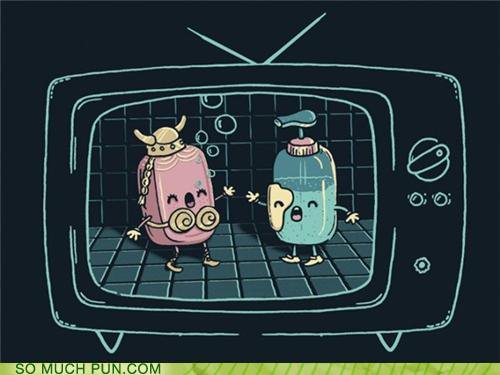
The themed entries featured commercial soap brands as part of common phrases (like IVORY TOWER and DOVE TAILED), which were then clued as “soap operas” for viewers.
It was a nicely constructed grid that flowed well, and it’s exactly the sort of puzzle to introduce new solvers to tournament puzzles while entertaining the established vets.
Interesting grid entries included DIWALI, ACADIA, and HOPE SO, and my favorite clue was “Card game that can go on and on and on and on and on and on and on, like this clue” for WAR.
Puzzle 2: The Final Countdown by Sid Sivakumar
This tall, thin 12×25 grid (coupled with THAT title) virtually guaranteed that Europe’s faux-epic anthem would be stuck in your head for a good chunk of the tournament, but I’ll forgive Sid, because I really enjoyed this puzzle’s hook.
The theme entries all began with a number (like 4 LETTER WORDS or 3-D TELEVISION), and as you expect, they counted down until reaching the climactic pronouncement AND WE’RE LIVE at the bottom part of the grid. It’s a fun idea that was complimented nicely by the unusual grid, and the puzzle flowed nicely from top to bottom as the entries counted down.
Interesting grid entries included PEARLED, RETURN KEY, MR SULU (which, before I looked at the clue, I kinda hoped would be MR. SHOW), and BUNGALOW. My favorite clues were “[Feed me! Pet me! Feed me! Play with me!] … or actually sometimes [Leave me alone!]” for MEOW and “‘Do not feed the ____’ (advice for bridge travelers and internet users)” for TROLL.
At this point, I noticed that both Puzzle 1 and 2 had an all-caps clue where the answer was a TV network. This feature continued throughout the tournament as a nice little through line, though its ultimate purpose wouldn’t reveal itself until after Puzzle 5. Stay tuned.
[Image courtesy of Pixar.]
Puzzle 3: Flipping Channels by Rachel Fabi
A swapping-themed puzzle is practically a tradition at Lollapuzzoola at this point, so I wasn’t at all surprised to see that idea adapted for TV with Puzzle 3’s hook. Each pair of theme entries not only included the names of channel, but swapped the second halves of phrases including those channels. For instance FOXGLOVES and OXYGENMOLECULES became OXYGENGLOVES and FOXMOLECULES.
As I solved, I wasn’t sure if these would be random pairs swapped, mirrored pairs swapped, or a continuous chain of swaps throughout the puzzle, so it took me a little longer to complete the grid. This was a definite step-up in difficulty from Puzzle 1 and 2, but not excessively so. (Some of the vocabulary also slowed me down, since I didn’t know NITTANY or INFODEMIC.) Still, it was a solid puzzle and an appropriate challenge for the midway point of the tournament.
Interesting grid entries included NOGOODNIK, CHEETO, HOT POCKET, GO GREEN, and the aforementioned INFODEMIC, and my favorite clues were “Nanjiani’s ‘The Lovebirds’ costar” for RAE and “Bisexual Greta of Old Hollywood” for GARBO, two clues that felt very fresh and topical, particularly for entries that solvers have seen plenty of times before.
[Image courtesy of Game Show Network.]
Puzzle 4: Deal or No Deal by joon pahk
A big jump in difficulty and complexity, Puzzle 4 was an immensely clever and well-executed grid that took a familiar crossword concept — removing or adding letters from entries — and mined it for unexpected depth. On the left-hand side of the grid, a letter was added to both the clue AND the entry. For example, “Entranced cover” clued DAWNING. [Bolding is my own to highlight the added letter.]
On the right-hand side of the grid (but in the same row, one black square away), that entry was complemented by the same letter subtracted from both clue AND entry. The example above, for instance, was matched by “Go _own a spout” cluing _RAIN OUT. [Again, spacing added is my own to highlight the missing letter.]
These letter trades — the deal or no deal of the title — were tightly executed and made total sense to the solver without any explanation needed. Not only that, but the added/missing letter was always taken from the same part of the word on the other side! (Third letter E in FREIGHT was the missing third letter in SH_ARING next door.)
It’s incredibly impressive construction that is nicely balanced by solid fill and strong cluing. This is easily my favorite joon pahk puzzle I’ve ever solved, and will no doubt make my list of top puzzles of the year.
Interesting grid entries included GONZAGA, MEERKAT, NIP/TUCK, TWYLA, and SCHLEP, and my favorite clues were “Slightly subpar, ironically” for ONE OVER, “Wednesday the third?” for SILENT D, and “Snow or paint, in certain arenas” for AMMO.
Puzzle 5: Schedule Swaps by Stella Zawistowski
This 21x marked the end of the regular tournament puzzles, and it felt like a suitable final boss for most solvers in the competition. The grid was dense, well-constructed, and challenging, featuring another smartly-executed swapping gimmick. This time around, the theme was common phrases where one of the words was also a TV show, but that show was replaced with another TV show to make a new phrase.
For example, the phrase BIRTHING COACH became BIRTHING SCRUBS as COACH was relocated elsewhere in the grid. Fitting in all these themed entries — six of them! — plus their accompanying TV shows was no doubt a hefty challenge for the constructor, but Zawistowski made it feel effortless in this demanding but well-made puzzle.
Interesting grid entries included GALILEO, SAN PEDRO, DISCIPLE, PETSIT, AIRPOPS, and SO SUE ME (as well as the thoroughly baffling ONE O’ CAT, which I had to look up after), and my favorite clue was “‘Silver Springs,’ to ‘Go Your Own Way'” for B-SIDE.
As for the all-caps TV network clues we spotted earlier? They also appeared in Puzzles 3, 4, and 5, and it turns out, they were part of a clever little metapuzzle hidden in the tournament grids.
The five TV networks, one in each puzzle, turned out to be TBS, VH1, SyFy, ESPN, and TNT. And if you take the first letter of each, you get the hidden answer TV SET.
Very nicely done, constructors!
Puzzle 6: Finals by Robyn Weintraub
As always, there were two sets of clues for the Finals puzzle, the Local and the more difficult Express clues. No matter which clues you were working with, you were in for a terrific tournament finale.
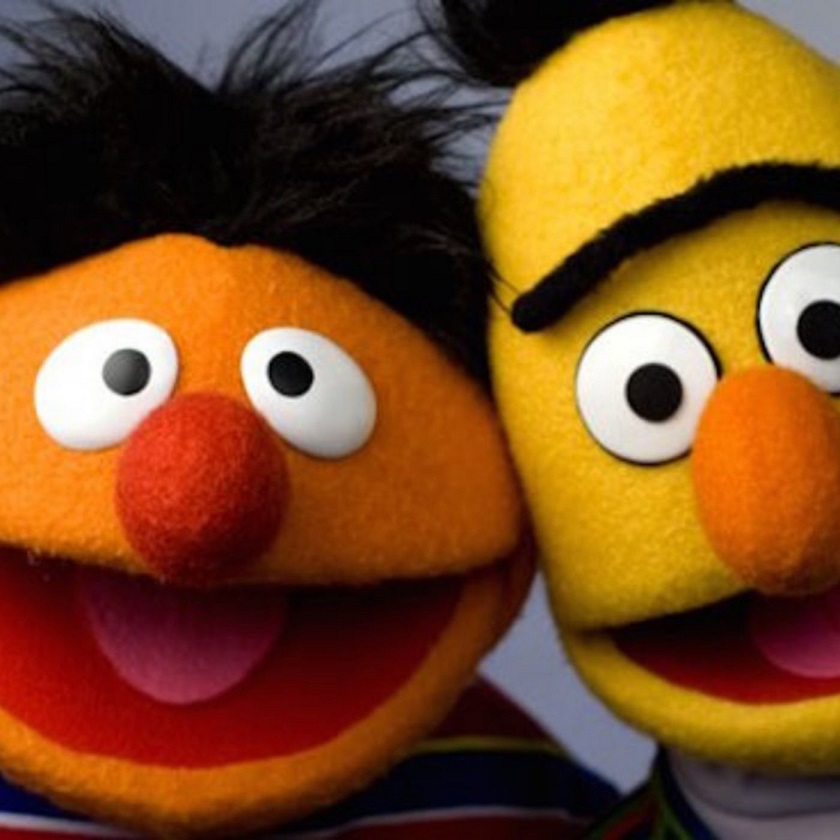
With a pair of 12-letter entries from classic children’s television as anchors for the puzzle — MISTER ROGERS and BERT AND ERNIE — Weintraub delivered a tight grid with some strong fill and plenty of long, crossing entries in the corners to keep solvers guessing.
For me, this was a nice tournament landmark, as I powered through the Express clues and completed the grid without having to reference the easier Local clues once. I know this is commonplace for the top solvers, but it was a nice confidence boost for me as an enthusiastic solver, but hardly the fastest or the most competent.
It was a perfect final puzzle to wrap up one of the most consistent and enjoyable puzzle sets they’ve ever assembled for the tournament. With over 1,000 solvers participating through the online format, I can’t think of a better way to introduce them to the spirit and style of Lollapuzzoola than this year’s puzzles. Nicely done, team!
Interesting grid entries included WENT TO BED, SQUARE PEG, FALSE ALARM, PECOS, and NSFW. Both the Local and Express sets of clues had some gems, so I’ll list them separately below:
Local clues:
“Big cheese with the bacon” for CFO
“Escape room finds” for KEYS
“Month in which National ‘Twilight Zone’ Day is observed” for MAY
“‘____ Pressure’ (‘Baywatch’ episode with a punny title)” for PIER
Express clues:
“Place after place” for SHOW
“Canal zone?” for EAR
“‘Ua Mau ke Ea o ka ‘Aina i ka Pono’ or ‘Excelsior'” for STATE MOTTO
“PBS ‘Viewers Like You'” for DONORS
“‘Panic at Malibu ____’ (‘Baywatch’ pilot episode) for PIER
[Top(less) puzzlers.]
There was also a tiebreaker themeless mini by Amanda Rafkin (who we recently interviewed!). The mini was a quick and satisfying solve, loaded with great vocabulary, offering a nice cooldown after a strong tournament and several really engaging puzzles.
Interesting grid entries included MACARONI ART and SO EXTRA, and my favorite clue from the mini was “One paying dollars for quarters” for TENANT.
The puzzles at Lollapuzzoola always impress, and this year was no exception. The grids were tight, there was little crosswordese, and the creative themes, grid designs, and puzzle mechanics ensured that not only would fun be had by all, but that the puzzles would linger in your memory.
Mission accomplished, and congratulations on the competitors and the organizers who made it all happen, especially in a virtual format with so many additional solvers. Lollapuzzoola is only getting more creative, more groundbreaking, and more clever with each passing year, and it’s just awesome to watch it grow and evolve.
I can’t wait to see what they come up with next year!
Thanks for visiting PuzzleNation Blog today! Be sure to sign up for our newsletter to stay up-to-date on everything PuzzleNation!
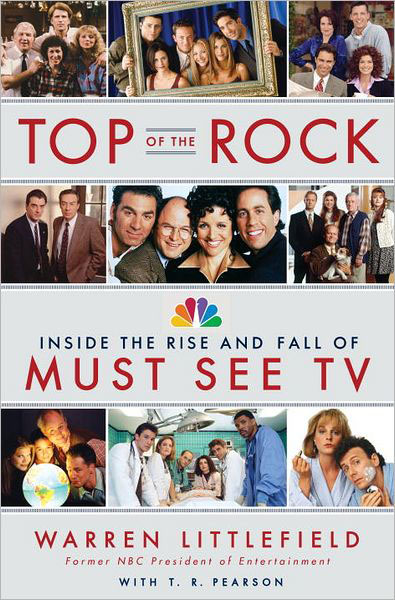
By the late 2000s and early 2010s, NBC’s Must See TV Thursday lineup was a thing of the past, but they were still putting out quality comedy content. My Name Is Earl, The Office, Community, Scrubs, Parks and Recreation, and 30 Rock all had loyal followings.
And you’d be surprised how much puzzle and game content ended up on those shows.
The Office featured in-house Olympics and betting games, as well as a Da Vinci Code-esque prank. Community had two Dungeons & Dragons-inspired episodes (which I should really cover at some point).
But those last two shows — Parks and Recreation and 30 Rock — both featured made-up games that either spoofed or were inspired by modern board games.
Parks and Recreation had The Cones of Dunshire, and 30 Rock had Colonizers of Malaar. Both of these games are much more elaborate takes on Settlers of Catan, a board game about resource management that is considered one of the top titles in modern board games.
In one episode of 30 Rock, executive Jack Donaghy is struggling with his position, given that NBC is under new ownership with Kabletown, and he finds refuge in a game of Colonizers of Malaar with the writers for comedy show TGS.
Jack believes his business acumen will make the game an easy victory, only to find the play experience strangely similar to his current problems at work. He flees the game for some fresh air.
Later, Jack returns to the game, inspired. He makes a seemingly ill-advised move — playing a fire card in a desert wasteland — that turns the game on its head. The fire turns all the sand into glass, a much-needed resource, and suddenly he’s back in control.
His success in the game inspires him to do the same with his new employers, and Jack leaves, reinvigorated.
The game itself allowed for a few silly throwaway lines, but Jack’s gaming experience was a clever way to allow him to reach rock bottom and rebound. Like many newcomers to a game, he struggled, found his way, and later triumphed, his day improved by playing the game.
Plenty of board game fans have had similarly joyful experiences.
Colonizers of Malaar, as far as we can tell, is a marketed game in the 30 Rock universe. The Cones of Dunshire from Parks and Recreation, on the other hand, is created by character Ben Wyatt and initially treated as a mistake, a nonsensical result of his boredom and frustrations.
The game becomes a running gag in the show. Ben leaves it as a gift at an accounting firm that he has been hired by (and walked away from) several times.
Later, we find out the game has been produced, and Ben stumbles across it when dealing with a dotcom company. He mentions that he invented it, but is shrugged off. He then proves not only his gaming skill but his authorship of the game when he beats the dotcom bosses in a tense playthrough.
It’s mentioned once that a gaming magazine called Cones of Dunshire “punishingly intricate,” a point that makes Ben proud.
Part of the fun of Cones of Dunshire is that the viewer never really understands what’s going on, so supposedly dramatic moments can be played for laughs. (I also appreciate that the name of the game is basically a fancy way of saying “dunce hat.”)
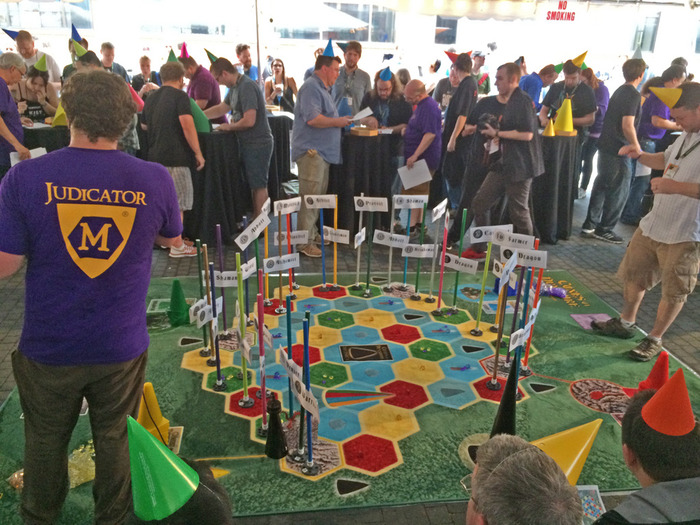
And, in the sort of cyclical storytelling that could only happen in a nerdly pursuit like board games, the company that made Settlers of Catan — Mayfair Games — produced a giant version of the game as part of a charity event at GenCon.
A Kickstarter campaign for a limited run of the game was launched twice, with copies costing $500 due to the insane complexity and number of pieces for the game, but it ultimately failed to reach its goal.
Nonetheless, these two fictional games made an impact on both the characters of the show and the fans as well. What more could you ask for?
Thanks for visiting PuzzleNation Blog today! Be sure to sign up for our newsletter to stay up-to-date on everything PuzzleNation!














 PuzzCulture