It’s Follow-Up Friday: Alice in Wonderland edition!

Welcome to Follow-Up Friday!

By this time, you know the drill. Follow-Up Friday is a chance for us to revisit the subjects of previous posts and bring the PuzzleNation audience up to speed on all things puzzly.

And today, I want to follow up on a classic unsolved riddle from Lewis Carroll.

Last week, I mentioned in my mondegreens and malaprops post that I often preferred the nonsensical, silly misheard lyrics of songs to the actual lyrics. And I received a private comment from author Mary Hammond, who likened my position on mondegreens to a topic that deeply interested her: Why is a raven like a writing-desk?

You see, many Carroll fans and scholars believe that the riddle is purposely nonsensical, taking Carroll’s word at face value when he claimed that the riddle was designed with no answer in mind. But Hammond believes that Carroll, wordsmith and gamesman that he was, hid the true answer to the riddle in plain sight.

Check out her solution to Carroll’s riddle, wonderfully summed up in this short YouTube clip:

Now, this is a Follow-Up Friday post not only because it calls back to my mondegreens post, but because over a year ago, I penned a post where I presented my own solution to Carroll’s riddle.

So I leave it up to you, fellow puzzlers and PuzzleNationers? Did Mary crack Carroll’s riddle? Did I? Or is the riddle simply destined to baffle and delight more puzzlers and scholars in the years to come?

[Thank you, Mary, for reaching out and sharing your solution with the PN readership. Click here to check out Mary’s book The Mad Hatter: The Role of Mercury in the Life of Lewis Carroll, and be sure to follow her on Twitter (@Hg4words) for all things Hammond (and Carroll).]

Thanks for visiting PuzzleNation Blog today! You can share your pictures with us on Instagram, friend us on Facebook, check us out on TwitterPinterest, and Tumblr, and be sure to check out the growing library of PuzzleNation apps and games!

Puzzles in Pop Culture: Die Hard With a Vengeance

die-hard-with-a-vengeance-original

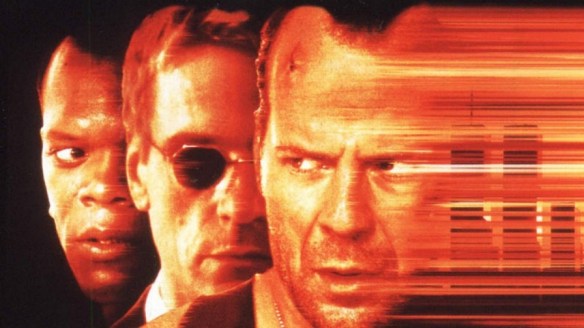
It’s summer, and when it comes to Hollywood, summer means big blockbuster action movies. One of my favorites is the Bruce Willis / Samuel L. Jackson modern classic Die Hard With a Vengeance.

For those who are unfamiliar with the film — shame on you! — it’s the third installment of the Die Hard franchise, featuring catchphrase-spouting New York City cop John McClane battling terrorists, criminals, and all sorts of unsavory characters.

In Die Hard With a Vengeance, a bomber named Simon is terrorizing the city and McClane is one of his playthings, forced to play Simon Says and accomplish increasingly difficult tasks that Simon sets before him. As McClane (and electrician Zeus Carver, who saves McClane from the first of Simon’s games) race around the city trying to prevent other bombs from going off, Simon enacts an elaborate scheme to rob the city.

Thankfully, McClane and Zeus have a knack for brain teasers and riddles, because several of Simon’s devious tasks require quick thinking and sharp puzzle skills.

diehardwithavengeance1

[One of the last movies to feature payphones as a key plot point…]

First, Simon hits them with a math problem:

As I was going to St. Ives, I met a man with seven wives. Each wife had seven sacks, every sack had seven cats, every cat had seven kittens. Kittens, cats, sacks, wives. How many were going to St. Ives?

As McClane fervently tries to do multiplication in his head, Zeus realizes this isn’t a word problem, it’s a riddle. The man was going to St. Ives when he met this man, meaning the man was coming from St. Ives. So the wives, sacks, cats, and kittens are irrelevant. Only the narrator is going to St. Ives, so the answer to the riddle is 1.

stives-1886892

[Seems like a nice place to take your many wives…]

In their second puzzly task, Simon offers the following question:

“What has four legs and always ready to travel?”

McClane doesn’t get it, but Zeus immediately identifies it as an elephant joke for kids (although he doesn’t actually deliver the punchline: an elephant, because it has four legs and a trunk).

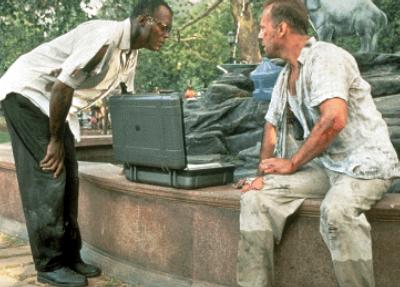
They quickly spot a nearby fountain with an elephant statue. Awaiting them is a suitcase bomb and two empty jugs. When McClane opens the suitcase, he accidentally arms the bomb, and Simon calls to inform them that the only way to disarm the bomb is to fill one of the jugs with exactly four gallons of water and place it on the scale in the suitcase.
die-hard-vengeance-laptop

[And they say what we learn in school has no practical, real-world applications…]

The problem is the two jugs hold 3 gallons and 5 gallons, respectively. Simon has set them up with another brain teaser, but one with a dire time limit to solve.

Thankfully, there are two ways to solve this brain teaser.

Method #1

  • Fill the 3-gallon jug and pour the water into the 5-gallon jug.
  • Refill the 3-gallon jug and pour the water into the 5-gallon jug until the 5-gallon jug is full, leaving 1 gallon in the 3-gallon jug.
  • Empty the 5-gallon jug and pour the 1 gallon of water from the 3-gallon jug into the 5-gallon jug.
  • Fill the 3-gallon jug again and empty it into the 5-gallon jug, leaving exactly 4 gallons in the 5-gallon jug.

Method #2

  • Fill the 5-gallon jug and pour that water into the 3-gallon jug until the 3-gallon jug is full, leaving 2 gallons in the 5-gallon jug.
  • Empty the 3-gallon jug and pour the 2 gallons of water from 5-gallon jug into the 3-gallon jug.
  • Refill the 5-gallon jug and pour that water into the 3-gallon jug until the 3-gallon jug is full, leaving 4 gallons in the 5-gallon jug.

Either way, you’ve disarmed the bomb. Good job!

140-billion-die-hard

[While Simon has McClane and Zeus run
all over the city, he has one specific goal…]

The final riddle Simon gives Zeus and McClane is another brain teaser masquerading as a math problem:

“What is 21 out of 42?”

At the time of the film’s release, there had been 42 presidents, so 21 out of 42 was President Chester A. Arthur, and Chester A. Arthur Elementary School was where Simon had hidden one of his bombs (a fake one, as it turns out) as a distraction.

In the end, McClane and Zeus outwit the cunning Simon, and once again, puzzle-solving skills save the day! Hooray!

Thanks for visiting PuzzleNation Blog today! You can share your pictures with us on Instagram, friend us on Facebook, check us out on TwitterPinterest, and Tumblr, and be sure to check out our library of PuzzleNation apps and games!

It’s Follow-Up Friday: Parking Lot edition!

Welcome to Follow-Up Friday!

For those new to PuzzleNation Blog, Follow-Up Friday is a chance for us to revisit the subjects of previous posts and update the PuzzleNation audience on how these projects are doing and what these people have been up to in the meantime.

And today, in the spirit of yesterday’s post about The Riddler, I’d like to post a brain teaser for you to solve!

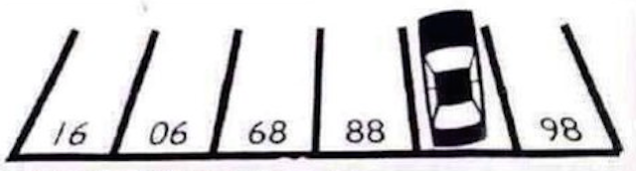
Can you explain the numbering system in this parking lot?

Also, do you have any favorite riddles or brain teasers? Let us know and we might feature them in a future post!

Thanks for visiting PuzzleNation Blog today! You can share your pictures with us on Instagram, friend us on Facebook, check us out on TwitterPinterest, and Tumblr, and be sure to check out the growing library of PuzzleNation apps and games!

Riddle Me This, Batman!

With so much Dark Knight-related news floating around, this might very well be the Year of Batman.

Not only is it the 75th anniversary of Batman’s first appearance in comics, but he’s going to be all over screens in the coming months. There are already teaser images out for the 2016 Batman Vs. Superman film, plus Fox’s upcoming prequel drama Gotham. As if that wasn’t enough, it was recently announced that the entire 1960s television series is coming to DVD and Blu-ray!

So it’s the perfect opportunity to take a look at Batman’s puzzliest foe, The Riddler.

Played by Frank Gorshin (and John Astin, in one episode) in the 1960s TV series, The Riddler was absolutely manic, often breaking into wild fits of anger and laughter, compulsive in his need to send taunting riddles to the Caped Crusader. (This actually became a point of contention with his fellow villains in the Batman film, since they didn’t appreciate Batman being tipped off to their plans by the Riddler’s riddles.)

His riddles were similarly inconsistent and unpredictable. Some of them were genuine puzzlers (highlight for answers):

  • How do you divide seventeen apples among sixteen people? Make applesauce.
  • There are three men in a boat with four cigarettes but no matches. How do they manage to smoke? They throw one cigarette overboard and make the boat a cigarette lighter.

Others were similar to children’s jokes, silly in the extreme:

  • What has yellow skin and writes? A ballpoint banana.
  • What suit of cards lays eggs? One that’s chicken-hearted.

While Gorshin’s Riddler is probably the most famous and familiar version of the villain, my personal favorite was the Riddler in Batman: The Animated Series.

This Riddler (voiced by actor John Glover) was more suave, sophisticated, and cunning. In his debut episode, entitled “If You’re So Smart, Why Aren’t You Rich?”, he challenged Batman and Robin with a boobytrap-filled labyrinth, complete with numerous riddles that were far more challenging than Gorshin’s Riddler would ever use.

Fittingly, a final riddle — the Riddle of the Minotaur — awaits Batman at the center of the labyrinth. Can you solve it?

I have millions of eyes, but live in darkness.
I have millions of ears, but only four lobes.
I have no muscles, but I rule two hemispheres.
What am I? The human brain.

This version of the Riddler only appeared a few times in the animated series, due to the writers’ difficulty coming up with his riddles and keeping his complex plots simple enough to fit into a single episode’s runtime. Nonetheless, this Riddler remains a fan favorite.

In the film Batman Forever, Jim Carrey actually gives us three versions of the Riddler: the scientist Edward Nygma (who definitely has a screw or two loose), the businessman Edward Nygma (a charming, public facade betraying none of his truly villainous tendencies), and the Riddler (a diabolical, borderline insane villain with an ax to grind with Bruce Wayne). Whether you like Carrey’s take on the character or not, he embodies an effective combination of Gorshin and Glover’s Riddlers.

Of course, despite his bizarre plan to read people’s minds through television and become smarter by doing so, this Riddler had one advantage over the previous versions: he had puzzlemaster Will Shortz designing his riddles for him.

While each riddle by itself meant little, except for providing a challenge to Batman’s intellect, all of them combined revealed the Riddler’s identity and set up the final showdown between the heroes and villains.

As for the newest version of the Riddler in Fox’s fall premiere Gotham, we don’t know a lot about him, since this is set in the days before Batman prowled the streets.

Apparently, the younger Edward Nygma (played by theater actor Cory Michael Smith) is a forensic scientist working for the police (who may formulate his notes in the form of riddles).

Hopefully, this Riddler will carry on the fine tradition of Riddlers past, challenging the defenders of Gotham to outthink him, rather than outfight him.


Thanks for visiting PuzzleNation Blog today! You can share your pictures with us on Instagram, friend us on Facebook, check us out on TwitterPinterest, and Tumblr, and be sure to check out the growing library of PuzzleNation apps and games!
Carroll’s classic conundrum!

After my post on Brain Melters (the diabolical siblings of brain teasers), I’ve had riddles on the brain, one in particular.

There’s a famous riddle that compares a raven and a writing desk. It was first penned by the brilliant, controversial, and utterly ridiculous Lewis Carroll.

The Hatter asked Alice, “Why is a raven like a writing-desk?”
“I give up,” Alice replied. “What’s the answer?”
“I haven’t the slightest idea,” said the Hatter.
Alice sighed wearily. “I think you might do something better with the time,” she said, “than waste it in asking riddles that have no answers.”

It was purposely devised as a riddle with no answer — prime Brain Melter territory — but that hasn’t stopped people from trying to solve it in various silly, pragmatic, and clever ways through the years.

A practical answer is “They both have legs”, but not only is that terribly boring, but it seems to abruptly ignore Carroll’s legacy of whimsy and logodaedaly.

(Come on, it wouldn’t be a truly Lewis Carroll-worthy post without some curious vocabulary. *smiles* And a pat on the back to those who didn’t have to look it up!)

Many people have incorporated assonance, rhyme, and wordplay into their solves. Here are some of the possible solutions people have conjured over the years:

–It is used to carry on work and work carrion.
–Because the raven has a secret aerie and the writing desk is a secretary.
–It understands its tails and quills would nevar [sic] work with the wrong end in front. (This is a variation on the answer Carroll eventually provided)

Carroll himself was quoted as saying that a raven is like a writing-desk “because it can produce very few notes, tho they are very flat; and it is nevar [sic] put with the wrong end in front.”

Despite Carroll’s typically obtuse and curious response, several sources have stated that the correct answer is that “dark wing site” is an anagram for “a writing desk”.

Ignoring all of these possible solutions, I prefer the one I consider the most simple, the most clever, and the most sensible…

How is a raven like a writing desk? Poe wrote on both. =)

Thanks for visiting the PuzzleNation blog today! You can like us on Facebook, follow us on Twitter, check out our Classic Word Search iBook, play our games at PuzzleNation.com, or contact us here at the blog!