Product Review: Gravitrax Starter-Set XXL

[Note: I received a free copy of this game in exchange for a fair, unbiased review.]

There’s something immensely satisfying about building a contraption and then setting it into motion. Marble runs, Rube Goldberg devices, clockwork toys, chain reactions… they all involve a meticulous step-by-step creation process that builds anticipation as you go.

And then finally, you get to pull the string, throw the lever, drop the marble… and enjoy the clicky-clacky fruits of your labor.

But I don’t think I’ve ever encountered a game that makes it both as challenging AND as effortless as Gravitrax does.

Allow me to explain.

Gravitrax takes the traditional marble run formula — gravity x (tracks + ramps) = good times — and improves it in every way.

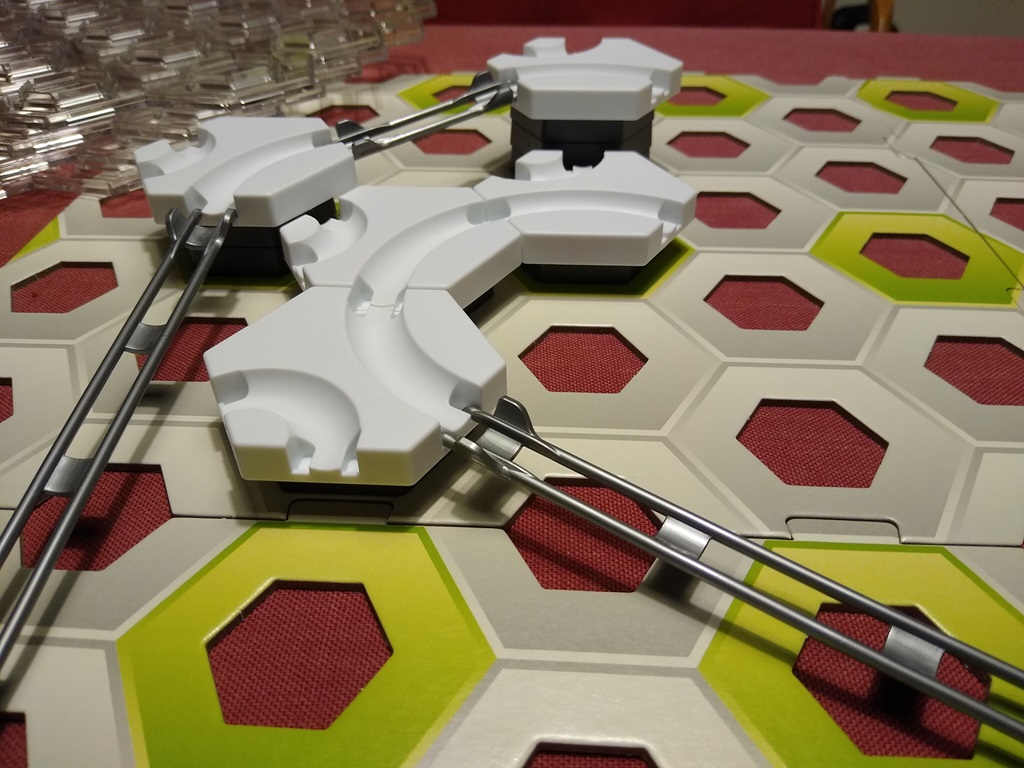
The hexagon matting provides a stable base that not only makes it easy to follow the instructions included for all sorts of designs, but makes the entire design perfectly steady. Every piece fits snugly into the hexagons, so there’s none of the wobbly uncertainty that can ruin a flawless marble run.

Factor in ALL of the pieces provided in the Starter-Set XXL — columns of two different thickness to raise pieces, plates to create entire new levels to build speed, curves and connectors galore, plus specialty pieces to add new tricks and challenges — and you have an amazing launchpad for creating your kinetic designs.

So much thought has been put into all of the pieces included. There’s a triple launcher so you can race multiple marbles along different paths OR set up different chain reactions all at once to dazzle the eye.

There’s even a magnetic accelerator that can launch a ball uphill to add further distance to your track!

The instruction books are another standout part of the package. Like a LEGO manual, they’re completely wordless, and yet, everything is crystal clear. The first book introduces all the pieces and how to use them, while the second (much thicker!) handbook offers all sorts of designs to try out, starting from simple to complicated and challenging ones. There are six difficulty ratings in all.

And the instructions lend themselves to puzzly minds. They show you the finished product first, so if you want to try to puzzle out how to build it yourself, you’re welcome to. If not, just keep reading, and you can follow the step-by-step instructions, complete with piece listings so you know exactly what you need for each step.
I’ve been a sucker for kinetic puzzles and games like this my whole life, and I can only imagine the crazy contraptions and high-speed runs younger me would have spent hours testing and assembling with a kit like this.

So when I say it’s both effortless and challenging, I mean it. This incredibly well-designed set can be picked up by a child immediately, and yet, there’s enough adaptability and opportunity here for new designs, more innovative builds, and limit-pushing attempts at speed and complexity.

I mean, it’s nearly 2 AM as I write this, because I spent two hours trying out a new idea I had instead of writing this review.

I’m not sure I can pay the Gravitrax Starter-Set XXL a higher compliment than that.

[The Gravitrax line of building toys is for any number of players, ages 8 and up, and it’s available from Ravensburger and participating websites (in numerous models and styles). The Gravitrax Starter-Set XXL starts at $129.99.]

Product Review: That’s Not a Hat

[Note: I received a free copy of this game in exchange for a fair, unbiased review.]

Most memory games are pretty simple, falling into one of two categories: you either observe a pattern and repeat it, or you look at multiple items and remember where they are when hidden/concealed.

Memory games that include a social mechanic are rarer, and memory games with a social mechanic AND bluffing are rarer still.

Imagine a white elephant or Yankee swap gift exchange, except in reverse. You know what all the gifts are to start, but then they are wrapped one by one and traded around, and you need to remember what’s inside each one.

That’s the main idea behind Ravensburger’s social memory game That’s Not a Hat, and it’s brilliantly simple… until it is suddenly not so simple.

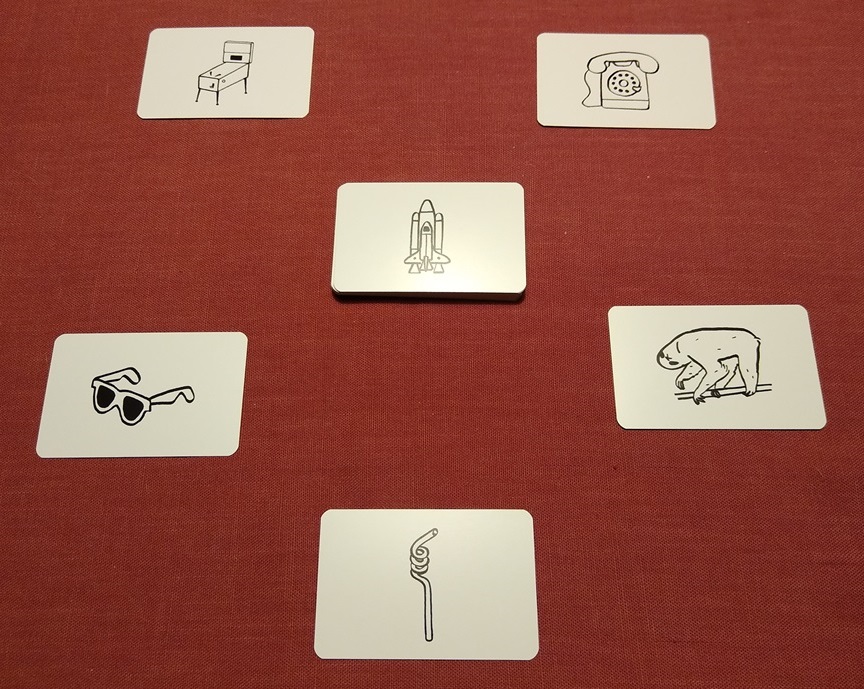
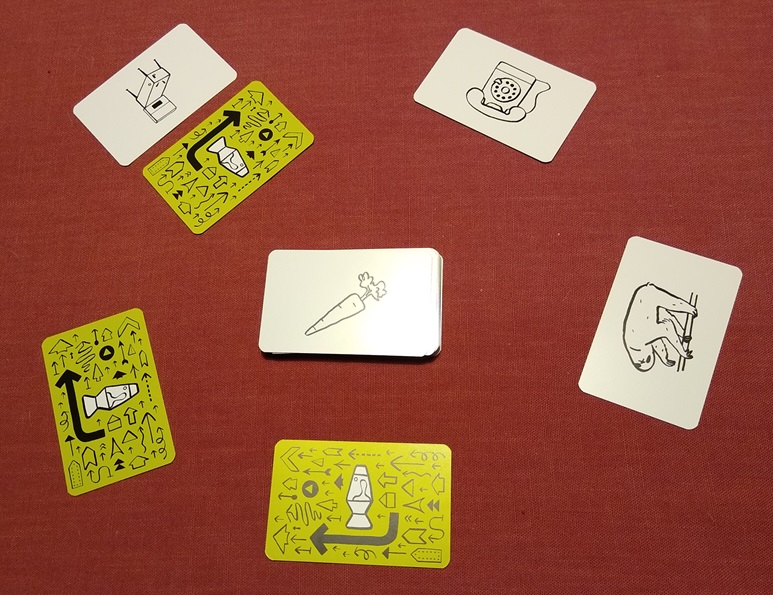
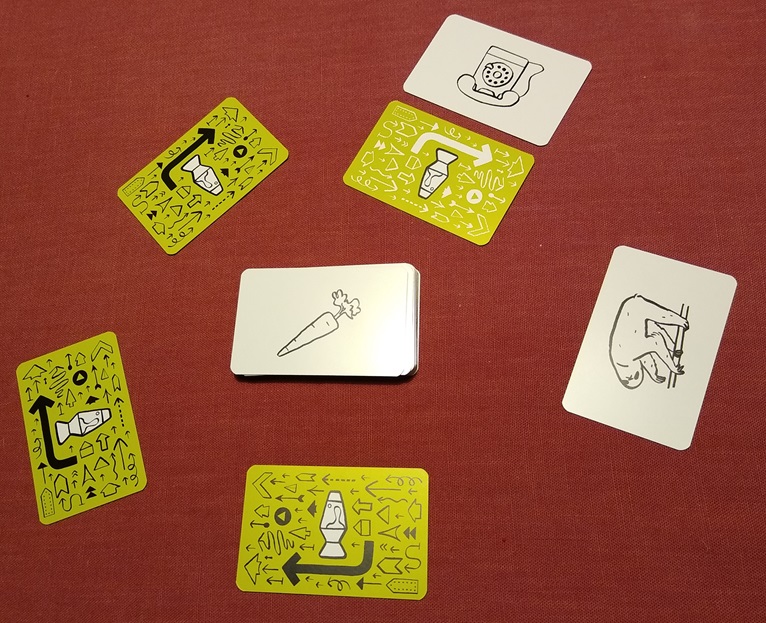
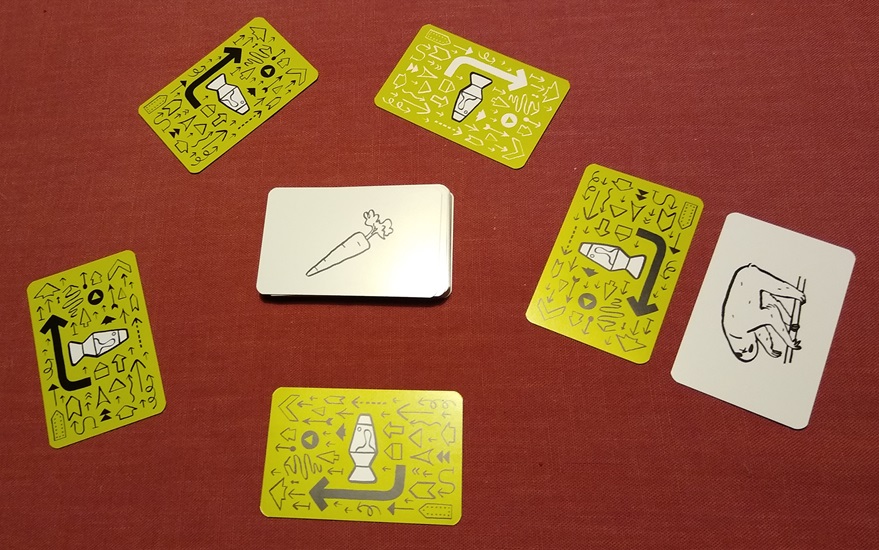
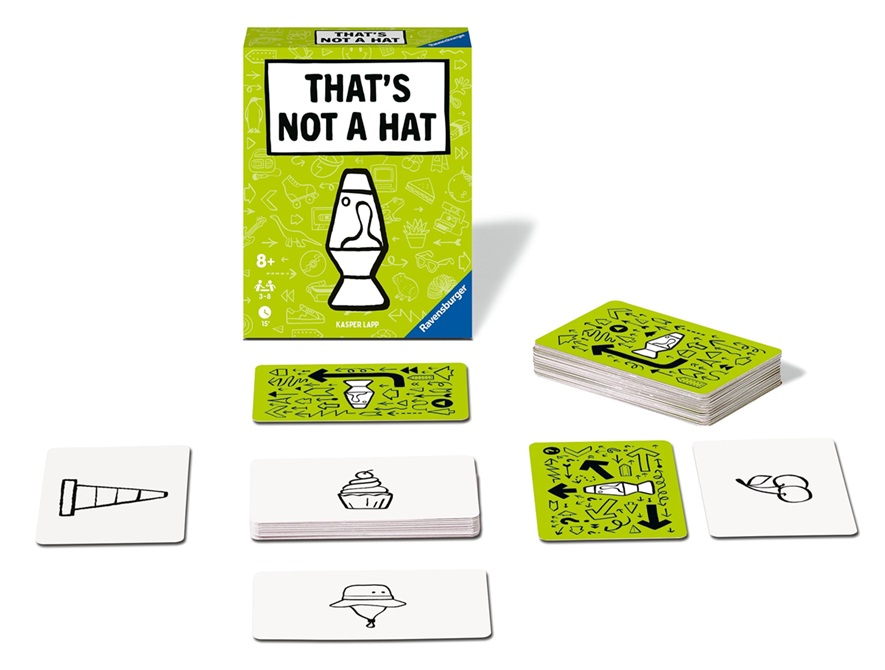
As you can see, everyone starts with a gift. The first player pulls a new gift from the stack in the center of the table, shows it to everyone, then places it facedown.

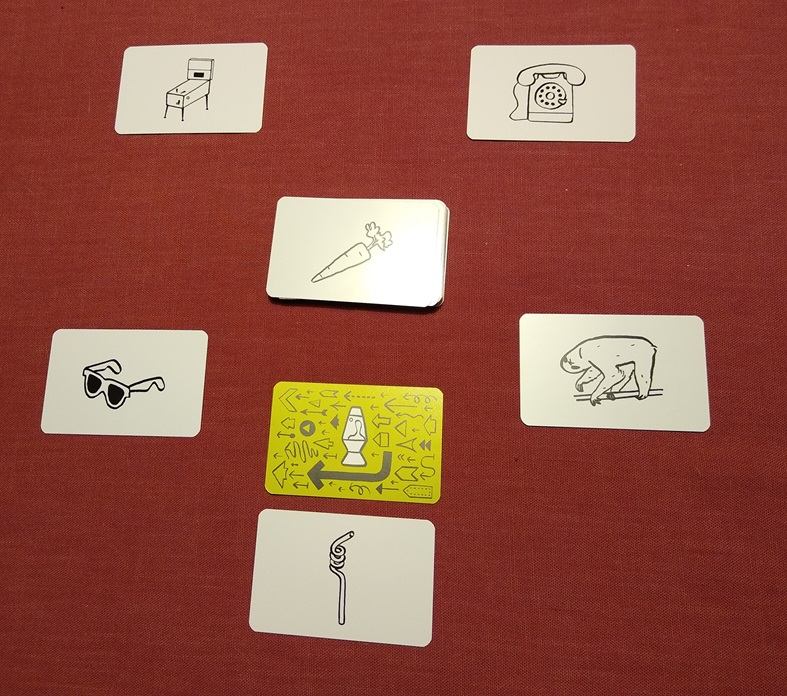
They then hand that gift to the player indicated by the arrow on the back of the card.

So the player to the right with the sloth card received the space shuttle, flipped it over, and handed it to the swizzle stick player to their left, saying “I have a nice space shuttle for you.”

The player receiving the gift has two options: accept the gift (meaning that they know it’s a space shuttle underneath and agree with the gift giver) or refuse the gift (meaning that they suspect the item underneath is NOT what the gift giver said).

In this case, the game has just started, so our swizzle stick player accepts the gift.

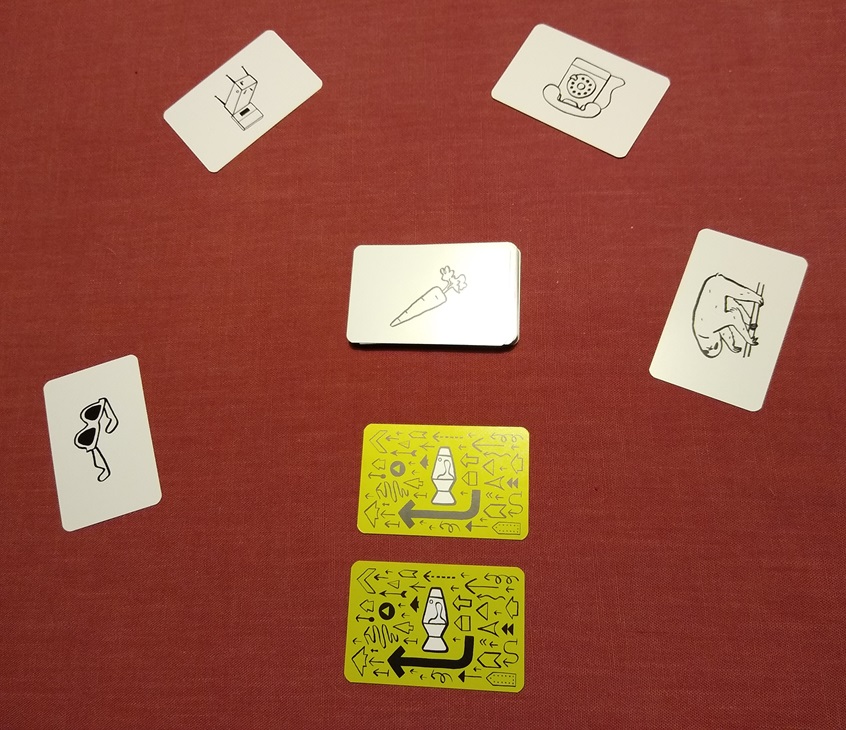
It would be rude to immediately regift what they were just given, so the swizzle stick player turns over their “old gift” and follows the arrow, saying “I have a nice swizzle stick for you” and giving that card to the player to the left (the sunglasses player).

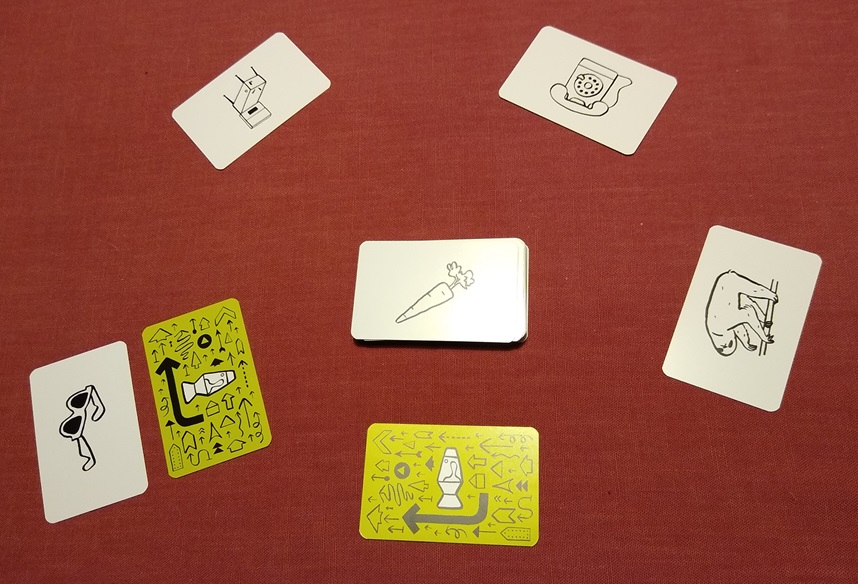
The sunglasses player accepts, turns over their old gift, says their line, and follows the arrow.

In this simplified version, the arrows only go in one direction, whereas in the regular game, arrows can go left or right (or, in the advanced play style, to any player, depending on the arrows).

Now, as the cards continue moving around from player to player, can you remember what was under all those cards? You’re gonna have to, because it gets harder and harder to remember what each card represents.

Eventually, someone is going to forget, and their “I have a nice __ for you” is going to be met with a refusal. If the refusing player is correct and the gift giver has forgotten what’s under the card, the gift giver takes that card and gets a point. If the refusing player is incorrect and the gift giver correctly remembered what’s under the card, then the refusing player takes the card and gets a point.

The game then resumes with a new present and all the previous cards STILL flipped over. The game ends when one player gets three points.


This combination of memory, interaction, and bluffing (if you forget what’s under your card) makes for a very fun, very mellow play experience, one that only grows tougher and more entertaining the more you play.

On the second game, I had so many images in my head from previous rounds that I immediately forgot what was under my card and earned a point.

With up to eight players at the table, 110 cards to choose from, plus mechanics to make the game easier or harder for the players, That’s Not a Hat is instantly replayable and never feels tired.

Now, you may start to worry about your memory before too long. It’s okay, though, because you’ll quickly be distracted by the laughter (and bad bluffs) to come.

[That’s Not a Hat is for 2 to 8 players, ages 8 and up, and it’s available from Ravensburger and participating websites (in two editions) starting at only $9.99!]

The World of Wooden Puzzles!

dragon1

Puzzles come in all shapes and sizes, adopting numerous forms that challenge the mind in seemingly endless ways.

While I spend a lot of time on PuzzleNation Blog talking about pen-and-paper puzzles (and their electronic siblings), today I’d like to focus on a brand of physical puzzles: ones made of wood!

As you’d expect, there are hundreds of different puzzles to choose from when discussing wooden puzzles, but I’ve tried to narrow the field down to a manageable size. Enough chatter, let’s get to it!


Sliding Tile Puzzles

[Available from FineWoodenToys.com.]

One of the oldest varieties of physical puzzles, sliding tile puzzles can be found in plastic, electronic, and wooden forms. And whether you’re shifting pieces in order to create a picture or pushing tiles around in order to put numbers in a specific order, the chain-solving technique is the same.


Tangrams

[Available from BrilliantPuzzles.com.]

A tactile and intuitive brand of puzzling, tangrams are a staple of the wooden puzzle market, utilizing simple geometric shapes in order to match designs or fit the pieces into a given space, as in the image above.


Brain Teasers

[Available from Mango Trees.]

These beautiful and elegant puzzles involve a level of craftsmanship and attention to detail that goes far beyond the usual mechanical puzzle experience.

Sometimes, you’re figuring out how to disassemble a shape into its component pieces (six examples of this sort of puzzle-solving appear above), while in others, you have to remove a given piece from a more complex arrangement, often involving ropes and other obstacles that interact with the wooden puzzle itself.


Puzzle Boxes

[Image found on FineWoodworking.com.]

A practical sibling of the brain teasers above, a puzzle box offers an additional incentive to the solving experience, since puzzle boxes can make terrific delivery mechanisms for cash or other gifts. (Sometimes solving them involves only one step, other times it can involve a dozen or more!)

My younger sister has a habit of employing puzzle boxes like the one pictured below to make my oldest nephews work a little harder for their birthday money. (One particularly diabolical design involved concealed magnets holding the trick access point shut.)

[Available from Pandora’s Puzzle Boxes.]


Labyrinths

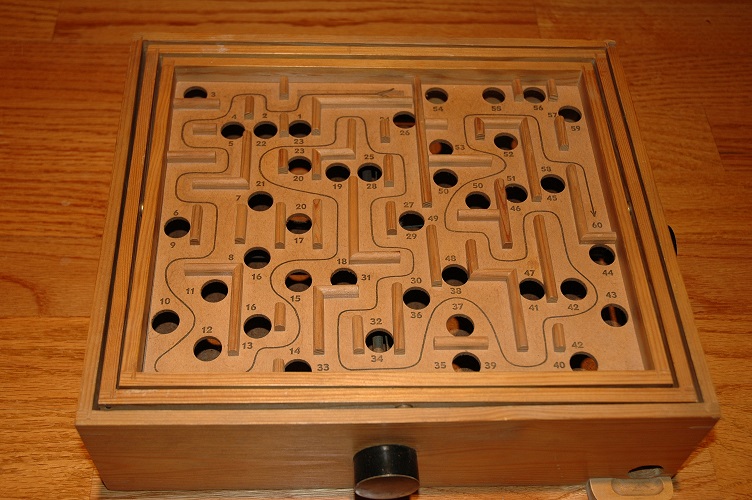
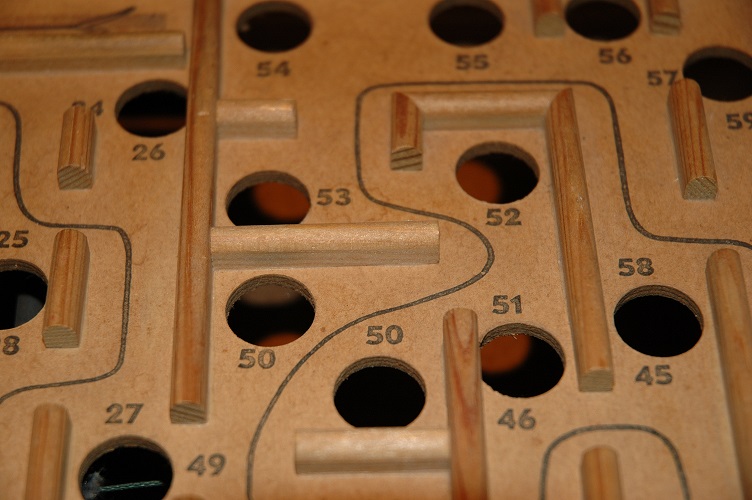
Everyone knows the goal of a maze or labyrinth: to get through it with as few wrong turns as possible. But when you have to navigate a steel ball through the labyrinth without falling into one of many pits, that becomes an even greater challenge.

Whether you’re using handles to manipulate the maze and allow gravity to shift the ball from point to point or turning the labyrinth this way and that in order to move the ball toward the finish line, your dexterity and patience are sure to be pushed to the limit.


Jigsaw Puzzles

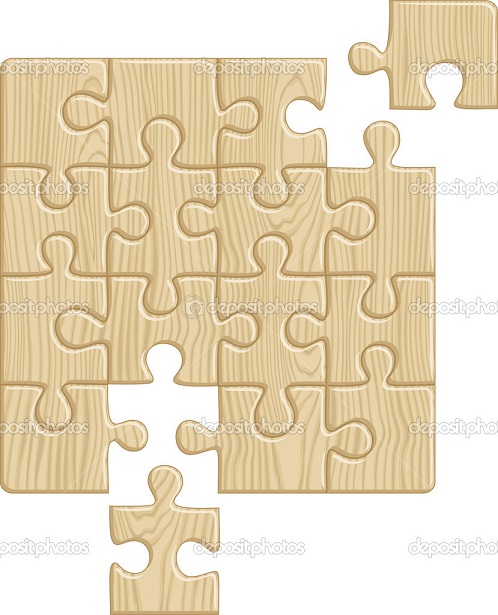
I would be remiss if I ignored the most common variety of wooden puzzle: the jigsaw puzzle!

Whether we’re talking about the more traditional shapes in a Ravensburger puzzle or a jigsaw incorporating unique and interesting pieces like those produced by Wentworth or our friend Rachel Happen of Baffledazzle (like the ones pictured below), jigsaw puzzles are among the first puzzles to which a young child is exposed.


3-D Jigsaw Puzzles

Of course, despite the many tough jigsaw puzzles available these days, you might be looking for a jigsaw with an additional dimension of difficulty. Thankfully, there are 3-D puzzles to give your spatial reasoning a run for its money!

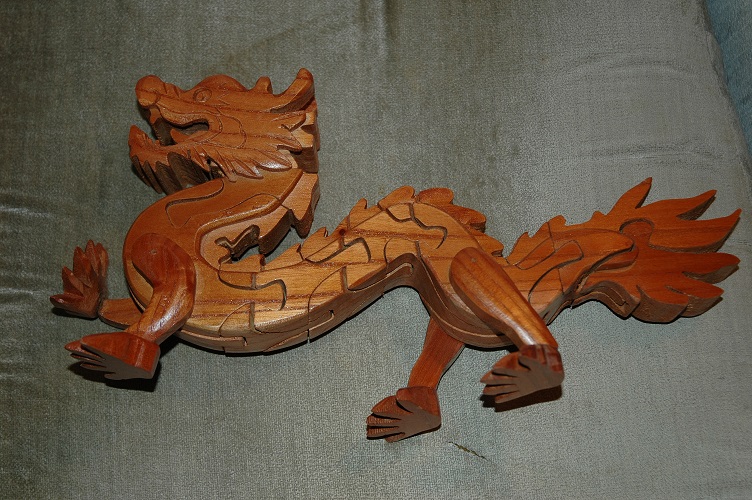
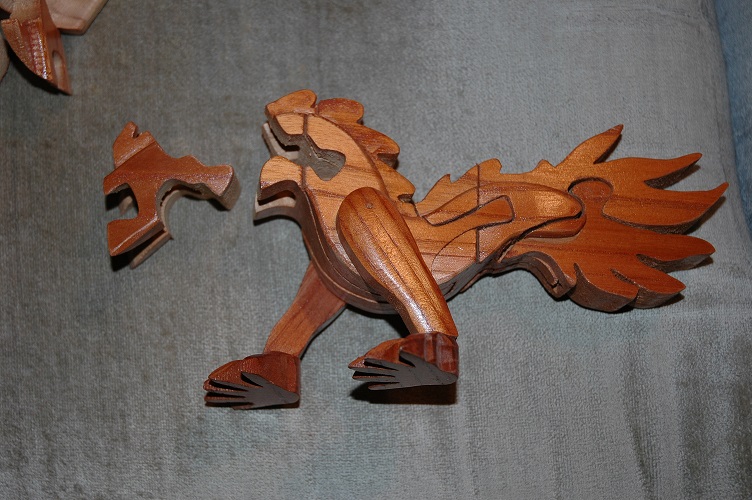
Both the dragon at the top of the page and the camel pictured above are 3-D puzzles that were sent to me by the lovely Sara Kingsland, owner of Completely Puzzled in Port Townsend, Oregon.

And let me tell you, these puppies put my jigsaw skills to the test. Let’s look at the camel disassembled:

Is it immediately clear to you how to proceed? It certainly wasn’t to me! Now let’s look at the dragon disassembled:

dragon2

Believe it or not, I solved the dragon before the camel!

dragon3

This is because the puzzles involve different approaches. The dragon was designed to be assembled from tail to head, and rarely required me to hold more than two pieces at a time to continue solving it.

The camel, on the other hand, has to be solved legs first, which means holding numerous pieces in place while manipulating others in order for everything to come together.


With the advent of laser printing, the sky is truly the limit when it comes to imagining new and challenging wooden puzzles. I can’t wait to see what these wickedly brilliant puzzlers come up with next.

Are there any types of wooden puzzle I missed, fellow puzzlers and PuzzleNationers? Let me know! (Other than Scrabble, that is. I left that one off the list intentionally.) And while you’re at it, tell me what your favorite kind of wooden puzzle is!

Thanks for visiting PuzzleNation Blog today! You can share your pictures with us on Instagram, friend us on Facebook, check us out on TwitterPinterest, and Tumblr, and be sure to check out the growing library of PuzzleNation apps and games!

It’s Follow-Up Friday: Games Across the World edition!

Welcome to Follow-Up Friday!

By this time, you know the drill. Follow-Up Friday is a chance for us to revisit the subjects of previous posts and bring the PuzzleNation audience up to speed on all things puzzly.

And today, I’d like to revisit International Games Day!

The American Library Association has been promoting community through gaming for years with International Games Day, and last Saturday, November 15, was the latest edition of this marvelous holiday.

Libraries across the world opened their doors to puzzle fans, board game devotees, card players, gamers, and especially families, inviting them to socialize and share culture through a common medium: games!

I’ve been meandering through photo archives, checking out all the great events and fun ways people have gotten into the IGD spirit.

Check out this giant-sized Settlers of Catan board, created by one intrepid dad so more kids could get in on the fun!

Each year, game and puzzle companies donate to libraries, giving both needy libraries and newbie game players the chance to try out some terrific games. This year was no exception, as Ravensburger, USAopoly Games, Steve Jackson Games, and Looney Labs all donated games to various libraries in support of this terrific holiday.

[Two tweets from a grateful librarian after some awesome donations to their upcoming IGD event.]

But, of all the anecdotes I’ve encountered, my favorite concerns an event hosted at last year’s International Games Day: the Global Gossip Game.

You know the game Telephone, right? Where you whisper a message in your friend’s ear, and they whisper what they heard to another person, and so on and so on, and eventually, you see how the original message has changed from the beginning?

Imagine that, but touching all 7 continents.

From the ALA.org site:

The game began in Geelong, Australia, as “Play is training for the unexpected” (from a paper by biologists Spinka, Newberry and Bekoff).

It then traveled through Antarctica, Asia, Africa and Europe, then branched twice in the Americas. The three endings on the day were:

“I love the world” in Washington, DC;
“Zombie” in Winlock, Wash.; and
“Clouds travel around the world” in Talkeetna, Ark.

In all, the GGG had 840 participants and ran for 29 hours straight, through 74 libraries in 18 international jurisdictions and 6 languages. The longest branch traveled 114,609 kilometers (71,230 miles), and the total distance traveled was 151,927 kilometers (94,423 miles).

Now THAT is some international community building.

Thanks for visiting PuzzleNation Blog today! And remember to check out our Facebook Giveaway for the chance to win a free puzzle app download!