A Mysterious Message, Inscribed on a Sword, Found in a River

_103722388_d0c23635-6379-4bf7-bac8-478493c2d1c7

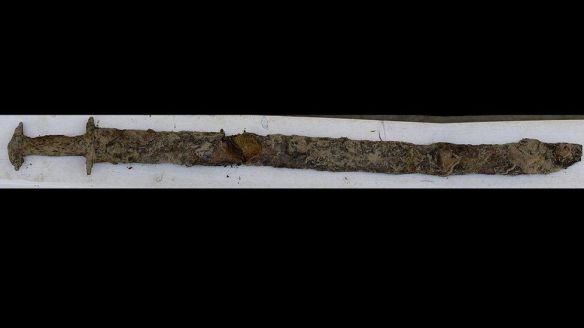
A few years ago, a very curious news story broke about an 8-year-old girl pulling a thousand-year-old sword out of a lake in Sweden.

Saga Vanecek — which sounds like the heroine of a YA novel series begging for a Netflix adaptation — discovered the sword while playing in the lake. The Jönköpings Läns Museum estimated that the sword is at least a thousand years old, and could be as old as 5th or 6th century.

No one is sure how it got there, but everyone agrees it’s an amazing find. (And many agree that Saga should now be queen. Hey, there are worse ways to choose a ruler.)

But there’s another story about a sword found in a body of water with an even stranger mystery attached: the River Witham sword.
river witham sword 1

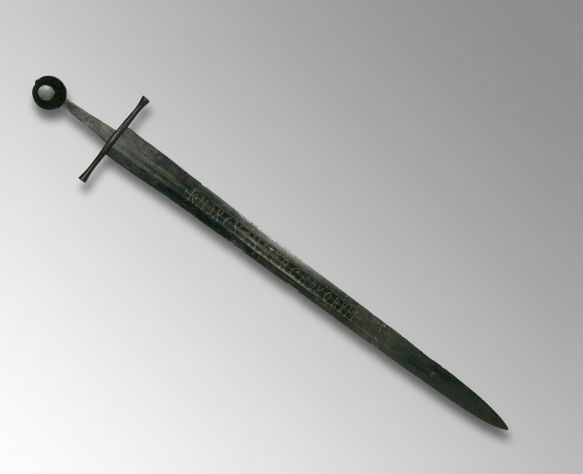
There are actually two River Witham swords — it’s just the right river to go sword-hunting in, I suppose — but we’re talking about what’s known as the River Witham “knightly sword.”

It was discovered in the river in 1825 and turned over to the Royal Archaeological Institute. It is now in the hands of the British Library.

And for more than two centuries, the meaning of the inscription has remained a mystery.

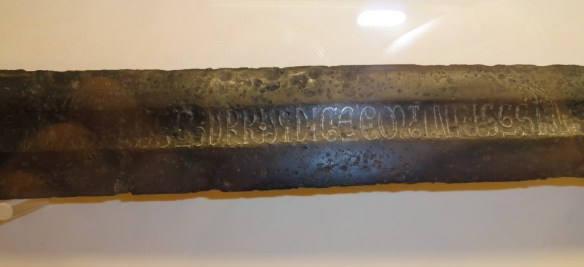
Inlaid along one of the sword’s edges, spelled out in gold wire, curious eyes find the following chain of letters:

+NDXOXCHWDRGHDXORVI+

Is it an abbreviation? An encryption? Or simply patterning in the shape of letters? No solid answers emerged during decades of study.

Eventually, the British Library decided to crowdsource the puzzle in the hopes of finding a solution. In 2015, officials from the library officially reached out to the public to finally crack the code detailed along the blade.

All sorts of amateurs and professionals weighed in, exploring possibilities in Latin, Welsh, German, Irish, Sicilian, and others. They compared it to the medal of St. Benedict and other medieval engravings in search of patterns.

And the British Library shared one contributor’s thoughts as an addendum to their original post about the River Witham sword.
alphen blade

[The Alphen aan den Rijn sword-blade.]

Historian Marc van Hasselt compared the sword to others from the same time period, roughly around the year 1200, and believed it was safe to assume the language was Latin.

He compared the inscription from the River Witham sword — +NDXOXCHWDRGHDXORVI+ — with an inscription on a Dutch sword-blade found in Alphen aan den Rijn, the Netherlands. That blade was inscribed on both sides:

+BENEDOXOFTISSCSDRRISCDICECMTINIUSCSDNI+

+DIOXMTINIUSESDIOMTINIUSCSDICCCMTDICIIZISI+

He explains his thought process:

To elaborate, let’s compare the River Witham sword to the sword from Alphen: both start with some sort of invocation. On the River Witham sword, it is NDXOX, possibly standing for Nostrum Dominus (our Lord) or Nomine Domini (name of the Lord) followed by XOX.

On the sword from Alphen, the starting letters read BENEDOXO. Quite likely, this reads as Benedicat (A blessing), followed by OXO. Perhaps these letter combinations – XOX and OXO – refer to the Holy Trinity. On the sword from Alphen, one letter combination is then repeated three times: MTINIUSCS, which I interpret as Martinius Sanctus – Saint Martin. Perhaps a saint is being invoked on the River Witham sword as well?

Unfortunately, the British Library’s investigation seems to have stopped there after the intriguing contributions of van Hasselt.

But, thankfully, there is always SOMEONE on the Internet trying to solve a seemingly unsolvable mystery. I did a bit of sleuthing and found a post on medium.com, originally posted in February of 2017, with a very through breakdown of a potential solution to the River Witham sword!
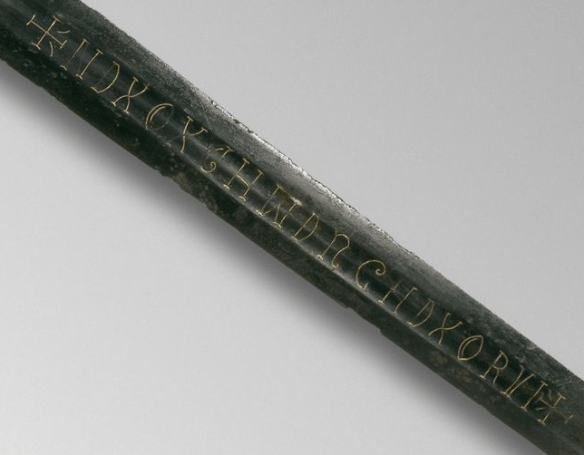
river witham sword 2

[A closer look at the River Witham sword inscription.]

The author of the piece, Stieg Hedlund, started by focusing on the W in the inscription, since the classical Latin alphabet didn’t have a W. Surmising that the inscription was an initialism — which is common for Latin inscriptions — he started looking for an aristocratic name starting with W.

Why aristocratic? Well, not just anyone in the 1200s or 1300s could afford a sword with gold wire inscriptions.

He quickly settled on some variation of William for the W, and then narrowed his search to Willem II of Holland, a count, and the initialism CHW on the sword could mean Comes Hollandia Willelmus, his name and title in Latin.

william of holland

Following that line of thought and digging into the history of Willem II revealed that he ruled not only Germany, but the southern Belgian region of Hainault as well.

This gives him “Comes Hollandia Willelmus Dei gratia, Rex Germania et Hainault Dei nutu” to cover CHWDRGHD in the inscription.

When he turned his attention to the first five letters, he agreed with the supposition of Marc van Hasselt and others that it referenced “in Nomine Domini” and the XOX represented the Holy Trinity.

So that covers NDXOXCHWDRGHD, approximately two-thirds of the inscription. What about XORVI?

Well, Hedlund believes the solution lies in Laudes Regiæ, a Catholic hymn most famous for its opening words: Christus vincit! Christus regnat! Christus imperat! (In English: Christ conquers, Christ reigns, Christ commands.)

Abbreviated versions of these words were often used by kings and royalty to solidify their position by tying themselves to the church. On a coin issued by Holy Roman Emperor Charles VI in 1384, you can read one rendition of the phrase: XPiσtoC VinCIT XPiσtoC RegnAT XPiσtoC InPERAT.

He believes XORVI is an abbreviated version, reading “XpiσtOσ Regnat! (xpiσtoσ) Vincit! (xpiσtoσ) Imperat!” where the capital letters form the inscribed message.

So, the completed message would read:

(in) Nomine Domini
Comes Hollandia Willelmus Dei (gratia), Rex Germania et Hainault Dei (nutu)
XpiσtOσ Regnat! (xpiσtoσ) Vincit! (xpiσtoσ) Imperat!

Or, in English:

In the Name of the Lord; of the Father and of the Son, and of the Holy Ghost
Count of Holland Willem by the grace of God, King of Germany and Hainault by the will of God
Christ reigns! Christ conquers! Christ commands!

It’s a compelling case, and certainly the most complete interpretation and explanation I’ve been able to find.

Imagine. All of that in that brief, beautiful, confusing inscription. It’s fascinating, and makes the mind positively whirl with possibilities.

Oh, and if you find any centuries-old swords while you’re perusing the nearby waterways, let me know! We might have a new mystery to solve.


Thanks for visiting PuzzleNation Blog today! Be sure to sign up for our newsletter to stay up-to-date on everything PuzzleNation!

You can also share your pictures with us on Instagram, friend us on Facebook, check us out on TwitterPinterest, and Tumblr, and explore the always-expanding library of PuzzleNation apps and games on our website!

Puzzly Ways to Manage Stress!

stress ball

Stress is a killer, no doubt about it. Everyone needs ways to escape it, to mitigate it, and to give their mind and body a break from the pressures of stressful situations.

There are all sorts of products out there and suggestions for how to manage stress, but in the last few years, there has been a marked increase in what are known as “stress toys” or “fidget widgets.” Sure, stress balls have been around for years, but now we have things like fidget spinners, fidget cubes, tangle toys, and more. These items are specifically designed to be played with, but they have no actual GOAL built in. Often, these items are played with while the person focuses on other thoughts.

And that’s the key. Many people find puzzles and games relaxing and distracting, but the fact that there is a goal attached — solving the puzzle, completing or winning the game — means the item is less effective at managing stress than other items where there is no inherent goal beyond play.

As reported by The Atlantic, a study by the Polytechnic Institute of New York University stated that playing with small toys can help relieve stress, enhance productivity, and aid in memory. Yes, that person doodling during the meeting might retain more information from it than the person intently staring at the speaker. Who knew?

Some folks suggest Play-Doh, paperclips, magnetic balls, or pipe cleaners as reliable fidget widgets. Today, we thought we would offer some puzzly options for small, stress-relieving puzzly items that could help you get through the day.


I’ve seen Rubik’s Cubes and other twisty puzzles suggested for something like this, but again, the implied goal of the Rubik’s Cube – solving it – disqualifies it from this list. Although the mini Rubik’s Cube keychains are sometimes cited as good stress toys, we’re going to focus on things with less of a reputation or mental association for being challenging.

For instance, let’s look at Knot Dice.

knot dice

These beautiful patterned dice can obviously be used for puzzling or gaming, but many of the folks I’ve introduced to Knot Dice simply enjoy the experience of playing with them and observing what patterns emerge. There is no end goal, just the joy of watching paths form and seeing beautiful knot-like designs appear.

I know several people who keep Knot Dice close at hand as a tool for distraction or letting their minds work on other things in the background while they play with the dice.

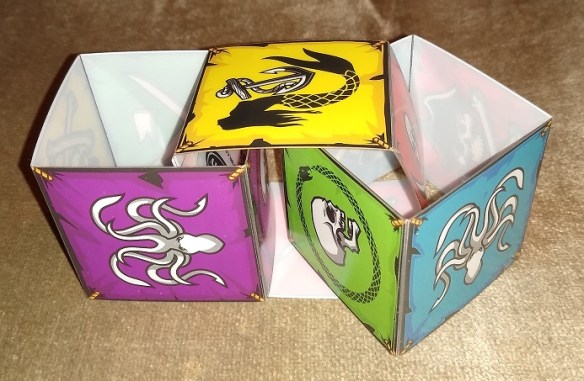
block chain 4

Our friends at ThinkFun have several puzzly games that would make good stress toys. While Fidgitz and Backspin come to mind, I think Block Chain is the best current example. These linked cubes can twist and turn and fold over each other to create cubes, but that feels secondary to the idle joy of simply watching how many patterns you can make with simple movements.

The design of the cube changes wildly based on your choices, and just fiddling with it and then folding it up is terrific fun. Plus the wild and varied imagery offers a nice change from the static colors and designs of many brain teasers, twisty puzzles, and other fiddly items.

lightbox3

But the puzzly item I find myself returning to most, something to keep my hands occupied while I puzzle over a problem in my head, is Lightbox. The simple action of lifting, twisting, and reconnecting the many stacked plates in different combinations — then seeing what pattern of light is created — has a certain associative aspect that really pushes my brain in positive directions.

Seeing the cube light up in different ways feels like getting that metaphorical lightbulb to appear over my head, and rarely do I need to spend more than a few minutes fiddling with this delightful device before some little burst of motivation, inspiration, or reinvigoration is unlocked inside me, and I can get back to being productive.


What are your go-to items when it comes to stress toys or other items you find yourself idly playing with during the workday, fellow puzzlers? Let us know in the comments section below! We’d love to hear from you.

Thanks for visiting PuzzleNation Blog today! Be sure to sign up for our newsletter to stay up-to-date on everything PuzzleNation!

You can also share your pictures with us on Instagram, friend us on Facebook, check us out on TwitterPinterest, and Tumblr, and explore the always-expanding library of PuzzleNation apps and games on our website!

The American Crossword Puzzle Tournament Returns This Weekend!

acptlogo

Hello fellow puzzlers and PuzzleNationers!

Normally, this reminder post would go up on Friday, but since the deadline to register to participate in this year’s virtual American Crossword Puzzle Tournament is noon tomorrow, we’re posting a day early.

Yes, the 43rd edition of the ACPT — jokingly referred to as the Nerd Olympics — has gone online this year (though some folks are still attending in person). But it’s not just the competition puzzles! Prizes, panels, and more are planned across the weekend.

A full slate of events has been scheduled for Friday through Sunday, including the Merl Reagle Award, puzzle workshops, trivia and games, and the live-solving finals, including commentary from Greg Pliska and Ophira Eisenberg!

But who is constructing this year’s puzzles, you ask? A fine question.

Constructors Sam Ezersky, Emily Carroll, Patrick Berry, Kevin Der, Lynn Lempel, Mike Shenk, Ruth Bloomfield Margolin, and Robyn Weintraub are all contributing puzzles to this year’s tournament.

You can click here to register and visit the ACPT website for full details!

Will you be competing, fellow puzzlers? Let us know in the comments section below! We’d love to hear from you.


Thanks for visiting PuzzleNation Blog today! Be sure to sign up for our newsletter to stay up-to-date on everything PuzzleNation!

You can also share your pictures with us on Instagram, friend us on Facebook, check us out on TwitterPinterest, and Tumblr, and explore the always-expanding library of PuzzleNation apps and games on our website!
Scrabble Removes 400 Offensive Words (and Tournament Players Are Freaking Out)

Pretty much everyone has at least one Scrabble friend. You know, that person who just destroys all comers by placing unlikely words and unexpected additions, snagging every last available point each turn.

I have two such friends, and their rivalry was so legendary that, during one particularly high-stakes game, the loser would have to write and perform a song celebrating the Scrabble supremacy of the victor.

And those are just Scrabble fans. Scrabble tournament players are another breed entirely.

Let me give you one example. In 2015, a guy from New Zealand won the French Scrabble Championship. Without speaking a word of French.

Yes, this guy memorized every word in the French Scrabble Dictionary and won the championship.

That is next level.

Which makes today’s news story slightly more understandable… even if it is still incredibly stupid and sad.

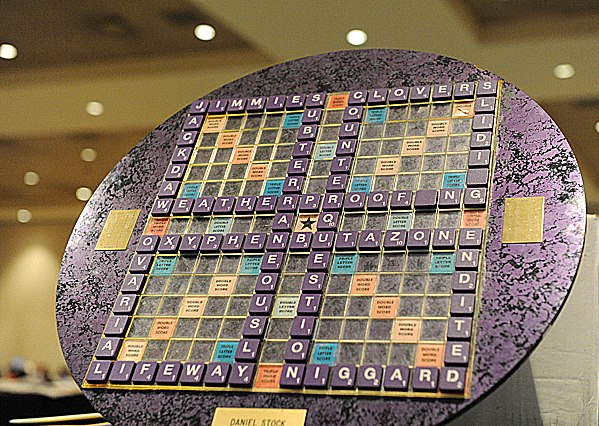
Mattel, the company who owns the rights to Scrabble outside North America, has come under fire for removing 400 words from the official accepted list of Scrabble words for being offensive or derogatory.

From an article published by UK outlet The Daily Star:

The company has refused to publish the list but the official word checker shows that the banned terms include epithets against black, Pakistani and Irish people as they believe the terms have no place in a family game.

The change follows a similar move by the American rights owner Hasbro and affects competition-level Scrabble, which is played by thousands of people at international tournaments.

And some competitive players claim this is overreaching by Hasbro and Mattel. In fact, three “prominent” members of WESPA, the World English-Language Scrabble Players Association, have supposedly quit competing in protest.

For the record, the Official Scrabble Dictionary, Fourth Edition contains 100,000 words. And for tournament play, the approved list of words reportedly runs as high as 278,000 words.

And these goofs are complaining about 400 offensive and derogatory words that, apparently, they simply cannot compete fairly without using.

Oh, and their argument against removing the words is equally stupid.

“Words listed in dictionaries and Scrabble lists are not slurs. They only become slurs when used with a derogatory purpose or intent, or used with a particular tone and in a particular context.” That’s according to Darryl Francis.

Who is Darryl Francis, you ask? Well, according to the Daily Star, he is “a British author who has overseen official Scrabble word lists since the 1980s.” Cool.

Well, good news for you, Darryl, that’s 400 fewer words to oversee.

According to Darryl, using the word on a Scrabble board is not offensive. Personally, I think puzzle constructor and author Eric Berlin summed up the issue perfectly in a similar discussion regarding entries like “Go OK” or “CHINK” (as in chink in one’s armor) when they appear in crossword grids:

Perhaps a good rule for this sort of thing is, if you were looking *only at the completed crossword grid* and not at the clues, what would CHINK or GOOK call to mind first?

That’s what I thought, and that’s why I would never dream of using either word in a puzzle.

The same rule should also apply to a Scrabble board. If someone strolls by and sees one of those 400 words, that reflects poorly on the game, the players, and the entire event.

And when you consider that competitive Scrabble in general has come under fire in recent years for a perceived gender bias against women, you’d think they might want to avoid further social dust-ups.

I mean, I don’t recall these same doofuses complaining when LGBTQIA+ terminology was added to the dictionary as part of a 2800-word addition to the approved list. Was that “misguided social manipulation” then? Was that bowing to political correctness?

No. It was just a chance for more points.

Guess what, folks? The Scrabble overlords giveth, and the Scrabble overlords taketh away. Such is life.

drawingroomscrabble

Oh, I nearly forgot. The other argument that has been made about removing these words from the accepted list regards the offensive words they DIDN’T remove.

Yup, Karen Richards, another member of WESPA — who helped to run the World Youth Scrabble Championship for 15 years — claims that these changes won’t make the game more family-friendly.

Why not?

Because children could still play other offensive words.

This is also a dumb argument.

That’s true. But they can’t play these offensive words, so there are fewer opportunities for these apparently slur-happy children to offend other people through the medium of Scrabble.

I wonder if she doesn’t bother to tell her children not to say the F-word, because they can just use another swear instead? I suspect not.

And I know, fellow puzzlers and PuzzleNationers, I know. This is a very minor, very stupid thing. So why are we talking about it?

I have a few reasons:

  • One, it’s puzzly and in the news, and that’s my wheelhouse.
  • Two, I cannot resist pointing out what gets “anti-PC” people all in a huff. I mean, I’m supposed to be the snowflake here, right? So why are they freaking out?
  • And three, it amazes me that in a world where there are big, important, actual problems, some folks go nuts over .4% of their potential Scrabble words going away. (That’s out of 100,000. When we go with 400 out of 278,000, it drops to .14%)

Seriously, tournament Scrabble players, get a grip. If you can’t win without these words, you probably wouldn’t win anyway.


Thanks for visiting PuzzleNation Blog today! Be sure to sign up for our newsletter to stay up-to-date on everything PuzzleNation!

You can also share your pictures with us on Instagram, friend us on Facebook, check us out on TwitterPinterest, and Tumblr, and explore the always-expanding library of PuzzleNation apps and games on our website!

 

I-Got-The Christie’s: A Puzzly Crime Hashtag Game!

170831526_4007871395926244_6804303427308015657_n

You may be familiar with the board game Schmovie or hashtag games on Twitter.

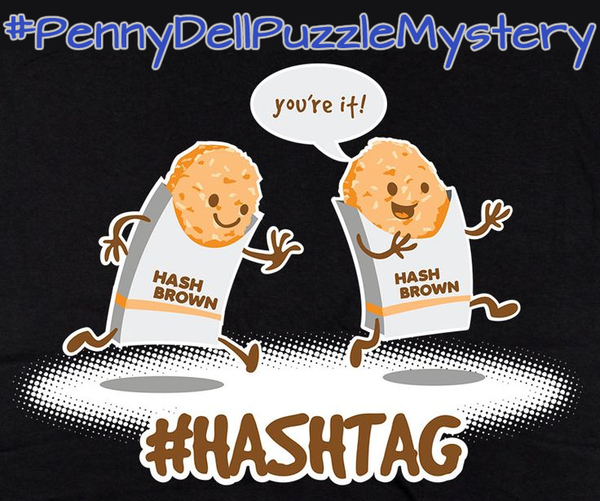
For years now, we’ve been collaborating on puzzle-themed hashtag games with our pals at Penny Dell Puzzles, and this month’s hook was #PennyDellPuzzleMystery. Today’s entries all mash up Penny Dell puzzles with TV shows, movies, books, characters, concepts, and anything else that fits the mystery genre!

Examples include: Sherlock Home Runs, Two at a Crime, or The Bricks and Mortar of Roger Ackroyd.

So, without further ado, check out what the puzzlers at PuzzleNation and Penny Dell Puzzles came up with!


Agatha Crisscrosstie

Mixed Bagatha

Murder on the Easy Crossword Express

Murder, She Quote / Murder, She Quotefinds

Mary Higgins Clark’s The Shadow of your Smile

Mary Higgins Clark’s On the Stretch Letters Where You Live

Joanne Fluke’s A Cinnamon Roll Recipe Time Murder

Paige Shelton’s The Killer Maze

Perry Mason’s The Case of the Mystery Melody

The Mirror Image Crack’d from Here to There

The Secret Word of the Old Clock

The Purloined Letterboxes

The Glass Keyword

Secret Word Agent

Double Trouble Agent

Word-a-Mata Hari

Nancy Drew and the Hidden Word Squares

Nancy Drew: Double Trouble Shooter

Sorry, Wrong Number Sleuth

D.O.ABC’s

Alfred Hitchcock and the Three of a Kind Investigators

Alphagrid HitchCrackers

PsyCodeword

To Catch a Themewords

Dilemma “M” for MurDittos / Dial-A-Grams for Murder

Rear Windowboxes

The 39 Stepping Stones

John GrishAnagrams

Miss Marbles

Hercule Poirows Garden

Fill-In Marlowe

Crackerjacks Reacher

The Alphabet Soup Murders

Pretty Maids All in a Rows Garden

They Only Kill Their Masterwords

Who’s Calling the Great Chefs of Europe?

Evil Under the Sunrays

Word Trails of the Pink Panther

Against All Odds and Evens

Body Double Trouble

Se7en-Up

Along Came a Spider’s Web

The Da Vinci Codewords

Trixie Belden and the Secret Words of the Mansion

Knives Out of Place

SpyMasterwords

Whopunit

The Dresden Tiles

Arth-Here-and-Thur Conan Double-Trouble-Doyle, Word Seek Mystery Person!

He’s the WatSunrays to your Sherlock Homeruns

The Sign of the Four Corners / The Sign of Foursomes

The Man With the Twisted Blips

221 ABC’s

Alphabet Soup For Two-Twenty-One-B Baker Street

Matchmaker Street Irregulars

“…What’s Left must be the truth.”

The Seven Percent Solution is on Page 178


I’m not very familiar with the mystery genre. I’ve heard of author Sara Pairsetsky and her novels Critical Masterword and Spellbound Game, though.

APPMystery


One intrepid puzzler went above and beyond by submitting the following pun-fueled message:

I have recently begun reading an author by the name of C.J. Boxes, needless to say he writes Mystery Word Seeks and I believe that that the C.J. is short for Crackerjacks.

Boxes is best known for his Joe Picker Upper series of novels and some of my favorites are “Savage Home Runs,” “Blackouts of Range,” “Breaking Point the Way,” and of course “Vicious Circle Sums.”

Recently Boxes’ latest series featuring a pair of Montana private investigators has been picked up by ABC’s television and the show depicts Double Trouble and the detectives come Face to Face with Deduction Problems in stories such as “Pair Off Dice Game Valley” where they ultimately answer the Big Question.

I’m glad to share this with y’all.


Have you come up with any Penny Dell Puzzle Mystery entries of your own? Let us know! We’d love to see them!

Thanks for visiting PuzzleNation Blog today! Be sure to sign up for our newsletter to stay up-to-date on everything PuzzleNation!

You can also share your pictures with us on Instagram, friend us on Facebook, check us out on TwitterPinterest, and Tumblr, and explore the always-expanding library of PuzzleNation apps and games on our website!
Squirreling Away Puzzle-Solving Skills?

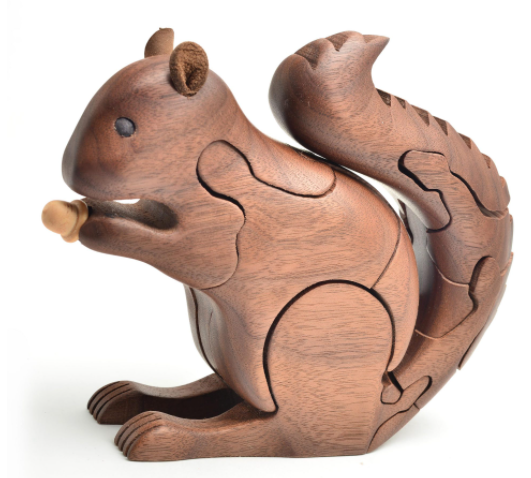
squirrel puzzle wood

[Image courtesy of Southern Highland Guild.]

It was less than two months ago that we discussed whether the problem-solving puzzly skills of pigs were enough to grant them membership in the puzzle-solving creatures club, alongside catsdogscrowscockatoosoctopuses, and bees.

As it turns out, scientists have been studying “can animal x solve puzzles?” for longer than I thought. One academic paper, entitled “How to stay perfect: the role of memory and behavioural traits in an experienced problem and a similar problem,” was published back in July of 2017.

And they concluded that squirrels might be a worthy addition to the pantheon of puzzle solvers.

img_2511

According to the scientists involved:

A neophobia test in the generalisation task suggested squirrels perceived the different apparatus as a different problem, but they quickly came to apply the same effective tactics as before to solve the task… Squirrels remembered and emitted task-effective tactics more than ineffective tactics. As a result, they consistently changed from ineffective to effective behaviours after failed attempts at problem-solving.

They went on to cite previous studies involving creatures as varied as monitor lizards, Atlantic cod, spotted hyenas, lions, and goats:

With regard to returning to previously experienced task, selectivity appears to be an important factor in the success of captive lions, Panthera leo, in solving a suspended puzzle box up to 7 months after experiencing it (Borrego and Dowling 2016), in the success of goats, Capra hircus, in solving a two-step food box challenge 10 months after first experiencing it (Briefer et al. 2014)

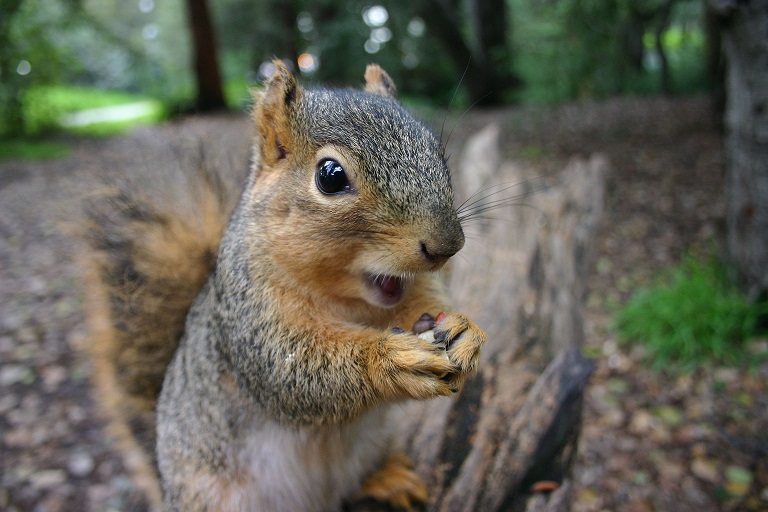
squirrel 2

One of the main questions they were trying to answer was what role memory was playing in this puzzle-solving. Were they remembering their previous puzzly experience OR re-learning the same tactics a second time, separate from the first test? These were the parameters:

Here, we examined how memory, alongside behavioural traits, contributes to enhance problem-solving efficiency by giving five grey squirrels, firstly a previously experienced task 22 months after they had last experienced it (hereafter, the ‘recall task’), and secondly a task requiring a previously successful action to be performed in a physically different apparatus (hereafter, the ‘generalisation task’).

Nearly two years between the initial solve and the secondary test! That’s a huge chunk of time. As Dan said in the Room Escape Artist article about this study, “22 months! I could probably replay an entire escape room after 22 months and not even notice.”

But that length of time was intentional, given the test subjects involved:

Grey squirrels are also known to have good long-term memory, at least in the spatial domain: they are scatter hoarders that cache thousands of nuts during the autumn (Thompson and Thompson 1980), and they are able to relocate their own caches (Jacobs and Liman 1991) and artificial caches (Macdonald 1997) after long intervals of time.

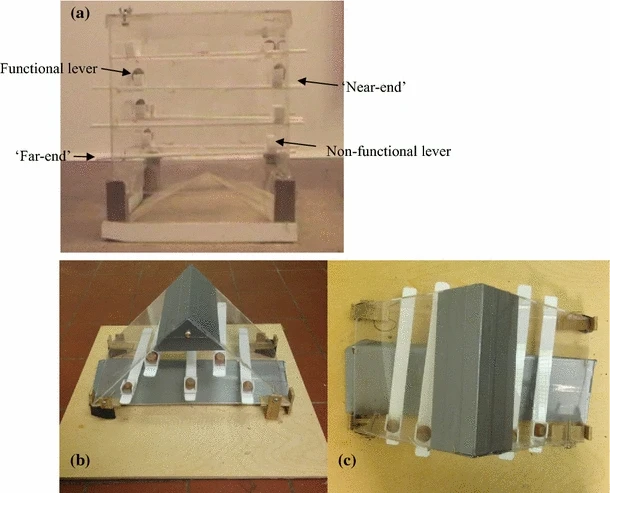
squirrel puzzle

So, what did they find when they tested Arnold, Leonard, Sarah, Simon, and Suzy in the lab?

In our case, squirrels may pay attention to cues such as the levers that contain hazelnuts to locate which lever to solve. But unlike what has been found in tool-use studies, the use of cues did not develop with increased experience during problem-solving. Squirrels showed an immediate strong preference to contact functional levers rather than non-functional levers, both when they first encountered this puzzle box 22 months prior to this study (Chow et al. 2016) and in the first trial of the recall task. These results imply that squirrels quickly focused their attention on the reward and reward-related components of the apparatus (levers) from their first encounter with the puzzle box.

In short, applying previously learned knowledge makes them far more effective problem-solvers!

Sounds like it’s time to add squirrels to the list.

Now, if you’ll excuse me, I have to start researching lions, hyenas, cod, monitor lizards, and any other animal studies cited in the footnotes. Clearly I have catching up to do!


Thanks for visiting PuzzleNation Blog today! Be sure to sign up for our newsletter to stay up-to-date on everything PuzzleNation!

You can also share your pictures with us on Instagram, friend us on Facebook, check us out on TwitterPinterest, and Tumblr, and explore the always-expanding library of PuzzleNation apps and games on our website!