We Found Some Ancient Puzzly Graffiti!

[Image courtesy of Patheos.com.]

The other day, I was perusing Crossword Kathy’s daily news post, and I stumbled across an article with this provocative title: “Ancient crossword puzzle found in Smyrna

Naturally, I clicked, being something of a puzzle historian. (I also looked up “Smyrna” because I wasn’t sure precisely where that is. Turns out it was an ancient Greek city, now known as Izmir, a city in Turkey.)

This puzzle was found on the wall of an old basilica in the marketplace (or agora, for the crossword fans in the audience), and dates back to somewhere between 2,000 and 2,500 years old.

[Image courtesy of Patheos.com.]

According to the person in charge of the excavations, Akin Ersoy:

It looks like an acrostic. The same words are defined both top to bottom and left to right in five columns. The word ‘logos’ in the center is said to have been used by a Christian group to communicate with each other during times of oppression. We want to consider this as a puzzle because there are benches in front of these wall paintings. The lives of those who were working here are depicted in these paintings.

Unfortunately, calling this a crossword is a bit of a misnomer. The puzzle is a 5×5 grid where the entries read both across and down. This isn’t a crossword, it’s a word square.

[Pictured above is perhaps the most famous word square in history,
known as the Sator Square. Image courtesy of Wikipedia.]

The Smyrna word square consists of five words, and some researchers believe there’s a Christian message or some religious intent behind the square.

[The full text of the Smyrna square.
Image courtesy of Cryptotheology.wordpress.com.]

The middle word, Logos, for instance, is shaped in a cross, and is believed to represent the incarnation and work of Christ.

But whether this is a religious message or simply some impressive puzzling that has stood the test of time, it’s fascinating to turn up more examples that puzzles in some shape or form have been with us not only for centuries, but for millennia.


Thanks for visiting PuzzleNation Blog today! Be sure to sign up for our newsletter to stay up-to-date on everything PuzzleNation!

You can also share your pictures with us on Instagram, friend us on Facebook, check us out on TwitterPinterest, and Tumblr, and explore the always-expanding library of PuzzleNation apps and games on our website!

PuzzleNation Product Review: The Oregon Trail Card Game

For gamers and puzzlers of a certain age, there are many fond memories of a certain historical journey that tested your wits, your luck, your tactical skills, and your endurance. I’m speaking, of course, of The Oregon Trail, a computer-game classic that not only taught millions of young minds about the perilous journey, but probably introduced most of them to the concept of death by dysentery.

Ick.

For those not in the know, The Oregon Trail was a computer game designed to explore 19th-century pioneer life on the long journey between Independence, Missouri, and Oregon’s Willamette Valley. Players would manage food, supplies, and the pace of the trek in their covered wagon, occasionally dealing with dangers like disease, thieves, broken equipment, accidents, and treacherous rivers to cross.

A classic in the eyes of many, this beloved game has made the jump from the digital realm to the analog one with a card-game variation released this year by Pressman Toys.

Pressman Toys have outdone themselves with this nostalgia-fueled adaptation. The trail cards themselves evoke the classic black-and-green screen of old-school computers, while the supply and calamity cards are pixelated in a style more akin to 8-bit video games.

I daresay, though, that the card game is harder than the computer game. I don’t know that I’ve ever encountered a game that stacks the deck against the player quite so brutally.

To make the journey to Oregon successfully, players must traverse 50 trail cards, avoiding illness and unpleasant twists of fate along the way (represented by the calamity cards that come up all too often), managing meager supplies, and testing their luck against river crossings (where a roll of the die determines your fate).

This quickly becomes a strategic battle of resource management, trying to hold onto fort and town cards for as long as possible (since they provide some of the rare opportunities to gain new supplies), playing trail cards (which must link up in a continuous line), and deciding whether it’s better to spend medicine and clean water supplies on saving fellow players stricken by illness or letting players die and hoarding supplies for the survivors.

I’ve played the game a few times now — each session has lasted about 30 minutes, with the team failing to reach Oregon both times (though we made it more than halfway on the second try) — and it remains an engaging, enjoyable play experience. Yes, it can be disheartening to see a player die early on (as I did by rattlesnake bite in my very first turn one game), but the group play experience — pitting all of you against the game itself — is only enhanced by the difficulty.

There are some aspects of the computer game — hunting, for instance — missing from the card-game experience, but I suspect the development of simple house rules (like spending a bullet card and letting a handful of dice rolls determine your success hunting, to more closely recreate the computer game’s hunting mechanic, for instance) would enrich the gameplay.

Whether you’re a fan of the classic computer game or a newcomer to the franchise, I suspect The Oregon Trail will delight you (and challenge you!) like few card games ever have.

[The Oregon Trail Card Game is available at Target stores and through online outlets.]


Thanks for visiting PuzzleNation Blog today! Be sure to sign up for our newsletter to stay up-to-date on everything PuzzleNation!

You can also share your pictures with us on Instagram, friend us on Facebook, check us out on TwitterPinterest, and Tumblr, and explore the always-expanding library of PuzzleNation apps and games on our website!

Vikings: Warriors in Life, Warriors in Dice

[Image courtesy of Arlington Viking Fest.]

Board games have been around a long time, longer than most people realize. Chess can be traced back to the 7th century in India, and Go has been played in China for more than 5,500 years!

And it turns out that board games were important to the Vikings as well. Not only were they valued in life, but in the afterlife as well.

An article in the UK’s Daily Mail details the discovery of a Viking grave site known as a boat burial where board games were among the items interred with the dead. And apparently, this was not an uncommon occurrence.

[Image courtesy of The Times.]

From the article:

Mark Hall, a curator at Perth Museum and Art Gallery, has published a new study on Viking board game burials across Northern Europe.

He says there have been 36 burials where board games of some description have been found in the graves around Northern Europe.

This grave site, dating back to the 9th century, grants intriguing insight into how the Vikings viewed board games as a learning tool. After all, board games require strategy and a level of initiative, which are both qualities found in accomplished Viking warriors, so it’s believed that including a board game among the effects of the deceased signals not only their skill and status as a warrior, but their preparedness for the afterlife itself.

So what sorts of games did the Vikings play?

The game pieces were used in multiple games. Researchers believe the dice were used in a game called tabulal alea, which is reminiscent of backgammon.

Many of the bigger pieces were used in a chess-like game known as hnefatafl. In hnefatafl, each player has a king protected by defender pieces, and the goal is for your king to reach the edge of the board before the other player takes him out.

Just imagine what the Vikings could have learned from a game like Risk.

[This story was brought to my attention by Kim Vandenbroucke.]


Thanks for visiting PuzzleNation Blog today! Be sure to sign up for our newsletter to stay up-to-date on everything PuzzleNation!

You can also share your pictures with us on Instagram, friend us on Facebook, check us out on TwitterPinterest, and Tumblr, and explore the always-expanding library of PuzzleNation apps and games on our website!

Puzzle Vandalism!

[Image courtesy of Milliande.com.]

It’s hard to know sometimes what qualifies as art.

Artists and entrepreneurs are constantly pushing the boundaries of visual and intellectual expression. Everything from paint and stone to light and shadow are used to realize artistic visions. Christo wraps buildings and calls it art.

That can make it tough for those who are less familiar with the fluid definition of art.

There was a famous incident back in May when a seventeen-year-old left his glasses on the floor of an art gallery and many patrons mistook them for an art installation.

This has only grown more complicated with the advent of interactive art pieces. Some works of art can only be viewed from a specific vantage point, while others actively engage patrons.

Recently a woman unintentionally vandalized a piece of art when she mistook it for part of an interactive exhibit.

And wouldn’t you know, that piece of art was based on a crossword puzzle.

[Image courtesy of Thoibao.today.]

The 91-year-old woman was visiting the Neues Museum in Nuremberg with a senior citizens group when she found the piece, “Reading-work-piece” by artist Arthur Koepcke, and began filling in the empty grid.

These days, you can understand her confusion and sympathize with her mistake. I mean, the exhibit did say “insert words,” after all. Those sound like instructions to me.

Plus the grid has remained incomplete since its creation in 1965. It’s about time somebody finished the puzzle.


Thanks for visiting PuzzleNation Blog today! Be sure to sign up for our newsletter to stay up-to-date on everything PuzzleNation!

You can also share your pictures with us on Instagram, friend us on Facebook, check us out on TwitterPinterest, and Tumblr, and explore the always-expanding library of PuzzleNation apps and games on our website!

A musical puzzle a thousand years in the making…

Most of the time, if I’m writing a blog post centered around a certain video, I explain the story of the video first, laying out all the necessary exposition so you as a reader will go into the video properly informed. Then I’ll share the video, share a few parting thoughts, and wrap things up.

I’m not going to do that today, though. Today, I’d like you to watch this video first and allow me to explain its significance afterward:

In all likelihood, that’s the first time you’ve heard this song. And there’s good reason for that. Until it was performed on April 23, it hadn’t been heard in a thousand years.

It has taken two decades of masterful puzzle solving, diligent research, and careful extrapolation to allow Sam Barrett of Cambridge University to reconstruct these melodies.

From the article on the University of Cambridge website:

The task of performing such ancient works today is not as simple as reading and playing the music in front of you. 1,000 years ago, music was written in a way that recorded melodic outlines, but not ‘notes’ as today’s musicians would recognise them; relying on aural traditions and the memory of musicians to keep them alive. Because these aural traditions died out in the 12th century, it has often been thought impossible to reconstruct ‘lost’ music from this era – precisely because the pitches are unknown.

Akin to decrypting an encoded poem, Barnett had to identify what are known as neumes (symbols representing a form of musical notation employed during the Middle Ages, specifically the 11th century), and then puzzle out how to translate those neumes into actual notes for musicians to perform.

The discovery of a missing manuscript leaf proved to be the key to unlocking what are now known as the Cambridge Songs:

“After rediscovering the leaf from the Cambridge Songs, what remained was the final leap into sound,” he said. “Neumes indicate melodic direction and details of vocal delivery without specifying every pitch and this poses a major problem.

“The traces of lost song repertoires survive, but not the aural memory that once supported them. We know the contours of the melodies and many details about how they were sung, but not the precise pitches that made up the tunes.”

This remarkable accomplishment marks the latest in a series of transformations the work has gone through since its creation in the sixth century as a poetic treatise on philosophy by Boethius.

His work was translated, then set to music, and then lost to the ages before being reconstructed and reimagined by Barnett and the three-piece group known as Sequentia, who perform a snippet of it in the video.

There have been times while I’ve been working on this that I have thought I’m in the 11th century, when the music has been so close it was almost touchable. And it’s those moments that make the last 20 years of work so worthwhile.

This is the sort of tenacity, creativity, and resolve I have come to expect from puzzle-minded people over the years, and it’s one more example of how seemingly nothing is beyond the reach of people willing to put in the time and effort to discover (and rediscover) what was once believed lost.

Amazing stuff.

[Although the information in this post came from the original article on the University of Cambridge website, I became aware of the story thanks to this article on Gizmodo.com.]


Thanks for visiting PuzzleNation Blog today! Be sure to sign up for our newsletter to stay up-to-date on everything PuzzleNation!

You can also share your pictures with us on Instagram, friend us on Facebook, check us out on TwitterPinterest, and Tumblr, and explore the always-expanding library of PuzzleNation apps and games on our website!

The Story Behind Bletchley Park

It’s amazing when you consider the impact one of the most common forms of puzzle solving, cryptography, has had on world history. From the Revolutionary War to World War II, codebreaking was a battlefront as crucial and as exhausting as any contested piece of land on the map.

This was brought into stark clarity recently when I read The Secret Lives of Codebreakers by Sinclair McKay, which chronicles the work and lives of the team members at Bletchley Park who dedicated themselves to cracking the German Enigma code. It’s been said that Bletchley Park’s achievements shortened the war by two or three years. That’s no small feat.

(You know the decryption work done at Bletchley Park was good if it inspired parts of two of Ian Fleming’s James Bond novels. The film The Imitation Game barely scratched the surface.)

From The Secret Lives of Codebreakers:

Here, in these grounds fifty miles to the north of London, they would be introduced to the gravest secret of the war. Every intercepted enemy message — every signal from every captain, commander, military division, battleship, U-boat — all these encrypted communications, jumbled up into seemingly random letters in groups of four and five, and transmitted by radio, were gathered by the many listening posts around the British coastline.

From the Battle of Britain to the Blitz, from Cape Matapan to El-Alamein, from Kursk to the V-1 flying bombs, to D-Day and Japan, the work of Bletchley Park was completely invisible, yet right at the heart of the conflict. It was a key player whose presence, at all times, had to be kept utterly hidden from the enemy.

Imagine working these incredibly intensive sessions, obsessively looking over bits of code for hours at a time, knowing that the fate of the world rested on your shoulders, and a simple transcription mistake could cost lives. It’s a mind-boggling concept.

And the book shed a great deal of light on the decryption work itself. For instance, I had no idea how many variations of the Enigma code they were expected to crack.

The German rule was that no message should be more than 250 letters in length; if it was necessary to send a longer message, it should be split into multiple parts. This was designed to make life more difficult for codebreakers: the longer the message, the easier it might be for such a person to see patterns of letters forming among the apparent chaos.

Thanks to preambles in each Enigma message, codebreakers could at least be organized under different color keys: yellow, green, red, and blue. When they ran out of colors, they named keys after marine life, then birds, then elephants, then insects.

This was a war, and organization was key, no pun intended.

The first big break is known as the Herivel Tip, when one of the Bletchley Park crew deduced that some Enigma machine operators might choose the new day’s settings based on the letters used the previous day. This became a valuable jumping-off point for daily decryption attempts with their own coding device, the bombe machine.

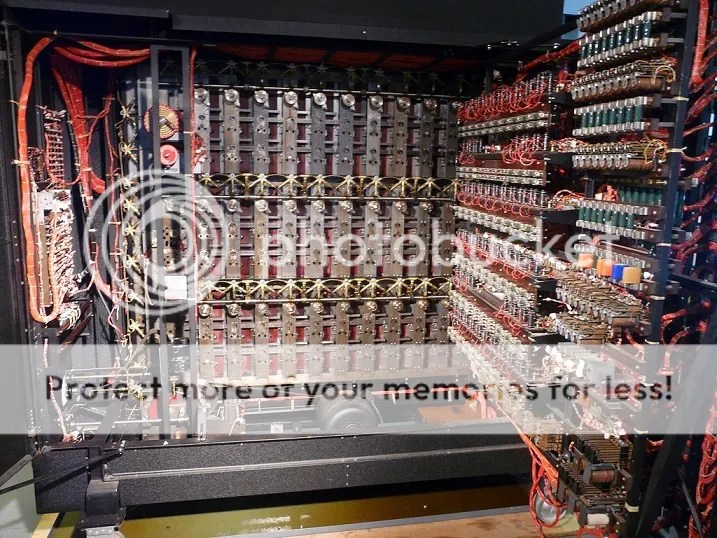
In 1941, the first major Enigma-style code, the Abwehr code, was broken by Bletchley Park. In June of 1941, they broke the Vulture key, which revealed German activity on the Eastern front.

But the Germans were constantly adapting and refining their codes. German paranoia led to submarines using a different code than surface naval vessels. So “Dolphin,” the surface naval code, was not the only code troubling Bletchley Park. “Shark,” the submarine key, was a new concern. Thankfully, when U-559 sank in 1942 and its crew abandoned ship, its Enigma machine and a book of current “Shark” keys was salvaged by Allied forces without German knowledge.

In 1943, they broke “Porcupine,” giving them access to all German air force messages for a few weeks.

Around this time, the German High Command began using another method to transmit encrypted messages, and this became yet another focus of Bletchley Park. The “Fish” or “Tunny” communications were between generals and the Fuhrer himself.

This led to the development of the big brother of the bombe machine, Colossus, which combined the logic engines of a Turing machine with electronic valves that allowed it to read 5000 characters a second, five times faster than the previous top machine.

(While this was going on, Turing himself was developing a new speech encipherment system, Delilah, so named because she was a deceiver of men.)

In January 1945, efforts were still going strong, as Bletchley Park not only cracked the “Puffin” and “Falcon” keys of the German army, but effectively countered attempts by the Luftwaffe to implement new encryptions. By this point, dozens of variations of Enigma had been unraveled by the team.

Of course, decryption wasn’t the only thing accomplished at Bletchley Park.

The grand deception that led to the Normandy invasion was also managed there. They gradually fed false data to German Intelligence about military groups like the First United States Army Group preparing to enter France via the Pas de Calais and the Twelfth British Army into Scandinavia and Turkey. This allowed for D-Day to proceed, as German attention was diverted.

But The Secret Lives of Codebreakers goes beyond their wartime victories. McKay takes us behind the scenes of Bletchley Park to share not only the hard-won achievements of the cryptographers there, but also what daily life was like on the isolated estate. From living conditions and several romances to rivalries and petty feuds caused by high tensions, the book catalogues the realities of such stressful work in richly detailed fashion.

I think my favorite discoveries were related to the off-time of the recruits:

Oliver and Sheila Lawn have especially fond memories of the way that Bletchley-ites contrived to use their leisure time: “There was music,” says Mr. Lawn, “Play readings. And play actings. Quite a bit of amateur dramatics. And concerts of all kinds.”

Highland dancing, madrigals, creating palindromes…they were offered all sorts of activities to help keep spirits up after grueling decryption sessions. Certain musical artists were even invited up to perform there!

When you consider how important their work was and how many years they were sworn to silence about Bletchley Park, these revelations become all the more stunning. This isn’t just a fascinating work of puzzle history, this is history itself.


Thanks for visiting PuzzleNation Blog today! Be sure to sign up for our newsletter to stay up-to-date on everything PuzzleNation!

You can also share your pictures with us on Instagram, friend us on Facebook, check us out on TwitterPinterest, and Tumblr, and explore the always-expanding library of PuzzleNation apps and games on our website!