Touching a Piece of Puzzle History

Friend of the blog Peter Kanter came by the other day and showed me this curious piece of puzzle history that his brother had stumbled upon in a garage sale or a flea market.

Little did I realize I would soon be holding a puzzle that predates the crossword puzzle by over twenty years.

According to the instruction manual — which features rules for ten different spelling and anagramming games, one or two of which bear no small resemblance to Bananagrams in play style and spirit — this game was copyrighted in 1890 by McLoughlin Bros.

According to one of their catalogs, this game “consists of a box full of letters, so selected as to be most useful in a number of exceedingly interesting spelling games. The letters, printed on cardboard, are easily distinguished and handled. The box label is unusually bright and attractive.”

Yes, thanks to the wonders of the Internet, I’ve been able to do a little research on this marvelous find.

McLoughlin Bros. was a publishing firm based in New York that operated from the mid-1800s until the early 1900s. They specialized in children’s books and picture books, but also published linen books, games, paper dolls, puzzles, and toys.

They were among the first publishing houses to employ color printing techniques in products marketed specifically for children. (They also helped popularize the works of Thomas Nast, curiously enough.)

[A sampling of McLoughlin Bros.-style art, a style definitely reflected in the box art of the anagram game above.]

As it turns out, after the death of one of the founders, the company was sold to none other than Milton Bradley — makers of Battleship, Axis & Allies, Candyland, Connect Four, Operation, and Jenga, among many many others — who had continued success with some of the McLoughlin Bros. products, including mechanical paper toys called “Jolly Jump-Ups.” (You might know “mechanical paper toys” better as pop-up books.) Production of those toys was halted, however, during World War II, presumably to save materials for the war effort.

There is now a collector’s market for McLoughlin products — check out this listing for a game board produced by the firm — and if this anagram game is any indication, the color and striking artistic designs from a century ago still hold up today.

And although I can’t definitively say that this exact game predates the crossword, there’s no doubt that this sort of wordplay was delighting kids and adults alike well before Arthur Wynne’s “Word-Cross” puzzle saw the light of day.

How cool is that?


Thanks for visiting PuzzleNation Blog today! Be sure to sign up for our newsletter to stay up-to-date on everything PuzzleNation!

You can also share your pictures with us on Instagram, friend us on Facebook, check us out on TwitterPinterest, and Tumblr, and explore the always-expanding library of PuzzleNation apps and games on our website!
Sudoku Around the World!

sudokuworld18

Sudoku is the most popular pen-and-paper puzzle since the crossword. No other puzzles come close. Whether it’s in your local paper, our iPad app, or one of the magazines offered by our friends at Penny/Dell Puzzles, chances are you’ve solved a Sudoku puzzle at one time or another.

And the solving experience is an integral part of its success. When you look at a Sudoku grid, you instinctively know what sort of puzzle you’re dealing with and what the goal is. You don’t need the instructions or any elaborate explanations. You can simply dive right in.

That sort of simplicity and accessibility gives Sudoku major appeal, and has contributed to its success as an iconic puzzle worldwide.

sudokuworld2

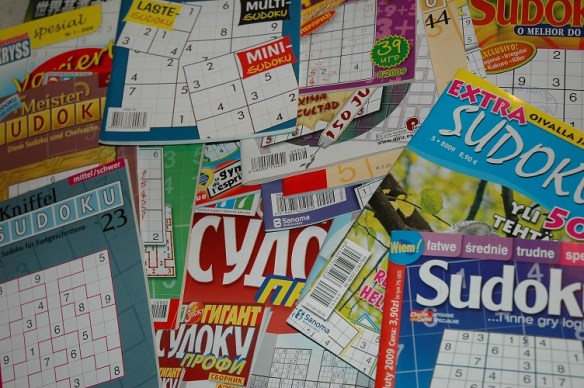
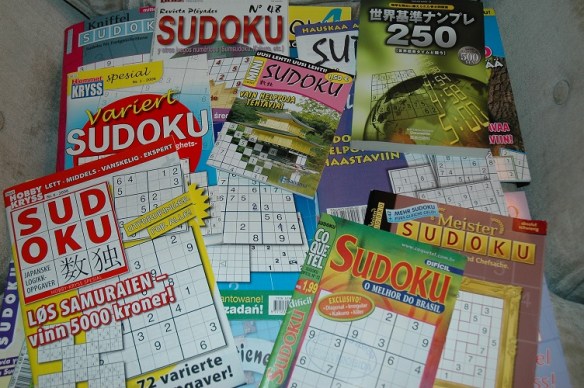
Look at this stack of puzzle books from around the world, loaned to me by a friend of the blog!

There are Sudoku books in Russian, French, Japanese, and other languages! And yet, you could pick up any one of these magazines and start solving immediately.

sudokuworld7

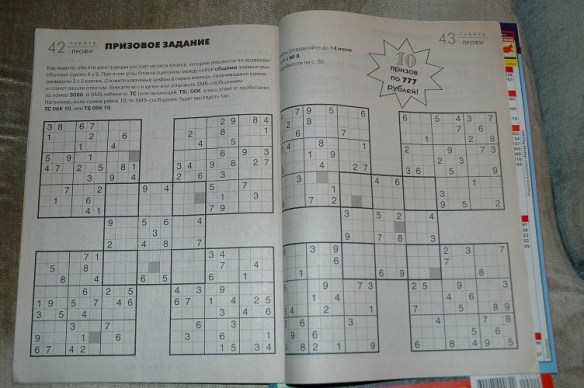
Here are two Samurai Sudoku from a Russian puzzle magazine. Again, these are identical to the overlapping grids you find in the States.

sudokuworld12

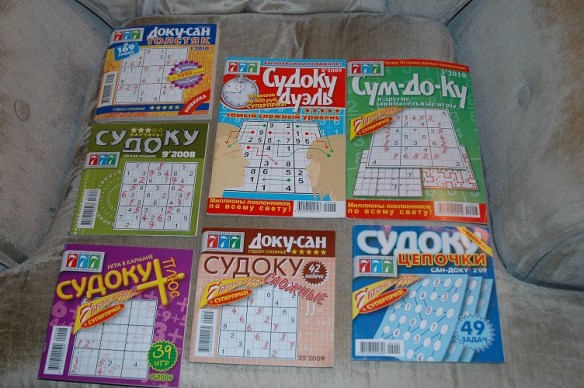
I did, however, encounter a few intriguing variations I was unfamiliar with as I perused these magazines published by 777.

sudokuworld14

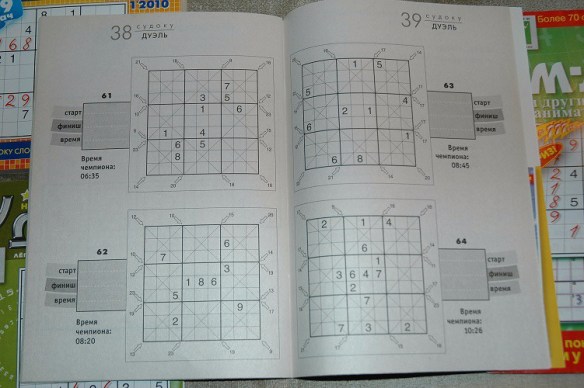
Instead of providing sums in smaller boxes within the grid like Sum-Doku puzzles, or along the edges like Kakuro, these puzzles offer totals that correspond to the three diagonal boxes in a line a given arrow points to.

sudokuworld16

In this Sudoku variant, there are no repeats of the numbers 1 through 8 in a given row or column, but there are also no repeats within each group of connected circles.

Again, although I couldn’t read the instructions for these new puzzles, I was easily able to figure out the mechanics of each and start solving within a few minutes. Very few puzzles have that sort of universal accessibility.

sudokuworld9

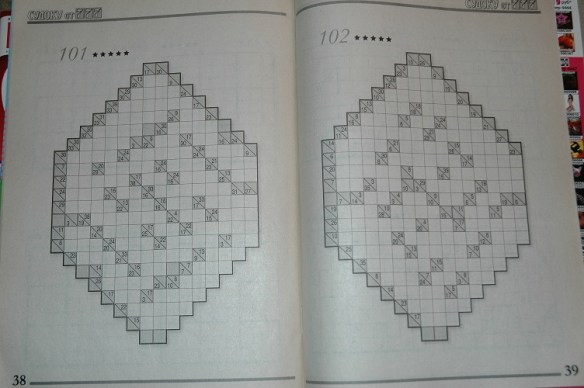
While I’m very familiar with Kakuro (or Cross Sums) puzzles, I’ve never encountered cut-style grids like these. I just love the simple elegance of these diamond-shaped grids. Very eye-catching.

Believe it or not, this is just a sampling of the hundreds and hundreds of Sudoku magazines and puzzle books released over the last decade.

Although the puzzle as we know it has been around since the ’70s under other names (To the Nines and Number Place, among them), it was only relatively recently that it exploded in popularity, becoming a true cultural touchstone and undeniable puzzle phenomenon.

[For another blog post exploring puzzle books from around the world, click here!]

Thanks for visiting PuzzleNation Blog today! You can share your pictures with us on Instagram, friend us on Facebook, check us out on TwitterPinterest, and Tumblr, and be sure to check out the growing library of PuzzleNation apps and games!

These anagrams are out of this world!

Planets are in the news, as Pluto’s dubious planetary status is under the microscope once again.

Recently, a debate over the defining qualities of a planet was held at the Harvard-Smithsonian Center for Astrophysics, and three of the top names in planetary science presented their cases to the attending audience.

Now, although the audience overwhelmingly voted in favor of Pluto’s planethood, that’s not binding. This wasn’t an International Astronomical Union vote or anything like that.

But it did put the solar system back in the news cycle, and that reminded me of a puzzly planetary story.

In the 1600s, Galileo Galilei was doing amazing work with his telescope, redefining our understanding of the solar system and our place in it. He was doing controversial work, but he still wanted to be able to prove he was the primary person behind a given discovery, so he mailed a letter to his colleague, Johannes Kepler.

Galileo sent Kepler this anagram: s m a i s m r m i l m e p o e t a l e u m i b u n e n u g t t a u i r a s

When properly solved, the anagram reads “Altissimum planetam tergeminum observavi,” meaning “I have observed the most distant planet to have a triple form.” You see, Galileo had glimpsed Saturn and its famous rings, but due to the poor magnification of his telescope, he’d mistaken the rings themselves for two moons orbiting the planet.

This was a tremendous discovery, adding to our knowledge of what was (at the time) the furthest reaches of our solar system.

But Kepler, while trying to untangle the anagram, came to a different solution. Believing that Galileo’s latest discovery involved Mars, not Saturn, Kepler’s solution read “Salue umbistineum geminatum Martia proles,” meaning Mars has two moons. (The ambiguity of Latin V’s and U’s didn’t help matters.)

So, while Kepler was wrong in his solution, he was unintentionally correct about Mars! (Phobos and Deimos, the two moons of Mars, wouldn’t be confirmed until 1877.)

Amazingly enough, this wouldn’t be the only time Galileo relied on Kepler and anagrams to prove provenance when it came to his discoveries.

In 1611, Galileo sent another anagram to Kepler: Haec immatura a me iam frustra leguntur o.y.

Properly unscrambled, the message reads “Cynthiae figuras aemulatur mater amorum,” or “The mother of love imitates the shape of Cynthia.” This one requires a little more explanation. The mother of love was Venus, and Cynthia was the Moon, meaning that Venus, when observed from Earth, has phases just like the moon.

[Click here for a larger version of this image.]

This probably sounds less important than Galileo’s studies of Saturn, but it’s not. This was an earthshaking discovery, because it was observable evidence that Venus had to pass on both sides of the sun, meaning that Venus orbited the sun. This violated the geocentric model of the solar system so strongly espoused by the church!

It was evidence like this that led to Galileo’s battle with the Inquisition.

And, weirdly enough, there might be one more twist to this story.

Some historians believe that Kepler also solved this Galilean anagram incorrectly, and that his solution once again revealed an unintentional discovery about the solar system.

According to the as-yet-unverified story, Kepler’s solution read “Macula rufa in Jove est gyratur mathem…,” which translates as “There is a red spot in Jupiter, which rotates mathem[atically].” (Again, yes, there’s the Great Red Spot on Jupiter, but there was no way for Kepler to have known that at the time.)

It’s hard to believe that Kepler could twice unravel a Galileo anagram and twice make accidental predictions about the solar system. While the first story is widely accepted, the second is viewed with far more skepticism.

But either way, it just goes to show that anagrams, while delightful, might not be the best method for announcing your great discoveries.

Thanks for visiting PuzzleNation Blog today! You can share your pictures with us on Instagram, friend us on Facebook, check us out on TwitterPinterest, and Tumblr, and be sure to check out the growing library of PuzzleNation apps and games!

A revolution in puzzles?

Crosswords have certainly changed the world. They’re the most popular puzzles in history, challenging the minds of millions every day and kickstarting a pencil-and-paper puzzle revolution in the process. Heck, they’ve even been used in England as part of the recruitment process for code breakers and other puzzly government positions!

But did you know that some constructors have been accused of trying to bring about actual revolutions with crosswords?

Oh yes! The Venezuelan newspaper El Aragueno has been accused on several occasions of hiding encrypted messages within their daily crossword puzzles in order to incite revolt against the government. (And a year ago, another Venezuelan newspaper, Ultimas Noticias, was accused of concealing messages ordering the assassination of a public official!)

While there are no details on what the incendiary message secretly contained within El Aragueno’s puzzle might have said, this isn’t the only time crosswords and constructors have run afoul of the powers that be.

Back in June of 1944, physics teacher and crossword constructor Leonard Dawe was questioned by authorities after several words coinciding with D-Day invasion plans appeared in London’s Daily Telegraph.

The words Omaha (codename for one of Normandy’s beaches), Utah (another Normandy beach codename), Overlord (the name for the plan to land at Normandy on June 6th), mulberry (nickname for a portable harbor built for D-Day), and Neptune (name for the naval portion of the invasion) all appeared in Daily Telegraph crosswords during the month preceding the D-Day landing.

So it was possible (though highly improbable) that Dawe was purposely trying to inform the enemy of Allied plans, and the powers that be acted accordingly. (In the end, no definitive link could be found, and consensus is that Dawe either overheard these words, possibly slipped by soldiers stationed nearby, and slipped them into his grids unwittingly, or this is simply an incredible coincidence.)

Either way, it just goes to show you how influential crosswords have been (and could be!) over the last hundred years.

Thanks for visiting PuzzleNation Blog today! You can share your pictures with us on Instagram, friend us on Facebook, check us out on TwitterPinterest, and Tumblr, and be sure to check out our library of PuzzleNation apps and games!

Let’s crack some Confederate codes!

[A table for cracking Vigenere ciphers.]

Cryptography is probably the only puzzly skill in history upon which lives have depended. The movements of troops, plans for invasion, locations of key officers, spies, and personnel… all of these vital pieces of information have been encoded numerous times across numerous conflicts, all in the hopes of keeping that data from prying eyes.

It’s not as if anyone has to solve a crossword to prevent a Dennis Hopper-esque madman from wreaking havoc on Los Angeles, or the outcome of a pivotal battle hinged on someone finding all the words in a word seek faster than the enemy.

But cryptography is both a delightful diversion and deadly serious, depending on the context.

Which makes it all the more curious that it took more than a hundred years for a Confederate message from the Civil War to be decoded.

The coded message was first displayed in The Museum of the Confederacy in Richmond, Virginia in 1896, after being donated by Captain William A. Smith, a member of Walker’s Greyhounds, a division of Texans fighting for the Confederacy.

The actual message was unknown. The rolled-up slip of paper was tied with a linen thread and placed in a small glass vial along with a .36-caliber lead pistol bullet, and stoppered shut. (The bullet was included in order to make the vial heavy enough to be tossed into the river and sink if the scout carrying it was in danger of being captured.)

The mysterious message was meant for General John C. Pemberton, the Confederate general attempting to protect and defend Vicksburg from the army of Union Major General Ulysses S Grant. The same general who would surrender Vicksburg to Grant on July 4, 1863 after 47 days under siege.

But the message never got to Pemberton. Instead, it ended up as part of a Civil War museum, its message undelivered, its code unbroken.

Until 2008, when curiosity among museum staff led to an unveiling a century later than intended. The message was photographed and then returned to the glass vial, which itself was then returned to its display.

And the message intended for General Pemberton?

SEAN WIEUIIZH DTG CNP LBNXGK OZ BJQB FEQT FEQT XZBW JJOA TK FHR TPZWK PBW RYSQ VOWPZXGG OEPF EK UASFKIPW PLVO JKZ HMN NVAEUD XYE DWRJ BOYPA SX MLV FYYRDE LVPL MEYSIN XY FQEO NPK M OBPC FYXJFHOHT AS ETOV B OCAJDSVQU M ZTZV TPJY DAW FQTI WTTJ J DQGOAIA FLWHTXTI QMTR SEA LVLFLXFO.

Unlike many simple coding techniques, this is not a Caesar cipher where each letter is simply another letter of the alphabet in disguise. (Every E is actually an L, every F an M, etc.)

This is a Vigenere cipher, where a key word or phrase is required to unlock the letter substitution involved. For centuries, this cipher was considered unbreakable, though this was no longer the case by the time of the Civil War. (The Union regularly cracked coded Confederate messages.)

By 2008, Vigenere ciphers were easily cracked by amateur and professional cryptographers alike, and the Confederate message was finally revealed to the world:

Gen’l Pemberton, you can expect no help from this side of the river. Let Gen’l Johnston know, if possible, when you can attack the same point on the enemy’s line. Inform me also and I will endeavor to make a diversion. I have sent some caps. I subjoin despatch from Gen. Johnston.

Essentially, the message means that the reinforcements Pemberton was hoping for to shore up Vicksburg’s defenses weren’t coming.

But the message never got to the general, because before the scout arrived with the bad news, Vicksburg had already fallen, and Pemberton had surrendered.

So instead, the scout, having somehow realized from afar that Vicksburg was lost, returned to his camp and handed the unopened message to a Captain Smith, the same man who would later donate the message to the Museum.

And an enduring mystery was born.

[I learned of this story in the book Hidden Treasures: What Museums Can’t or Won’t Show You by Harriet Baskas, which also inspired my post a few weeks ago about the Morris Museum music box.]

Thanks for visiting PuzzleNation Blog today! You can share your pictures with us on Instagram, friend us on Facebook, check us out on TwitterPinterest, and Tumblr, and be sure to check out the growing library of PuzzleNation apps and games!

PuzzleNation Reviews: Cirkusu (by Baffledazzle)

In our most recent edition of 5 Questions, I introduced you to Rachel Happen, the puzzler behind Baffledazzle, a Kickstarter to create high-end jigsaw puzzles that are aesthetically pleasing and more challenging than the average puzzle.

She sent us a review copy of one of the five initial Baffledazzle puzzles she’s created, so let’s give Cirkusu the full PuzzleNation review treatment!

[Note: This is intended as a spoiler-light review, so while I do discuss the completed puzzles in vague terms, I won’t include any pictures of completed puzzles.]

Cirkusu is a series of jigsaw puzzles centered around the history of games. It’s up to the solver to complete each puzzle, and once they’re assembled, to unravel the identities of each game.

cirkusupiecesall

[A fleet of puzzle pieces awaits the solver upon opening the box.]

First off, these pieces are beautiful. The wooden pieces are well cut, visually interesting, and simply fun to play with. Despite the curious shapes and inscribed patterns, it’s still a very challenging jigsaw-style puzzle. And since there’s no picture on the cover to bias the solver, it becomes a matter of matching words, patterns, and different fonts in order to solve the seven puzzles included.

cirkusupieces

[Just a small sample of the variety of Cirkusu puzzle pieces.]

Each puzzle is inscribed with text, presenting historical context for the game’s creation or rules on how to play, enriching the solving experience and offering clues for the second part of the solve: determining each game’s identity.

Also included are numerous miscellaneous bits and bobs, made from wood, plastic, acrylic, and other materials. These allow some of the puzzles to become full playable games, encouraging the solver to experiment further with different play styles, perhaps even inventing your own game along the way toward figuring out the actual game. (Other puzzles explain how to create a given game on your own, even providing blueprints for how to do so.)

close-upforreview

[A close-up of a few individual pieces.]

What separates a Baffledazzle puzzle from the average jigsaw is not only the fine craftsmanship and attention to detail, but also the exploration each puzzle encourages. You can hit the library or take to the Internet in order to find out more about the puzzles, or you can play with the games and make it your own. You dictate when the puzzling experience ends (particularly when there are hint and solution envelopes included).

Solving the puzzle becomes one part of a greater journey. And that makes for a truly memorable solving experience.

[You can check out all of Rachel’s Baffledazzle puzzles, including Cirkusu, on her Kickstarter page.]

Thanks for visiting PuzzleNation Blog today! You can share your pictures with us on Instagram, friend us on Facebook, check us out on Twitter, Pinterest, and Tumblr, and be sure to check out the growing library of PuzzleNation apps and games!