PuzzleNation Product Reviews: Collide-O-Cube and Rudenko’s Disk

The folks at Brainwright specialize in puzzles intended for younger solvers, but with enough challenge and style to keep older solvers busy as well. From curiously cut jigsaws to color-based deduction puzzles, they take classic puzzle concepts and add their own curious spin to create new puzzle experiences.

They offered us the chance to try out two of their puzzles for the younger puzzling set, and we put them to the full PuzzleNation Blog test.

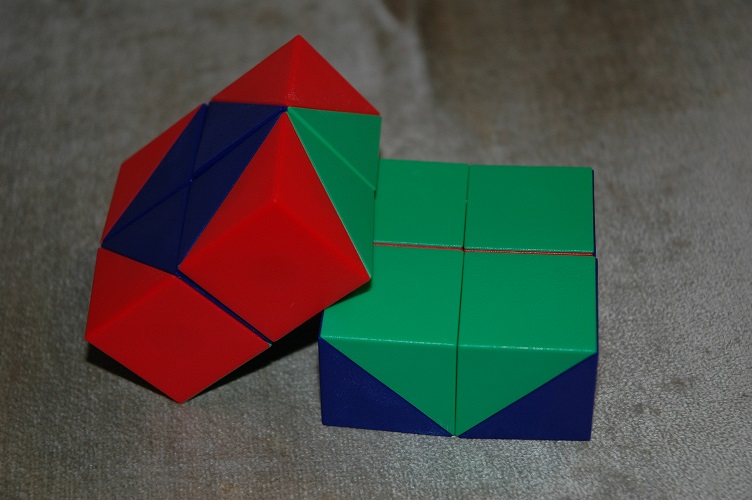
Collide-O-Cube looks simple — after all, it’s just eight identical multicolored blocks — but plenty of great puzzles appear simple, yet offer seemingly endless variation and challenges the more you tinker with them.

You see, the eight Collide-O-Cube blocks aren’t quite identical. Each one contains a unique pattern of magnets inside that offers another level to the solving process as you try to recreate the several dozen cube patterns in the challenge booklet included. This makes for a curious solving experience that combines pattern recognition, deduction, and patience as you play around with blocks until the solution snaps into place.
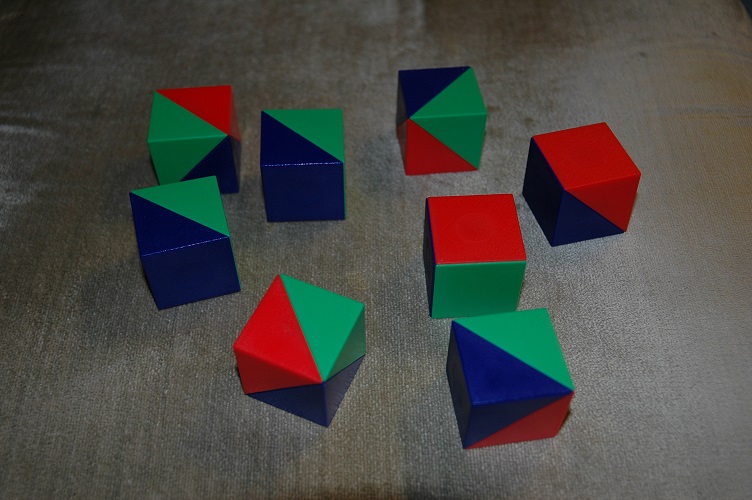
Although designed for kids ages 8 and up, adults will certainly enjoy fiddling with Collide-O-Cube, and I suspect kids will spend as much time creating their own puzzly patterns and shapes with the blocks as they will solving the various cube puzzles.
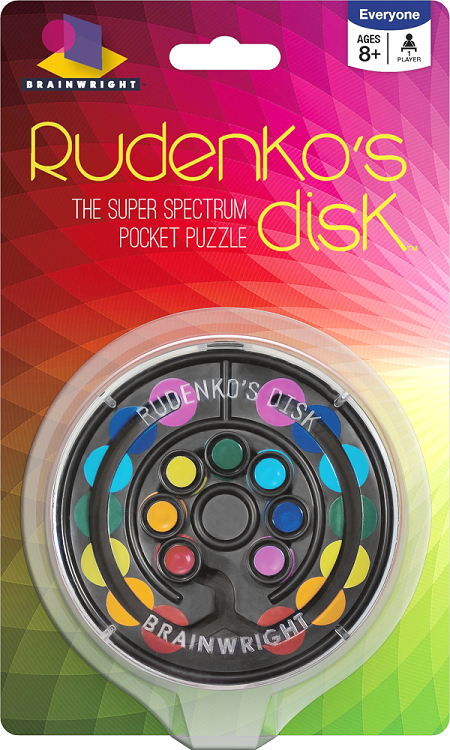
Rudenko’s Disk, on the other hand, is more in the vein of a sliding tile game; a marvelous, colorful, self-contained version of the classic Tower of Hanoi puzzle, Rudenko’s Disk challenges the solver to move various colored posts along the track in order to recreate the color pattern along the side of the disk.

Again, this seems simple enough, but Rudenko’s Disk includes a crafty wrinkle to the solving process: each colored post clicks into place when in a spot with a matching color.

So, for instance, the orange post can only go as far to the left, right, or center as the orange circle, and no further. You can’t place the orange post on the yellow, the green, the blues, or the purple. But you can place the dark blue post on any circle between dark blue and red. (Only the purple is off-limits for the dark blue post.) A strategic chain-solving puzzle lurks within the simple sliding mechanic.
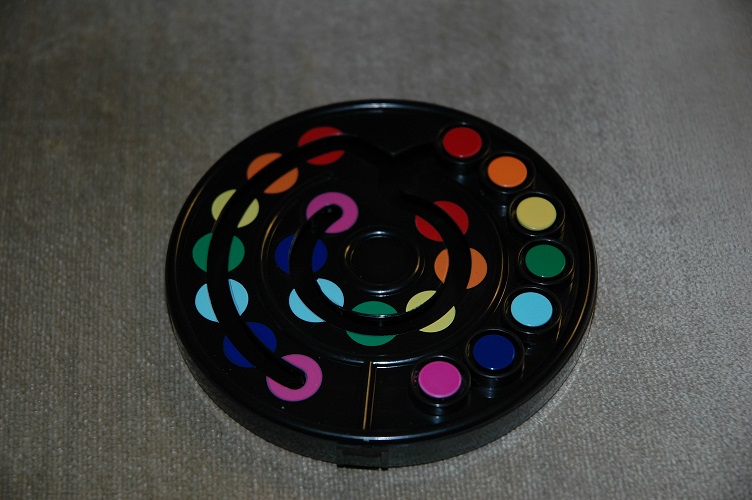
Rudenko’s Disk could be a little off-putting or frustrating for the youngest solvers among us — similar to another color-based puzzle of some renown, Rubik’s Cube, but not nearly as daunting.

These are two intriguing examples of color-based puzzles, but they’re very different solving experiences. Collide-O-Cube’s hidden magnets add a delightful bit of unexpected randomness and chaos to what would otherwise be a simple pattern-matching game — making for a puzzle that encourages fiddling around the blocks in open play — while Rudenko’s Disk’s rigid mechanics require solvers to be a bit more tactical.

But both puzzles are immensely satisfying when the solution clicks into place.

I think Brainwright‘s formula of familiar puzzles with new touches and complications is a recipe for continued success and puzzly fun.

Thanks for visiting PuzzleNation Blog today! You can share your pictures with us on Instagram, friend us on Facebook, check us out on Twitter, Pinterest, and Tumblr, and be sure to check out the growing library of PuzzleNation apps and games!

PuzzleNation Reviews: Cirkusu (by Baffledazzle)

In our most recent edition of 5 Questions, I introduced you to Rachel Happen, the puzzler behind Baffledazzle, a Kickstarter to create high-end jigsaw puzzles that are aesthetically pleasing and more challenging than the average puzzle.

She sent us a review copy of one of the five initial Baffledazzle puzzles she’s created, so let’s give Cirkusu the full PuzzleNation review treatment!

[Note: This is intended as a spoiler-light review, so while I do discuss the completed puzzles in vague terms, I won’t include any pictures of completed puzzles.]

Cirkusu is a series of jigsaw puzzles centered around the history of games. It’s up to the solver to complete each puzzle, and once they’re assembled, to unravel the identities of each game.

cirkusupiecesall

[A fleet of puzzle pieces awaits the solver upon opening the box.]

First off, these pieces are beautiful. The wooden pieces are well cut, visually interesting, and simply fun to play with. Despite the curious shapes and inscribed patterns, it’s still a very challenging jigsaw-style puzzle. And since there’s no picture on the cover to bias the solver, it becomes a matter of matching words, patterns, and different fonts in order to solve the seven puzzles included.

cirkusupieces

[Just a small sample of the variety of Cirkusu puzzle pieces.]

Each puzzle is inscribed with text, presenting historical context for the game’s creation or rules on how to play, enriching the solving experience and offering clues for the second part of the solve: determining each game’s identity.

Also included are numerous miscellaneous bits and bobs, made from wood, plastic, acrylic, and other materials. These allow some of the puzzles to become full playable games, encouraging the solver to experiment further with different play styles, perhaps even inventing your own game along the way toward figuring out the actual game. (Other puzzles explain how to create a given game on your own, even providing blueprints for how to do so.)

close-upforreview

[A close-up of a few individual pieces.]

What separates a Baffledazzle puzzle from the average jigsaw is not only the fine craftsmanship and attention to detail, but also the exploration each puzzle encourages. You can hit the library or take to the Internet in order to find out more about the puzzles, or you can play with the games and make it your own. You dictate when the puzzling experience ends (particularly when there are hint and solution envelopes included).

Solving the puzzle becomes one part of a greater journey. And that makes for a truly memorable solving experience.

[You can check out all of Rachel’s Baffledazzle puzzles, including Cirkusu, on her Kickstarter page.]

Thanks for visiting PuzzleNation Blog today! You can share your pictures with us on Instagram, friend us on Facebook, check us out on Twitter, Pinterest, and Tumblr, and be sure to check out the growing library of PuzzleNation apps and games!

PuzzleNation Product Reviews: Loonacy

loonacy

Looney Labs is a game company with a creative model everyone can get behind: high replay value through wildly interactive, adaptable game play. Perhaps best known for their card game Fluxx, Looney Labs games are designed for portability, packing a lot of punch into smaller, more efficient packaging.

Their latest release is Loonacy, a pattern-matching card game that requires quick reflexes, a quicker eye, and no small amount of strategy.

In Loonacy, players compete to drop all of the cards in their hand by dropping them one-at-a-time into various piles by matching one of two symbols on the card. For instance, if you’ve got a card with a cookie and a brain on it, you can drop that card onto a pile with a cookie on top or a brain on top.

loonacy2

You can try to strategize by arranging cards into your hand by symbol or possible chains — brain/cookie, cookie/ship, ship/puppy — but you have to play each card individually before you can drop the next card. And since everyone is racing to empty their hands at the same time, it can rapidly become a very chaotic playing experience.

(And in your enthusiasm, you’ll probably end up bending a few cards. Hey, it happens.)

But there is an element of strategy to the gameplay. If you have multiple cards with a cookie, you’ll want to play the card where the other symbol doesn’t help your opponents. (For instance, if there’s already a brain symbol showing and no one can play on it, play the cookie/brain card.)

That way, you can play your second (and hopefully, your third) cookie cards in a row and decrease the number of cards in your hand in a hurry. Of course, if someone drops their card on top of that cookie card, your strategy might go right out the window.

But that’s part of the fun. Loonacy tests observation, reflexes, and decision-making skill, all in the matter of a few minutes per game.

While it’s light on the puzzling, it’s high in charm, replay factor, and style. The sheer number of potential images to match makes this far more interesting than the average card game or pattern-matching challenge.

Looney Labs has a winner on their hands with Loonacy. I suspect it’ll be a big hit on Saturday during our International TableTop Day celebrations at home.

[Click here to check out our reviews of several other Looney Labs products!]


Thanks for visiting PuzzleNation Blog today! You can share your pictures with us on Instagram, friend us on Facebook, check us out on Twitter, Pinterest, and Tumblr, and be sure to check out the growing library of PuzzleNation apps and games!

PuzzleNation Product Review: Pink Hijinks, Chrononauts, and Fluxx: The Board Game

fluxx0

Looney Labs is a game company with a creative model everyone can get behind: high replay value through wildly interactive, adaptable game play. Perhaps best known for their card game Fluxx, Looney Labs games are designed for portability, packing a lot of punch into smaller, more efficient packaging.

They offered us the opportunity to try out three of their games for the Holiday Puzzly Gift Guide, each with its own unique flavor and playing style, and we put them to the full PuzzleNation Blog test.

pink1

The set-up for Pink Hijinks seems simple enough. Three stacks of pink pyramids (small on top of medium on top of large, like a little tree) occupy the middle row of a 3×3 grid.

Based on the roll of the die, you and your opponent maneuver your pieces with one of two goals in mind: either trying to either fill your home row with all three pyramids of a given size, or pushing all nine pyramids into your opponent’s row.

It’s a miniature chess game, allowing for offensive and defensive strategies. After a few rounds, we started improvising new rules and different gameplay styles, and discovered how much fun you could have with nine little pink pyramids. Pretty good for a game that fits in your pocket.

pink2

Pink Hijinks is part of Looney Labs’ multi-colored Looney Pyramids series, an ever-expanding line of puzzle games built around their signature pyramid game pieces. Not only can you buy individual games, but the company is constantly releasing new variations on their games through their website, allowing players to combine pieces from multiple Looney Pyramids products and play brand-new games. (They’ve even compiled a listing of fan-designed games using Looney Pyramids!)

As far as I can tell, the Looney Pyramids series has the loftiest of goals: to offer as many unique playing experiences as a deck of cards, arguably the most adaptable tool in a gamester’s arsenal. And based on their lineup thus far, Looney Labs is well on their way toward reaching that goal.

chrono1

Time travel isn’t easy. If it was, everyone would do it. And Looney Labs takes that idea to the next level with Chrononauts, a card game where multiple time travelers are manipulating history, capturing artifacts, and racing to return to their own time with their missions complete.

Chrononauts is all about the cards. You’ve got mission cards, ID cards, timeline cards that make up the playing space, artifact cards, cards that change history (and others that change it back), as well as cards that can help or hinder your fellow time travelers.

chrono2

The history-changing aspect is the most puzzly part of the game, as you determine what moments to change (and which to protect from your opponents) in order for your timeline to come to pass, but ensuring you don’t accidentally end the game by creating too many temporal paradoxes. The designers did an impressive job figuring out how major points in history were interconnecting, and watching the effect ripple down through the cards after making a bold history-altering move is arguably the best part of the game.

My one caveat regarding Chrononauts is that the game goes far too quickly with only two players. It’s a game designed around consequences, and the more consequences that are out of your hands, the more engaging and challenging the game becomes. I’d recommend you always recruit as many players as possible to make the gameplay last.

fluxx2

There are certain things you take for granted when playing a board game. You pick your game piece, and that’s yours for the duration of the game. You draw a given number of cards per turn. The board itself is static, so you can strategize.

But in Fluxx: The Board Game (titled to distinguish it from Fluxx: The Card Game), all of these givens are up for grabs, making for easily the most gleefully chaotic board game experience I’ve ever had. The board is made up of nine individual tiles, which can be shifted or rotated by your fellow players. The rules can be changed, affecting the number of spaces you move per round, how many cards you can hold, and even how many goals you must achieve before the game is over.

fluxx1

[A simple punch card helps players keep track of the ever-shifting rules.]

It’s mind-melting fun, a game that demands constant awareness and a strong ability to think on your feet, since the rules can change in an instant. (One game, a card was played that made the players switch game pieces, so I went from little blue men to little green circles, and the swerve threw me off for at least two rounds.)

fluxx3

Fluxx is the perfect example of the Looney Labs creative model: high replay value through wildly interactive, adaptable game play. Every game of Fluxx is different, not only because the rules are so malleable, but because with multiple games under your belt, you and your opponents become craftier, more adeptly manipulating the board and the rules to your advantage. It’s a great time.

I think puzzle fans and board game fans alike will find quite a bit to enjoy with the games from Looney Labs. So if you’ve got some Christmas cash burning a hole in your pocket, check them out!


Thanks for visiting the PuzzleNation blog today! You can like us on Facebook, follow us on Twitter, cruise our boards on Pinterest, check out our Tumblr, download our Classic Word Search iBook (recently featured by Apple in the Made for iBooks category!), play our games at PuzzleNation.com, or contact us here at the blog!

PuzzleNation Product Reviews: The Stars Are Right and Castellan


Steve Jackson Games is a recognized and well-regarded name in both the roleplaying and board game communities. With a tradition of creating games that offer engaging and curious twists on well-worn puzzle and game templates, you never quite know what you’re getting yourself into when you pick up one of their products.

They offered us the opportunity to try out two of their games for the Holiday Puzzly Gift Guide, each with its own unique flavor and playing style, and we put them to the full PuzzleNation Blog test.

The Stars Are Right is a multiplayer card game where you rearrange the stars in the sky in order to summon minions and gather enough power to summon an elder god and destroy the world. It’s perfect for Christmas! =)

Seriously, though, this game is an effective fusion of several types of strategy and puzzle games. You have a simplified Magic: The Gathering-style card game with the different minions you can summon, as well as a wonderfully illustrated variant on a sliding tile puzzle in the 5×5 sky tiles laid out between the players.

Each card grants you a different opportunity to manipulate the sky (by flipping tiles over, swapping them, or shifting an entire row) and create new constellations. The more complicated the constellation, the more powerful the creature you summon, and the more points you get.

This sort of chain-solving and forward thinking becomes both more challenging and more enjoyable as you compete with other players and race toward your 10-point goal and victory. It’s as exciting to see someone change the sky to your advantage as it is frustrating to see your hard work foiled by an opportunistic move.

The artistic style of The Stars Are Right is thoroughly weird, channeling the works of H.P. Lovecraft and offering up all sorts of gross and bizarre creatures, which is juxtaposed nicely by the effective (and quite lovely) style of the sky tiles. It creates a curious separation between down-and-dirty (the card game aspect) vs. high-and-lofty (the elegant tile-puzzle aspect) that’s quite enjoyable.

All in all, The Stars Are Right is not only a strong introduction into more complicated card games, but a thoroughly fun puzzle game.

Which brings us to today’s second product review!

Castellan is a two-player puzzle-game where players both compete and collaborate to build an elaborate castle.

Every time a player completes a courtyard — walling it off completely from the rest of the game board — that courtyard is claimed, and the player is awarded points based on the number of towers framing the courtyard. The players have two small decks of cards that determine what pieces — towers, short walls, and long walls — they can play on their next turn, and once the cards are exhausted and every piece has been played, the player with the higher number of points wins, claiming the castle.

One of the most intuitive puzzle-games I’ve played in a long time, Castellan requires only a quick skim of the simple instructions before playing, making it a great introductory puzzle game for first-timers. And the molded plastic pieces add a wonderful tactile dimension to the playing experience. What kid, young or old, doesn’t want to build a castle?

But since the level of strategy and complexity is dictated by the players, this is hardly a game for kids alone. Puzzlers will find their spacial reasoning challenged as they assemble courtyards in their heads and try to determine which cards to play. Tactics and forward planning play a huge role in the gameplay, as you try to seize opportunities left by your opponent, claim courtyards, and use up your remaining pieces in ways that help you but won’t leave openings for your opponent to take advantage of.

And, quite honestly, it’s just fun to watch the board sprawl out as more and more pieces are added.

Castellan is appropriate for practically all ages (while The Stars Are Right’s monster art and general sensibilities could prove offputting to younger players or more traditional puzzle-gamers), but both bring something new to the table in terms of strategy, interactive gameplay, and puzzly challenges.

Thanks for visiting the PuzzleNation blog today! You can like us on Facebook, follow us on Twitter, cruise our boards on Pinterest, check out our Classic Word Search iBook (recently featured by Apple in the Made for iBooks category!), play our games at PuzzleNation.com, or contact us here at the blog!

PuzzleNation Product Review: The Walk-By Scrabble Board

Hammacher Schlemmer is perhaps best known for its library of high-end products, from massage chairs and high-tech toys to outlandishly marvelous devices like a jetpack that propels you into the air on columns of water.

But they’re also home of some unexpectedly delightful puzzle products, like the latest edition to my cubicle space, the Walk-By Scrabble Board.

Lightweight, durable, and easy to mount around the home or office, the Walk-By Scrabble Board is designed for puzzlers who don’t mind taking some time between moves to accomplish other tasks.

The magnetic letters adhere well to both the board and the player tags that conceal your tiles from others, and the dry-erase board scoreboard doesn’t stain easily. It’s perfect for repeated, regular play.

But the Walk-By Scrabble Board has another terrific facet: the casual nature of its layout infuses your gameplay. There isn’t the tension and gravitas of having several players watch you as you make your move, feeling seconds tick away as you scramble to anagram in your head. 

You can play at your leisure, offering a similar playing experience to electronic versions of the game like Words with Friends and Lexulous, but without sacrificing the more social, familial spirit of playing a game with your family. 

That combination of the best of the electronic and board game versions makes for a much more congenial playing experience overall.

As you can see, it’s a hit here at the PuzzleNation office.

Well-made and affordable, the Walk-By Scrabble Board is a great way to reignite the puzzly spirit of your household in a fun, casual way.

[This product and many others will be featured in our Holiday Puzzly Gift Guide, going live on PuzzleNation Blog next Wednesday!]

Thanks for visiting the PuzzleNation blog today! You can like us on Facebook, follow us on Twitter, cruise our boards on Pinterest, check out our Classic Word Search iBook (recently featured by Apple in the Made for iBooks category!), play our games at PuzzleNation.com, or contact us here at the blog!