PuzzleNation Book Review: Kubrick’s Game

Welcome to another installment of PuzzleNation Book Reviews!

All of the books discussed and/or reviewed in PNBR articles are either directly or indirectly related to the world of puzzling, and hopefully you’ll find something to tickle your literary fancy in this entry or the entries to come.

Let’s get started!

The subject of today’s book-review post is Derek Taylor Kent’s novel Kubrick’s Game.

Shawn Hagan is a film student at UCLA’s School of Film and Television, a gifted director of photography, cameraman, and lighting designer with aspirations toward directing. He’s probably like many cinephiles you know: obsessive, prone to losing himself in films, with a hard time relating to others.

He’s also a fan of puzzly scavenger hunts, tackling them with his friend Wilson, a former child star with his own directorial ambitions. They also recruit Shawn’s TA (and crush), Samira Singh, to join them. But when Shawn’s film professor asks for Shawn’s help deciphering the contents of a mysterious package, Wilson, Sami, and Shawn will find themselves on a puzzle hunt unlike anything they’ve ever seen.

The package is from visionary director Stanley Kubrick, a man who has been dead for fifteen years. Apparently, he left one last gift to his fans and fellow film lovers: an elaborate puzzle whose endgame could change history.

As Shawn, Wilson, and Sami unravel each clue, delving deep into Kubrick’s life and filmography, they discover they’re not the only ones in pursuit of the solution to Kubrick’s game; not only are students from other film schools also on the hunt, but shadowy forces are also working to solve the puzzle…forces that are willing to lie, cheat, steal, and worse to get what they want.

What could Kubrick have left behind to justify such means? Will Shawn, Sami, and Wilson solve the famous chessmaster’s last gambit?

Kubrick’s Game is a puzzly thriller/adventure piece very much in the vein of The Da Vinci Code, though a far more satisfying read, more akin to the Shakespeare-fueled mystery of Jennifer Lee Carrell’s Interred with Their Bones or Haunt Me Still than the smack-you-in-the-face-with-coincidence style of Mr. Brown. Kent is clearly a fan of Kubrick’s work, and that enthusiasm infuses every page of the story.

Part puzzle hunt, part tribute, and part whodunit, Kubrick’s Game revels in the minutiae of classic films, adding depth and meaning to cinematic quirks and questions that hardcore film geeks have been debating and theorizing about for years.

But Kent goes one step further by including relevant images and frames of film, allowing the reader to follow the narrative. You can’t quite solve the puzzles alongside the protagonists, especially in the later puzzles (unless you’re a serious Kubrick aficionado, that is), but you know enough to avoid any possible frustration.

On the puzzle side, there are really three puzzly narratives to unravel. The first is the puzzle hunt early in the game, which is very straightforward. The second is Kubrick’s game itself. The third is the whodunit of the story, pondering who Shawn and his team can trust and who they’re working against. It’s a multilayered narrative that never bogs down, despite the twists and turns and numerous characters in play.

[Image courtesy of Biography.com.]

Kubrick himself becomes a major player in the story, as his motivations, his choices, and his interests are crucial to the plot. His films as well become intriguing characters — particularly Eyes Wide Shut, often a maligned part of Kubrick’s legacy, though one I have more appreciation for after reading this book.

(And Kent is clearly having some fun with some of the conspiracy theories surrounding Kubrick’s life and works in this novel, but he does so without mocking.)

As for the human characters, Sami and Wilson are amiable support characters; they’re likable and capable, focused and flawed in their own ways, but Shawn is clearly the centerpiece of the novel, so most of Sami and Wilson’s more intriguing character aspects only emerge in reaction to Shawn.

As for Shawn, he’s a little polarizing, because you want to like him, but several of his choices make it hard to do so. Some of this can be attributed to Shawn’s social awkwardness and insensitivity; there are certain character moments that are selfish and border on the emotionally brutal.

(Some characters theorize that Shawn is on the spectrum, but I don’t feel comfortable commenting either way. It isn’t particularly germane to the plot, so long as you can accept that Shawn is fairly tone-deaf socially and has difficulty connecting with others.)

That being said, you cheer when Shawn succeeds and you root for him when he falters, which are signs of a solid protagonist.

Although the antagonists descend a bit into cartoonish villainy, that’s a minor quibble. For the most part, the stakes feel high and the mentality of Shawn, Wilson, and Sami’s team against the world is an easy one to buy into.

Kent has done an impressive job of constructing an elaborate mystery worthy of Kubrick’s labyrinthine storytelling, one that should satisfy thriller fans and puzzle fans alike.

Kubrick’s Game is available on Amazon in hardcover, softcover, audiobook, and ebook.

[Full disclosure: I received a free copy of today’s book in exchange for a review.]


Thanks for visiting PuzzleNation Blog today! Be sure to sign up for our newsletter to stay up-to-date on everything PuzzleNation!

You can also share your pictures with us on Instagram, friend us on Facebook, check us out on TwitterPinterest, and Tumblr, and explore the always-expanding library of PuzzleNation apps and games on our website!

PuzzleNation Product Review: LEGO Maze

For years, one of the most marketable things about LEGO sets has been that you can use their pieces in your own ingenious creations. They’ve taken it a step further over the last few years, and now fan creations have the chance to become actual sets!

The Ecto-1 from GhostBusters, the set of The Big Bang Theory, a collection of noteworthy female scientists… these are some of the awesome sets that were designed by amateur builders, voted on by LEGO fans, and approved to become marketed LEGO sets.

And the latest edition to that fan-created line of specialty sets is one of the puzzliest products they’ve ever sold: the LEGO Maze.

Jason Allemann of JK Brickworks created the original design, which was voted on by fans, approved by LEGO, and then improved upon by professional LEGO model designer Steen Sig Andersen.

It’s based on classic wooden marble mazes; the goal is to tilt the board with the two dials on the sides of the maze in order to navigate your marble from one end of the maze to the other without dropping the marble through one of the many treacherously placed holes.

In the LEGO maze, those holes are replaced by black depressions in the maze that trap your marble without dropping it out of sight. (Though I’m sure amateur builders are already designing their own maze layouts that incorporate actual holes just to up the challenge factor.)

[The medieval layout included in the instructions.]

Oh yes, there’s not just one layout. As you can see, the set includes all sorts of pieces with which to create numerous possible layouts from basic ones to advanced. (I’m currently working on one of my own design. Maybe it’ll pop up on Instagram soon!)

The adaptability of the maze layout is one of the highlights of this set, encouraging the same entrepreneurial building spirit that inspired the set in the first place.

And speaking of the set, the design is pretty impressive. It cleverly allows you to lock the tilting maze in place by using the storage box for the marbles as a stabilizer, and you can remove it just as easily. (Remove one piece — and the travel lock under the opposite corner, and you’re ready to play!)

Replicating the full range of motion cannot have been an easy task for either Allemann or Andersen, and that leads to the only negative aspect of the set. I was a little underwhelmed by the control offered by the two dials. Each tilts more toward one direction than the other, so you don’t have the full range of traditional marble mazes. (I suspect this could be remedied by a slightly shorter rod connecting each dial to the two frames allowing you to tilt the maze more in the opposite direction.)

That being said, it’s a minor quibble. On a perfectly flat surface, a steady hand will lead you to victory, if you’re patient enough.

[The build in progress…]

As a long-time fan and builder, I enjoyed both the simple and complex aspects of the building process, and I was surprised that they didn’t number each bag of pieces, as they’ve recently started to do with their higher-end, more complicated sets. That might put off a casual builder, but as someone who enjoys the additional challenge of digging through a pile of pieces looking for that one particular piece, I didn’t mind at all.

LEGO has really been pushing the boundaries of what you can accomplish with these classic interlocking bricks, and the LEGO Maze is one of the most inventive and impressive designs I’ve ever seen.

[The LEGO Maze is available from LEGO.com for $69.99.]


Thanks for visiting PuzzleNation Blog today! Be sure to sign up for our newsletter to stay up-to-date on everything PuzzleNation!

You can also share your pictures with us on Instagram, friend us on Facebook, check us out on TwitterPinterest, and Tumblr, and explore the always-expanding library of PuzzleNation apps and games on our website!

PuzzleNation Product Review: Slideways

One of the most popular forms of puzzle gaming involves placing four game pieces in a row on a board. Four-in-a-row games like Connect Four are rooted in the tactical simplicity of Tic-Tac-Toe or three-in-a-row solving, but take it a step further.

We’ve explored several four-in-a-row puzzle games before. ThinkFun’s All Queens Chess added a wrinkle by employing the rules of chess in four-in-a-row solving. Quarto used pieces of varying heights, colors, and shapes to create a more complex game play experience.

And now, Tricia McLaughlin and R&R Games bring us another evolutionary step in four-in-a-row puzzle gaming: Slideways.

At first glance, Slideways offers a simple 4×4 play area, where the blue squares can be rotated to reveal a gold or red square claimed by the player in a given turn. Each play claims one square per turn.

In this picture, two squares each have been claimed by the players. But Slideways allows the player to manipulate the play area itself by sliding a row one square in either direction, adding another dimension to the game.

So now players can claim blue squares or shift the rows to give themselves the best opportunity to not only get four in a row, but to thwart an opponent’s efforts to do the same. (Be careful, though, as the sliding feature can be a little clunky.)

But that’s not all. Slideways has one more trick up its sleeve.

Players also have the option of changing claimed squares to their own color! In this case, one player rotated a gold-claimed square into a red-claimed square.

And honestly, this is the feature that really separates Slideways from other four-in-a-row games, because it requires the player to constantly assess and reassess the game every single turn. You can’t take it for granted that a claimed square will stay claimed, or that the three squares you already have lined up will stay lined up.

There is one exception to this rule: you cannot reverse a square a player has just claimed. You have to wait a round before doing so.

So the red square claimed in the top row this turn cannot be immediately turned into a gold one. The other player has to wait until the next round, so instead, the other player changes one of the red squares in the third row into a gold one.

All of these possible moves — claiming a square, shifting a row, or taking an opponent’s square — make Slideways the most complex and controllable four-in-a-row puzzle game I’ve ever seen, and it can make for a fun and nerve-wracking playing experience, especially against a skilled opponent.

Plus games move so quickly (usually lasting less than 10 minutes) that you’re sure to play multiple rounds without giving up a huge chunk of your day. My opponent and I played 11 or 12 games in about half an hour, and each one felt new and different because of the many play options available to us.

(Plus there’s a three-player variation that starts with some squares flipped to red, others flipped to gold, and the third player uses blue as their color.)

Simple to learn, but tough to master, Slideways is a marvelous addition to the four-in-a-row puzzle game field, one that ensures you’ll take no move and no turn for granted. Portable and self-contained, this one is a treat.

[I discovered Slideways at the Connecticut Festival of Indie Games. You can pick it up on the R&R Games website for $11.99.]


Thanks for visiting PuzzleNation Blog today! Be sure to sign up for our newsletter to stay up-to-date on everything PuzzleNation!

You can also share your pictures with us on Instagram, friend us on Facebook, check us out on TwitterPinterest, and Tumblr, and explore the always-expanding library of PuzzleNation apps and games on our website!

PuzzleNation Product Review: Back Spin by ThinkFun

[Note: I received a free copy of this game in exchange for a fair, unbiased review. Due diligence, full disclosure, and all that.]

Imagine someone hands you a small puzzle game. You twist and turn it this way and that way, trying to line up all the different colored components so that they match, spinning and manipulating it so that one particular piece falls into place, but by doing so, three others end up somewhere else, and now you have to chase them down.

It probably sounds like I’m describing solving a Rubik’s Cube, but the same description fits cracking the latest puzzle game from ThinkFun: Back Spin.

And you know what? Back Spin is the younger sibling of the Rubik’s Cube that I wish I could’ve tried out first.

[Both sides of Back Spin, with the spheres all mixed up between the two.]

Designed for solvers aged 8 and up, Back Spin only features two sides (front and back) to Rubik’s six, but each of those sides has six small colored chambers, intended to hold matching colored spheres. Rotating the front or the back allows you to line up these chambers and swap spheres between them.

As for the spheres, there are nine different colors to sort; red, yellow, and orange are on both sides, but each side has a different shade of blue, green, and pink/purple, meaning some spheres can go on either side, but some are only meant for the front or the back.

Whether you’re moving colored spheres from back to front or rotating them in overlapping chambers to shift the spheres’ positions within the chamber — a la the sliding tiles in one of those picture puzzles — this is an introduction to chain-thinking and solving, a step up from simpler mechanical brain teasers, but not nearly as daunting as Rubik’s infamous cube.

[Alright, it’s solved! Oh, no, wait, this is only one side. Darn.
There are still spheres misplaced on the other side of the puzzle.]

And although the game is marketed as a single-solver puzzle, you really need two: one to mix all of the spheres up, and the other to unravel it. It’s much more satisfying to conquer the challenge someone else sets out for you than one you set for yourself, because you can’t help but retain some of the steps involved in mixing up the puzzle.

Having someone else mix up the spheres not only allows for a tougher solve, but the process of mixing them up for another solver is just as valuable a puzzling experience as solving it.

[Okay, this time I’ve got it. All the spheres properly placed on both sides. Phew!
(You can also see that there are only two purple spheres, since one chamber
has to allow a sphere to pass from back to front for the puzzle to be solvable.)]

Back Spin is a wonderfully vivid variation on a classic style of puzzle solving, one whose simple mechanics — a wheel that goes back and forth and holes that line up — allow for deep, meaningful, logic-based puzzling.

It encourages exploration and experimentation, staving off both the boredom and the frustration that more difficult brain teasers often spark. It’s a terrific addition to the ThinkFun line-up of puzzle games that teach while you play.

Back Spin is available for $14.99 on the ThinkFun website. To check out previous ThinkFun product reviews on PuzzleNation Blog, click here.


Thanks for visiting PuzzleNation Blog today! Be sure to sign up for our newsletter to stay up-to-date on everything PuzzleNation!

You can also share your pictures with us on Instagram, friend us on Facebook, check us out on TwitterPinterest, and Tumblr, and explore the always-expanding library of PuzzleNation apps and games on our website!

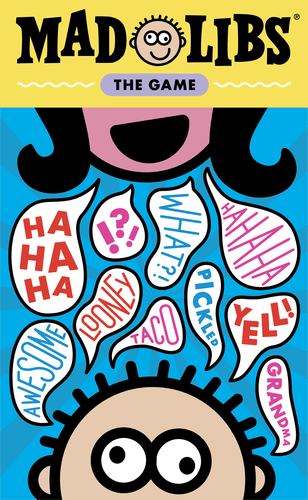
PuzzleNation Product Review: Mad Libs: The Game!

mad-libs_uawibn

[Note: I received a free copy of this game in exchange for a fair, unbiased review. Due diligence, full disclosure, and all that.]

There are a lot of puzzly games where wordplay is key. In Scrabble, Bananagrams, or Words with Friends, it’s all about forming words and fitting them into grids. In Taboo, it’s all about communicating without using certain words. In Balderdash, it’s all about crafting the perfect definition, either to mislead other players or to demonstrate your mastery of language and vocabulary.

Mad Libs: The Game follows in that grand tradition of wordplay, but instead of forming words, avoiding them, or defining them, this game is about using them to their utmost in order to entertain your fellow players.

madlibs2

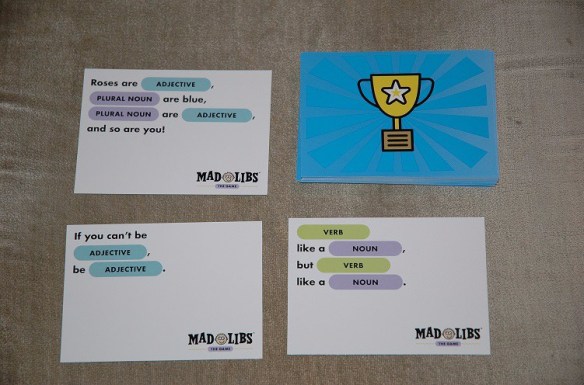
Each player starts with 7 Word cards. Each card depicts a word in noun, verb, adjective, or adverb form (or multiple forms, for adaptable words), and these cards are the ingredients for cooking up funny, weird, entertaining sentences in the game.

But what do you do with those cards? Easy! Just like the original fill-in-the-blank stories, you’re going to use those cards to conjure up the best ways to fill the blanks in our Sentence cards.

So each round begins with a new Sentence card and the players choosing Word cards from their hand in order to come up with the most entertaining words to fill in the blanks for this round’s Sentence card. Then everyone reads their completed sentence aloud, and a vote is held where players point to the player with the best completed sentence. That player then wins a point.

The first player to earn three points wins.

madlibs1.jpg

Now, this style of gameplay won’t seem revolutionary to anyone who has played with magnetic poetry or indulged in the much-raunchier Cards Against Humanity or one of the many other games in that vein.

But whereas those games tend to traffic in shock value for their humor, Mad Libs: The Game is all about silliness. This is a game that encourages that same level of creativity, wordplay, and surprise, but in a way that’s appropriate for family gameplay. For example, unlike the very adult themes found in CAH, the harshest words in this game are more along the lines of “pierce” or “heartless,” nothing that would raise a parent’s eyebrow.

madlibs3

[Example of a completed sentence:
Puppies may make the world go ’round,
but it’s flower girls that pay the bills.”]

This is a terrific gateway game for younger puzzlers to get them to not only think about words, but to explore how to use them effectively. It combines humor, storytelling, silliness, and craft to make a good, clean, and most importantly, fun time.

Looney Labs is usually the home of gleefully chaotic games like Fluxx and Loonacy, but they always manage to couch their products in family replayability, and Mad Libs: The Game is no exception.

You can pick up Mad Libs: The Game here, and to check out all of our reviews of Looney Labs games and products, click here!


Thanks for visiting PuzzleNation Blog today! Be sure to sign up for our newsletter to stay up-to-date on everything PuzzleNation!

You can also share your pictures with us on Instagram, friend us on Facebook, check us out on TwitterPinterest, and Tumblr, and explore the always-expanding library of PuzzleNation apps and games on our website!

PuzzleNation Product Review: Firefly Fluxx

firefly-fluxx-card-game

[Note: I received a free copy of this game in exchange for a fair, unbiased review. Due diligence, full disclosure, and all that.]

Looney Labs is celebrating 20 years of puzzle-game goodness this year. From Pink Hijinks and Just Desserts to Retro Loonacy and Chrononauts, they have built a reputation for games that endlessly reinvent themselves every time you play, maximizing both fun and replayability.

And their newest edition to their flagship Fluxx series typifies the spirit of Looney Labs: it’s bright, chaotic, stylish, and entertaining as all get out.

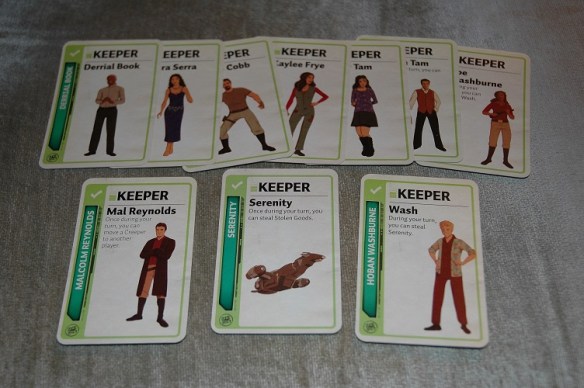
Firefly Fluxx makes the most of the much-beloved fan favorite one-season wonder, utilizing the characters, tropes, and best lines from the show to place their particular spin on the shifting rules, goals, and actions of earlier editions of Fluxx. (And you won’t even need to brush up on your Chinese expletives!)

firefly2

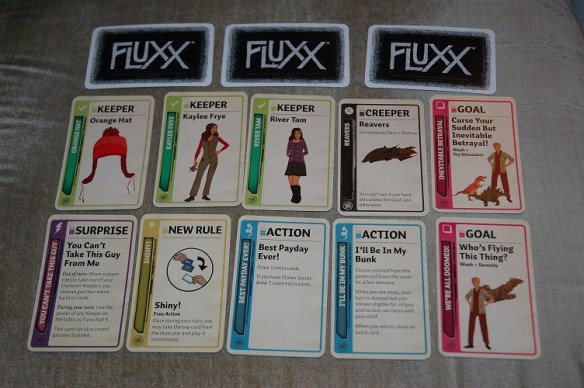
Now, anyone who has played Fluxx in the past is familiar with action cards, goal cards, keeper cards, new rule cards, and surprise cards. For those unfamiliar with the game, the basic idea is to collect keeper cards in the hopes of completing a goal and winning the game. But since every player can change rules (like how many cards you draw during your turn, how many you drop, etc.) as well as what the current goal is that will allow you to win the game, you have to be on your toes.

Firefly Fluxx capitalizes on the outlaw spirit of the show to encourage players to swap out goals, play diabolical creeper cards, and spring devastating surprises on their opponents, all while sharing in the collective fandom with references like “Shiny!,” “I’ll be in my bunk,” and my personal favorite, “Curse Your Sudden But Inevitable Betrayal!”

firefly3

[The crew of the Serenity reunites to elude the Reavers,
gather some loot, and escape unscathed, Fluxx-style.]

The art is delightful in a cartoony way, visually bringing home their larger-than-life adventures. Even the backgrounds of each card get a washed-out, Old West-style color palette to compliment the game and its fictional universe.

Although they’re not reinventing the wheel here with this newest edition of Fluxx, they are providing another terrific example of what they do best: marrying fun pop culture properties with great puzzly gameplay. It’s a winning combination.

You can pick up Firefly Fluxx here, and to check out all of our reviews of Looney Labs games and products, click here!


Thanks for visiting PuzzleNation Blog today! Be sure to sign up for our newsletter to stay up-to-date on everything PuzzleNation!

You can also share your pictures with us on Instagram, friend us on Facebook, check us out on TwitterPinterest, and Tumblr, and explore the always-expanding library of PuzzleNation apps and games on our website!