John Oliver is a household name after his work on The Daily Show and Last Week Tonight, but did you know he and his comedy partner Professor Andy Zaltzman have played a part in the history of cryptic crosswords?
Nineteen years ago this month, they created The Bugle, a half-hour satirical comedy news podcast that covered the biggest, smallest, weirdest, and Hugo Chavez-est news stories of the day. This podcast spanned the Atlantic, as Andy would record from England and John from America.
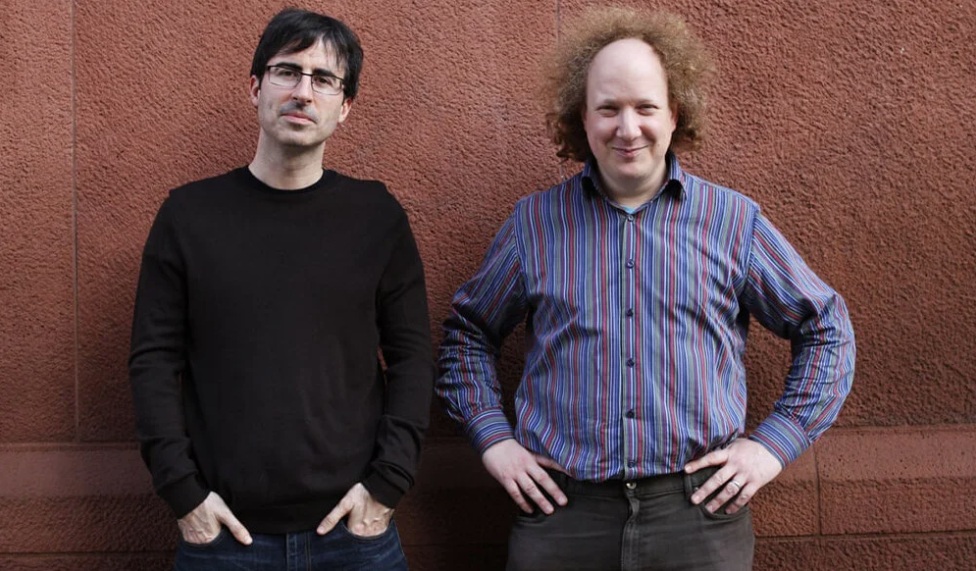
Subtitled “an audio newspaper for a visual world,” The Bugle would go on to last hundreds of episodes before Oliver departed. But it was resurrected by Zaltzman in 2016 (relaunching and jumping straight to episode 4001) and has now launched a network of informative and comedic broadcasts.
So, what does this beloved podcast have to do with cryptic crosswords?
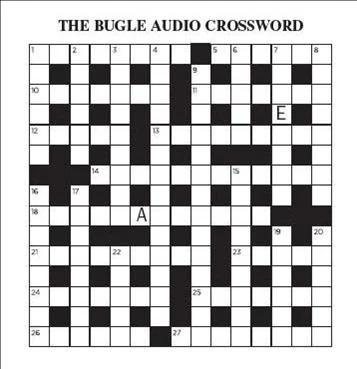
Well, nineteen years ago when The Bugle debuted, one of the recurring features was their groundbreaking Audio Cryptic Crossword. Each episode, Andy would read a single cryptic crossword clue, including answer length and its grid position.
(Oh, and there was a prize offered to the first person to complete the puzzle. That prize? The right to treat yourself to a cup of tea and a sit down after a job well done.)
As the weeks went on, Zaltzman continued to offer new clues. Well, most of the time. On a few occasions, he would accidentally repeat a clue listeners had heard before.
Eventually the actual puzzle grid was revealed on The Times website for solvers, indicating this was an actual puzzle and not just a bit.
As the ACC progressed and more clues were revealed, Oliver grew increasingly dismissive of and exasperated by the entire endeavor.
At one point, Oliver compared the crossword to the Third Reich. Zaltzman quickly agreed, calling the crossword “a triumph for persistence, doggedness, and the value of standing up to pressure from the other side of the Atlantic,” and that “people were glad when the war was over, but that doesn’t mean it wasn’t the greatest part of British history.”

Oliver doubted whether anyone was keeping track of clues or attempting the puzzle, while Zaltzman would talk about the “billions” of listeners choosing sides in the Audio Cryptic Crossword debate. (It is also worth noting that, at one point, it was suggested that several lines from the Book of Revelations were not divine scripture, but were, in fact, cryptic crossword clues.)
From October 15th, 2007 to May 19th, 2008 when the final clue was revealed, the question remained: had anyone written down all the clues, figured them out, and submitted a completed puzzle?
We wouldn’t have to wait long for the answer.
The very next week, the email section featured a message from loyal Bugler and crossword enthusiast Elliot from the UK, who included a picture of his complete (and correct!) Audio Cryptic Crossword.
It seemed that Andy was right, and John’s claims that no one was bothering with the ACC were mistaken.
After the conclusion of the feature, attempts to replace the Audio Cryptic Crossword with other audio puzzles and games failed miserably.
There was an Audio Spot-the-Difference, an omnishambles of an Audio Sudoku, an Audio Tic-Tac-Toe game (or Audio Naughts-and-Crosses for UK readers), and an Audio game of Bridge, among others.
John wasn’t enthusiastic about any of them. And none of them could fill the Audio Cryptic Crossword-shaped void in Andy’s heart.
So what about the actual puzzle?
You can find the grid and the clues online, but there’s not a convenient place to solve it without potentially seeing the answers as well.
I decided to fix that.
I went through the first 29 episodes of The Bugle and transcribed the clues (some of the online archives didn’t get the wording quite right), then retyped the grid, including the two set letters from the original grid.
So if you’d like to test your puzzly mettle against the Audio Cryptic Crossword, now’s your chance!
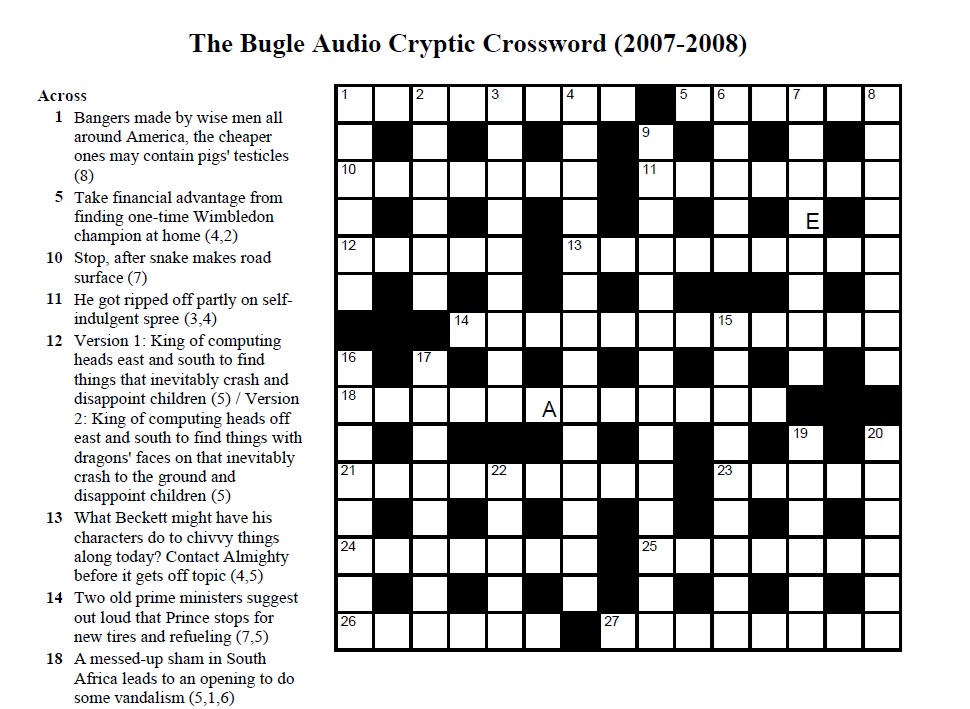
[Click here to download a PDF of the ACC.]
Now, as you can see, the cluing is interesting. Many of the clues thematically matched the news stories they covered on a given week, and the cluing practically drips with snark. (Although it does quite admirably follow the rules of cryptic-style cluing.)
12-Across was accidentally read on two different episodes of The Bugle, and there were minor differences, so I included both versions. Similarly, Andy offered a ridiculously long second clue for 16-Down just to irk John, so I was duty-bound to transcribe both.
17-Down, on the other hand, jokingly presented one clue for girls and one for boys as The Bugle’s contribution to “International Gender Stereotyping Week.”
And that’s the end of the story for The Bugle‘s Audio Cryptic Crossword, the world’s first (and possibly only) serialized cryptic crossword in audio form.
Well, sorta.
Zaltzman frequently encouraged Bugle listeners to edit Wikipedia articles and forum posts about The Bugle to make them as ridiculous, lie-filled, and entertaining as possible, and the legacy of the Audio Cryptic Crossword did not escape the machinations of Buglers.
According to the fan lore of the show, “Elliot” was actually John in disguise (first as Gordon Sumner, aka the musician Sting, then as François Marie Arouet (aka the philosopher Voltaire), intentionally spoiling Andy’s secret (and very confusing) plan for world domination.
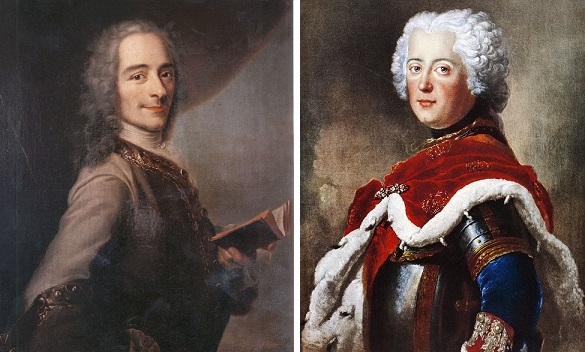
John bragged about this online: “Haha everybody, look at me, I’m awesome. I defeated and foiled Andy Zaltzman’s plans for world domination with a discreet undertone and a lot of anonymity. Signed, John Oliver”.
In his fury, Andy battled John atop Big Ben in London, alternating between martial arts strikes and awful puns. This bombastic duel soon became a tag team match, as Florence Nightingale joined on the side of Andy, while the Queen, Her Majesty Herself, joined on John’s side.
The battle raged on until Big Ben suddenly exploded. Emerging from the wreckage was the true victor of the fight, an impala. (This is a reference to an ongoing gag in the show about Andy making fun of impalas. I think an eland, gnu, or okapi would have been more apropos, given that a crossword puzzle started all this chaos.)
The impala pranced away in victory to return home, sit on the couch, make fun of lions, and savor his triumph.
Thus, the saga of the Audio Cryptic Crossword came to an end, both officially and fictionally.
Whether you prefer what actually happened or the epic, action movie-fueled silliness of the fan version, there’s no denying that the Audio Cryptic Crossword was something new, a symbol of the deep intelligence and subversive energy that represented The Bugle at its best.
Thanks for taking this stroll through puzzle history with me.
Were you or are you a Bugle listener? Did you tackle the Audio Cryptic Crossword? Let me know in the comments section below! I’d love to hear from you.