The World of Wooden Puzzles!

dragon1

Puzzles come in all shapes and sizes, adopting numerous forms that challenge the mind in seemingly endless ways.

While I spend a lot of time on PuzzleNation Blog talking about pen-and-paper puzzles (and their electronic siblings), today I’d like to focus on a brand of physical puzzles: ones made of wood!

As you’d expect, there are hundreds of different puzzles to choose from when discussing wooden puzzles, but I’ve tried to narrow the field down to a manageable size. Enough chatter, let’s get to it!


Sliding Tile Puzzles

[Available from FineWoodenToys.com.]

One of the oldest varieties of physical puzzles, sliding tile puzzles can be found in plastic, electronic, and wooden forms. And whether you’re shifting pieces in order to create a picture or pushing tiles around in order to put numbers in a specific order, the chain-solving technique is the same.


Tangrams

[Available from BrilliantPuzzles.com.]

A tactile and intuitive brand of puzzling, tangrams are a staple of the wooden puzzle market, utilizing simple geometric shapes in order to match designs or fit the pieces into a given space, as in the image above.


Brain Teasers

[Available from Mango Trees.]

These beautiful and elegant puzzles involve a level of craftsmanship and attention to detail that goes far beyond the usual mechanical puzzle experience.

Sometimes, you’re figuring out how to disassemble a shape into its component pieces (six examples of this sort of puzzle-solving appear above), while in others, you have to remove a given piece from a more complex arrangement, often involving ropes and other obstacles that interact with the wooden puzzle itself.


Puzzle Boxes

[Image found on FineWoodworking.com.]

A practical sibling of the brain teasers above, a puzzle box offers an additional incentive to the solving experience, since puzzle boxes can make terrific delivery mechanisms for cash or other gifts. (Sometimes solving them involves only one step, other times it can involve a dozen or more!)

My younger sister has a habit of employing puzzle boxes like the one pictured below to make my oldest nephews work a little harder for their birthday money. (One particularly diabolical design involved concealed magnets holding the trick access point shut.)

[Available from Pandora’s Puzzle Boxes.]


Labyrinths
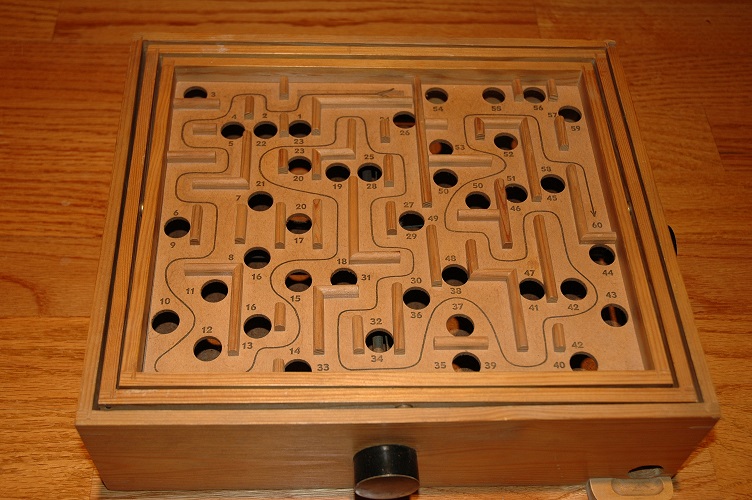
Everyone knows the goal of a maze or labyrinth: to get through it with as few wrong turns as possible. But when you have to navigate a steel ball through the labyrinth without falling into one of many pits, that becomes an even greater challenge.
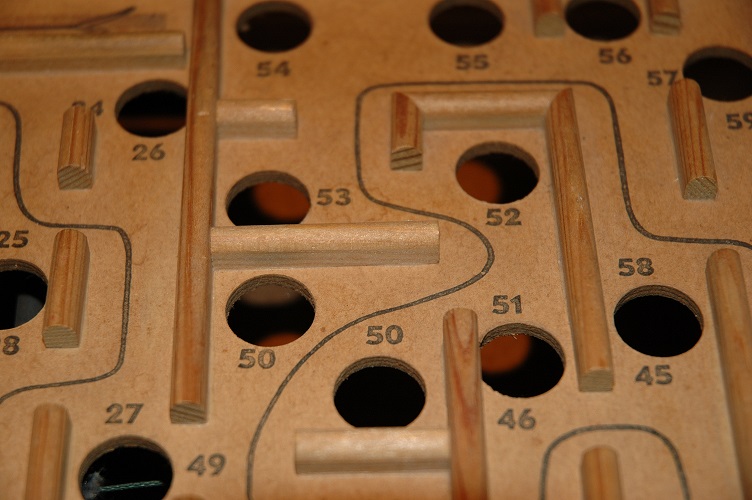
Whether you’re using handles to manipulate the maze and allow gravity to shift the ball from point to point or turning the labyrinth this way and that in order to move the ball toward the finish line, your dexterity and patience are sure to be pushed to the limit.


Jigsaw Puzzles
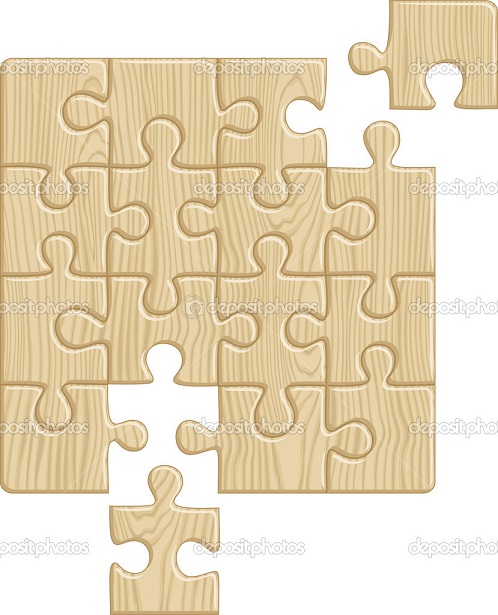
I would be remiss if I ignored the most common variety of wooden puzzle: the jigsaw puzzle!

Whether we’re talking about the more traditional shapes in a Ravensburger puzzle or a jigsaw incorporating unique and interesting pieces like those produced by Wentworth or our friend Rachel Happen of Baffledazzle (like the ones pictured below), jigsaw puzzles are among the first puzzles to which a young child is exposed.


3-D Jigsaw Puzzles

Of course, despite the many tough jigsaw puzzles available these days, you might be looking for a jigsaw with an additional dimension of difficulty. Thankfully, there are 3-D puzzles to give your spatial reasoning a run for its money!

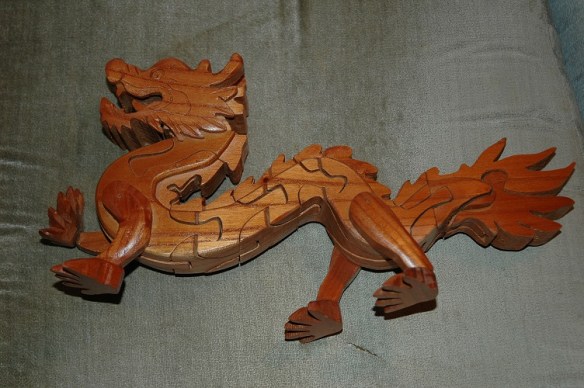
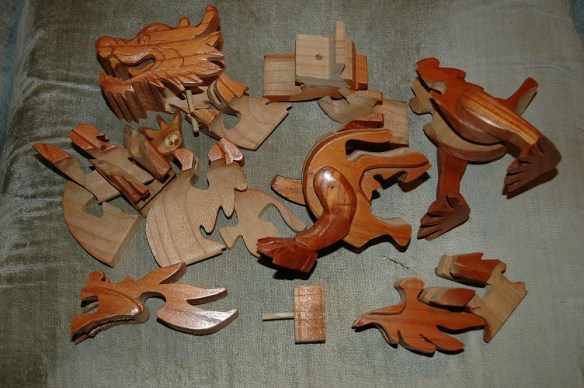
Both the dragon at the top of the page and the camel pictured above are 3-D puzzles that were sent to me by the lovely Sara Kingsland, owner of Completely Puzzled in Port Townsend, Oregon.

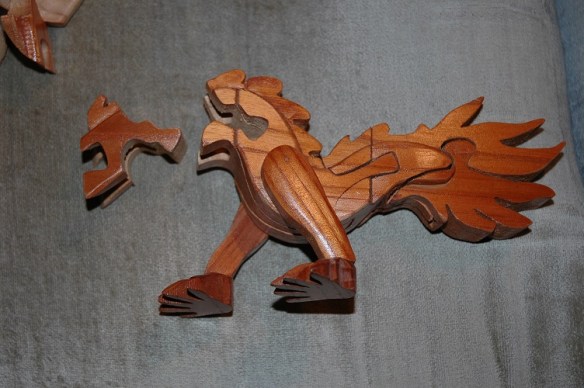
And let me tell you, these puppies put my jigsaw skills to the test. Let’s look at the camel disassembled:

Is it immediately clear to you how to proceed? It certainly wasn’t to me! Now let’s look at the dragon disassembled:
dragon2

Believe it or not, I solved the dragon before the camel!
dragon3

This is because the puzzles involve different approaches. The dragon was designed to be assembled from tail to head, and rarely required me to hold more than two pieces at a time to continue solving it.

The camel, on the other hand, has to be solved legs first, which means holding numerous pieces in place while manipulating others in order for everything to come together.


With the advent of laser printing, the sky is truly the limit when it comes to imagining new and challenging wooden puzzles. I can’t wait to see what these wickedly brilliant puzzlers come up with next.

Are there any types of wooden puzzle I missed, fellow puzzlers and PuzzleNationers? Let me know! (Other than Scrabble, that is. I left that one off the list intentionally.) And while you’re at it, tell me what your favorite kind of wooden puzzle is!

Thanks for visiting PuzzleNation Blog today! You can share your pictures with us on Instagram, friend us on Facebook, check us out on TwitterPinterest, and Tumblr, and be sure to check out the growing library of PuzzleNation apps and games!

Color My Puzzle World

I’ve written about jigsaw puzzles often in the past, because they’re an integral part of the puzzle world.

Whether we’re talking about the world’s largest jigsaw puzzle or a stone jigsaw puzzle curtain, an incredibly difficult puzzle with only 14 pieces or an entire house disassembled and rebuilt jigsaw-style, there seem to be endless variations in how jigsaw puzzles are brought to life.

Puzzle designer Clemens Habicht has an intriguing new take on the jigsaw puzzle, one that plays with a common solving technique.

Many jigsaw solvers organize pieces by color, focusing on one part of the final image and then moving on to the next. But what if every single puzzle piece was a different color?

Habicht has created a 1000-piece jigsaw puzzle that abandons any image clues other than color. There are no buildings, no animals, no hard lines or edges to locate. You’re using only your natural ability to distinguish between various color gradients to complete the puzzle.

Eschewing the classic ROY G BIV rainbow, this puzzle instead uses the color printing model known as CMYK, which stands for the four inks used in color printing: cyan, magenta, yellow, and key (a.k.a. black).

Habicht claims that the puzzle is actually easier to solve than the average jigsaw, because each piece is connected to every other piece in one continuous spectrum, creating an associative puzzle-solving experience.

What do you think, fellow puzzlers and PuzzleNationers? Is color-based solving more intuitive or less?

Thanks for visiting PuzzleNation Blog today! You can share your pictures with us on Instagram, friend us on Facebook, check us out on TwitterPinterest, and Tumblr, and be sure to check out the growing library of PuzzleNation apps and games!

It’s Follow-Up Friday: Jumbo Jigsaw edition!

Welcome to Follow-Up Friday!

By this time, you know the drill. Follow-Up Friday is a chance for us to revisit the subjects of previous posts and bring the PuzzleNation audience up to speed on all things puzzly.

And today, I’d like to return to the subject of world records!

Follow-Up Friday has become something of a repository of puzzly world records.

In previous installments, Follow-Up Friday posts have covered Largest Architectural Video Game Display (when a 29-story game of Tetris was played in Philadelphia), Most Game Show Episodes Hosted by the Same Presenter (for Alex Trebek’s run on Jeopardy!), and the solving of the World’s Largest Rubik’s Cube-style Puzzle.

Heck, just last week, I posted about the World’s Largest Vertical Maze.

And this week, I’ve got another cool one for you: the world’s largest jigsaw puzzle.

It is called “Wildlife,” and it’s produced by Educa. It retails for $400. It’s composed of 33,600 pieces. It measures 5 feet by nearly 19 feet. It is so large that it comes in ten separate bags, inside a wooden box on wheels for ease of movement. It is a monster.

The young woman pictured solved it in 450 hours (over the course of two and a half months). There is a world speed record for solving it, but it took 100 people over 19 hours to do it.

Pretty amazing, especially since she owns a cat, a creature rarely conducive to the solving of jigsaw puzzles.

So, fellow puzzlers and PuzzleNationers, what’s the biggest jigsaw puzzle you’ve ever tackled? Let me know! I’d love to hear about it!

Thanks for visiting PuzzleNation Blog today! You can share your pictures with us on Instagram, friend us on Facebook, check us out on TwitterPinterest, and Tumblr, and be sure to check out the growing library of PuzzleNation apps and games!

The Ultimate Jigsaw Puzzle

Jigsaw-style puzzling is a huge part of puzzle culture, one that’s easy to overlook. Even the average jigsaw is hardly average these days.

You can get them without squared-off edges — removing that crucial first step of finding all the border pieces — or with extra pieces that aren’t intended to fit anywhere. Some, like Baffledazzle puzzles, come without the final image as a guide, leaving you to rely on texture as well as shape. Others involve incredibly detailed or repetitive patterns, eliminating “find this color/image”-style searching. Some are even double-sided!

(My sister had a 550-piece edgeless puzzle that was nothing but coffee beans and some random cups. Another was golf balls and tees. They were mind-melting.)

Then there are the three-dimensional ones that tax your dexterity as well. Whether you’re making a sphere or a replica of the Taj Mahal, your jigsaw skills will be tested severely.

[A massive 3-D puzzle of New York’s skyline… in progress.]

Other forms of puzzles are hardly immune to jigsaw-style solving. Tangrams and pentominoes eschew jigsaw shapes for triangles, squares, and Tetris-style pieces. Even some pen-and-paper puzzles, like Penny/Dell’s Brick by Brick crossword, employs jigsaw pieces.

And, of course, there are all the building toys that rely on the same hand-eye coordination and pattern-finding skills that jigsaw puzzles require. Erector sets, K’Nex, Mega Bloks and LEGO and Tinker Toys and Lincoln Logs and many many others… all have their roots in jigsaw-style puzzling.

But I think I’ve stumbled across one of history’s greatest jigsaw puzzles, and I’m curious if any of the jigsaw puzzle enthusiasts in the PuzzleNation community think they could’ve handled this challenge.

An entire London mansion, broken down and reconstructed jigsaw-style.

Yes, between 1910 and 1912 a mansion in Essex called Cedar Court was dismantled and moved piece-by-piece over 70 miles to its new home in Surrey and painstakingly rebuilt.

The mansion was already over 400 years old at the time, and it’s become known as the “jigsaw puzzle” house ever since.

According to the article in The Telegraph, “Every part of the building was sectioned out and numbered so that it could be stuck back together again exactly as it was after its trip across the capital.”

This was clearly a monumental undertaking, and even with careful planning, I suspect a few jigsaw-savvy workmen were required to get the mansion back in shape.

And hey, are any jigsaw aficionados out there interested in owning this bit of puzzle history? It’ll only cost you fourteen MILLION pounds to acquire it.

Thanks for visiting PuzzleNation Blog today! You can share your pictures with us on Instagram, friend us on Facebook, check us out on TwitterPinterest, and Tumblr, and be sure to check out the growing library of PuzzleNation apps and games!

It’s Follow-Up Friday: Games Across the World edition!

Welcome to Follow-Up Friday!

By this time, you know the drill. Follow-Up Friday is a chance for us to revisit the subjects of previous posts and bring the PuzzleNation audience up to speed on all things puzzly.

And today, I’d like to revisit International Games Day!

The American Library Association has been promoting community through gaming for years with International Games Day, and last Saturday, November 15, was the latest edition of this marvelous holiday.

Libraries across the world opened their doors to puzzle fans, board game devotees, card players, gamers, and especially families, inviting them to socialize and share culture through a common medium: games!

I’ve been meandering through photo archives, checking out all the great events and fun ways people have gotten into the IGD spirit.

Check out this giant-sized Settlers of Catan board, created by one intrepid dad so more kids could get in on the fun!

Each year, game and puzzle companies donate to libraries, giving both needy libraries and newbie game players the chance to try out some terrific games. This year was no exception, as Ravensburger, USAopoly Games, Steve Jackson Games, and Looney Labs all donated games to various libraries in support of this terrific holiday.

[Two tweets from a grateful librarian after some awesome donations to their upcoming IGD event.]

But, of all the anecdotes I’ve encountered, my favorite concerns an event hosted at last year’s International Games Day: the Global Gossip Game.

You know the game Telephone, right? Where you whisper a message in your friend’s ear, and they whisper what they heard to another person, and so on and so on, and eventually, you see how the original message has changed from the beginning?

Imagine that, but touching all 7 continents.

From the ALA.org site:

The game began in Geelong, Australia, as “Play is training for the unexpected” (from a paper by biologists Spinka, Newberry and Bekoff).

It then traveled through Antarctica, Asia, Africa and Europe, then branched twice in the Americas. The three endings on the day were:

“I love the world” in Washington, DC;
“Zombie” in Winlock, Wash.; and
“Clouds travel around the world” in Talkeetna, Ark.

In all, the GGG had 840 participants and ran for 29 hours straight, through 74 libraries in 18 international jurisdictions and 6 languages. The longest branch traveled 114,609 kilometers (71,230 miles), and the total distance traveled was 151,927 kilometers (94,423 miles).

Now THAT is some international community building.

Thanks for visiting PuzzleNation Blog today! And remember to check out our Facebook Giveaway for the chance to win a free puzzle app download!

United we solve…

[President Bill Clinton and Brit Hume team up to tackle one of Merl Reagle‘s crosswords.]

A while back, I wrote a post about some of the many puzzle competitions and tournaments that are hosted around the world. But ever since then, I’ve been pondering how odd it is that puzzle competition is so prevalent when puzzles themselves have always been a collaborative effort.

Think about it. Jigsaw puzzles can be solved alone, but aren’t your memories of previous jigsaw puzzles always the ones you solved with others? When you get stuck on a crossword, what’s the first thing you do? You ask someone nearby. I know plenty of couples that solve crosswords and other puzzles together.

[How great is this stock photo I found? It makes me laugh every time I look at it.]

Paradoxically, most group puzzle games are competitive, like Boggle or Bananagrams. Even the games where you build something together, like Words with Friends, Scrabble, Jenga, or Castellan, are all competitive games.

Board games follow the same pattern. The vast majority of them pit players against each other, encouraging adversarial gameplay that leaves a single winner.

[Let the Wookiee win…]

But thankfully, there is a small (but growing!) number of board games that have the same cooperative spirit that pen-and-paper puzzles often do. These cooperative games encourage the players to strategize together and help each other to accomplish tasks and achieve victory as a team. Essentially, instead of playing against each other, they’re playing against the game.

Whether you’re defending your castle from monsters (Justin De Witt’s Castle Panic) or trying to stop a monstrous evil from conquering the world (Arkham Horror), you succeed or fail as a team. It’s a wonderful gameplay experience either way.

One of the top names in cooperative board games is Matt Leacock, creator of Pandemic and Forbidden Island. His games are exceedingly challenging but an immensely good time, even if you fail to stop the viruses or the island sinks before you can gather up all the treasures. It just makes you more determined to play better next time. (This is a wonderful counterpoint to the disillusionment that can crop up when one player trounces another in standard board games.)

There are some cooperative games, like Shadows Over Camelot or Betrayal At House On The Hill that have it both ways, serving as a team game until one player betrays the others, and then it becomes a team vs. spoiler game.

While competitive gameplay certainly does have its advantages, sometimes it’s nice to take some time out and win or lose as a team.

What do you think, PuzzleNationers? Do you prefer games with a winner, or do you enjoy cooperative games? Are there any great cooperative games or puzzles I missed? Let me know!

Thanks for visiting PuzzleNation Blog today! You can share your pictures with us on Instagram, friend us on Facebook, check us out on TwitterPinterest, and Tumblr, and be sure to check out the growing library of PuzzleNation apps and games!