I spy with my puzzler’s eye…

007 AcrossYou know, it occurs to me that many of the skills in the standard puzzle-solver’s arsenal would serve you well in the high-stakes cutthroat world of Hollywood-style espionage.

Now, I’m not saying that a facility with sudoku means you can avoid rockets in your Aston Martin or that mad crossword skills will help you foil a supervillain’s million-strong chocolate soldier army preparing to overwhelm Switzerland and secure their private banks for him/herself.

But there is definitely some overlap in the mental dexterity department.

Think about it. Beyond the numerous trivial bits and bobs of information that are squirreled away in the heads of puzzlers that could prove utterly essential in a pinch — the capital of Burkina Faso? Why that’s Ouagadougou! — there are plenty of spy-centric situations that call for a puzzly knack.

There’s nothing like a Rubik’s Cube to teach you patience and spatial reasoning. A facility with anagrams wordplay suggests strong alternate thinking and deduction is at work (and no doubt helps with timely quips and tension-defusing asides).

Who better than a cryptograms whiz to crack the villain’s secret code? Or a Cut the Rope/Angry Birds fan to quickly puzzle out where to throw an apple to topple a ladder that then catapults a ficus into the air that hits a nameless goon square on the noggin and who then hits the giant red release button on your cell door and sets you free?

While neutralizing a bomb with a timer steadily counting down to destruction might seem tense, it’s nothing new to the iron will and sure hand of a person who has navigated the harrowing “you’re near the top of the screen” escalation of music in a high-level game of Tetris. If your nerves can take that, you’re ready for anything.

I don’t know about you, but I’m thoroughly convinced. In fact, I might just stop the blog entry right here and start penning the whimsically thrilling adventures of Trent Puzzlington, Agent of PuzzleNation. First installment: The Rebus of Doom!

But until then, keep calm, puzzle on — the puzzle community, heck, even the world might need your services one day! — and I’ll catch you next time.

I’m looking for a Word Chain reaction.

Part of being a fan of crosswords is enjoying the interaction of across and down entries as they construct an entire grid under the tip of your pencil (or pen, if you’re hardcore about it).

Part of constructing crosswords and similar puzzles is being able to build those grids, laying out words in an intricately woven lattice of linguistic delights (and occasional words-you-only-see-in-crosswords, like NENE or ELHI.)

But some puzzles rely more heavily on letter placement and interaction. (For one impressively visual example, there’s the Rows Garden puzzle Eric posted on Monday.)

I don’t know if there’s a more official version of this puzzle out there in the untamed wilds of the puzzle world, but I call it Word Chain (or Word Loops), and it takes letter placement and interaction to another level.

In Word Chain, the solver is given clues to a series of six-letter words. The “chain” (or “loop”, if you prefer) aspect comes from the answers themselves. The last three letters of one answer become the first three letters of the next answer, and so on down the line, until the final answer’s last three letters are the same as the first answer’s first three letters, completing the chain.

For instance, here’s a 9-entry Word Chain:

Toyota model                  _ _ _ _ _ _
Basement                       _ _ _ _ _ _
More massive                 _ _ _ _ _ _
Like some shepherds?   _ _ _ _ _ _
Devoted insect?              _ _ _ _ _ _
Cold-sufferer’s need       _ _ _ _ _ _
Soft-surfaced leathers     _ _ _ _ _ _
Tyrant                              _ _ _ _ _ _
Sherman or Harry           _ _ _ _ _ _

The biggest advantage to the solver is that one answer provides valuable clues for the neighboring answers. Let’s say you can’t think of the first or second words, but LARGER immediately jumps to mind as the answer to the third.

You fill it in:

Toyota model                  _ _ _ _ _ _
Basement                       _ _ _ _ _ _
More massive                L A R G E R
Like some shepherds?   _ _ _ _ _ _
Devoted insect?              _ _ _ _ _ _
Cold-sufferer’s need       _ _ _ _ _ _
Soft-surfaced leathers     _ _ _ _ _ _
Tyrant                              _ _ _ _ _ _
Sherman or Harry           _ _ _ _ _ _

And then you place the connected parts of the Word Chain above and below:

Toyota model                  _ _ _ _ _ _
Basement                        _ _ _ L A R
More massive                 L A R G E R
Like some shepherds?   G E R _ _ _
Devoted insect?              _ _ _ _ _ _
Cold-sufferer’s need       _ _ _ _ _ _
Soft-surfaced leathers     _ _ _ _ _ _
Tyrant                              _ _ _ _ _ _
Sherman or Harry           _ _ _ _ _ _

And suddenly, CELLAR and GERMAN spring to mind.

Now, while I haven’t completed this one, you can probably see where it’s going, with MANTIS as the next answer down the chain.

I think the inherent challenge of such an interconnected word list is what I enjoy most about constructing this puzzle.

Oddly enough, this puzzle actually becomes easier to construct the longer it is. Here’s a 13-entry version of Word Chain I whipped up just for the blog.

Jesus’s teachings        _ _ _ _ _ _
Of the hip area             _ _ _ _ _ _
Winner                         _ _ _ _ _ _
Rotation force              _ _ _ _ _ _
Canadian province      _ _ _ _ _ _
Transform into             _ _ _ _ _ _
Breakfast dish             _ _ _ _ _ _
Deadly                         _ _ _ _ _ _
Make holy                    _ _ _ _ _ _
Farthest down             _ _ _ _ _ _
Writer Friesner           _ _ _ _ _ _
“The Munsters” dad    _ _ _ _ _ _
Tropical fruits             _ _ _ _ _ _

With more time to build a chain back to the first entry, the puzzle’s loop is far easier to complete. But I set myself the challenge of creating the smallest Word Chain that still offered some challenge. (After all, while CANCAN would be a Word Chain in itself, it’s not the most taxing puzzle in the world, either to construct or solve.)

I settled on a four-line Word Chain, which was hands down the most difficult Word Chain I’ve yet constructed, because of the severe limitations the short word count imposed.

Nonetheless, here you go:

Hindu chant           _ _ _ _ _ _
Qualities               _ _ _ _ _ _
The very thing       _ _ _ _ _ _
Danny or Jenna    _ _ _ _ _ _

Well, I hope you’ve enjoyed today’s post, and that Word Chains provided you with a bit of brain-teasing fun for the day. Keep calm, puzzle on, and I’ll catch you next time.
I’ve got a five-letter word for you…

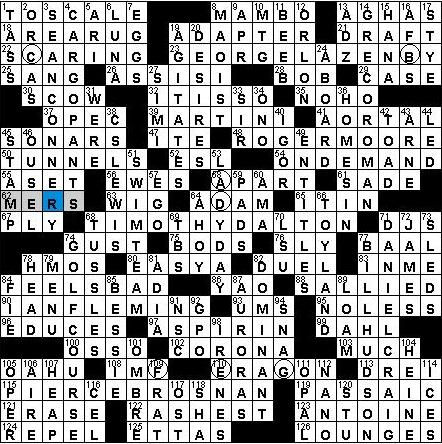
Last week, Eric posted a link to an article chronicling the top ten works of fiction to prominently feature crossword puzzles.

While the Guardian’s countdown included some choice entries — mentioning not only The West Wing but another show near and dear to the heart of yours truly — there’s one glaring omission from their otherwise impressive listing.

M*A*S*H. More specifically, the season 5 episode entitled “38 Across,” which aired on January 11, 1977.

Now, for those of you who’ve never known a world without the Internet, I’ll explain. 

(*gasp* I know! A world without the Internet! Think of it! Heaven is chock full of people who’ve never known Facebook!)

M*A*S*H centered around a mobile army surgical hospital (mad acronym skills at work here) and the trials and tribulations endured by those stationed in Korea during the war.

Some of M*A*S*H’s best episodes came from the medical staff’s desperate need to alleviate boredom at all costs during their downtime, and in “38 Across,” Hawkeye becomes fixated on completing the New York Times Crossword.

Stymied by a single clue — the Yiddish word for bedbug — he goes as far as to contact an old naval buddy, Lt. Tippy Brooks. In his fervor to solve the puzzle, he says it’s an emergency.

This comes back to bite Hawkeye and his chums when Tippy arrives, with his commanding officer Admiral Cox in tow, expecting a medical emergency, not a linguistic one.

(Click here for a terrific plot synopsis of the episode.)

It’s a very funny episode that plays nicely with a classic sitcom trope — the big misunderstanding. (The title is also a clever inside reference to the 38th Parallel, the line crossed by invading Communist forces, igniting the Korean War.)

Considering how beloved M*A*S*H was, and still is, I was surprised this episode didn’t make The Guardian’s cut.

Alas, no top ten list is perfect. (Just ask David Letterman.)

Oh! For the curious readers, the answer was “vantz.” (The fact that Hawkeye never once mentions the Down words crossing the entry makes me think puzzles aren’t exactly his forte. *laughs*)

And there you have it! All is well with the puzzle world once more. Hope you enjoyed this post, and as always, keep calm, puzzle on, and I’ll catch you next time.
I prefer ink to pencil.

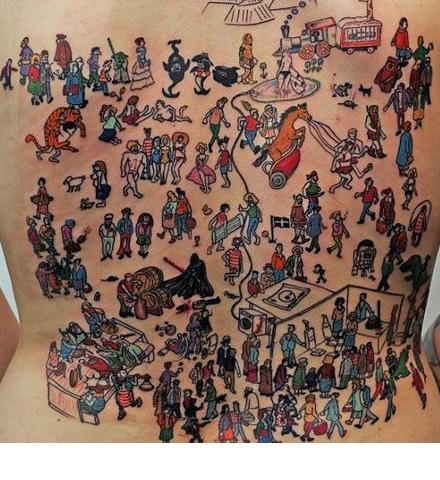
(Yes, that’s a tattoo of a Where’s Waldo? scene.)

A buddy of mine was showing off his latest tattoo the other day.

Naturally, this led to everyone in the group showing off their choicest pieces of body art.

And then other people at the coffeeshop joined in. Total strangers lifted sleeves and doffed shirts to show off their tattoos.

At one point, I was pretty sure every inked person in a 3-mile radius was there, and I was awash in butterflies and tribal patterns, cursive script and symbolic tributes to loved ones.

I was the odd man out, seeing as I have no tattoos to compare and/or flaunt, as the case may be.

I’ve got nothing against tattoos. I think they’re cool, actually, and they can be creative and artistic (and just plain badass). Obviously, many of my friends are tatted up. I just haven’t taken the plunge yet, and I don’t know that I ever will.

But I do have plenty of ideas for tattoos.

They range from the nerdy to the esoteric:

–Luke Skywalker’s severed hand, still clutching Anakin’s old lightsaber, with the words “Never Forget” underneath.

–A teddy bear with a hatch open in its belly, revealing a little green man as a pilot

–A chainsaw with the word Groovy along the chainbar

–A globe made of LEGO bricks

–Zombie Lincoln, surrounded by campaign signs

–Silhouettes of a man and woman tangoing across a crossword grid floor

And that last one got me thinking. I’ve seen plenty of tattoos honoring fandom and hobbies. From movies and TV shows to literature and music, but I don’t think I’ve ever encountered a puzzle-centric tattoo in the wild that wasn’t a jigsaw puzzle piece. (Surprisingly common, as it turns out.)

So, I did a small incantation, tossed a little salt around, and summoned a helpful imp to search the Internet for me. That imp is better known as “Google Image Search”.

And I turned up quite a few puzzle-themed tattoos! Check it out!

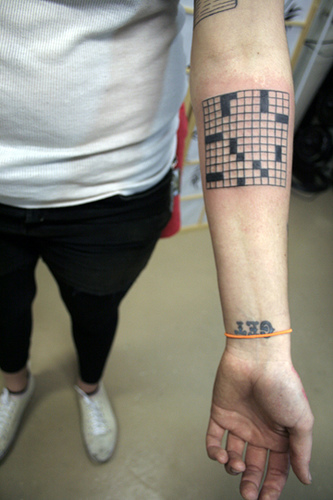
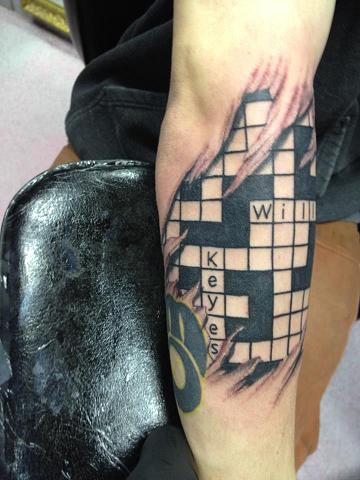
Here’s a fresh shot of an asymmetrical puzzle grid. (And it’s 12 x 12 boxes too. Definitely a personalized grid.)

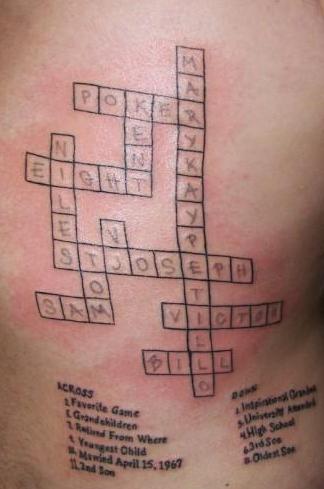
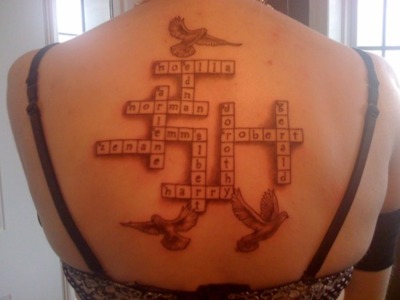
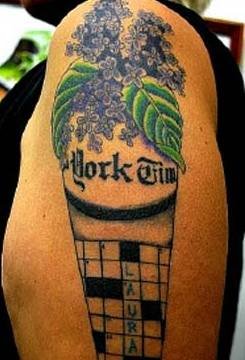
A lot of crossword-style tattoos I discovered involve answers with a personal connection: the names of children, family members, hobbies, accomplishments, etc.

This one is a particularly lovely example of the above style.

And, of course, here’s a nod to the most legendary and infamous crossword of all, The New York Times Crossword.

This one is probably my favorite. (Except for the Connect-the-Dots giraffe tattoo I found while searching.) I love the idea that lurking just beneath the surface is a puzzle fiend, easily recognized by all and sundry. =)

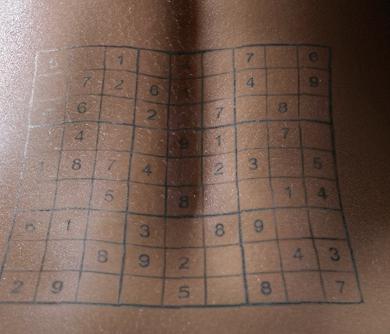
And here’s a Sudoku! Perfect for lazy days at the beach.

Why, the possibilities are endless! Maybe I could get the Diggin’ Words dogs along the inside of my forearm, or a cryptogram of a favorite Mark Twain quote along my calf! Or the PuzzleNation logo on my forehead! It’s free advertising!

Yeah, it’s probably best that I remain tattooless for now. But in the meantime, I can keep calm and puzzle on, and I suggest you do the same. Until next time…

Puzzles in Pop Culture: The Simpsons

From Stanley’s love of crosswords on The Office to the clever conundrums constantly conjured by the Riddler in various iterations of Batman, puzzles have played roles both big and small in numerous TV shows and films.

But for my money, few shows have made puzzles the centerpiece of storyline development and family interaction quite like The Simpsons.

The first episode that comes to mind — and my personal favorite — is season 9’s Lisa the Simpson.

In the episode, Lisa is stumped by a brain teaser and begins to worry about her intelligence, a concern that is only exacerbated by Grandpa’s revelation of the Simpson Gene, a genetic quirk that caused Homer and Bart’s descent from academic achievement to hilarious idiocy.

In the end, of course, Lisa discovers she’ll be just fine — the defective gene is on the Y chromosome, so only male Simpsons are afflicted — and she conquers the brain teaser.

Puzzly themes would continue to crop up in the show from time to time.

For instance, Homer discovers a secret acrostic message from his mother in the newspaper in season 15’s My Mother the Carjacker. But most of the puzzle-centric goodness centered around Lisa.

She indulged in palindromic fun with fellow Mensa members in season 10’s They Saved Lisa’s Brain, as well as an anagramming game in the season 6 classic Lisa’s Rival.

(That’s when I first learned that Alec Guinness anagrams into Genuine Class.)

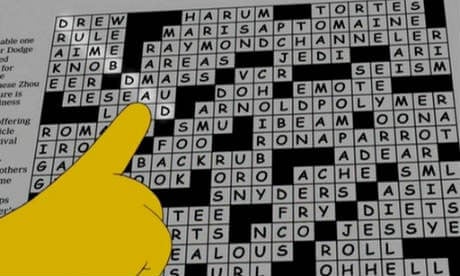
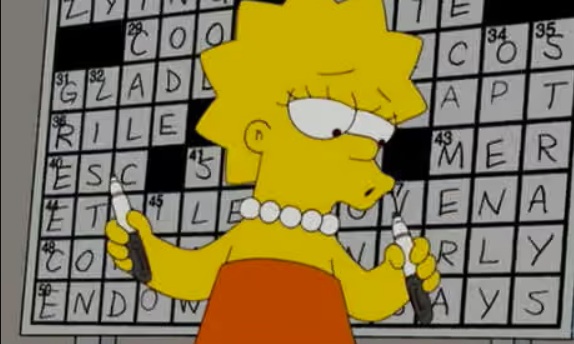
But puzzles wouldn’t again take center stage until season 20’s episode Homer and Lisa Exchange Cross Words.

In the episode, Lisa quickly becomes a crossword fiend, solving all the puzzles she can and eventually entering the Crossword City Tournament.

Trouble brews when Homer bets against her in the championship round, and their relationship fractures.

This was a real watershed moment in synergy for the show, since they somehow managed to convince The New York Times to publish the same puzzle in the paper that Homer uses to apologize to Lisa.

(You can click here to see the full puzzle.)

Homer’s hidden message runs along the diagonal, and it’s a brilliantly unobtrusive trick. I’m sure some solvers never even noticed the tie-in. (The puzzle didn’t reference The Simpsons or the episode in any other way.)

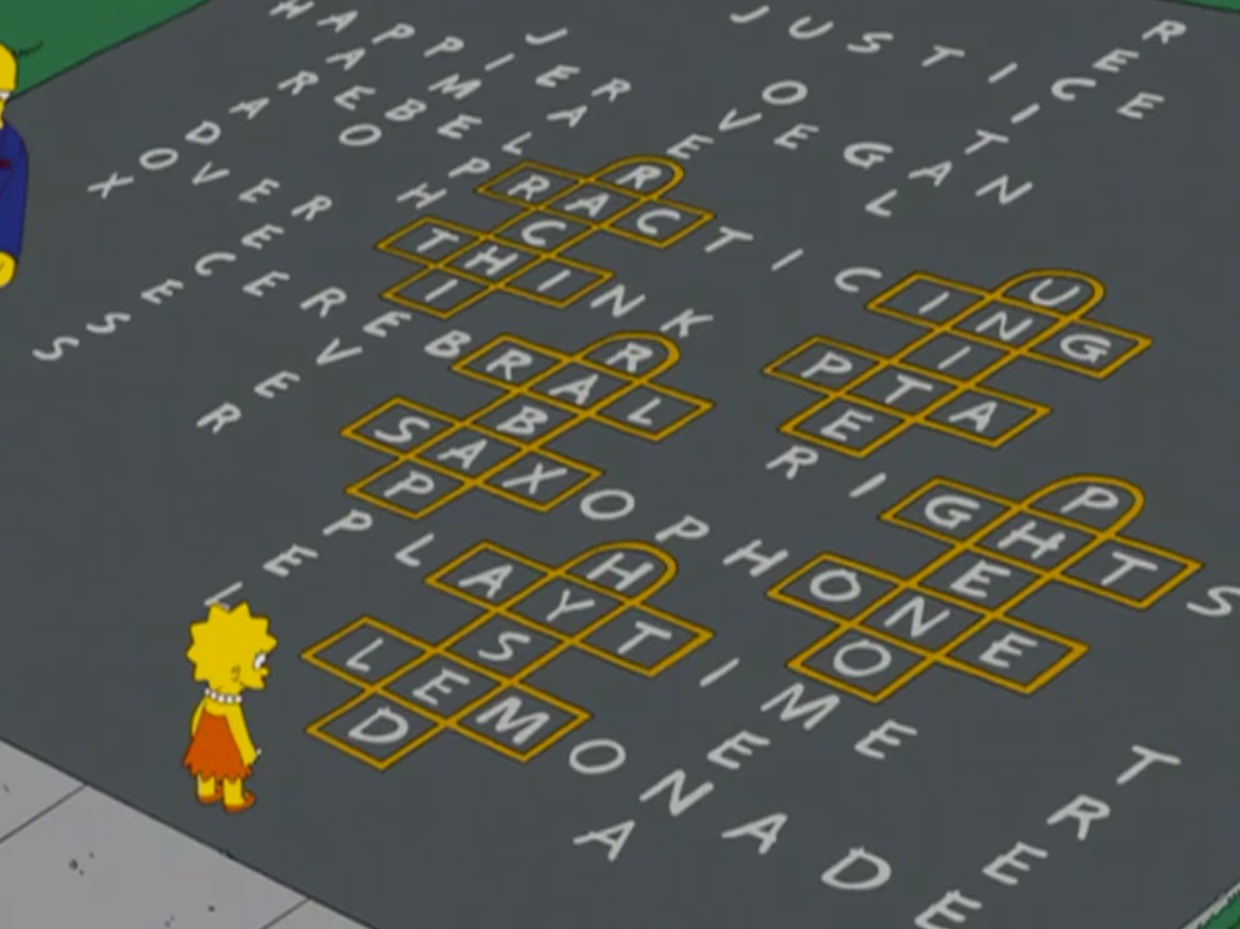
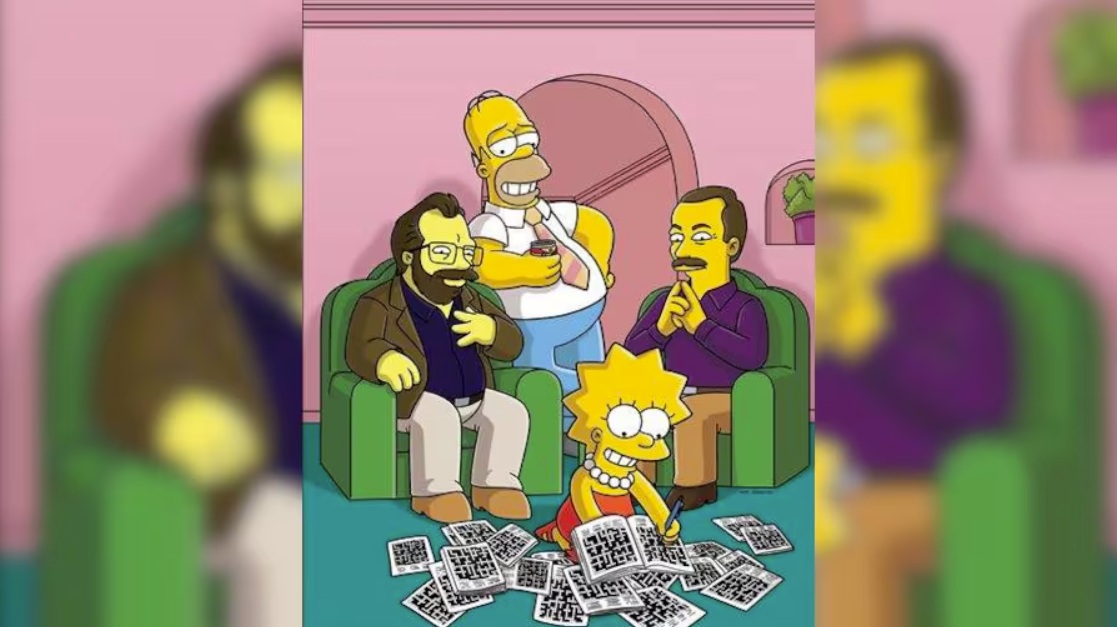
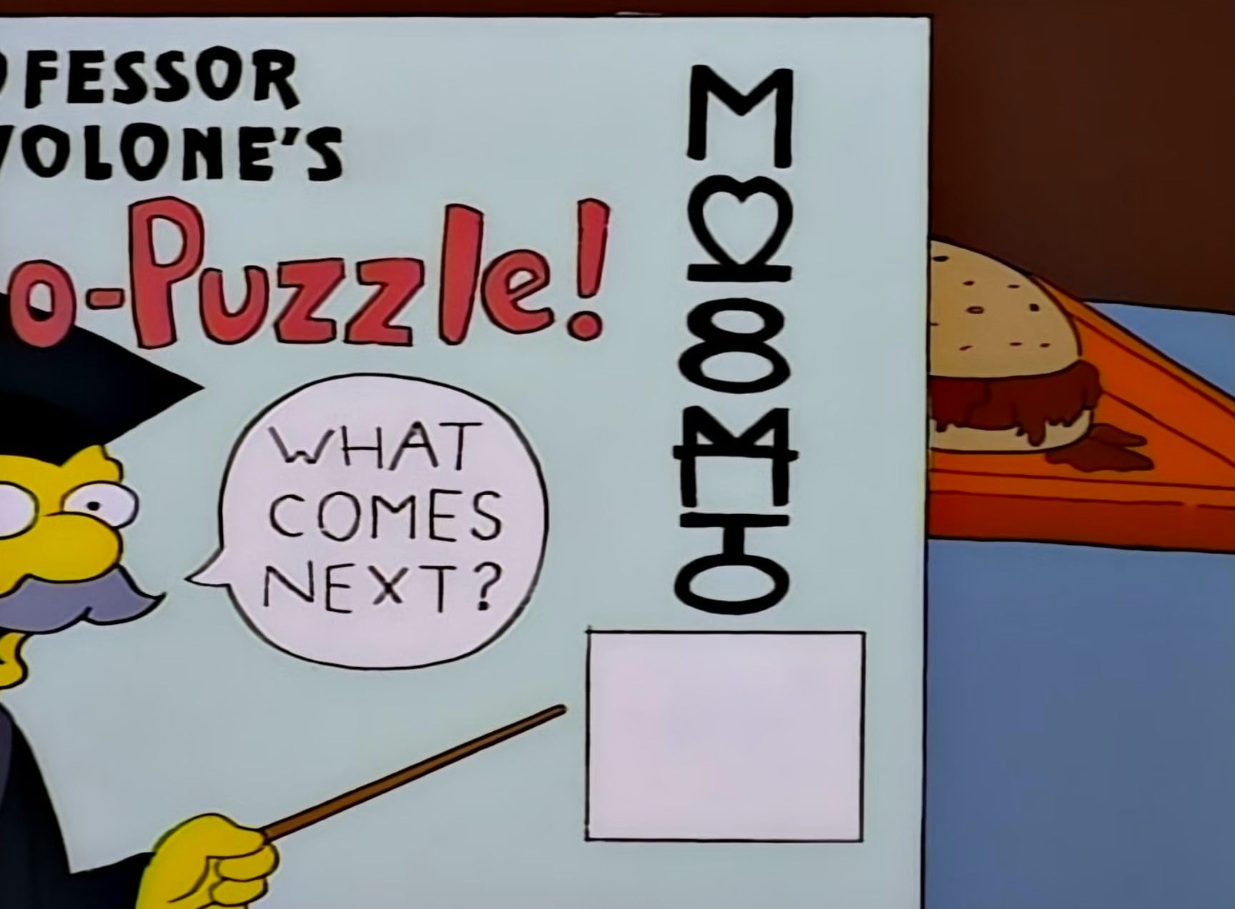
Puzzlemaster Merl Reagle created the puzzle, and Will Shortz oversaw the project. Both also appeared in the episode. (Reagle also created the word crossings for the hopscotch puzzle pictured above.)

It’s a real treat to see puzzles incorporated into a narrative like this. Instead of a time-killer or a mere passing interest, they become linchpins of each story. The puzzles create conflict, drive epiphanies, and bring people together.

It’s a testament to the power of puzzles in pop culture. Plus, they’re just a buttload of fun.

Hope you enjoyed this little (animated) trip down memory lane. Until next time, keep calm, puzzle on, and I’ll catch you again soon.

The Nerd Potluck Looms Large!

Aloha, fellow puzzlers and solvers galore!

Last week, I mentioned that I’d be attending a Nerd Potluck this coming weekend. It’s a celebration of all things puzzle, game, and nerd-centric, and I’ve been working on a new word puzzle to challenge my fellow attendees.

And as promised, you’re getting the first peek at it. I call the puzzle “Word Personals.”

Word Personals is based on the singular parlance of personal ads and dating slang.

Your standard personal ad looks something like this:

SWM, 31, brown hair, brown eyes, calf muscles of a Roman gladiator, enjoys full contact rock-paper-scissors and the films of Ben Stiller…

The breakdown is pretty simple.

–SWM is short for single white male in standard personal ad jargon. SWF would be single white female. (SBF would be single black female, MWM would be married white male, etc.)
–That’s followed by the person’s age and a brief description.

So my idea was to employ this format, but make the ads themselves word puzzles to be decoded by a solver.

Here’s an example:

SWF, 6, one letter once, one letter twice, and one letter three times, enjoys hanging out and giving people the slip.

Again, the breakdown is pretty simple.

–SW stands for “single word.” (If it was “MW,” it would be “multiple words,” indicating a phrase.)
–The next letter, F, stands for “features,” indicating that characteristics of the word will follow. (If it was “M,” it would be “means,” indicating a definition, synonym, or hint toward the definition would follow.)
–The number that follows is the number of letters in the word or phrase.
–Finally, there’s the description, which is in two parts. The first part, as indicated by “F,” gives some characteristics of the word. The second part is a jokey clue to provide further information.

And there you have it, Word Personals. I’m sure you’ve solved the example one already, so how about we check out a few more?

1) SWM, 8, power or vigor, enjoys vowel conservation and Herculean qualities.

2) MWF, 11, can read backwards and forwards, enjoys formal greetings and the days before holidays.

3) SWF, 4, goes from one syllable to three by adding a letter, enjoys taking car trips in the past tense.

4) MWM, 9, stutter-stop way of talking, enjoys frequent breaks and a certain British inspector.

I admit, It’s a bit esoteric, but I like the concept quite a bit, and I think it’ll be a hit.

Naturally, your thoughts are welcome. What’s confusing? What works? Is it too prone to alternates? Too easy? Too difficult? Your input would be very much appreciated.

In the meantime, I hope Word Personals provided you with a bit of brain-teasing today. So keep calm, puzzle on, and I’ll catch you next time. Wish me luck!