Anagram Answers for Patriotic Puzzlers!

My apologies for the delay in posting the answers to our Patriotic Anagrams, my fellow puzzle fiends. I hope you enjoyed untangling these little puzzles!

And so, without further ado, here are your answers!

Penny Aced Indeed = Independence Day

Flared Prosy Kiwis = Fireworks display

Horologic Gent Kiln = Cooking on the grill

Legend For Merit = Let freedom ring

Attend Suites = United States

Nice solo = Colonies

It’s Spartan Dress = Stars and Stripes

Phi Alpha Deli = Philadelphia

How many did you get? Let us know in the comments below!

Fourth of July = Joyful Fourth

It’s Independence Day, and is there any better way to celebrate the marvelous mixing pot of American culture than some holiday anagrams? I hardly think so!

Unscramble the following phrases to uncover some Fourth of July words and phrases, and enjoy!

Penny Aced Indeed

Flared Prosy Kiwis

Horologic Gent Kiln

Legend For Merit

Attend Suites

Nice Solo

It’s Spartan Dress

Phi Alpha Deli

Answers will be posted on the blog tomorrow afternoon! Enjoy your day!

On the hunt for ambitious silliness…

From the Great Urban Race to Leslie’s Valentine’s Day puzzle challenge on Parks & Rec, we’ve covered scavenger hunts and puzzle-game quests on the blog several times in the past.

Scavenger hunts have a special place in my heart as a puzzler, because they’re the pinnacle of puzzly thinking on the fly. Deductive reasoning, creativity, ingenuity, a penchant for plotting and executing step-by-step moves to conquer a challenge… scavenger hunts combine all of these features (and throw in some exercise, for better or for worse).

Now, for the uninitiated, scavenger hunts at their simplest are games where individuals (or, more often, teams) are assigned a list of items to obtain or actions to perform, and the first person or team who completes the list is the winner.

Scavenger hunts by definition incorporate a spirit of silliness, lightheartedness, and frivolity. Whether you’re hunting down the gaudiest things you can find at a tag sale or photographing yourself getting a piggyback ride from a police officer, the goal of most scavenger hunts is to have fun.

And it seems like scavenger hunts are becoming more creative and more diabolical with every passing day. Let’s take a look at two of the most ambitious scavenger hunts challenging players these days.

The first is GISHWHES, a.k.a. The Greatest International Scavenger Hunt the World Has Ever Seen.

GISHWHES combines the playfulness of scavenger hunts with a humanitarian ideal, challenging players to make the world a better and more interesting place through their challenges.

Designed to be played around the world through the Internet, GISHWHES has previously tasked its players to perform such varied feats as performing puppet shows for sick kids and documenting a session of ski yoga. Creating art, doing good, and being gloriously silly is what GISHWHES is all about.

The second scavenger hunt is called Midnight Madness, and was recently profiled on Quartz.com.

A high-concept game that became a brilliantly-clever fundraiser when Goldman Sachs got involved, Midnight Madness is a fiendishly challenging series of puzzles and activities scattered throughout New York City.

Goldman Sachs employees — every division of the company is represented — race around the city, unraveling electrical puzzles, playing laser mini golf, and deciphering complex clues, all in the hopes of determining the location of the next challenge.

The most recent edition of the game lasted fifteen hours and raised over a million dollars for charity. While it’s much more exclusive than GISHWHES, Midnight Madness has the same humanitarian spirit and the same sense of ambitious lunacy at its heart.

For puzzly fun on the run, scavenger hunts can’t be beat.

“I have the solution,” Tom answered.

As promised, here are the answers to Friday’s PuzzleNation live game, a.k.a. the Tom Swifties challenge! Thank you to everyone who gave it a shot. I look forward to doing another live puzzle game soon!

TWITTER

1.) “This is all from memory,” Tom… wrote.

2.) “That just doesn’t add up,” said Tom… nonplussed.

3.) “There’s no need for silence,” Tom… allowed.

4.) “Little devils don’t always tell the truth,” Tom… implied.

5.) “You don’t see the point, do you?” asked Tom… stabbing in the dark.

6.) “No test throw,” thought Tom… triflingly.

7.) “The exit is right there,” Tom… pointed out.

FACEBOOK

1.) “I can take photographs if I want to!” Tom… snapped.

2.) “That’s already been taken care of,” Tom… pretended.

3.) “She’s repeating an SOS message,” said Tom… remorsefully.

4.) “I only have diamonds, clubs and spades,” said Tom… heartlessly.

5.) “I’m covering the neighborhood with heavy cotton cloth,” said Tom… canvassing the area.

6.) “I’ve deduced that this is the right way,” said Tom… pathologically.

7.) “I have a split personality,” said Tom… being frank.

And if there’s some kind of live game puzzle challenge you’d like to see, be sure to let us know! You can like us on Facebook, follow us on Twitter, or contact us here!

PuzzleNation Reviews: Laser Maze

Here at the PuzzleNation blog, we love spreading the word about great new puzzle-solving experiences of all sorts, so when the creative folks at ThinkFun passed along a free copy of their latest puzzle game, Laser Maze, we were all for testing it out.

And I’m pleased to say that Laser Maze is a terrific puzzle game.

The concept is deceptively simple. All you have to do is set up the mirrors, gateways, and other game pieces and light up your targets with the laser. Some pieces allow you to bounce the beam at a right angle, others allow you to split the beam in two, and still others can double as both reflecting mirrors and light up targets. An impressive amount of adaptability is packed into 11 game pieces.

There are 60 challenge cards that range in difficulty from beginner to expert. In the earliest challenges, there are only a few pieces on the game board, and you’re given both their location and the direction each piece faces, and it’s up to you to complete the laser’s path by adding only the pieces listed on the card.

In later challenges, you get less information. You might know a piece’s location on the board, but you don’t know which direction it should face. The number of targets to light up with the laser increases, and the solutions become more complex.
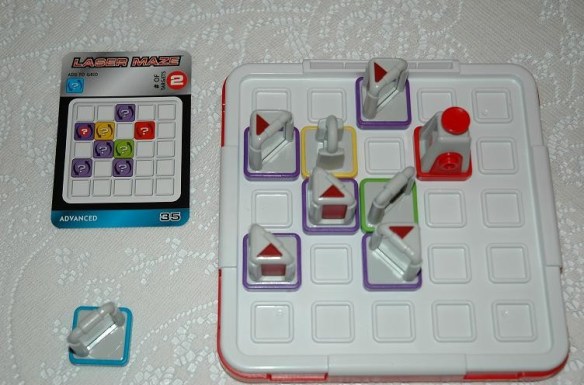
laser maze 2

But the genius of Laser Maze is that the beginner and intermediate puzzles teach you the fundamentals necessary to tackle the harder puzzles to come. Like the best puzzle games, Laser Maze allows you to learn by doing, building your skills, your deductive reasoning, and your bag of game-piece-centric tricks as you become more proficient at using the mirrors and beam-splitters to direct the laser precisely where you need it.

Plus, the gameplay itself is intuitive. With just a brief skim of the instructions and a minute to familiarize myself with the symbols key for the puzzles, I was in.

I played through a number of beginner, intermediate, advanced, and expert puzzles. As a pretty puzzle-savvy guy, I expected to breeze through the early challenges, but a few of the intermediate puzzles made me pause and restrategize. By the time my confidence grew and I was sure none of the intermediate puzzles would stymie me, I still didn’t WANT to move on to the next level. I was having too much fun.

I progressed through the advanced challenges and into the expert puzzles, and then went back to the intermediate puzzles to test the game’s replay value. And that’s when I discovered another facet of Laser Maze.

Once you’ve solved a given puzzle, you clear the board and prepare for the next one. By design, you start with a clean slate. But you’re also forced to completely ignore any preconceived notions you have about the puzzle to come, because each one has its own challenges.

As I played through puzzles I knew I’d played before, they still FELT like fresh challenges, because of the sheer adaptability of the game pieces. This wasn’t going to end up a one-time playing experience.

You’ll no doubt note similarities between Laser Maze and the popular game Khet, which also features a laser. That’s to be expected, since they were both invented by devious puzzlesmith Luke Hooper. But while Khet is a strategy game to played against an opponent, Laser Maze pits a single player against the game itself. It’s a learning experience disguised as an incredibly fun game.

Plus, every time I’ve played, I’ve attracted family and friends as onlookers and collaborators. It might be designed for one player, but it’s hardly a solitary endeavor.

Of course, I’m covering the gameplay as an adult solver, and Laser Maze is designed for ages 8 and up. (Plus, there’s an actual REAL laser, so safety first, fellow solvers.)

Fellow PuzzleNationer Fred took the game home and unleashed his kids on the game, and as you can see, he had ample time to snap a pic of his very focused son Max, ready to activate the laser and solve his latest challenge.

All in all, Laser Maze is both great fun and an engaging puzzle-solving experience. ThinkFun really knocked it out of the park with this one.

(Check out Laser Maze on ThinkFun or on Amazon!)

Three posts, five rings, endless possibilities…

I’ve always been a big fan of DIY puzzling. With seven nieces and nephews to keep engaged and entertained at family gatherings, I often find myself cobbling together new games and puzzles for them from whatever I can find around me.

(For instance, you’d be surprised how many board games are spiced up a bit by the addition of dinosaur figurines.)

So last weekend, I discovered my youngest nieces have three of those ring-stacking toys with the colored rings, the ones I think every kid has played with at some point or another.

And I realized I had all the tools necessary to whip up a challenge for the kids and adults alike… a Tower of Hanoi puzzle.

The Tower of Hanoi puzzle and its many variants look simple, but can be fiendishly puzzling. The rules are simple: move the stack of rings from the first post to the third. You move one ring at a time, and at no point can you place a larger ring atop a smaller ring.

(The standard puzzle is five rings, but variants can go as high as 10.)

I gave the adults first crack at it, and after laughing it off as childishly simple, it took them far longer than expected to solve the puzzle, especially in the later stages as you try to place the largest ring. There was plenty of pointing and strategy and “No, no, not there! THERE!”

The kids, on the other hand, worked together, and managed to solve the puzzle in about fifteen minutes, each taking turns moving colored rings here and there (and for my youngest niece, occasionally biting them, as you do). Their sense of accomplishment was a joy to watch, and each crowed to their parents about their victory.

As a placement puzzle, the Tower of Hanoi is much like a sudoku puzzle, a combination of strategy — where to place a number or a ring — and deduction — determining which moves you can’t make based on the information provided. It’s one of those universal puzzle-solving skills that will serve a puzzle fiend well for decades to come.

(To try the Tower of Hanoi puzzle, check out this online version I found.)