PuzzleNation Product Reviews: Collide-O-Cube and Rudenko’s Disk

The folks at Brainwright specialize in puzzles intended for younger solvers, but with enough challenge and style to keep older solvers busy as well. From curiously cut jigsaws to color-based deduction puzzles, they take classic puzzle concepts and add their own curious spin to create new puzzle experiences.

They offered us the chance to try out two of their puzzles for the younger puzzling set, and we put them to the full PuzzleNation Blog test.

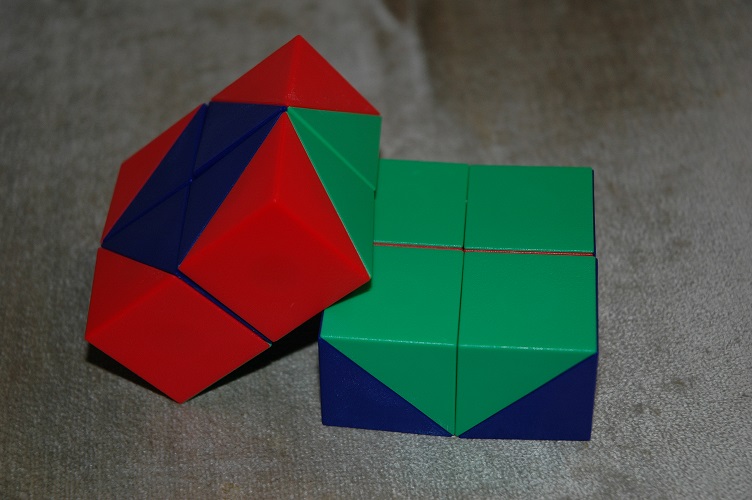
Collide-O-Cube looks simple — after all, it’s just eight identical multicolored blocks — but plenty of great puzzles appear simple, yet offer seemingly endless variation and challenges the more you tinker with them.

You see, the eight Collide-O-Cube blocks aren’t quite identical. Each one contains a unique pattern of magnets inside that offers another level to the solving process as you try to recreate the several dozen cube patterns in the challenge booklet included. This makes for a curious solving experience that combines pattern recognition, deduction, and patience as you play around with blocks until the solution snaps into place.
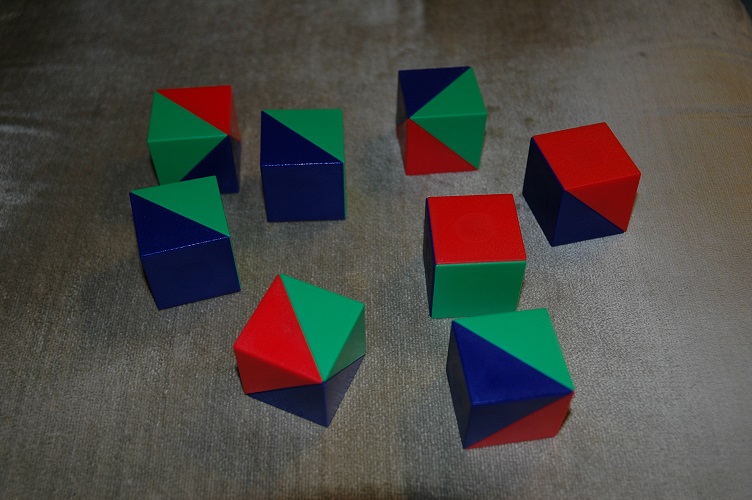
Although designed for kids ages 8 and up, adults will certainly enjoy fiddling with Collide-O-Cube, and I suspect kids will spend as much time creating their own puzzly patterns and shapes with the blocks as they will solving the various cube puzzles.
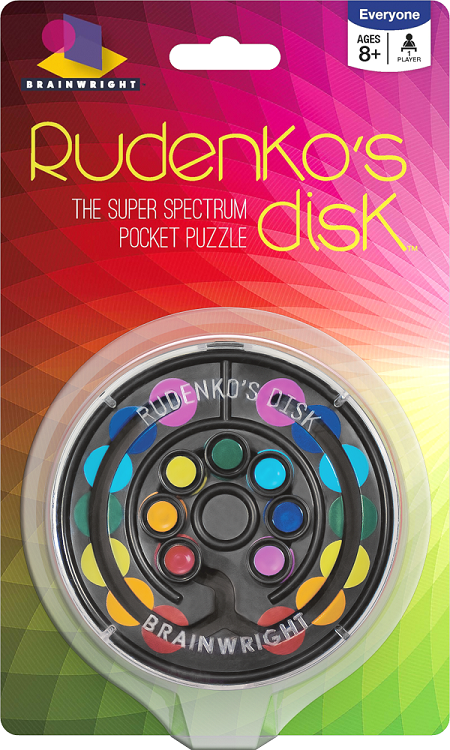
Rudenko’s Disk, on the other hand, is more in the vein of a sliding tile game; a marvelous, colorful, self-contained version of the classic Tower of Hanoi puzzle, Rudenko’s Disk challenges the solver to move various colored posts along the track in order to recreate the color pattern along the side of the disk.

Again, this seems simple enough, but Rudenko’s Disk includes a crafty wrinkle to the solving process: each colored post clicks into place when in a spot with a matching color.

So, for instance, the orange post can only go as far to the left, right, or center as the orange circle, and no further. You can’t place the orange post on the yellow, the green, the blues, or the purple. But you can place the dark blue post on any circle between dark blue and red. (Only the purple is off-limits for the dark blue post.) A strategic chain-solving puzzle lurks within the simple sliding mechanic.
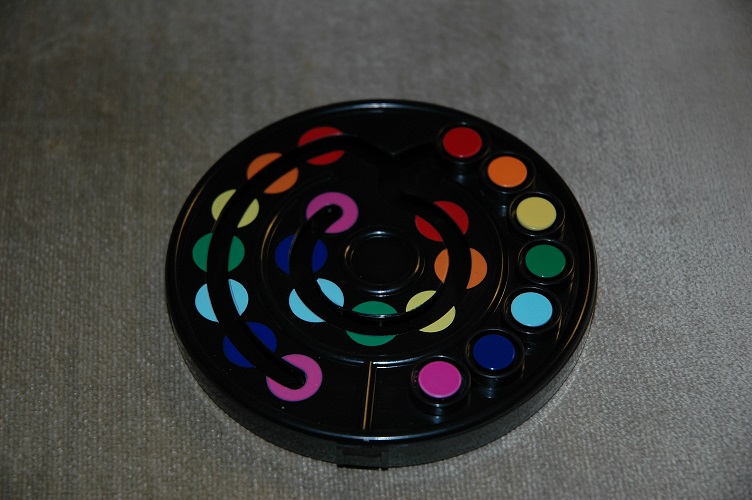
Rudenko’s Disk could be a little off-putting or frustrating for the youngest solvers among us — similar to another color-based puzzle of some renown, Rubik’s Cube, but not nearly as daunting.

These are two intriguing examples of color-based puzzles, but they’re very different solving experiences. Collide-O-Cube’s hidden magnets add a delightful bit of unexpected randomness and chaos to what would otherwise be a simple pattern-matching game — making for a puzzle that encourages fiddling around the blocks in open play — while Rudenko’s Disk’s rigid mechanics require solvers to be a bit more tactical.

But both puzzles are immensely satisfying when the solution clicks into place.

I think Brainwright‘s formula of familiar puzzles with new touches and complications is a recipe for continued success and puzzly fun.

Thanks for visiting PuzzleNation Blog today! You can share your pictures with us on Instagram, friend us on Facebook, check us out on TwitterPinterest, and Tumblr, and be sure to check out the growing library of PuzzleNation apps and games!

Follow-Up Friday: Kickstarter edition!

Welcome to Follow-Up Friday!

For those new to PuzzleNation Blog, Follow-Up Friday is a chance for us to revisit the subjects of previous posts and update the PuzzleNation audience on how these projects are doing and what these people have been up to in the meantime.

And today, I’m happy to update you on some of the Kickstarter accounts we’ve featured in recent weeks.

First, the Board Games: Now Blind Accessible Kickstarter — dedicated to modifying existing card games and board games to allow visually impaired people to play — wrapped up yesterday with great success.

In total, the campaign met its goal nearly three times over! (Over $20,000!)

I’ll be sure to keep you posted on further updates from 64 Oz. Games and this very worthy cause.

And second, one lucky solver will be getting a set of Baffledazzle Code Breakers puzzles, courtesy of Rachel Happen!

In Rachel’s edition of 5 Questions, she not only discussed her Kickstarter campaign for high-end, high-quality, challenging jigsaw puzzles — 80% funded with 9 days to go! — but she snuck a puzzle into her interview answers!

And intrepid solver Caroline Kerstens was the first to unravel Rachel’s puzzle by spotting the clues and following the breadcrumb trail!

From Caroline’s post:

Hey, I was wondering if the puzzle you hid in the Puzzlenation interview has already been solved. If not, I think I have the answer!

Clues:

  • a “clever British spy” (female) 
  • translating Polish sayings 
  • French public transport 
  • navigating into new waters

There was a woman of Polish nobility who worked as a spy for the British SOE during WWII, which combines the first two clues. She outwitted the German Gestapo on various occasions and even tricked a Gestapo officer into carrying her package of illicit documents into Poland by making him believe it was a bag of black-market tea for her mother.

(You could link French public transport to her as well: the most famous public transport system in France is the Métropolitain or subway, which is an underground network. She, as a spy, was also part of an underground network, and she also operated in France.)

Her whole life was a series of “navigating new waters”:

  • from Polish nobility to adventurous spy 
  • she had a “varied” love life 
  • She skiied into occupied Poland with British propaganda, so if snow counts as water, this would work 🙂 
  • After the war, she worked as a cruise ship stewardess and literally navigated new waters.

So, is the answer to the hidden riddle Christine Granville? Or am I thinking in the wrong direction?

She was, in fact, correct, and will soon receive her very own set of Baffledazzle Code Breakers puzzles.

Here’s hoping Baffledazzle sees the same sort of wonderful success as the folks at Board Games: Now Blind Accessible.

Thanks for visiting PuzzleNation Blog today! You can share your pictures with us on Instagram, friend us on Facebook, check us out on TwitterPinterest, and Tumblr, and be sure to check out the growing library of PuzzleNation apps and games!

We interrupt your regularly scheduled post for something wonderful…

I originally had our latest session of 5 Questions scheduled for today, but yesterday I stumbled upon a marvelous, time-sensitive story, and I really wanted to share it with the PuzzleNation audience, because it exemplifies the very best of the puzzly gaming community.

In last week’s Follow-Up Friday post, I briefly discussed Joe Michael MacDonald’s marvelous version of Qwirkle designed for colorblind players. And lo and behold, here is a Kickstarter campaign with even loftier goals.

The folks at 64 Oz. Games are in the final hours of a project called Board Games: Now Blind Accessible, wherein they produce specialty sleeves and other modifications for established board games and card games, allowing visually impaired players to play alongside their sighted pals.

Not only have they developed a touch-based game called Yoink! that is based on tactile gameplay, but a combination of Braille and clever use of QR codes has opened up games like Munchkin, King of Tokyo, and numerous roleplaying games to a previously excluded audience.

This inclusive spirit is brilliantly typical of the puzzle and game communities, since so many members — both designers and players/solvers — want nothing more than to share their love of games with the world.

And numerous board game, card game, and puzzle game companies are supporting the endeavor. Not only the folks at Cheapass Games, but also companies like Rio Grande Games, 9th Level, Living Worlds, and (hilariously, considering their reputation) Cards Against Humanity. (You can check out the full list of companies here.)

It’s an absolutely wonderful idea, and although there are only a few hours left to donate to this very worthy cause, I’m overjoyed to say that they’ve raised more than double their hoped-for campaign total!

This is Kickstarter and the puzzle and game communities at their best, and I’m glad I discovered it in time to share it with my fellow puzzlers.

Thanks for visiting PuzzleNation Blog today! You can share your pictures with us on Instagram, friend us on Facebook, check us out on TwitterPinterest, and Tumblr, and be sure to check out the growing library of PuzzleNation apps and games!

PuzzleNation Book Reviews: The Code Busters Club, Case #3

Welcome to the ninth installment of PuzzleNation Book Reviews!

All of the books discussed and/or reviewed in PNBR articles are either directly or indirectly related to the world of puzzling, and hopefully you’ll find something to tickle your literary fancy in this entry or the entries to come.

Let’s get started!

Our book review post this time around features Penny Warner’s third Code Busters Club novel, The Mystery of the Pirate’s Treasure.

I regularly get questions from fellow puzzlers who are looking for fun ways to get their kids into math, science, history, and other subjects through the media of board games or puzzles. Sadly, I don’t always have the picture-perfect recommendation for them prepped and ready in my back pocket, gift-wrapped for delivery.

That’s what makes stumbling upon a book tailor-made for encouraging both reading AND a love of puzzles such a delight. And if you’re looking for a gateway book for scavenger hunts or coded puzzles, look no further than The Code Busters Club series.

When there’s a puzzle to be unraveled or a code to be cracked, you can count on the crafty quartet known as the Code Busters. Friends Cody Jones, Quinn Kee, Luke LaVeau, and M.E. Esperanto are ready at a moment’s notice to put their codecracking skills to the test, and a field trip to Carmel Mission might be the perfect opportunity. There are some shifty characters lurking about, but with rumors of a pirate’s treasure hidden nearby, what else would you expect? Can the Code Busters make history and solve the riddle of de Bouchard’s gold?

If you’re looking for a fun way to introduce coded puzzles to younger readers, you’d be hard-pressed to find a book that employs as many different styles of coding as The Mystery of the Pirate’s Treasure. Warner has clearly done her research, employing everything from Morse code and semaphore to symbols, skip codes, Caesar ciphers, alphanumerics, and more.

[A quick interlude for coded-puzzle newbies:

  • A skip code is a message wherein you skip certain words in order to spell out a hidden message concealed within a larger one.
  • A Caesar cipher, also known as a shift cipher, works by shifting the alphabet a predetermined number of letters. For instance, if you shift the alphabet 5 letters, A becomes F, B becomes G, etc.
  • An alphanumeric code (in its simplest form) replaces the letters in words with their corresponding digits on a telephone keypad. So an A, B, or C becomes 2 while G, H, or I becomes 4.

End informational interlude.]

As a puzzler with plenty of experience with coded puzzles and cryptography, I was impressed by the breadth of codes and secret messages Warner had snuck into book that’s less than 200 pages, including illustrations and a sizable typeface.

The story itself is a bit threadbare, but considering the brisk storytelling pace and the sheer number of puzzles included, it’s easy to forgive the author for providing just enough impetus to get the Code Busters (and the reader) from one puzzle to the next. After all, this is a book about friends solving puzzles, and the puzzles are dynamite introductory-level puzzles for young readers.

I’ll definitely be keeping my eyes peeled for further Code Busters Club adventures.

[To check out all of our PuzzleNation Book Review posts, click here!]

Thanks for visiting PuzzleNation Blog today! You can share your pictures with us on Instagram, friend us on Facebook, check us out on TwitterPinterest, and Tumblr, and be sure to check out the growing library of PuzzleNation apps and games!

It’s Follow-Up Friday (in color!)

Welcome to Follow-Up Friday!

For those new to PuzzleNation Blog, Follow-Up Friday is a chance for us to revisit the subjects of previous posts and update the PuzzleNation audience on how these projects are doing and what these people have been up to in the meantime.

And today, I thought I’d mention a curious and clever board game development I stumbled across recently.

One of the most popular games from our recent TableTop Day event was Qwirkle.

A wonderful tile game featuring different colors and symbols, Qwirkle follows in the strategy and pattern-matching tradition of Uno and Mexican Train dominoes.

Unfortunately, my fellow puzzlers and I quickly discovered that the colors chosen for the game are difficult for colorblind players to tell apart. And in a game where you don’t want to show other players your tiles before you play them, it becomes much harder to tell the different between red and orange tiles, which is a crucial distinction during gameplay.

Thankfully, a software developer and board game fan named Joe Michael McDonald took it upon himself to design a colorblind-friendly color palette for Qwirkle.

qwirklecolorblind

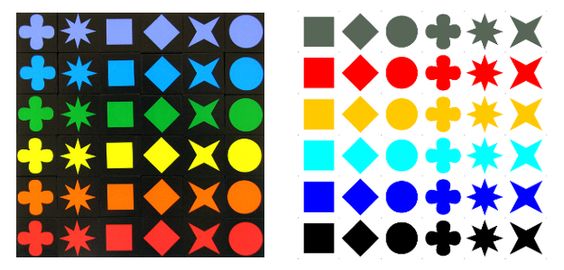
[On the left is the standard Qwirkle color options. On the right is McDonald’s colorblind-friendly variant.]

It’s a terrific example of player ingenuity solving an unforeseen problem and opening up the game to a whole new audience.

Kudos to you, sir. Here’s hoping more games offer a colorblind-friendly variant very soon.

Thanks for visiting PuzzleNation Blog today! You can share your pictures with us on Instagram, friend us on Facebook, check us out on Twitter, Pinterest, and Tumblr, and be sure to check out the growing library of PuzzleNation apps and games!

A globetrotting musical mystery…

Every moment in history is a puzzle to be unraveled. What threads had to be drawn together, what forces had to converge, what improbable series of events had to unfold in precise order to create the exact circumstances to allow that moment to happen?

Any student of history is a puzzler at heart, every personality and preceding event a clue, a potential piece, one domino in the chain of events.

And one student of history found the solution for an unexpected puzzle in a museum in New Jersey.

The Morris Museum in Morristown, New Jersey is home to hundreds of mechanical musical instruments and players, displaying numerous pieces of the Murtogh D. Guinness collection.

In 2011, when W. Anthony Sheppard stumbled upon a music box — an 1877 Swiss cylinder music box known as a harmoniphone — at the Morris Museum, he had a mystery on his hands.

It was a Swiss music box, much like the one featured above, but the titles of the melodies it played were written in Chinese characters. These were Chinese pieces of music, intended for a Chinese audience. And yet, several of the tunes were strikingly similar to themes from two of Puccini‘s operas: Turandot (set in China) and Madama Butterfly (set in Japan).

Now, Sheppard knew from his musical studies that Puccini used Chinese tunes in the creation of Turandot, but the origins of several tunes in Madama Butterfly have proven more elusive. (The general belief at the time was that the Madama Butterfly tunes in question were inspired by Japanese music, but no one had definitively tied any particular melodies to the opera.)

Yet in an American museum, a Swiss machine with Chinese melodies, traced to an Italian composer, shifted the spotlight from Japan… and back toward China.

[The card that pointed Sheppard in a new direction.]

And the globetrotting didn’t end there. The box had a stamp for a Shanghai department store, as well as a stamp from a repair shop in Rome from the early twentieth century. Not only had the box been manufactured in Europe for sale in China, but it later returned to Europe for service.

Later, Sheppard would further track the providence of the piece, believing it to be the actual music box Puccini listened to before creating his famous operas.

A single clue with widespread ramifications for the history of opera. A music box that not only traveled the world, not only offers proof of how music circulated more than a century ago, but also solved a mystery and rewrote its own corner of history.

It just goes to show you that puzzles are everywhere, sometimes hiding in plain sight, ready to challenge a sharp mind and change the way we see the world.

[I learned of this story in the book Hidden Treasures: What Museums Can’t or Won’t Show You by Harriet Baskas. The Morris Museum music box is just one of many interesting stories featured within.]

Thanks for visiting PuzzleNation Blog today! You can share your pictures with us on Instagram, friend us on Facebook, check us out on Twitter, Pinterest, and Tumblr, and be sure to check out the growing library of PuzzleNation apps and games!