Indie 500, Titan Series, and 100 Games updates!

Today’s blog post is all about what’s going on in the world of puzzles and games, and let me tell you, some awesome exciting things are afoot for puzzlers in the days ahead!

First off, The Indie 500 crossword tournament is this weekend!

There are only a few days left to sign up for this new puzzle tournament spearheaded by constructors Erik Agard, Peter Broda, Neville Fogarty, Andy KravisEvan Birnholz, and Finn Vigeland. And if you can’t make it to Washington, D.C., this weekend, don’t fret! For just $10, you can participate from home, receiving the puzzles by mail or email. (There are even bonus puzzles being offered, and you name your own price!)

You better believe I’ve already signed up for both sets of puzzles. I can’t wait to see what the Indie 500 crew has in store for its inaugural event.

Secondly, there are only a few days left to contribute to the incredibly ambitious Titan Series Kickstarter campaign. A three-year, nine-game program masterminded by the folks at Calliope Games, the Titan Series involves some of the top names in the field of board games and card games, including James Ernest, Paul Peterson, Zach and Jordan Weisman, and Eric Lang.

Congratulations are already in order, as the campaign passed its initial funding goal of $135,000 (!!!), and is now pursuing additional games as stretch goals! Although the entire lineup of games created for the Titan Series won’t be completed until 2018, there will be plenty to talk about in the months ahead.

Finally, there is a list floating out there called the 100 Games You Must Know, and Amber Cook has accepted the challenge. She’s launched a blog called The 100 Games Project, and she intends to tackle all one hundred games on the list!

As a member of the Looney Labs team, Amber has contributed to some terrific games herself, so I’m looking forward to reading her thoughts as she experiences all sorts of new games and puzzly challenges.

With so much going on in the world of puzzles and games, it’s hard to keep up, but immensely worthwhile.

Thanks for visiting PuzzleNation Blog today! You can share your pictures with us on Instagram, friend us on Facebook, check us out on TwitterPinterest, and Tumblr, and be sure to check out the growing library of PuzzleNation apps and games!

#350: A PuzzleNation Blog Milestone

This is my 350th post on PuzzleNation Blog.

For almost three years now, I’ve endeavored to make PuzzleNation Blog a hub for all things puzzles and games. From historical events and technological advancements to the newest (and oldest!) brain teasers and the latest and greatest in modern puzzling, I have tried to chronicle the incredible diversity, expansiveness, influence, and ever-changing dynamism of the puzzle world.

It was always my goal to make PuzzleNation Blog a destination for puzzlers, a place they could explore to learn about the complex, multifaceted world of puzzles and games available to them. It has widened my puzzle knowledge considerably, introducing me to new mysteries, new puzzles, and new experiences. Every day, I’m granted another opportunity to learn something new, to meet another constructor or puzzler that is contributing in a meaningful way to the online puzzle community. I hope I’ve succeeded.

I’m certainly not the only blogger who talks about puzzles. There are some terrific, insightful websites out there by New York Times crossword constructors and solvers, as well as blogs by topnotch independent constructors, game designers, and puzzle fans. I know this because I try to read as many of them as possible to keep up-to-date on the many MANY aspects of the puzzle world.

And along the way, hopefully, readers and fellow puzzle enthusiasts would click through and check out PuzzleNation itself, home to some of the best puzzle apps on the market today.

That might sound like a cheap plug, but it’s not. I’ve enjoyed serving as the primary voice of PuzzleNation’s social media team since our earliest days, and getting to see firsthand not only the hard work put in by the PuzzleNation Team day in and day out, but watching the fruits of their labor hit the marketplace and thrive…it has been an absolute privilege to work alongside my fellow PuzzleNationers.

Looking back on 350 posts, many of them announcing our latest puzzle apps and updates, I’m immensely proud of the work we’ve done so far. And now, looking forward, I imagine the blog posts to come, announcing new projects and exploring how the puzzle world will change and grow and evolve. And I cannot wait.

Here’s to the next 350 blog posts — to the puzzles yet unsolved, to the outstanding PuzzleNation apps to come, and to more of the best PuzzleNation Team has to offer.


Thanks for visiting PuzzleNation Blog today! You can share your pictures with us on Instagram, friend us on Facebook, check us out on TwitterPinterest, and Tumblr, and be sure to check out the growing library of PuzzleNation apps and games!

It’s Follow-Up Friday: Single Letter Answers edition!

Welcome to Follow-Up Friday!

By this time, you know the drill. Follow-Up Friday is a chance for us to revisit the subjects of previous posts and bring the PuzzleNation audience up to speed on all things puzzly.

And today, I’ll be posting the answers to the single letter puzzles from Tuesday’s blog post all about the power of single letters in puzzles!

The first puzzle was a brain teaser.

There’s a word in the English language in which the first 2 letters signify a male, the first 3 signify a female, the first 4 signify a great man, and the whole word signifies a great woman. What is that word?

The word is HEROINE. The first two letters are HE, the first three are HER, and the first four are HERO.


The second puzzle involved the first letters of words forming a pattern, and I asked you to both deduce the pattern and provide the next entry in the series.

O, T, T, F, F, S, S, E, ?

The next entry in the series is N, for Nine. These are the first letters of numbers — One, Two, Three, Four, Five, Six, Seven, Eight.

J, F, M, A, M, J, J, A, S, O, N, ?

The next entry in the series is D, for December. These are the first letters of the months of the year.

S, M, H, D, W, M, ?

The next entry in the series is Y, for Year. These are the first letters for increasing lengths of time — Second, Minute, Hour, Day, Week, Month.

M, V, E, M, J, S, U, ?

The next entry in the series is N, for Neptune. These are the first letters of the planets in the solar system, from closest to the sun to furthest from it.

D, K, P, C, O, F, G, ?

The next entry in the series is S, for Species. These are the first letters of the classification system for all life on Earth — Domain, Kingdom, Phylum, Class, Order, Family, Genus.


The third and final puzzle involved the first letters of words, but with numbers added, and I asked you to deduce what the letters represent.

3 F in a Y: 3 feet in a yard

366 D in a LY: 366 days in a leap year

12 S in the Z: 12 signs in the Zodiac

4 Q in a D: 4 quarters in a dollar

13 C in a S: 13 cards in a suit


How did you do? Did you solve them all, or did these crafty single letter puzzles stump you?

Thanks for visiting PuzzleNation Blog today! You can share your pictures with us on Instagram, friend us on Facebook, check us out on TwitterPinterest, and Tumblr, and be sure to check out the growing library of PuzzleNation apps and games!

Sudoku Around the World!

sudokuworld18

Sudoku is the most popular pen-and-paper puzzle since the crossword. No other puzzles come close. Whether it’s in your local paper, our iPad app, or one of the magazines offered by our friends at Penny/Dell Puzzles, chances are you’ve solved a Sudoku puzzle at one time or another.

And the solving experience is an integral part of its success. When you look at a Sudoku grid, you instinctively know what sort of puzzle you’re dealing with and what the goal is. You don’t need the instructions or any elaborate explanations. You can simply dive right in.

That sort of simplicity and accessibility gives Sudoku major appeal, and has contributed to its success as an iconic puzzle worldwide.

sudokuworld2

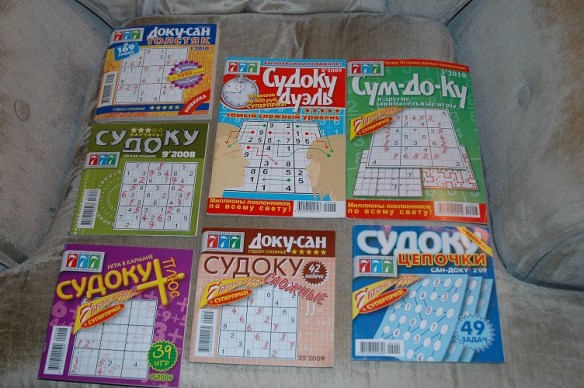
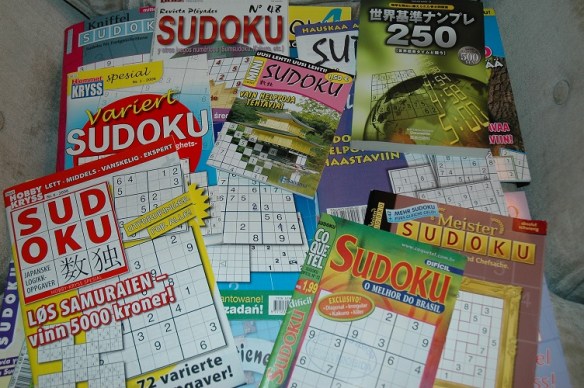
Look at this stack of puzzle books from around the world, loaned to me by a friend of the blog!

There are Sudoku books in Russian, French, Japanese, and other languages! And yet, you could pick up any one of these magazines and start solving immediately.

sudokuworld7

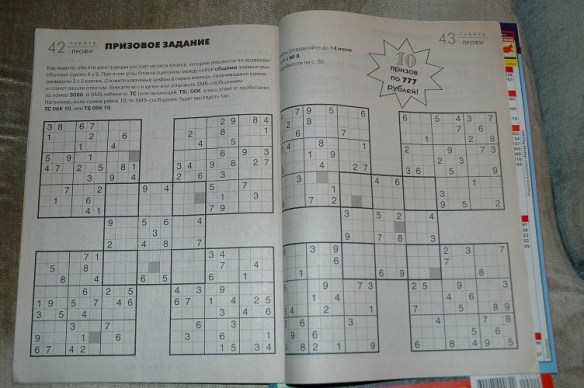
Here are two Samurai Sudoku from a Russian puzzle magazine. Again, these are identical to the overlapping grids you find in the States.

sudokuworld12

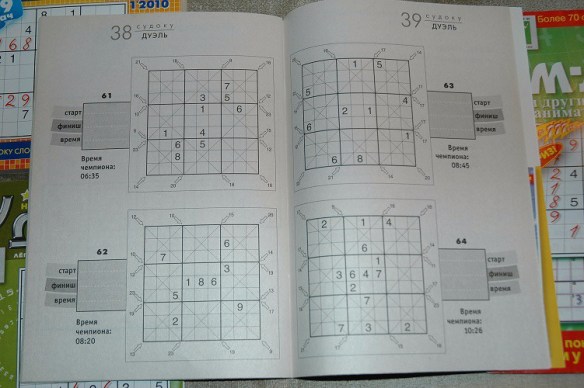
I did, however, encounter a few intriguing variations I was unfamiliar with as I perused these magazines published by 777.

sudokuworld14

Instead of providing sums in smaller boxes within the grid like Sum-Doku puzzles, or along the edges like Kakuro, these puzzles offer totals that correspond to the three diagonal boxes in a line a given arrow points to.

sudokuworld16

In this Sudoku variant, there are no repeats of the numbers 1 through 8 in a given row or column, but there are also no repeats within each group of connected circles.

Again, although I couldn’t read the instructions for these new puzzles, I was easily able to figure out the mechanics of each and start solving within a few minutes. Very few puzzles have that sort of universal accessibility.

sudokuworld9

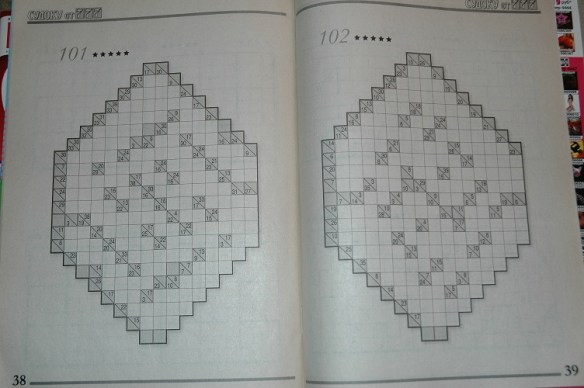
While I’m very familiar with Kakuro (or Cross Sums) puzzles, I’ve never encountered cut-style grids like these. I just love the simple elegance of these diamond-shaped grids. Very eye-catching.

Believe it or not, this is just a sampling of the hundreds and hundreds of Sudoku magazines and puzzle books released over the last decade.

Although the puzzle as we know it has been around since the ’70s under other names (To the Nines and Number Place, among them), it was only relatively recently that it exploded in popularity, becoming a true cultural touchstone and undeniable puzzle phenomenon.

[For another blog post exploring puzzle books from around the world, click here!]

Thanks for visiting PuzzleNation Blog today! You can share your pictures with us on Instagram, friend us on Facebook, check us out on TwitterPinterest, and Tumblr, and be sure to check out the growing library of PuzzleNation apps and games!
One Letter Makes All the Difference

I spend a lot of time on this blog talking about the power of words, and rightly so. Words are the foundation of civilization. They’re how we communicate, how we express ourselves, how we interpret and process and quantify the world around us.

And playing with them is a cornerstone of entertainment. Jokes and puns depend on wordplay, as do riddles, brain teasers, and so many puzzles. Whether they’re being crossed, anagrammed, or shared with friends on an online Scrabble board, words are puzzle power.

That’s true even of letters. A single letter can not only speak volumes, it can be the key to unlocking an entire puzzle.

For instance, let’s talk crosswords. Knowing one across entry is a plural often allows you to place an S, giving you an anchor for the down entry that crosses it.

Cryptograms often offer a single letter as a hook to get you started. In addition, anytime you see a lone letter in a quote, you know it’s an I or an A.

Numerous anagram puzzles involve adding a single letter to a word, anagramming the result, and getting something new and unexpected.

That sort of letter addition reminds me of a brain teaser:

There’s a word in the English language in which the first 2 letters signify a male, the first 3 signify a female, the first 4 signify a great man, and the whole word signifies a great woman. What is that word?

In all of these examples, single letters are part of a greater puzzle. But what about puzzles composed entirely of single letters?

Easy. I can think of two.

In the first, single letters are the first letters of words forming some sort of pattern. Can you deduce the pattern AND provide the next entry in the series?

  • O, T, T, F, F, S, S, E, ?
  • J, F, M, A, M, J, J, A, S, O, N, ?
  • S, M, H, D, W, M, ?
  • M, V, E, M, J, S, U, ?
  • D, K, P, C, O, F, G, ?

In the second, the single letters are still the first letters of words, but we’ve added numbers and it’s up to you to deduce what the letters represent.

  • 3 F in a Y
  • 366 D in a LY
  • 12 S in the Z
  • 4 Q in a D
  • 13 C in a S

All of this, sprung from a single letter. Pretty impressive, isn’t it? No wonder we can accomplish so much with words, given building blocks like these.

Thanks for visiting PuzzleNation Blog today! You can share your pictures with us on Instagram, friend us on Facebook, check us out on TwitterPinterest, and Tumblr, and be sure to check out the growing library of PuzzleNation apps and games!
It’s Follow-Up Friday: Mother’s Day Answers edition!

Welcome to Follow-Up Friday!

By this time, you know the drill. Follow-Up Friday is a chance for us to revisit the subjects of previous posts and bring the PuzzleNation audience up to speed on all things puzzly.

And today, I’ll be posting the answers to our Mother’s Day Unscramblers puzzle!

On Sunday, in honor of the many puzzle-loving moms in the audience, I created a twofold challenge. First, you had to unscramble the names of 12 famous sitcom mothers, and then you had to match them with their respective TV shows.

So, without further ado and hullabaloo, here are the answers!

1. Marion Cunningham — H. Happy Days
2. Samantha Stephens — D. Bewitched
3. Morticia Addams — B. The Addams Family
4. Jill Taylor — L. Home Improvement
5. Peggy Bundy — G. Married… With Children
6. Sophia Petrillo — K. The Golden Girls
7. Claire Dunphy — J. Modern Family
8. Florida Evans — E. Good Times
9. Maggie Seaver — F. Growing Pains
10. Thelma Harper — A. Mama’s Family
11. Harriette Winslow — I. Family Matters
12. Jane Jetson — C. The Jetsons

How did you do? Are you a Mother’s Day puzzle master, or did you sitcom this one out?

Thanks for visiting PuzzleNation Blog today! You can share your pictures with us on Instagram, friend us on Facebook, check us out on TwitterPinterest, and Tumblr, and be sure to check out the growing library of PuzzleNation apps and games!