We’re halfway to Christmas already, but remember Thanksgiving? It wasn’t all that long ago, we swear!
We celebrated the holiday by posting a fun little logic puzzle for our fellow puzzlers and PuzzleNationers. And we’re overdue to post the solution to our little dinner dilemma!
So, without further ado, let’s get to work!
Four girls — Emma, Taylor, Madison, and Morgan — are waiting for the Thanksgiving dinner.
Each is a different age (8, 9, 10, or 11) and looking forward to eating a different Thanksgiving staple (turkey, mashed potatoes, stuffing, or pumpkin pie).
Can you puzzle out the age and favorite Thanksgiving food of each girl from the clues below?
Madison is looking forward to eating turkey.
The girl who likes pumpkin pie is one year younger than Morgan.
Emma is younger than the girl that loves turkey.
The girl who likes stuffing is two years older than Morgan.
So where do we start? Simple. We start with Morgan.
Why Morgan? Because we have two clues connected to her that mention ages, clues 2 and 4.
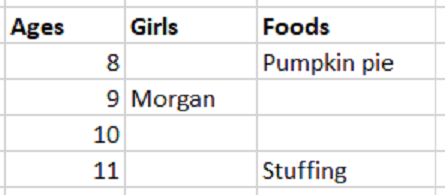
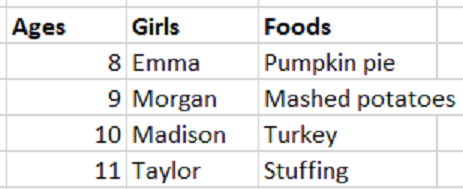
There is a girl one year younger than Morgan and a girl two years older. Since the ages are 8, 9, 10, and 11, that means Morgan must be 9 years old.
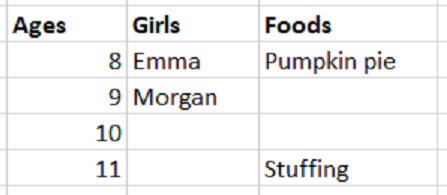
Now let’s look at clue 3. The girl who loves turkey is either age 9 or 10, since we already have foods for the other ages. Emma is younger than that girl. The only way Emma can be younger than age 9 or 10 is to be 8 years old.
So let’s fill that part in.
Sticking with turkey-related clues, we can now look at clue 1. If Madison is the one who likes turkey, she has to be age 10, because that’s the only age in the chart with both the girl’s name and the favorite food uncompleted.
And by process of elimination, that means Morgan likes mashed potatoes and Taylor likes stuffing.
How did you do, fellow puzzlers? Did you solve the logic puzzle in time for turkey dinner? Let us know in the comments section below! We’d love to hear from you.
Thanks for visiting PuzzleNation Blog today! Be sure to sign up for our newsletter to stay up-to-date on everything PuzzleNation!
I’ve had riddles on the brain recently, because I keep seeing them everywhere. Over the last few weeks, they’ve popped up in games, TV shows, books, and even emails to the blog.
It all started with our twice-monthly office D&D game. Every other Thursday, a group of us commandeers one of the conference rooms at lunchtime and enjoys an hour of dice-fueled storytelling, adventure, and fun.
As is often the case with a fantasy-inspired game, there was a river to cross and a riddle to answer in order to pass.
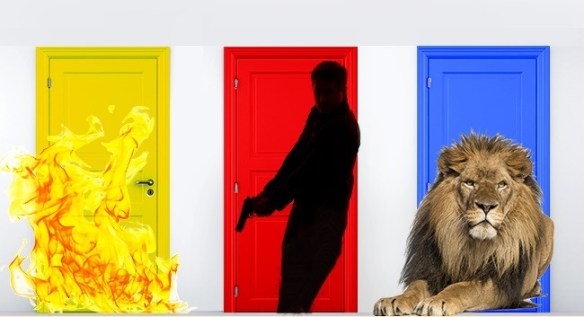
A murderer is condemned to death. He has to choose between three rooms. The first is full of raging fires, the second is full of assassins with loaded guns, and the third is full of lions that haven’t eaten in a year. Which room is safest for him?
This is a classic riddle, usually titled “Three Doors” or “The Murderer’s Riddle.”
And when you’ve got a team of puzzle solvers in your D&D group, this riddle is no challenge at all.
(If you’re curious about the solution, you pick door #3. After a year of not eating, the lions would be dead, so it would be safe to enter that room.)
Later on in the game, we again had to barter passage across a body of water, either answering a riddle or battling a demon to the death.
Naturally, we chose the riddle.
What is the creature that walks on four legs in the morning, two legs at noon and three in the evening?
This is another classic riddle — the Riddle of the Sphinx, most famously solved by Oedipus — and posed no challenge to our merry band of misfit adventurers.
(If you don’t know this one, the answer is “man,” since you walk on four legs as a child, aka crawling, two legs as an adult, and with a cane when you’re older. The day — morning, noon, and evening — represents a lifetime.)
We crossed the lake, and our adventure continued, and I thought I was done with riddles for a bit.
Then a few days later, I got caught up on the latest season of MTV’s The Challenge, a reality/competition game show. (I’ve written about some of their puzzly challenges in the past.)
And, wouldn’t you know it, this week’s challenge involved a riddle.
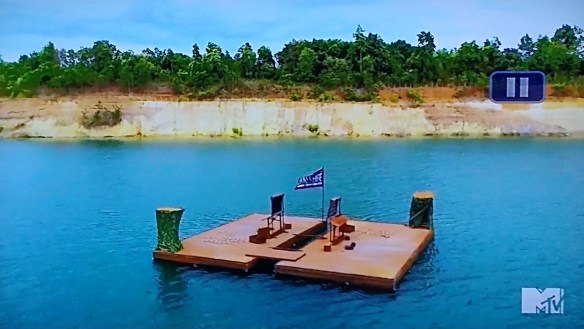
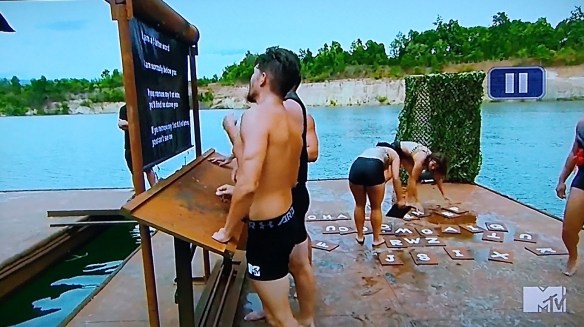
Both teams would start on this platform, sending pairs of swimmers out on a long swim to retrieve keys. Those four keys would then open both a chest full of letter tiles and a riddle to be solved. The first team to solve the riddle with the letters available would win the challenge.
Once all the drama of selecting partners — given that many of the players weren’t strong swimmers, and the slowest-swimming team would be eliminated from the game — there was plenty of tension to be had.
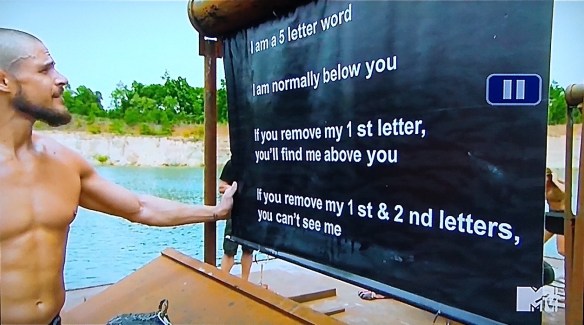
But finally, all four keys were retrieved by the teams, and the riddle revealed:
I am a 5 letter word.
I am normally below you.
If you remove my 1st letter, you’ll find me above you.
If you remove my 1st and 2nd letters, you can’t see me.
The teams were initially baffled, playing around with different words and various combinations of letter tiles in the hopes that it would spark something.
Eventually, competitor Ashley came up with a three-letter word that you couldn’t see — AIR — and her team quickly came up with the correct answer: CHAIR.
(A chair is normally below you, hair is above you (sorta), and air can’t be seen.)
So, three riddles in a matter of days. It’s officially a pattern. And so far, I’m three for three on solving these riddles.
A week or so later, though, yet another riddle arrived, this time by email. And I admit, I’m a little stumped.
What has a bell but isn’t a church. Is full of air but is not a balloon?
What do you think, fellow puzzlers and PuzzleNationers? Any ideas? Let me know in the comments section below. I have a few theories, but nothing that feels like a conclusive answer.
Thanks for visiting PuzzleNation Blog today! Be sure to sign up for our newsletter to stay up-to-date on everything PuzzleNation!
As I perused this year’s edition of the iconic record-keeping tome, there was a two-page spread dedicated to Rubik’s Cube world records alone. (There were numerous other puzzly records scattered throughout the book as well.)
So, since 2019 is drawing to a close in the next few weeks, why not dedicate one of the last blog posts of 2019 to the most up-to-date puzzly world records I can track down?
Shall we? Let’s shall.
Let’s start with a few Scrabble records.
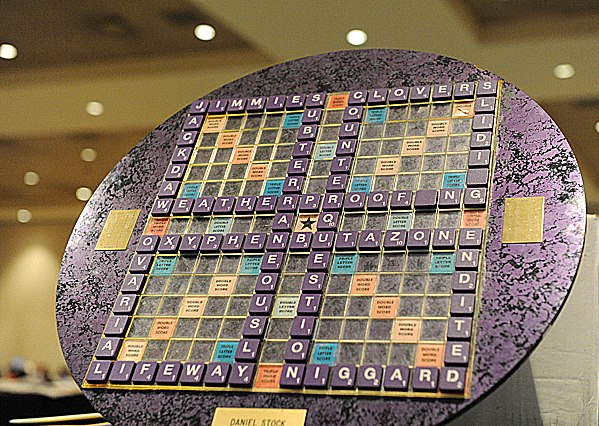
On January 21, 2012, Singapore’s Toh Weibin amassed the highest score ever recorded in a Scrabble tournament at the Northern Ireland Scrabble Championship in Belfast, scoring 850 points.
January is apparently a good month for word-tile world records, as on January 5, 2015, Lakshan Wanniarachchi set a record for playing the most opponents in Scrabble simultaneously — 40! — in Colombo, Sri Lanka. He defeated 31 of the 40 players in order to qualify for the record.
(So, yeah, you might have more Words with Friends games going at once than Wanniarachchi did, but did you win that many? Probably not.)
Instead of multiple opponents, how about one opponent for 20 hours and 15 minutes?
That’s how long chess masters Ivan Nikolic and Goran Arsovic faced off in Belgrade on February 17, 1989, where they set a world record for the most moves played in a single chess game: 269.
We can stick around Europe for one more puzzly world record, this time in Wageningen, Netherlands, as the Ceres Student Association teamed with Hasbro to create a Monopoly board the size of three-and-a-half tennis courts. Yes, on November 30, 2016, they unveiled a 9,687-square-foot version of the famously frustrating game board.
9,687 square feet? That’s pretty big, I guess. Unless, of course, you’re talking about a world record set in Dubai in the United Arab Emirates, where everything is ludicrously oversized and lavish.
On July 7, 2018, the Dubai Multi Commodities Centre (DMCC) unveiled the world’s largest jigsaw puzzle, a 65,896-square-foot puzzle that commemorated the late Sheikh Zayed.
And speaking of jigsaw puzzles, students at the University of Economics Ho Chi Mihn City in Vietnam set a record by completing the jigsaw puzzle with the most pieces — 551,232 pieces! — on September 24, 2011, breaking the record previously set in Singapore — 212,323 pieces — which had stood since 2002.
According to the Guinness article covering the event:
It took the students 17 hours to first break up the 3,132 sections, each containing 176 pieces, into which the jigsaw puzzle had been divided, and then re-assemble them to create the puzzle.
Seventeen hours of puzzling is ambitious, but what about 24 hours of puzzling?
That’s what Richard Bragg, Daniel Egnor, Amanda Harris, and Ana Ulin — aka Bloody Boris’s Burning Bluelight Brigade — tackled when they set the world record for most escape rooms attended in one day. On October 3, 2018, they visited 22 escape rooms in 24 hours in Moscow, Russia. The team’s success rate was just as impressive; the team escaped all but one of the rooms in the allotted time.
Now that’s an escapade.
Of course, we couldn’t have a world records puzzling post without talking about the Rubik’s Cube.
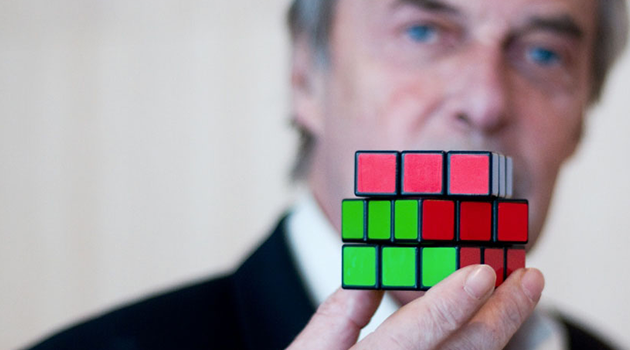
The official fastest time for solving a standard 3x3x3 Rubik’s Cube is held by Feliks Zemdegs, who set an average time of 5.8 seconds in the 2017 Malaysian Cube Open. (In competition solving, the average time across three different solves comprises your official time.)
The unofficial record for the fastest 3x3x3 solve — meaning it was outside of tournament conditions — was set in China: 3.47 seconds by Du Yesheng.
But that’s only the official size. What about other Cubes? Let’s look at the fastest solves (that I can verify):
7x7x7: 1 min 47.89 sec by Max Park
6x6x6: 1 min 13.82 sec by Max Park
5x5x5: 37.28 sec by Max Park
4x4x4: 18.42 sec by Max Park (starting to see a pattern here…)
2x2x2 (average solve): 1.51 Lucas Etter
2x2x2 (single solve): .49 sec by Maciej Czapiewski
And, just to show off, Stanley Chapel holds the record for a blindfolded 4x4x4 solve: 1 minute, 29 seconds.
[A different blindfolded solver. Image courtesy of Le Rubik’s Cube.]
Of course, now that we’ve mentioned one weird way to solve a Cube, let’s explore a few others.
Feliks Zemdegs set another world record by solving a 3x3x3 one-handed in 6.88 seconds. On March 1, 2015, Bhargav Narasimhan solved five Rubik’s Cubes one-handed in a blistering 1 minute, 23.93 seconds.
Daniel Rose-Levine holds the record for solving a 3x3x3 with his feet: 16.96 seconds. Not to be outdone, Que Jianyu unscrambled a trio of Rubik’s Cubes with his hands and feet simultaneously in just 1 minute, 36.38 seconds, in Xiamen, Fujian Province, China. (For the record, he solved one in each hand and one with his feet).
He later hung from a pole to record the fastest time to solve a Rubik’s Cube upside-down: 15.84 seconds. (He also holds the record for solving three Cubes while juggling, doing so in 5 minutes, 2.43 seconds.)
Jack Cai solved one blindfolded in 16.22 seconds. On July 22, 2018, at the Delhi Monsoon Open in Ghaziabad, Uttar Pradesh, India, Shivam Bansal shattered the field with the most Rubik’s Cubes solved while blindfolded: 48 out of 48 in under 1 hour.
George Turner holds the record for solving on a pogo stick: 24.13 seconds.
Krishnam Raju Gadiraju solved 2 Cubes simultaneously — underwater! — in 53.86 seconds. Kevin Hays achieved a world record for solving eight 3x3x3 Cubes underwater on August 19, 2015. He held his breath for 2 minutes and 4 seconds.
[Here’s a YouTube video of a different, but still impressive, underwater solve.]
Now let’s get truly ridiculous.
Phillip Kwa’han Espinoza holds the world record for most 3x3x3 Cubes solved while running a marathon. On November 14, 2015, he solved 839 Cubes over the course of 4 hours, 56 minutes, and 1 second during the 26.2 mile run in the REVEL Canyon City Marathon in Azusa, California, shattering the previous record of 175 Cubes.
26.2 miles is pretty good. But what about 12,000 feet?
That’s how high up Dan Knights was in June of 2003 when he jumped from a plane and solved a Rubik’s Cube in freefall while skydiving. He solved it in 34 seconds… which is good, because he only had 40 seconds before he’d have to deploy his parachute to safely execute a 12,000-foot fall.
To close things out today, let’s look at some Rubik’s records about quantity.
What about the most cubes solved:
one-handed while treading water in one hour? 137 by Shen Weifu
on a unicycle? 250 by Caleb McEvoy
on a bicycle? 1,010 by P K Arumugam
Finally, in January 27, 2018, the Kaligi Ranganathan Montford Group of Schools set a world record by bringing together the most people simultaneously solving Rubik’s Cubes — 3,997 — at Jawaharlal Nehru Stadium in Chennai, India. The average time to solve for the assembled students? A few minutes.
Today is a day for celebrating with family and friends, and giving thanks for all the good things in our lives. And we here at PuzzleNation want to thank you, our fellow puzzlers and PuzzleNationers, because you help make PuzzleNation one of the greatest puzzle communities in the world.
When it comes to saying thanks, a Thanksgiving puzzle seems like the perfect offering.
So we’ve cooked up a little Thanksgiving logic puzzle for you to enjoy!
Four girls — Emma, Taylor, Madison, and Morgan — are waiting for the Thanksgiving dinner.
Each is a different age (8, 9, 10, or 11) and looking forward to eating a different Thanksgiving staple (turkey, mashed potatoes, stuffing, or pumpkin pie).
Can you puzzle out the age and favorite Thanksgiving food of each girl from the clues below?
Madison is looking forward to eating turkey.
The girl who likes pumpkin pie is one year younger than Morgan.
Emma is younger than the girl that loves turkey.
The girl who likes stuffing is two years older than Morgan.
Best of luck unraveling our little food-filled mystery!
Oh, but before we go, don’t forget about the Deal of the Day!
Every single day through the end of 2019, we’ll be offering a special deal for our puzzle apps!
We’re talking sales, discounts, special promotions, the works! And the best part? It’s something exciting and different every single day!
Check out today’s Deal of the Day!
It’s our Ruby Value Pack, offering 150 terrific crossword puzzles of all difficulties for your puzzling pleasure!
Don’t forget to keep your eyes peeled across all our social media (Facebook and Twitter especially!) for new announcements each and every day for the rest of the year!
Happy Thanksgiving and happy solving!
Thanks for visiting PuzzleNation Blog today! Be sure to sign up for our newsletter to stay up-to-date on everything PuzzleNation!
You may be familiar with the board game Schmovie, hashtag games on Twitter, or @midnight’s Hashtag Wars segment on Comedy Central.
For years now, we’ve been collaborating on puzzle-themed hashtag games with our pals at Penny Dell Puzzles, and this month’s hook was #PennyDellPuzzlyFoods, mashing up Penny Dell puzzles with meals, drinks, appetizers, desserts, cutlery, and more!
Examples include: Sandwich Way Words, Letterjuiceboxes, and Restaurant Chain Words.
So, without further ado, check out what the puzzlers at PuzzleNation and Penny Dell Puzzles came up with!
What’s Leftovers?
TiramiSudoku
Soupdoku
Hot Crossbuns Club
Flour Power / Cauliflower Power
Heads of Lettuce & Lobster Tails
LemonHeads & OxTails (The most revolting dish in all the land)
A good optical illusion is a puzzle for the eyes, a visual treat that tricks you into seeing things that aren’t there. The most convincing optical illusions can even affect your sense of balance and make you question every footstep you take.
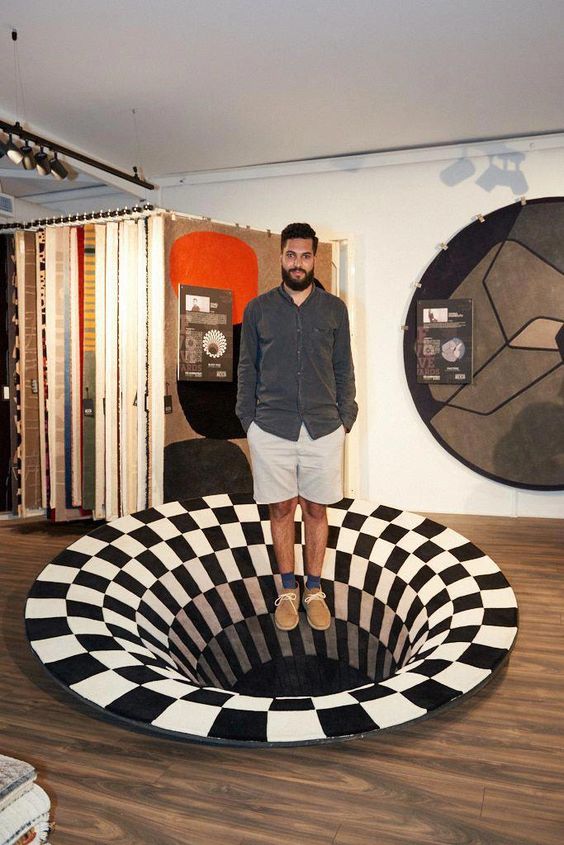
For instance, imagine walking into a room and seeing this:
This is a rug called “Black Hole,” designed by Daniel Malik, and it’ll make you doubt the ground beneath your feet.
Don’t believe me? Check this out:
And that’s just the tip of the iceberg when it comes to optical illusions that can leave you dizzy and spinning.
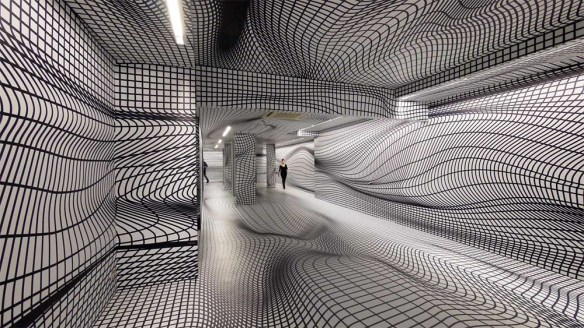
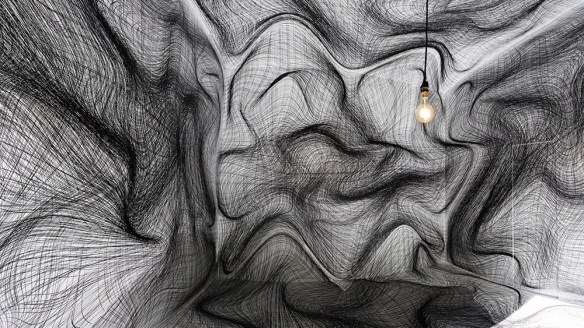
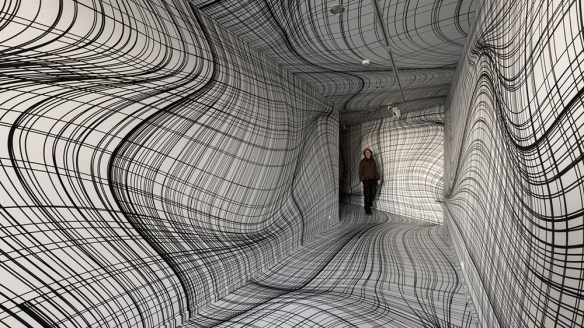
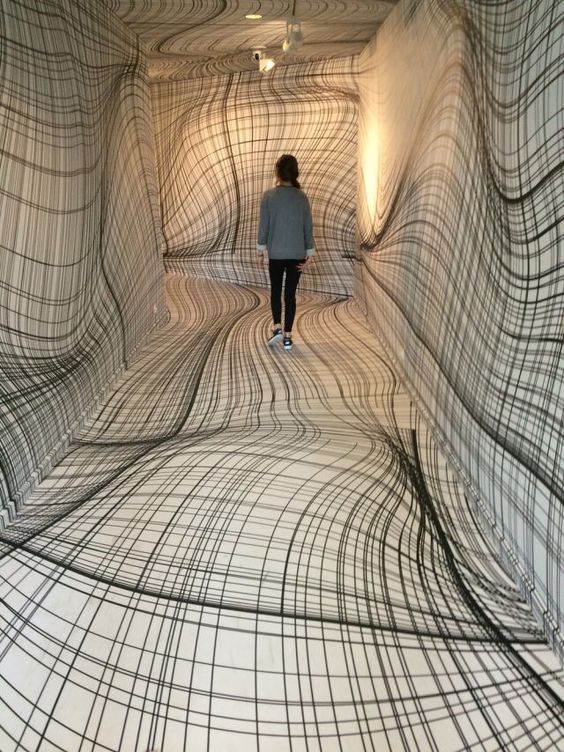
Austrian artist Peter Kogler specializes in making empty spaces look larger, more twisted, and vertigo-inducingly unsettled.
Employing the walls, the floor, and the ceiling (along with any structural beams or other objects in the area), Kogler challenges your spacial awareness with lines and imagery that offset your natural depth perception.
Astonishingly, the few recognizable items in this works — like a hanging lightbulb or even a fellow spectator — enhance the effect, making everything around those steady, relatable objects into an eye in the storm of chaotic imagery.
You no longer trust your ability to gauge height, distance, or even the angle of the room itself, even though you know in your heart that you’re walking on a flat surface.
We’ve featured some clever floor designs in the past — including one in a school that was designed to keep kids from running in the halls — but nothing on the scale of Kogler’s work.
It almost makes you nostalgic for the simple trickery of a circular area rug that looks like a tunnel to the center of the Earth, doesn’t it?
Thanks for visiting PuzzleNation Blog today! Be sure to sign up for our newsletter to stay up-to-date on everything PuzzleNation!









 PuzzCulture