What Makes a Good Brain Teaser?

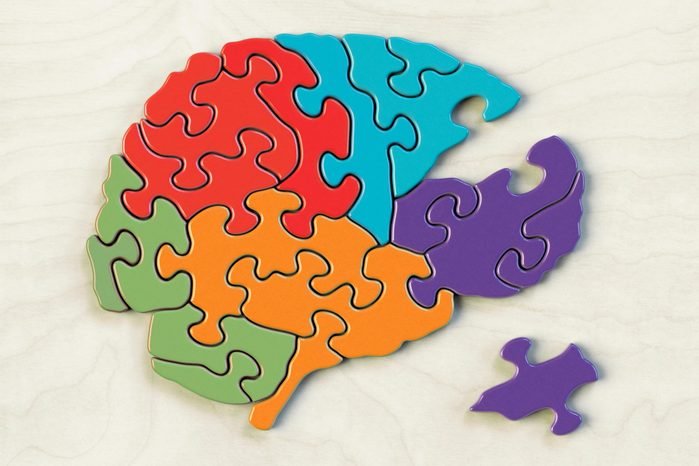
I was going through a collection of brain teasers a fellow puzzler gave me, and it occurs to me that “brain teaser” is one of the least specific puzzle terms around.

Riddles, logic and deduction, math puzzles, and wordplay games all fall under the brain teaser umbrella. So you never know what you’re gonna get. Are your math skills required? Your outside-the-box thinking? Your ability to pay attention to the specifics of the question itself?

In this collection alone, I found examples of each of these types of puzzles:

Riddle: Sometimes I’m green, sometimes I’m black. When I’m yellow, I’m a very nice fellow. That’s when I’m feeling mighty a-peeling. What am I?

Logic / deduction: 3 guys go into a hardware store, all looking for the same thing. William buys 1 for $1. Billy buys 99 for $2. Finally, Willie buys 757 for $3. What were they buying?

Math puzzle: The sum is 12 and the same digit is used 3 times to create the sum. Since the digit is not 4, what is the digit?

Wordplay: Which state capitals would you visit to find a ram, cord, bus, and dove?

So, if someone challenged you to a brain teaser, these would all be fair game. Would you be able to solve all four of them?


It’s possible you wouldn’t, because good and bad brain teasers alike employ tricks to keep you on your toes.

Some hide the answer in plain sight:

Homer’s mother has 4 children. 3 of them are named Spring, Summer, and Autumn. What is the 4th named?

Some use misdirection, purposely phrasing the question to get you thinking one way and steering you away from the real solution:

The big man in the butcher shop is exactly 6’4″ tall. What does he weigh?

In fact, both of these examples use plain sight (Homer, butcher shop) and misdirection (implying a pattern with seasons, specifying his height) to distract you.

I suspect you weren’t fooled by either of them, though.

Others try to overwhelm you with information so you bog yourself down in the details instead of clearly analyzing the problem at hand:

Nina and Lydia start from their home and each runs 2 miles. Nina can run a mile in 8 minutes 30 seconds and Lydia can run a mile in 9 minutes 10 seconds. When they finish running, what is the furthest apart they can be?

A lot of numbers get thrown at you, but they’re irrelevant, since the question only asks about the distance, not the time. So if they each run 2 miles, the furthest apart they can be is 4 miles. The rest is just smoke.

These are all effective techniques for teasing a solver’s brain. You’re given all the information you need to solve the puzzle, plus a little extra to distract, mislead, or overwhelm you.


Unfortunately, some brain teasers use unfair techniques to try to stump you:

Jacob and Seth were camping in June. Before going to sleep they decided to read a book. They both agreed to stop reading when it got dark. They were not fast readers, but they finished the entire encyclopedia. How?

Ignoring the fact that these two boys somehow brought an entire encyclopedia with them on a camping trip, we’re not actually given a lot of information here.

So that makes the intended answer seem like more of an insane leap than a logical jump to the conclusion: They were in Lapland, land of the midnight sun, and the sun didn’t set until September.

WHAT?

There’s no reasonable way for someone to reach this conclusion based on the information given. In fact, it makes less sense the more you read it. Presumably Jacob and Seth know where they are camping, and that it wouldn’t get dark for months. So why would Jacob and Seth agree to stop reading when it got dark IF THAT MEANT THEY’D BE READING UNTIL SEPTEMBER!?

This is gibberish, and you’d be surprised how often something like this gets passed off as acceptable in a collection of brain teasers. (I discussed a similar issue with detective riddles in a previous blog post.)


Let’s close out today’s discussion of the ins and outs of brain teasers with a few fun, fair examples, shall we?

  • In what northern hemisphere city can you find indigenous tigers and lions?
  • Scientists have found that cats are furrier on one side than the other. The side with the most fur is the side that cats most often lie on. Which side of a cat has more fur?
  • A woman married over 50 men without ever getting divorced. None of the men died and no one thought she acted improperly. Why?

Did you solve them all? Let us know! Also, please share your favorite brain teasers (or your tales of treacherous and unfair brain teasers) in the comments below!

Happy puzzling, everyone!
Solutions to Last Week’s Detective Riddles!

cluedupp1

Last week, we delved into a curious cousin of brain teaser family — detective riddles. These crime-fueled and investigation-filled little logic problems often cast you as the detective, the accused, or simply someone putting on their deerstalker hat and endeavoring to suss out the actual truth.

And we couldn’t resist putting your puzzle skills to the test with a few detective riddles. Did you unravel them easily or find yourself stumped?

Let’s find out, shall we?


#1

A Japanese ship was leaving the port and on its way to open sea. The captain went to oil some parts of the ship and took his ring off so it wouldn’t get damaged. He left it on the table next to his bunk. When he returned, it was missing. He suspected three crew members could be guilty and asked them what they had been doing for the ten minutes that he had been gone.

The cook said, “I was in the kitchen preparing tonight’s dinner.”

The engineer said, “I was working in the engine room making sure everything was running smoothly.”

The seaman said, “I was on the mast correcting the flag because someone had attached it upside down by mistake.”

The captain immediately knew who it was. How?

Answer: The seaman was to blame.

The key to this one is paying attention to the ship and the flag. A Japanese ship would be flying the Japanese flag, and it’s hard to believe a white field with a red circle in the center could be hung “upside down.”

302568

#2

A chemist was murdered in his own lab. The only evidence was a piece of paper that had the names of chemical substances written on it. The substances were nickel, carbon, oxygen, lanthanum, and sulfur. The chemist only had four people come by his lab on the day of the murder: fellow scientist Claire, his nephew Nicolas, his wife, and his friend Marc.

The police arrested the murderer right away. How did they know who it was?

Answer: Nephew Nicolas was to blame.

If you know your elemental abbreviations, you probably noticed the correlation between what the chemist wrote down and one of the suspects. Ni + C + O + La + S spells the criminal’s name and points the finger at the criminal from beyond the grave.

#3

A man was found on the floor dead with a cassette recorder in one hand and a gun in the other. When the police arrived at the scene they pressed play on the recorder. It was the man’s voice. He said, “I have nothing else to live for. I can’t go on,” followed by the sound of a gunshot.

After listening, the police knew that this was a murder, not a suicide. How?

Answer: Dead men don’t rewind.

The cassette recorder was all prepped for someone to press play, which means someone stopped the tape and rewound it after the gunshot was recorded. If it had been a suicide, the tape recorder would have just kept running after the gunshot, since there wasn’t anyone alive to stop it.


How did you do, fellow puzzlers and PuzzleNationers? Did you solve all three? Let us know in the comments section below! We’d love to hear from you.

Thanks for visiting PuzzleNation Blog today! Be sure to sign up for our newsletter to stay up-to-date on everything PuzzleNation!

You can also share your pictures with us on Instagram, friend us on Facebook, check us out on TwitterPinterest, and Tumblr, and explore the always-expanding library of PuzzleNation apps and games on our website!

Be a Sleuth with Detective Riddles!

cluedupp1

Brain teasers come in many forms. Riddles, logic problems, math puzzles, and deduction games all fall under the umbrella of brain teasers.

One variety of brain teasers that has always appealed to me is the detective riddle. It’s probably because, deep down, who wouldn’t want to glance at a crime scene and deduce what happened, a la Sherlock Holmes?

While brain teasers can consist of all sorts of scenarios, detective riddles usually center around a crime committed or a police investigation to be completed.

crossword mysteries td 0

Here’s an example of a detective riddle:

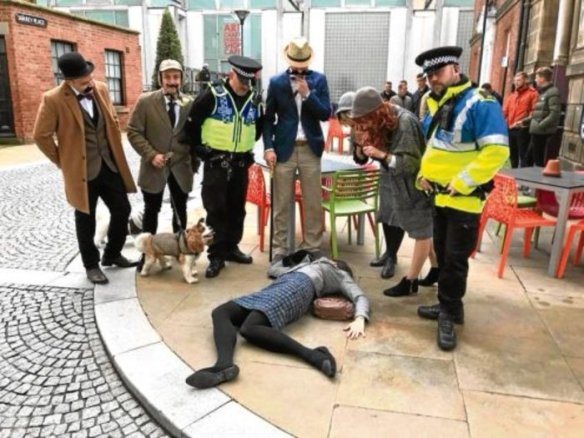
A dead female body lies at the bottom of a multistory building. It looks as though she committed suicide by jumping from one of the floors.

When the detective arrives, he goes to the first floor of the building, opens the closed window, and flips a coin towards the floor. He goes to the second floor and does the exact same thing. He continues to do this until he gets to the top floor of the building.

When he comes back down, he states that it was a murder and not a suicide. How does he know that?

This is a good example of the detective riddle, because you’re given all of the information you need in the writeup. Some detective riddles involve making strange, unlikely assumptions, which are a sign of a poorly constructed brain teaser. This one is fair, but not ideal.

The solution, of course, is that the window was closed on every floor, meaning that someone shut the window after the person’s body went out the window. (We ARE told that the body fell from “one of the floors,” but doesn’t that necessarily preclude the roof? That little question mark keeps this riddle from being an ideal example of the form.)

bestpuzsherlock

Now, here’s an example of a bad detective riddle:

Nicole went to the police to report that someone had stolen her vintage ring. When the police got to her house they notice that the window was broken, there was a total mess inside, and there were dirty footprints on the carpet. But, there were no other signs of a break-in.

The next day, the police arrested Nicole for fraud. Why?

The solution? Well, according to the source I found: As soon as the police got to the “crime scene,” they knew that Nicole has most likely staged the break-in. The glass from the broken window was all outside of the house, meaning that it had been broken from the inside.

But the riddle doesn’t mention any glass. In fact, it says there were “no other signs of a break-in,” which would include the glass on the OUTSIDE.

See? This one is full of holes.

Now that you have a sense of how detective riddles work, let’s test your puzzly skills with a few!


#1

A Japanese ship was leaving the port and on its way to open sea. The captain went to oil some parts of the ship and took his ring off so it wouldn’t get damaged. He left it on the table next to his bunk. When he returned, it was missing. He suspected three crew members could be guilty and asked them what they had been doing for the ten minutes that he had been gone.

The cook said, “I was in the kitchen preparing tonight’s dinner.”

The engineer said, “I was working in the engine room making sure everything was running smoothly.”

The seaman said, “I was on the mast correcting the flag because someone had attached it upside down by mistake.”

The captain immediately knew who it was. How?


chemistryfluxx

#2

A chemist was murdered in his own lab. The only evidence was a piece of paper that had the names of chemical substances written on it. The substances were nickel, carbon, oxygen, lanthanum, and sulfur. The chemist only had four people come by his lab on the day of the murder: fellow scientist Claire, his nephew Nicolas, his wife, and his friend Marc.

The police arrested the murderer right away. How did they know who it was?


#3

A man was found on the floor dead with a cassette recorder in one hand and a gun in the other. When the police arrived at the scene they pressed play on the recorder. It was the man’s voice. He said, “I have nothing else to live for. I can’t go on,” followed by the sound of a gunshot.

After listening, the police knew that this was a murder, not a suicide. How?


Did you unravel these detective riddles? Let us know in the comment section below! We’d love to hear from you.

Thanks for visiting PuzzleNation Blog today! Be sure to sign up for our newsletter to stay up-to-date on everything PuzzleNation!

You can also share your pictures with us on Instagram, friend us on Facebook, check us out on TwitterPinterest, and Tumblr, and explore the always-expanding library of PuzzleNation apps and games on our website!