
During my extensive dive into crossword history in preparation for my Braille Crosswords post, I encountered all sorts of curious tidbits and trivia about crosswords. I tucked many of them away at the time, looking forward to digging into them properly later once the piece was completed.
So, with that post done and dusted, I had some time to pour through those tidbits and trivia for blog post ideas. And I knew I had to start with this snippet from The Omaha World-Herald on Sunday, July 22nd, 1979:
Portland: February 23, 1959. Two Oregon daily papers cry “Doublecross!” Charging that their crossword contests are being “fixed” by a “nation-wide ring” headquartered in Detroit, they discontinue the contests and call in the FBI
A criminal crossword ring? Tell me more about these cruciverbalist ne’er-do-wells!
I mean, we’ve discussed criminal activity and crosswords in previous posts, but those were strictly of the fictional variety. This story, on the other hand, is an honest-to-Shortz crossword criminal conspiracy, concocted nearly 70 years ago.
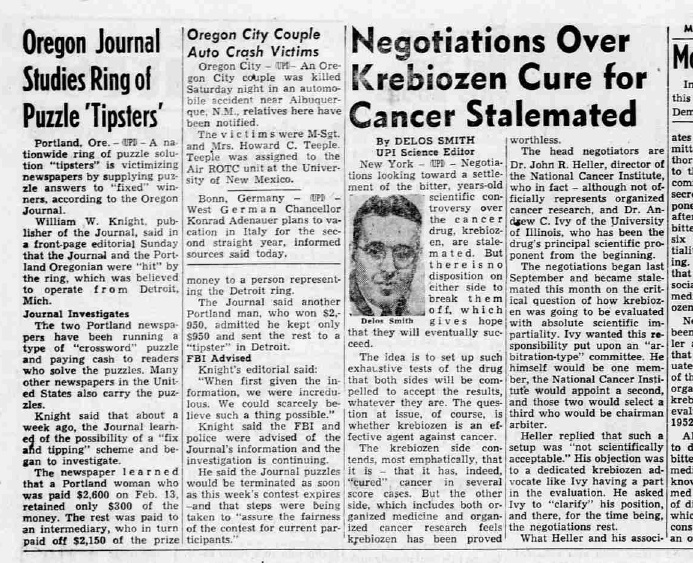
Our story begins in Oregon, where publisher William W. Knight of The Oregon Journal shared his suspicions in a front-page editorial piece on February 23rd, 1959.
The Oregon Journal and The Portland Oregonian were just two of the many newspapers around the United States who ran crossword contests with cash prizes. Subscribers would send their solutions to the paper in the hopes of being the first correct solver (or sometimes, the correct solver chosen at random) and winning some money.
But Mr. Knight reported that his sources at The Oregon Journal had uncovered something peculiar. They had learned about two previous Portland winners who only kept part of their money, the rest being forwarded to an intermediary, and after that to the suspected ringleader in Detroit, Michigan.
One woman won $2600 but retained only $300. $150 went to the intermediary, and $2150 to Detroit. Another winner received $2950 but he only kept $950 and sent the rest to a “tipster” in Detroit. (Geez, even when committing the same crimes, women are still getting paid less than men!)
Knight referred to this conspiracy as a “fix and tipping” scheme.
“Fix” in this case means illegally rigging the outcome of the crossword contest, and “tipping” means that someone was informing the “contestants” of the solution in order to guarantee a win.
But the two primary distributing syndicates — Superior Features Syndicate, Inc. and General Features Syndicate — claimed this was impossible, calling their precautions “foolproof.”
These “foolproof” precautions basically meant that the puzzle grid and clues went to subscribing newspapers, but the puzzle solution went to an associated bank “or some other unimpeachable agency.” That bank/agency would hold the solution until the contest submission deadline had passed, and then release it to the subscribing newspapers.
(This is obviously pretty foreign to modern solvers, who are accustomed to seeing the previous day’s solution published alongside today’s new puzzle.)
Despite the reassurances of the distribution syndicates, Knight had already reached out to the FBI with his suspicions, and declared that The Oregon Journal would no longer be participating in crossword puzzle contests.
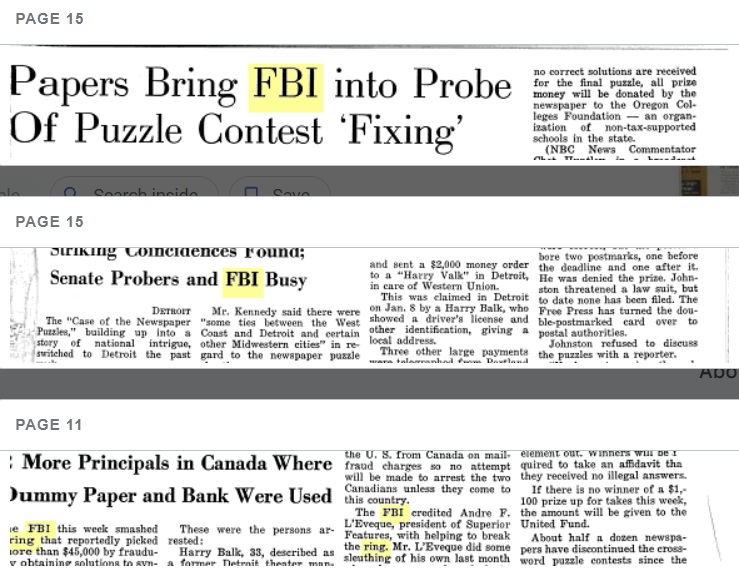
His editorial went out on February 23rd, and the next day, other papers began reporting on Knight’s alleged criminal crossword conspiracy.
But the Crossword Ring’s reign of terror would be short-lived.
One month to the day that Knight’s accusations hit the front page, J. Edgar Hoover himself announced the arrest of those responsible for the Crossword Ring conspiracy.
The headline in The New York Times the following morning read “12 SEIZED BY F.B.I. IN CONTEST FRAUD; 2 in Canada Also Accused of Being in a Ring That Got Puzzle Answers.“
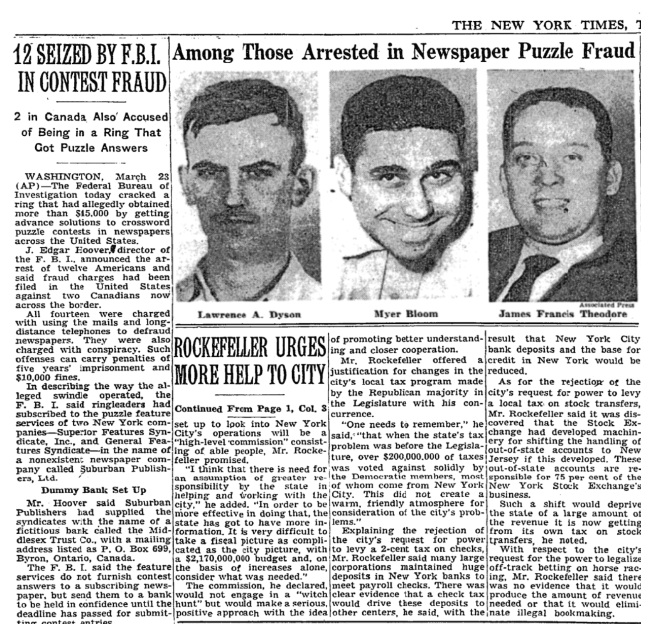
Knight’s suspicions were correct, but the conspiracy ranged far wider than Portland and Detroit. The actual ringleaders were based in Ontario, Canada, and they telephoned answers to agents in Chicago, Philadelphia, Harrisburg, and Minneapolis as well.
So, how did the ringleaders get around those “foolproof” precautions we heard about before?
In staggeringly simple fashion.
The scam worked like this:
Step One: Set up a fictitious bank, Middlesex Trust Co., complete with a fake mailing address.
Step Two: Subscribe to the puzzle distributors in the name of a nonexistent newspaper company, Suburban Publishers, Ltd.
Step Three: Receive the puzzle solutions from the Syndicate via the fictitious bank’s P.O. Box, then contact agents in the United States to submit perfect solutions to their local papers before most other newspapers would’ve even published the contest puzzle.

All it took to circumvent the “foolproof” precautions was Step One.
The Crossword Ring had raked in $45,000, which is equivalent to over half a million dollars in 2026. And the FBI operation to arrest them all took only 86 minutes.
Amazingly, this wasn’t the end of crossword contests in the United States.
Despite further allegations of wrongdoing throughout the 1960s — including bribery and extortion — the contests remained popular, and prize amounts collected by contest entrants kept rising. One New York contest winner received a cash prize of $44,000, nearly the same amount that the Crossword Ring had scammed from newspapers over the course of weeks.
Now, if you’ll excuse me, I have to get back to my brand-new newspaper venture, The PuzzCulture Tribune Gazette Times-Herald-Daily. More about our crossword contests soon! *a-wink*
So, fellow puzzler, what’s your favorite crossword crime, fictional or otherwise? Let us know in the comment section below! We’d love to hear from you.
 PuzzCulture