The Connecticut Festival of Indie Games!

Last year, one of our most popular posts was Max’s review of the Boston Festival of Indie Games. And when I heard that Connecticut was hosting its first Festival of Indie Games this year on International TableTop Day, I definitely wanted to check it out.

Now, I have neither Max’s charm nor his good looks, but I hope you’ll indulge me in my own rundown of the CT FIG this weekend.
ctfig12

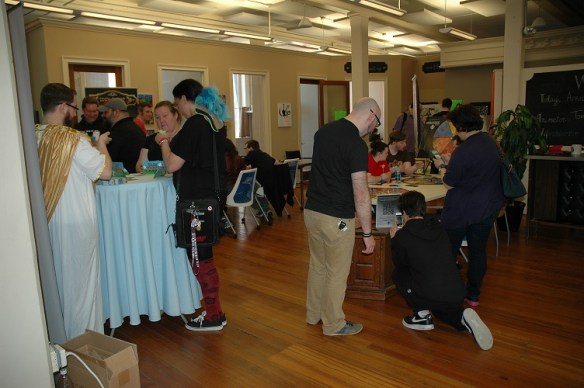
Elm City Games and The Grove combined forces to host the inaugural event in New Haven, and it made for a fun, intriguing, and intimate event.

The designers were spread out all over the building, wherever there was space, so you’d go down a hall and find a half-dozen tables, then head upstairs for a dozen more, and then down around random corners for a few more exhibitors. It was like a game-filled scavenger hunt with surprises around every turn.

ctfig1

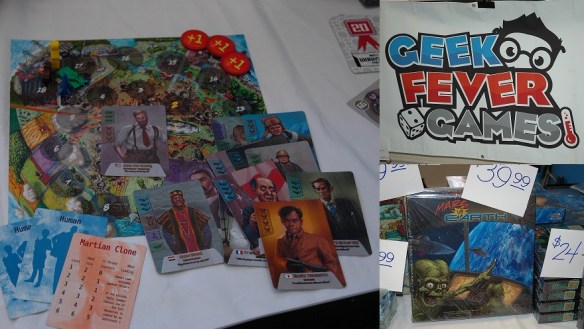
One of the first booths I visited belonged to the folks at Geek Fever Games, because only last week, I touted their Kickstarter for Avoid the Void right here on PuzzleNation Blog!

They had a playtesting area set up where guests could try out the game, as well as several games available for sale, including an alien invasion game called Mars vs. Earth, a robot-building card game called Awesome Bots, and Young Wizards, a card game that brings magic and RPGs to life in a simple, easy-to-learn format.
ctfig8910

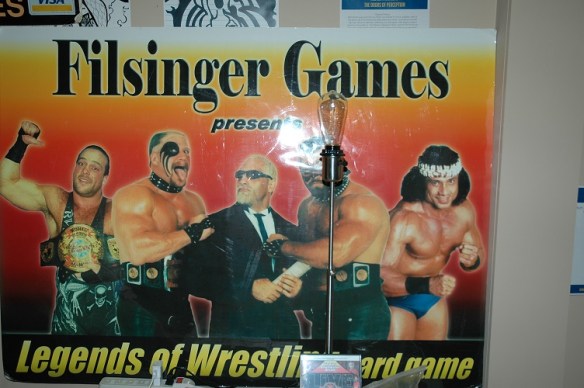
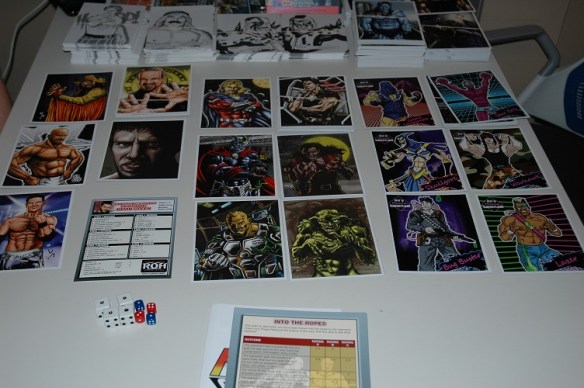
I also had a chance to sit down with Todd from Filsinger Games — one of the nicest guys on the planet — who was offering an intriguing take on role-playing games: a pro-wrestling edition.
ctfig14

Yup, Filsinger Games figured out how to boil down all the mechanics and style of professional wrestling into a game you can play with any old six-sided die, and it’s great fun. The company has licensed with classic wrestlers and new indie stars to use their likenesses and move-sets for the game, and you can learn how to play in minutes flat.

I realize that RPGs and wrestling may not be everyone’s cup of tea, but I was thoroughly impressed by the simple, elegant design of the game, as well as the outside-the-box variations, like ’80s-style video game wrestlers, monsters, and more.
ctfig13

It’s worth noting at this point that my goal was to make it to noon before spending any money on games. I arrived at the event at 10:30.

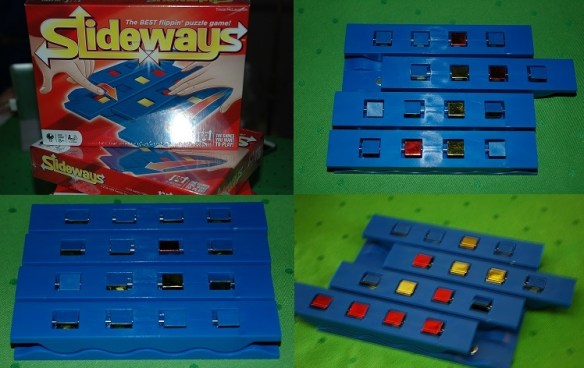
Slideways was the puzzle game to first crack my resolve, then my wallet.
ctfig1516

[A progression of my first time playing Slideways. The creator was red and I was gold. As you can see, I lost. Also, the last photo looks different because I photographed it in nighttime mode in order to better show off the metallic colors of the flippable tiles.]

Proudly displayed alongside an award earned at the Boston FIG, Slideways is the brainchild of Tricia McLaughlin and distributed by R&R Games.

Combining the classic four-in-a-row playing style of Connect Four or Quarto with the board-manipulating game play of Rush Hour Shift, Slideways offers a lot of choice in a little package.

Plus you can change moves your opponent has made, allowing even more flexibility of play! (And if you order through the R&R Games website, use the promotion code SLIDEWAYS to get 25% off!)
ctfig23

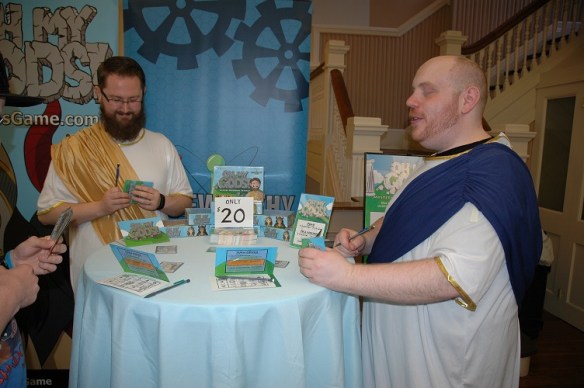
[Designer Tim Blank closes his eyes dramatically before bestowing judgment upon an unsuspecting player.]

After visiting the well-dressed fellows at Gameworthy Labs (and winning a copy of Oh My Gods! in a raffle; review coming soon!), I continued exploring the plethora of possible booths to check out.

(It’s worth noting that unlike Boston FIG, CT FIG was almost exclusively board games and card games, with very few digital games to be seen. I suspect more digital games will be involved with every passing year.)

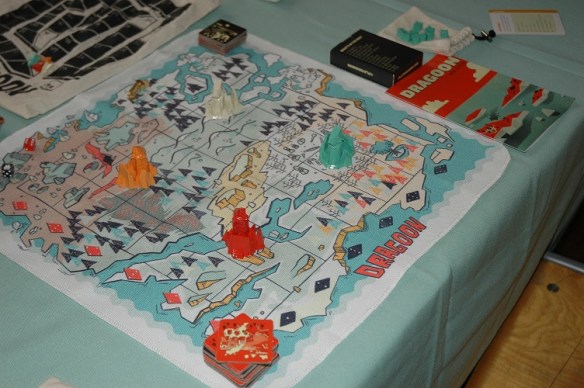
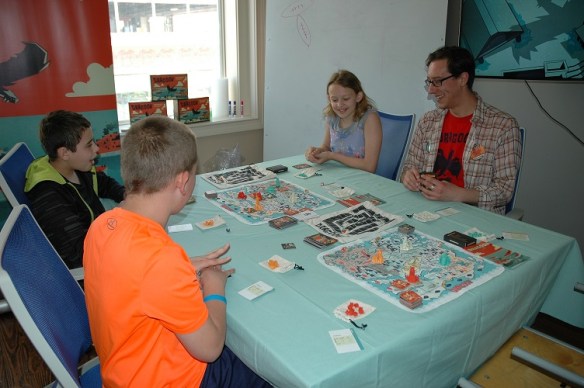
One board game that caught my eye was Dragoon, a clever reversal of classic fantasy storytelling tropes by the team at Lay Waste Games.
ctfig21

Usually, it’s humans fighting off dragons, but in Dragoon, you play a dragon whose lands are being invaded by humans! How rude! So it’s up to you to roar and be generally dragon-y and keep them away, all while stealing their gold, because as we all know, dragons love gold.

It’s a funny concept executed beautifully. With a cloth map as your game board, well-crafted metal pieces for the dragon and its cave, and some sharp game play mechanics, it’s terrific stuff.
ctfig22

I spoke to Jon Ritter-Roderick of Lay Waste Games, and he shared that this was another Kickstarter success story, and that they were taking pre-orders for the game because they’d already sold out of their original print run! (Good news for my wallet, since I would definitely have bought a copy right then and there.)

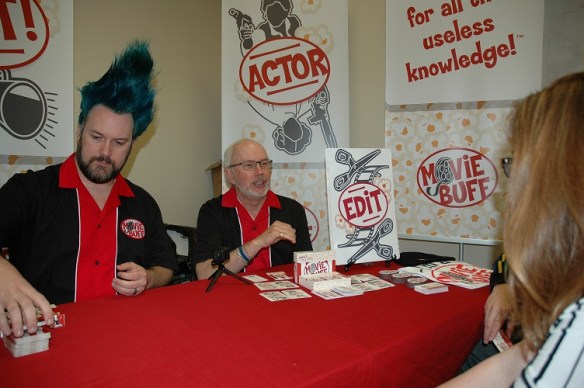
I had a similar experience when I sat down with the dapper crew behind Movie Buff, a card game that pits your movie knowledge against that of your fellow players. If someone names a movie, how fast can you name an actor in it or quote that movie?
ctfig44

[And the Oscar for Best Hair goes to…]

Combining your own knowledge of the movies with the order-shifting rules of Uno, Movie Buff is a fun and frenetic way to establish your cinematic dominance over friends and loved ones alike.

Oh, and spoiler alert: When we played a round to show off the game, I won. (They’re also taking pre-orders now.)

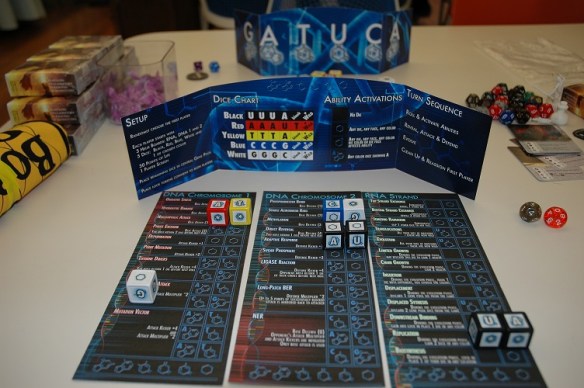
I next tested my puzzle-game skills in a round of GATUCA, a dice-rolling combat game based on DNA, of all things. (And riffing on the sci-fi film Gattaca.)
ctfig43

Oh, and my opponent? The nephew of the friend of the guy who designed the game.

Allow me to explain: The designer and his pals from The Board Room needed a fourth person to demo their game-in-development This Is Only a Test, so this amiable fellow (nephew of the friend of the designer) stepped up. And when the designer and his team went off to do a livestream demonstration of one of their games, said nephew-friend was left to man the table.

But he stepped up and made for an impressive opponent in my first round of the game. You roll dice to determine what components you have available, and then you apply them to the game sheets in front of you in order to attack, defend, or evolve. It’s a little overwhelming at first, but new players will catch on quickly, and it’s a fun variation on simpler dice-rolling combat games.
ctfig52

I went from learning about DNA (and how to make it work to my advantage in combat) to learning about language and color theory with the team at TPG.

They’re teachers who also play and design games, and their mission is simple: combine those two worlds to create games that help students learn.

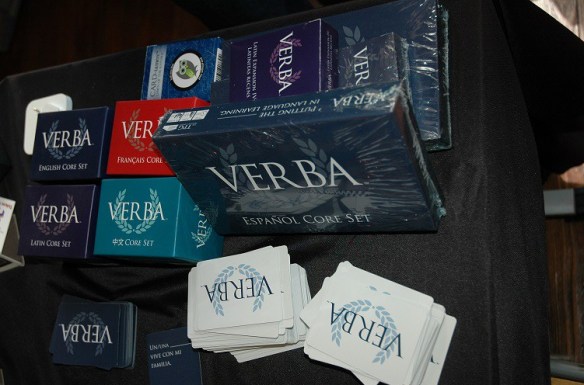
Their flagship product is Verba, a language game that uses the card-combining game play of Cards Against Humanity or Apples to Apples in order to reinforce and engage foreign-language learning. Students are given sentences (the blue cards) and must complete them with one of the white cards.
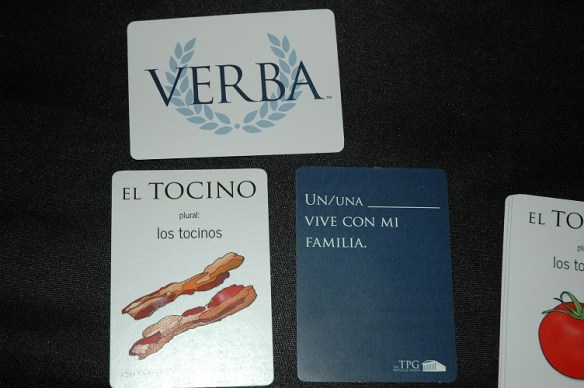
ctfig54

With editions in Latin, Spanish, French, and English (for English language learners), it’s a terrific immersive way to explore an unfamiliar language with practice and fun, one that appealed greatly to the word nerd and language lover in me.

(They also had a game where you hatched dragon eggs with color theory, which looked fascinating, but that I didn’t get to try out. Hopefully I’ll get a second chance to give that game a shot.)

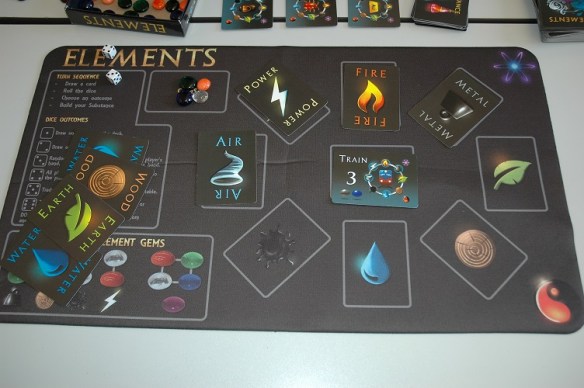
I did, however, get to try my hand at wielding the elements and bringing items to life, thanks to the crew at Rampage Games and their game Elements.
ctfig55

Elements is all about combining the elements fire, air, earth, and water to bring different substances into existence. You have to manage your limited resources, use your cards wisely, and outwit your opponents in order to complete your substances before they complete theirs. I can easily see this game appealing to all sorts of puzzle fans. (And it must have, since its Kickstarter campaign closed out successfully that very day!)

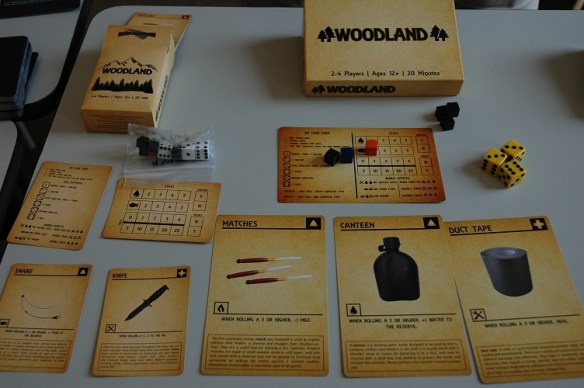
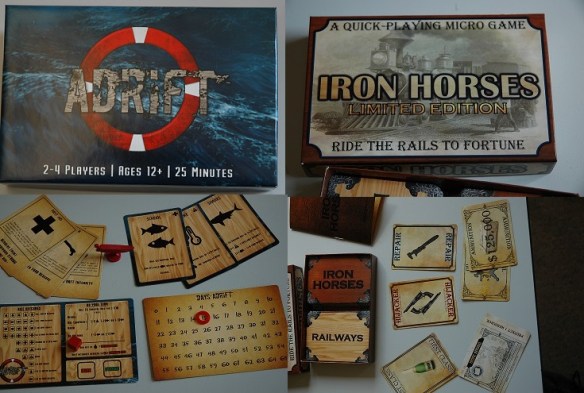
Nick Rossetti of Rampage Games was kind enough to walk me through some of the other games they also have available, including quick-play survival games like Woodland and Adrift, as well as Iron Horses, a card game where competing train companies battle to be the biggest and best in the land.
ctfig61

ctfig6263

But it was their soon-to-be-available card game Aurora that piqued my puzzly interest. While Elements is all about building single items or substances, Aurora is about building entire solar systems and tending to them so that intelligent life may emerge. Talk about ambitious!

ctfig57

[Aurora and Elements were both added to the increasingly long list of games I would’ve bought on the spot, had they been available.

I did end up returning to the Geek Fever Games table and buying Awesome Bots, as well as a card game called Plus Word Plus that’s all about finding common ground between words.

And several other games from other booths.]

As you can see, there were so many noteworthy and interesting games that I can barely describe them all. Heck, this is a pretty long post. And guess what? We’re only halfway done. There were so many great games to cover that I’m splitting my CT FIG recap into two posts.

I devoted this post to games that are available right now (or will be soon). Thursday’s post will be all about games in development or not yet available for sale!


Thanks for visiting PuzzleNation Blog today! Be sure to sign up for our newsletter to stay up-to-date on everything PuzzleNation!

You can also share your pictures with us on Instagram, friend us on Facebook, check us out on TwitterPinterest, and Tumblr, and explore the always-expanding library of PuzzleNation apps and games on our website!

PuzzleNation Product Review: Quarto

Tic-Tac-Toe is probably the first strategy game a child encounters, and it’s a simple concept: get three in a row. Other games expand on this idea, like Connect Four, which increases the pattern to four in a row and adds the vertical play aspect to the game. ThinkFun put their own spin on the idea with All Queens Chess, adding the rules of chess to that Connect Four aesthetic.

And Quarto ups the ante significantly, adding elegance and variety to this particular corner of the puzzle-game genre.

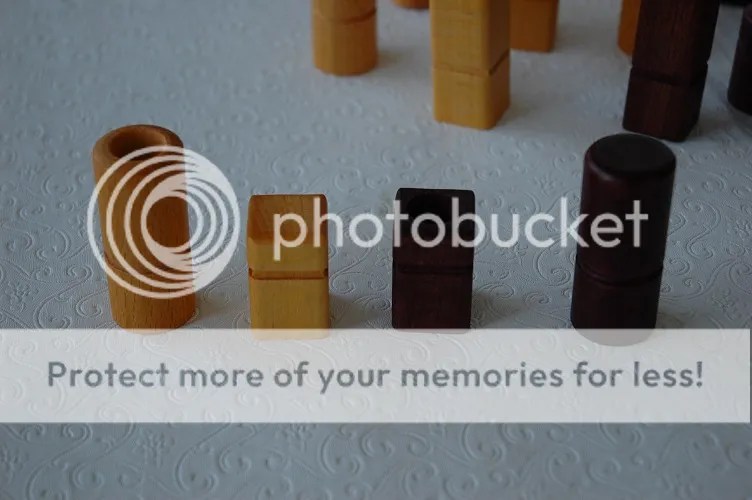
You have a board with sixteen spaces laid out in a 4×4 grid, and your goal is to place four pieces in a row. Sounds simple, right? Sure. But when you look at the playing pieces, it gets a little more involved.

As you can see, across these sixteen differently-shaped pieces, eight different characteristics are possible: light, dark, round, square, solid, hollow, tall, and short. Each piece represents four of these characteristics.

So you have to make a row of four pieces with at least one characteristic in common. It could be four hollow pieces (meaning shape, color, and size don’t matter), four dark pieces (meaning shape, size, and solid/hollow don’t matter), or any of six other possible common factors.

And to add a little more challenge to the gameplay, your opponent chooses which piece you play each round. You have to strategize on the fly, because you never know which piece you’ll be placing next!

For example, here’s a game in progress. There are three dark pegs in a line, so naturally, your opponent picks a light-colored piece, preventing you from taking advantage.

But wait! They accidentally chose a hollow piece, allowing you to complete a line of four hollow pieces in a row! But remember to yell “Quarto!” when you do, or it doesn’t count!

There’s so much strategy wrapped up in such a simple mechanic. Quarto can be explained in a few seconds, but it offers a massive amount of replayability. Especially when you consider how much of the gameplay is happening in your mind as you try to figure out not only what piece to choose for your opponent, but what you might do with whatever piece you’re handed next.

Quarto is a wonderful variation on a classic style of puzzly gameplay. The beautiful playing pieces are well-made and offer plenty of possibilities, and it’s quickly become a favorite in my house as a palate cleanser between longer game sessions.

Quarto was created by Blaise Muller, is published by Gigamic Games, and is available from Marbles: The Brain Store and Amazon.


Thanks for visiting PuzzleNation Blog today! Be sure to sign up for our newsletter to stay up-to-date on everything PuzzleNation!

You can also share your pictures with us on Instagram, friend us on Facebook, check us out on TwitterPinterest, and Tumblr, and explore the always-expanding library of PuzzleNation apps and games on our website!

It’s Follow-Up Friday: Schools and Spheres edition!

Welcome to Follow-Up Friday!

By this time, you know the drill. Follow-Up Friday is a chance for us to revisit the subjects of previous posts and bring the PuzzleNation audience up to speed on all things puzzly.

And today, I’d like to return to the subject of Kickstarter philanthropy!

[Image credit: for-preneur]

I’ve written about crowdfunding a lot in this blog, because over the last few years, platforms like Kickstarter and Indiegogo have changed how many puzzles and games are created, funded, and brought to market.

There’s a virtual board game and card game renaissance stemming from these websites, and many puzzle constructors are bypassing traditional publishing formats and taking their puzzle suites and projects straight to the audience this way.

But there’s also the opportunity to give back to your community in meaningful ways.

I recently stumbled across the Kickstarter campaign for StrataSphere, a strategy puzzle game from Family Games America that really caught my eye.

Like a next-level version of Connect Four and KerPlunk, StrataSphere challenges you to place your sliding tabs in various slots around the cube, then use them to drop your spheres to the bottom layer first.

But what most intrigued me about the project wasn’t the puzzle itself, but one of the crowdfunding options being offered. Instead of just pledging for a copy of the game for yourself, you could pledge a little more money and donate a copy of the game in your name to a school of your choosing. Puzzle philanthropy.

I reached out to the team at FGA to find out more about the project, and had the opportunity to chat with Paulette Hall, communications director for FGA.

Where did the idea for StrataSphere come from?

The game was originally envisioned and developed by German designer Claudia Herz, who originally named it BallCube. Claudia remembers that after spending time sketching and offering the idea to other game publishers she finally made a handmade sample of acrylic glass and presented it at a trade-show not too far from her home.

The reaction and feedback was overwhelming. People wanted to know everything about the game and know where it can be purchased. This is what encouraged her to pursue the project. With a combination of inspiration from Claudia and outer-space, we renamed the game StrataSphere 2.0.

For people unfamiliar with FGA, what sort of puzzles and puzzle-games are your bread and butter? Is StrataSphere a traditional FGA-style puzzle, or is it a new direction for you?

FGA’s tag-line, Learning Through Laughter, has been been incorporated into all of our gift, game, and puzzle products since being established in 1987. StrataSphere 2.0 is not so much a puzzle but a strategy tabletop game that is a more contemporary modern addition to our line of products.

Our more popular items include eco-friendly wooden games and puzzles like Cathedral, Don’t Break The Bottle, and our wood and wire puzzles. While this strategy game is new to FGA, FGA is not new to strategy games.

The option for supporters to donate an additional copy to a school of their choosing is one I’ve never seen before, and I’m surprised more Kickstarter campaigns haven’t utilized it. Is this the first product that has incorporated this sort of program? Is this a long-term goal for FGA going forward?

FGA helped raise funds for actor Ted Danson’s American Oceans Campaign in the late ’80s and early ’90s with their environmental games and puzzles such as Endangered and Colorful Kingdom. A percentage of sales was also given to the ASPCA.

Donations of FGA products go out yearly to schools and organizations. A big part of FGA is our ability to give back, and we wanted to start 2016 with a campaign that will help us continue to do that. Our students are our future, and the state of our school systems has geared our focus of this campaign to get valuable learning material back into our schools and into their hands.

I think this is not only a really exciting puzzle game, but a worthwhile cause as well. You can check out all the details on the StrataSphere Kickstarter page. They’re more than halfway to their funding goal, and I sincerely hope they make it there and beyond.


Thanks for visiting PuzzleNation Blog today! Be sure to sign up for our newsletter to stay up-to-date on everything PuzzleNation!

You can also share your pictures with us on Instagram, friend us on Facebook, check us out on TwitterPinterest, and Tumblr, and explore the always-expanding library of PuzzleNation apps and games on our website!

Touching a Piece of Puzzle History

Friend of the blog Peter Kanter came by the other day and showed me this curious piece of puzzle history that his brother had stumbled upon in a garage sale or a flea market.

Little did I realize I would soon be holding a puzzle that predates the crossword puzzle by over twenty years.

According to the instruction manual — which features rules for ten different spelling and anagramming games, one or two of which bear no small resemblance to Bananagrams in play style and spirit — this game was copyrighted in 1890 by McLoughlin Bros.

According to one of their catalogs, this game “consists of a box full of letters, so selected as to be most useful in a number of exceedingly interesting spelling games. The letters, printed on cardboard, are easily distinguished and handled. The box label is unusually bright and attractive.”

Yes, thanks to the wonders of the Internet, I’ve been able to do a little research on this marvelous find.

McLoughlin Bros. was a publishing firm based in New York that operated from the mid-1800s until the early 1900s. They specialized in children’s books and picture books, but also published linen books, games, paper dolls, puzzles, and toys.

They were among the first publishing houses to employ color printing techniques in products marketed specifically for children. (They also helped popularize the works of Thomas Nast, curiously enough.)

[A sampling of McLoughlin Bros.-style art, a style definitely reflected in the box art of the anagram game above.]

As it turns out, after the death of one of the founders, the company was sold to none other than Milton Bradley — makers of Battleship, Axis & Allies, Candyland, Connect Four, Operation, and Jenga, among many many others — who had continued success with some of the McLoughlin Bros. products, including mechanical paper toys called “Jolly Jump-Ups.” (You might know “mechanical paper toys” better as pop-up books.) Production of those toys was halted, however, during World War II, presumably to save materials for the war effort.

There is now a collector’s market for McLoughlin products — check out this listing for a game board produced by the firm — and if this anagram game is any indication, the color and striking artistic designs from a century ago still hold up today.

And although I can’t definitively say that this exact game predates the crossword, there’s no doubt that this sort of wordplay was delighting kids and adults alike well before Arthur Wynne’s “Word-Cross” puzzle saw the light of day.

How cool is that?


Thanks for visiting PuzzleNation Blog today! Be sure to sign up for our newsletter to stay up-to-date on everything PuzzleNation!

You can also share your pictures with us on Instagram, friend us on Facebook, check us out on TwitterPinterest, and Tumblr, and explore the always-expanding library of PuzzleNation apps and games on our website!
PuzzleNation Product Review: Rush Hour Shift and All Queens Chess

ThinkFun has always specialized in games that educate as you play, from the optics and angles of Laser Maze and the chain problem-solving of Gravity Maze to the coding-for-kids gameplay of Robot Turtles and the mental agility challenges of their Brain Fitness line of puzzles-for-one.

Two of their newest products bring the best of those puzzles-for-one brain fitness games into the realm of head-to-head competitive solving for two players aged 8 to adult. And while All Queens Chess and Rush Hour Shift focus on two different styles of puzzle-solving, they both highlight the pluses of two-player puzzle games in their own unique ways.

Rush Hour Shift

There have been numerous variations on Rush Hour in the past, all of which center around the same tile-shifting mechanic: moving a series of cars around the board in the proper order to allow your car to escape the traffic jam.

Rush Hour Shift adds a new wrinkle to the puzzle by pitting two players head-to-head in a race to escape the traffic jam. But not only can players shift a personal car (known as the hero car) and the many cars in the way, they can also shift entire sections of the board in order to maximize their efforts to escape or thwart those of their opponent.

[Sometimes, you end up literally head-to-head.]

Your moves are dictated by the cards you draw from a small deck of options. You can either move a certain number of spaces, slide a vehicle as far as it will go before hitting an obstacle, or shift one side of the board or the other in order to create openings for yourself and further obstacles for your opponent. So not only are you solving an ever-evolving maze for your own car, but you’re trying to make your opponent’s maze more challenging.

My one caveat when it comes to Rush Hour Shift is that the game is incredibly dependent on which cards you draw. Between shifting the grid and moving both your hero car and all of the other cars, you have lots of options.

But if your opponent is drawing high-number cards and you’re not, there’s only so much you can do to slow them down or maneuver yourself in the hopes of staying in the game. A few good cards in a row can form a nearly insurmountable advantage.

That being said, Rush Hour Shift is a clever spin on a familiar formula, and a terrific way of introducing kids to the tile-shifting style of puzzle solving.

All Queens Chess

Many of the best games have extremely simple rule sets that still allow for major replayability and inherently complex gameplay, and All Queens Chess absolutely fits that bill.

You’ve got a 5×5 playing field, six queens each, and you’re trying to place four of your queens in a row Connect Four-style while preventing your opponent from doing the same. Each queen moves according to standard chess rules, except there’s no capturing of your opponent’s pieces. This puzzle game is all about placement and strategy.

And when you consider that the game pieces occupy nearly half of the playing area, it’s remarkable that there’s so much maneuverability and tactical potential in such a confined space.

Moreover, my expectation that, after a few games, the inability to capture and remove pieces from the board would prove tedious or frustrating was completely misproven. Six pieces is enough to strike a strong balance of offense (trying to place four in a row) and defense (preventing my opponent from doing so). I never felt locked into a few token moves.

This is a rare open-the-box-and-go puzzle game, and it’s an absolute treat.

Thanks for visiting PuzzleNation Blog today! You can share your pictures with us on Instagram, friend us on Facebook, check us out on TwitterPinterest, and Tumblr, and be sure to check out the growing library of PuzzleNation apps and games!